Determinants and barriers to oral health services utilisation at Katutura Hospital, Namibia
Abstract
INTRODUCTION: Oral diseases remain a significant public health concern globally, particularly in low- and middle-income countries where access to dental services is often limited. In Namibia, utilisation of oral health services is influenced by multiple individual and systemic factors, resulting in delayed care-seeking and poor oral health outcomes. AIM AND OBJECTIVE: This study aimed to explore the factors influencing the utilisation of oral health services and the perceived barriers to accessing these services among patients attending Katutura Hospital in Windhoek, Namibia. METHODS: A qualitative cross-sectional exploratory study was conducted among adult patients attending the outpatient department and dental clinic at Katutura Hospital between March and August 2024. Purposive sampling was used to recruit 24 participants. Data were collected through in-depth interviews using open-ended questions and analysed using an inductive thematic content analysis approach. RESULTS: Three major themes emerged: (1) knowledge and awareness of oral health, (2) perceived barriers to utilisation of oral health services, and (3) patterns of oral health service utilisation. Participants demonstrated basic awareness of oral health but had limited understanding of preventive care and available services. Utilisation was predominantly problem-driven, with most participants seeking care only when experiencing severe pain. Key barriers included financial constraints, long waiting times, limited service availability, dental anxiety, and negative perceptions of healthcare providers. Misconceptions about oral diseases and the use of harmful self-care practices were also reported. CONCLUSION: Oral health service utilisation in this setting is shaped by limited awareness, structural barriers, and a strong reliance on symptomatic care. Strengthening oral health education, improving accessibility and service delivery, and promoting preventive care are essential to enhance utilisation and improve oral health outcomes.
Oral health; service utilisation; barriers; dental care; Namibia
INTRODUCTION
Oral health is an integral component of general health and well-being, yet it remains one of the most neglected areas within public health, particularly in low- and middle-income countries (LMIC). Worldwide, oral diseases, such as dental caries, periodontal disease and oral infections, continue to affect billions of people and contribute significantly to pain, impaired function, reduced quality of life and avoidable healthcare costs.12-9
Studies on financial barriers to a wide range of health care services found that irrespective of age, income level and type of insurance, more people reported financial barriers to receiving dental care compared to any other type of health care. Lack of awareness of the importance of dental care may have contributed to these results. 10,11 In many sub-Saharan African (SSA) settings, including Namibia, access to oral-health services is often limited by shortages of dental personnel, inadequate infrastructure, long waiting times and financial constraints. These systemic issues are further compounded by individual-level barriers, such as limited awareness of oral-health practices, fear or anxiety associated with dental treatment, cultural perceptions and low prioritisation of preventive care. As a result, many patients seek dental treatment only when symptoms become severe, leading to late presentations, higher treatment costs and poorer outcomes. 11-19 WHO Oral Health Country profile report 2022 for Namibia indicated that the total expenditure on dental care is estimated at US$ 2.8 million, and the total productivity loss due to dental diseases is US$ 45 million. 20
Katutura Hospital is a public sector intermediate level facility that is located in Windhoek that serves as a major referral facility, providing both outpatient and dental services to a large and diverse population. Despite the availability of dental services, anecdotal evidence and clinical observations suggest that utilisation patterns remain sub-optimal, many patients presenting with advanced stages of oral disease. 21
This study therefore seeks to understand the factors influencing the utilisation of oral-health services, and to explore the perceived barriers to accessing these services among patients attending the Katutura Hospital Outpatient Department (OPD) and Dental Clinic. This entailed exploring the types of oral health services available, assessing their oral health knowledge and awareness, understanding the pattern of oral health service utilisation and the perceived barriers of oral health services utilisation. The findings will inform targeted strategies to enhance access, reduce delays in seeking care, and ultimately improve oral-health outcomes within the community.
MATERIAL AND METHODS
Study design and approach
This cross-sectional, explorative study was facility based and entailed the collection of qualitative data using in-depth interview with open-ended questions of patients attending the Katutura Hospital outpatient department (OPD) and dental clinic from March to August 2024.
Study setting
The study was conducted at Katutura hospital, the second biggest referral hospital in Namibia and serves the Khomas Region, which has a population of approximately 486,186 people 22
Study population, sample size determination and sampling procedure
Purposive sampling was used to select participants, the selection criteria being adult patients 18 years old and above attending the Katutura Hospital OPD and dental clinic during the time of study who resided in Windhoek and could speak English. The sample size of 24 participants was determined by data saturation, 23
Data collection and quality control
A voice recorder was used to record the interviews and transcribed, to enable the data to be transcribed verbatim, then coded, categorised and developed themes during thematic analysis. 23
Data analysis
The data was analysed using inductive, conventional content analytical approach based on grounded theory, with all the text or responses that exemplifies the same theoretical or descriptive idea being coded the same name. This was followed by grouping the initial codes into a smaller group to develop the conceptual categories to capture important information in relation to the research questions. Finally, similar conceptual categories were grouped into themes, and the influence, relevance and meaning of each discussed.
Reliability and Trustworthiness
Reliability and trustworthiness are essential aspects of any study to enable the findings to be regarded as credible and potentially relevant for other settings. 24
This was addressed as follows:
Dependability: detailed description of the methods and how the study was conducted were provided. A thorough description of the entire research process enabled an unrestricted shared understanding, which enhanced a clearer and better analysis of the data.
Credibility: Prolonged engagement until the scope of data was adequately covered and data saturation obtained, with referential adequacy achieved through use of a tape recorder and field notes, purposive sampling and dense descriptions. To reduce information bias, the researcher established a good relationship and a friendly environment with the research participants to win their trust and confidence and thereby obtain reliable data. Using the method of open-ended, unstructured interviews with strategically chosen participants also reduced bias.
Reflexivity: The researcher kept memos and voice recorder as a trace trail and reflexibility of his opinion. Efforts were made to minimise researcher bias by regularly reflecting on the data and the analysis process. The researcher used the interpretivist paradigm, which follows an inductive approach that is flexible and emergent in design, enabled some uncertainty and fluidity within the context of the phenomenon of interest and was not based on a set of determinate rules. The researcher identified his possible underlying beliefs or opinions that could have potentially impacted the study outcome.
Ethical Consideration
Ethical approval was obtained from University of KwaZulu-Natal Human Science Research Ethics Committee (HSSREC/00006068/2023), the research ethics committee of the Ministry of Health in Namibia (Ref: 22/4/2/3), and permission to conduct the study granted by the management committee of Katutura Hospital. Study participants were required to provide signed consent to participate and were informed that the anonymous research findings may be used to improve health service delivery in Namibia. Unique identifiers were used instead of participant's names to ensure that confidentiality and anonymity were maintained throughout the study.
RESULTS
The results are presented as follows: summary table of participants demographic characteristics, and in three themes according to participants' knowledge and awareness of oral health, perceived barriers to utilisation of oral health services and pattern of oral health services utilisation.
Demographic characteristics
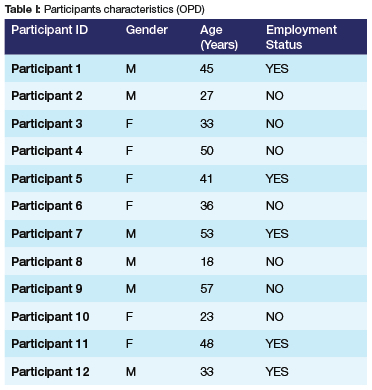
Participants were drawn from Katutura hospital OPD and dental clinic. A total of 24 participants including 11 males and 13 females adults consented and participated in the study. Only 7 participants were employed. (Table I and II)

Theme 1: Knowledge and Awareness of oral health
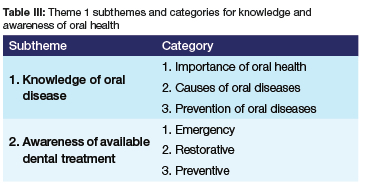
Knowledge and awareness of oral health is an important component of overall well-being, as it influences individuals' attitudes, behaviours and utilisation of dental services. Having adequate knowledge and awareness enables people to understand the importance of maintaining good oral hygiene, seeking preventive care and recognising early signs of oral diseases. (table III)
Subtheme 1: knowledge of oral diseases
Knowledge of oral diseases plays an important role in shaping oral health behaviours and outcomes. When individuals are well informed about common oral health conditions, their causes and prevention, they are more likely to practice proper oral hygiene and seek timely professional care.
Category 1. Importance of oral health
Participants demonstrated a basic and functional understanding of the importance of oral health, with most associating healthy teeth with eating and chewing. Participants emphasised the role of teeth in food consumption as "teeth are important for eating" (participant 2) and "for chewing'' (participant 3). These responses indicate that oral health was primarily valued for its immediate practical function rather than its broader health implications.
Category 2. Causes of oral disease
Participants' responses revealed diverse and sometimes conflicting perceptions regarding the causes of oral diseases, ranging from accurate biomedical explanations to misconceptions rooted in personal beliefs and cultural interpretations. Three key patterns emerged within this subtheme, namely: the role of diet and of oral hygiene, lifestyle related causes and misconceptions, and hereditary beliefs regarding oral health.
Most participants demonstrated a reasonable level of awareness by correctly associating tooth decay with excessive sugar consumption and the contribution of poor oral hygiene practices. For example, one participant stated:
"it is the sweet things that we eat and then we go to work from 7 to 7 eating a lot of snacks, but I do not go with my toothbrush'' (participant 2). "sugar causes tooth decay'' (participant 5)
Some participants expanded their explanations to include lifestyle behaviours, such us alcohol and smoking, as causes of oral diseases. A participant noted that, "Too much alcohol and smoking can damage your teeth'' (Participant 1).
A few participants attributed tooth decay to factors such as inadequate breastfeeding, too much eating of meat or hereditary factors. One participant said that 'when there was not enough breast milk from the mother, the teeth get weak''
(Participant 8), while another claimed "meat causes tooth decay because it goes between the teeth'' (Participant 4). Some perceived tooth decay as a genetic condition rather that a preventable disease, as reflected in statement such as:
"I think I can can inherit tooth decay from my family because my daddy has also terrible teeth problems'' (Participant 7)
"most of my aunties have teeth diseases, this cannot be because of sweet, it is heritage'' (Participant 10)
Category 3. Prevention of oral diseases
Participants indicated that toothbrushing is important for preventing tooth decay and that "You have to brush your teeth 3 times a day'' (Participant 3). However, participants felt that
"men cannot take care of their mouth like ladies, ne!... (Participant 8)
"Men can use one toothbrush for one-year, haaaa!'' (Participant 10).
"If one use toothbrush for more than two months it can damage the teeth'' (Participant 9)
Sub-theme 2: Awareness of available treatment
Awareness of available dental treatment is essential to promote effective utilisation of oral health services. When individuals are informed about the range of dental services offered, including emergency, curative, restorative and preventive, it may influence their choice of treatment.
Category 1. Emergency
Most participants indicated that they only seek emergency treatment (mainly) for tooth extraction due to severe pain:
"It started paining last year, then I crushed Panadol and put on the tooth to stop the pain. This time the pain was too much, even Panadol could not stop it especially at night. I decided to come to the hospital'' (Participant 6)
However, some participants recognised the need for dental services and recommended that "the dental clinic should be opened even in the weekends and after hours'' (Participant 4)
For some participants, the first port of call was family, friends or the internet when they had toothache as "I do not come here when I have pain, but people advise me to use Colgate toothpaste, it relieves pain" (Participant 7), only presenting when the pain was unbearable.
Despite engaging with advice from family, a number of participants still ended up at the dental clinic for treatment, as stated by one participant:
"last year I had a toothache but did not come to the hospital because people advised me to put the clove oil in my tooth and the pain got better. But this time the pain is unstoppable'' (Participant 6)
Category 2. Restorative
Some participants indicated that they did not know if government health facilities could offer other types of dental treatment besides tooth extraction. They were unaware that teeth with holes could be filled "The thing is, we do not get informed, like me I had a hole in my tooth, but I was not informed that I can fix my tooth'' (Participant 8), and that it was possible to get artificial teeth "Oho! Imagine! Didn't know that you can get artificial teeth here'' (Participant 10). The participants were surprised that government facilities were able to offer services similar to those offered in the private sector
"Ohoo! Do you also do other dental treatments like in private?! What we do know is that you only do teeth extraction" (Participant 4)
Although some participants were aware of the dental services provided and had previously presented to the dental clinic, their experiences of filling teeth had not been very satisfactory:
"I had a decayed tooth, I filled it and after 6 month it was again painful, I decided to remove it. Filling is not good option" (Participant 2)
Patients were keen for dentists to inform them of their options when they present with holes in their teeth:
"They must inform us on different types of treatment available (Participant 7). "tell us if they can put something on your tooth instead of removing it before they inject us" (Participant 10)
Category 3. Preventive
Most participants acknowledged that they were not aware about preventive services available at the hospital. However, one participant came for preventive service after he was informed by a relative about the importance of routine dental check-up.
"Like me, I have removed more than four teeth, the last time I came to the hospital, I was informed to come for a routine check-up twice a year'' (Participant 4)
Theme 2: Perceived barriers of utilisation of oral health services
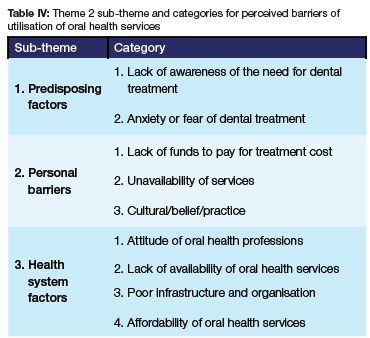
Perceived barriers to the utilisation of oral health services may influence individuals' decisions to seek dental care. These barriers included predisposing factors, personal barriers and health system factors.(table IV)
Subtheme 1: Predisposing factors
Predisposing factors for oral health services utilisation refers to individual characteristics and perceptions that influence the likelihood of seeking oral health care. These factors include lack of awareness of the need for dental treatment and anxiety about treatment.
Category 1. Lack of awareness
Most of the participants perceived that they need to go to the hospital only if you have unbearable pain.
"You must go to the hospital only if the tooth is very painful, otherwise you can use the pain killers'' (Participant 5)
Others indicated that when they have a toothache they do not need to go to the hospital, but can use painkillers or other home remedy to relieve the pain, such as smoking and car brake fluid.
"For us guys, we smoke so that the pain can come down, it sterilises the pain for an hour, hahahahaaaaa!'' (Participant 9);
"I was using brake fluid of the car to stop pain; it kills pain but also it breaks the tooth into small pieces.'' (Participant 10)
Some where unaware that Katutura Hospital, or any other government facility, could do fillings or provide artificial teeth:
"Katutura hospital also does fillings? Me, I only come here for extractio'' (Participant 3) "Me, I thought only private hospitals can fill the tooth. So, I come here to remove my tooth'' (Participant 5)
A few believed that as tooth decay is a hereditary disease, there was nothing they could do:
"Most of my aunties have tooth diseases, this cannot be because of sweet, it is in heritage" (Participant 10)
Some revealed that dental problems were not a priority:
"Just to wakeup and come to the hospital to me it is a problem. I just do not have time;" (Participant 3)
Category 2. Anxiety or fear of dental treatment
Participants highlighted that anxiety and fear of dental treatment were a significant deterrent to the use of dental services. This fear was largely shaped by previous painful dental treatment experience and injections, resulting in many individuals delaying or avoiding seeking professional dental care. Several participants described past dental treatment as extremely painful and traumatic. One participant recalled,
"Last year I had a toothache but did not go to the hospital because a year before I went to the hospital, they took out two teeth, I had a terrible pain, that was the most terrible day of my life'' (Participant 3)
Fear of injection was repeatedly mentioned as a specific source of anxiety. Participant expressed apprehension about needles and their associated pain, which discouraged timely dental visits. One participant stated,
"like for me, I have a problem of fear of injection, so before I must come to the hospital, I use Panadol or clove oil or anything possible to avoid injection'' (Participant 10)
Subtheme 2: Barriers
Barriers to utilisation of oral health services continue to limit access to timely and appropriate dental care for many individuals.
Category 1. Lack of funds to pay for treatment cost
Participants indicated that lack of funds, long travelling distances, waiting times and queues at the hospital were reasons for not going to the dental clinic.
"We really suffer because we do not have medical aid, so we have to look for cash'' (Participant 6)
Category 2. Availability of services
Participants indicated that Katutura Hospital is congested with too many patients due to the limited availability of dental services among the population it serves:
"Some of us, we stay in the location, it is very dangerous, there is no taxis, can't they build a dental clinic in the location'' (Participant 5)
"You have to ware up very early so that you can get infront of the queue, for example, like me, I arrived here at 4 in the morning but I am still here unattended'' (Participant 4)
Subtheme 3: Health system factors
Health system factors, such as the attitude of oral health professionals, availability of dental service, poor infrastructure and well as quality of care received influenced the use of dental services.
Category 1. Attitude of oral health professions
Participants indicated that the negative attitude of health care workers, long queues and poor infrastructure were some of the reasons that could prevent patients going to the hospital. Several participants reported the uncaring or unprofessional behaviour of some dentists, which discouraged future visits. One participant stated,
"Some staff members are busy on their cell phones instead of assisting patients" (Participant 2),
Others highlighted inadequate communication as a major concern, particularly the failure of professionals to explain the procedures and treatment options, which they found frustrating, and that the dentists were stressed due to high patient loads:
"When we say our problems, the doctor must listen to us, try to make patient understand too, doctors must take time not to rush us'' (Participant 9)
"Dentists at Katutura Hospital are always stressed due to the long queue of patients'' (Participant 10)
Category 2. Lack of availability of oral health services
Participants highlighted that dental services are limited to only being available in town, making it difficult for those staying in locations out of town to reach the services. Many participants had tiring experiences:
"You have to work-up very early morning and walk a long distance to Katutura hospital to be able to get a number in the queue but sometimes you find that the numbers for that day are finished! So you go back home without any treatment" (Participant 5)
Another participant wanted to know "why dental clinics do not open after hours and during the weekends?''(Participant 1)
Category 3. Poor infrastructure and organisation
Old, dilapidated and dirty hospital buildings were a key deterrent for not seeking professional dental services for most participants. One participant complained about its condition:
"I was admitted here for two days, the hospital is very dirty and smelling. I signed a consent form to go home before I was discharged. I do not want to go there again" (Participant10)
Another participant complained about the long queues and poor organisation,
"Like me, I arrived here earl in the morning but I am still here because of the long queue and poor organisation, I have seen some patients who arrived after me are passing me'' (Participant 5)
Category 4. Affordability of oral health services
The study found that most of participants come to Katutura Hospital as it is cheap compared to the private dental clinic. The participants stated,
"I had severe pain but did not want to come to Katutura Hospital, I wanted to go to private dentist, but did not have money hence I ended up coming here!'' (Participant 6)
Only Katutura Hospital takes many patients, other dental clinic takes few patients and they are expensive'' (Participant 7)
Theme 3: Pattern of oral health services utilisation
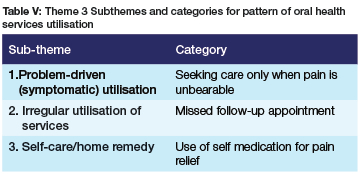
The pattern of oral health services utilisation generally reflects how, when and why individuals seek dental care, and is often characterised by irregular and problem-oriented visits rather than routine preventive care.(table V)
Subtheme 1: Problem-driven (symptomatic) utilisation
Problem driven oral health services utilisation refers to a pattern in which individuals seek dental care primarily in response to pain, discomfort or visible oral health problems rather than for preventive or routine check-up.
Category 1. Seeking care only when pain is unbearable
Most of the participants indicated that they only go to the hospital when they have unbearable pain. Others believed that dental care is only for an emergency, that they must wait until they are in pain to visit the hospital:
"Just to woke-up to go to the hospital, for me it is difficulty! Unless I have a severe pain'' (participant 4)
Subtheme 2: Irregular utilisation
Irregular utilisation of oral health services is characterised by inconsistent and infrequent dental visits that often occurr only when the symptoms become severe or unavoidable.
Category 1. Missed follow-up appointment
The study revealed that participants did not make routine hospital visits and sought care only when experiencing pain. Some participants expressed a desire for dentists to provide guidance and information on treatment options and the need for regular visits. They also indicated that they would like the dentists to follow up with them and send reminders about their appointments:
"I came here for treatment, I was given an appointment for a follow-up, but they did not contact me up to date" (Participant 1)
"Does Katutura Hospital have a 'dial a dentist' telephone line? Because we would want to get some advises or appointment even when we are at home'' (Participant 10)
Subtheme 3: Self-care/home remedy
Home remedy dental care utilisation refers to the practice of managing oral health problems using traditional methods or self-care approach instead of seeking professional dental services.
Category 1. Use of self medication for pain relief
Some participants indicated that they preferred using painkillers, such as Panadol and clove oil, to avoid going to the hospital. A few participants noted that they use traditional medicine herbs that they put in the tooth until the tooth comes out. One participant indicated that he uses the herbs to relieve pain as revealed in the following participants' responses.
"Every time I have a tooth ache, I use a certain herb that I got from my mother, it relieves pain" (Participant 7)
DISCUSSION
The findings from this study provide insight into the oral health knowledge and awareness, perceived barriers to accessing dental care, and patterns of oral health services utilisation among participants attending Katutura Hospital. Overall, the results highlight significant gaps in preventive dental behaviour, limited understanding of available services and a reliance on problem-driven care.
Theme 1. Knowledge and awareness of oral health,
Participants demonstrated basic awareness of tooth decay and identified sugar consumption and poor oral hygiene as contributing factors. However, misconceptions were also evident, including beliefs that tooth decay is hereditary or unrelated to dietary sugars. Similar inconsistencies in oral health knowledge have been reported in other low- and middle-income contexts, where biomedical explanations coexist with cultural beliefs. 25
Although toothbrushing was widely acknowledged as important, participants showed limited understanding of effective oral hygiene practices, including correct brushing frequency and toothbrush replacement. This finding aligns with existing literature indicating that knowledge does not necessarily translate into sustained health behaviour. 26, 33,34 For example, research conducted in Germany among children and adolescents found that while many participants know the recommended toothbrush frequency and duration, their brushing habits were weaker or inconsistent, indicating that appropriate knowledge does not automatically translate into correct behaviour. 35
Participants largely framed the importance of oral health in functional terms, primarily eating and chewing without linking it to broader health or quality-of-life outcomes, his narrow conceptualisation possibly limiting motivation for preventive engagement.
Notably, many participants believed that government facilities only provide extractions for when the tooth ache is so severe that patients can no longer tolerate the pain, with most not being unaware of the restorative and preventive services offered. This aligns with findings from studies in other low-resource settings, where communities perceive public oral health services as limited to emergency extractions. 2730
Preventive services were minimally recognised, with only a small proportion of participants reporting that they attended routine check-ups, often following advice from relatives or healthcare workers. This limited awareness of preventive care contributes to delayed presentation and reinforces symptom-based utilisation.
Theme 2: Perceived barriers to utilisation of oral health services
Predisposing factors, including limited awareness and dental anxiety, shaped utilisation patterns. Many participants perceived dental care as necessary only in the presence of severe pain, reflecting a curative orientation. This perception is widely reported in oral health research and is associated with delayed service utilisation. 2628
Structural barriers were prominent. Financial constraints, long waiting times, transportation challenges, and service congestion limited timely access. Although Katutura Hospital was perceived as more affordable than private facilities, indirect costs and logistical burdens remained substantial obstacles. Financial and accessibility barriers have consistently been identified as determinants of underutilisation in low- and middle-income countries. 2618
Perceived need strongly influenced care-seeking behaviour. Participants commonly reported seeking care only when pain became unbearable. Some considered asymptomatic dental decay unworthy of treatment, while others attributed oral disease to hereditary causes. According to Andersen's behavioural model, perceived need is a central determinant of healthcare utilisation. 6
Health system factors further shaped utilisation, with reports of negative provider attitudes and limited communication undermining trust and continuity of care. Effective provider-patient communication is essential for fostering satisfaction and ongoing attendance. 26
Theme 3. Pattens of oral health services utilisation
The main utilisation pattern was reactive, with most participants only seeking care when they experienced severe pain. This problem-driven approach mirrors findings from similar settings, where dental services are accessed primarily for emergency relief rather than prevention. 7
Preventive and routine utilisation of dental services was limited, with few participants attending regular check-ups, with awareness of preventive services being low. Evidence consistently demonstrates that regular dental attendance is associated with improved oral health outcomes and reduced disease progression. 313033
Self-medication and home remedies were widely practiced, with some participants reporting that they used analgesics, clove oil, herbs, and, in extreme cases, harmful substances such as brake fluid. This behaviour reflects fear, financial barriers, limited awareness and accessibility constraints. Similar practices have been documented in low-resource settings where access to formal care is restricted. 34
Similar global studies report high prevalence of self-medication for toothache. For example, a study in Cameroon found that people use analgesics or other substances without professional guidance, which has been linked to delayed professional care and poor health outcomes. 3636
LIMITATIONS OF THE STUDYThis study provides valuable insights into the determinants and barriers influencing oral health service utilisation at Katutura Hospital; however, several limitations should be acknowledged.
First, the study employed a qualitative cross-sectional design with a relatively small sample size of 24 participants. Although data saturation was achieved, the findings may not be generalisable to the wider population of Namibia or other settings, particularly rural areas with different healthcare access challenges.
Second, the study was facility-based, involving only patients attending Katutura Hospital OPD and dental clinic. This may have introduced selection bias, as individuals who do not seek care at health facilities - potentially those facing the greatest barriers - were not included. Their perspectives might differ significantly from those captured in this study.
RECOMMENDATIONSTo improve oral health service utilisation and outcomes, targeted interventions are required at both community and health system levels. Oral health education programs should be strengthened to promote preventive practices, correct misconceptions, and discourage harmful self-care behaviours. Increased awareness of available public dental services, particularly restorative and preventive care, is essential to improve informed utilisation.
Efforts should also focus on enhancing accessibility through extended clinic hours, decentralisation of services, and improved staffing to reduce long waiting times. Addressing financial and logistical barriers, including transportation challenges, may further support access. In addition, improving health system efficiency, infrastructure, and patient flow management is necessary to enhance patient experience.
Strengthening patient-provider communication and introducing structured follow-up systems, such as appointment reminders, may improve continuity of care. Interventions to reduce dental anxiety should also be considered. Finally, promoting a shift from problem-driven to preventive care, alongside further research in diverse settings, is critical for achieving sustainable improvements in oral health outcomes.
CONCLUSION
The study revealed that limited knowledge and awareness, multiple barriers and problem-driven utilisation patterns shape how individuals engage with dental services. To improve oral health outcomes, interventions need to strengthen oral health education focused on prevention and available services and address structural barriers by improving service accessibility and organisation. In addition, enhancing patient-provider communication and follow-up systems may encourage more regular, preventive orientation towards oral health care and reduce reliance on emergency-only utilisation. Optimising dental health not only has implications for oral health, but for the longer term ability to chew, enjoy food and take in sufficient nutrition to enjoy a good quality of life.
CONFLICT OF INTERESTThe authors declares that the study was conducted without any commercial or financial associations that may give rise to a conflict of interest
REFERENCES
-
1. Peres MA, Macpherson LMD, Weyant RJ, Daly B, Venturelli R, Mathur MR, et al. Oral diseases: a global public health challenge. Lancet. 2019;394(10194):249-60. doi:10.1016/S0140-6736(19)31146-8.
» https://doi.org/10.1016/S0140-6736(19)31146-8 -
2. World Health Organization. Oral health [Internet]. Geneva: WHO; 2025 [cited 2026 Feb 18]. Available from: https://www.who.int/news-room/fact-sheets/detail/oral-health
» https://www.who.int/news-room/fact-sheets/detail/oral-health - 3. Kearns CE, Bero LA. Promoting radical action for global oral health: integration or independence? Lancet. 2019;394:249-61.
- 4. Crocombe LA, Stewart JF, Brennan DS, Slade GD, Spencer AJ. Is poor access to dental care why people outside capital cities have poor oral health? Aust Dent J. 2012;57(4):477-85.
- 5. Saekel R. Evaluation of different oral care systems: results for Germany and selected highly developed countries. Dent Oral Craniofac Res. 2018;4(4):1-8.
-
6. Nagdev P, Iyer MR, Naik S, Khanagar SB, Awawdeh M, Al Kheraif AA, et al. Andersen health care utilization model: factors affecting utilization of dental health services among school children. PLoS One. 2023;18(6):e0286945. doi:10.1371/journal.pone.0286945.
» https://doi.org/10.1371/journal.pone.0286945 - 7. Kandelman D, Arpin S, Baez RJ, Baehni PC, Petersen PE. Oral health care systems in developing and developed countries. Periodontol 2000. 2012;60(1):98-109.
- 8. Susarla SM, Trimble M, Sokal-Gutierrez K. Cross-sectional analysis of oral healthcare vs general healthcare utilization in five low- and middle-income countries. Front Oral Health. 2022;3:911110.
- 9. Foote T, Willis L, Kuo Lin TC. National oral health policy and financing and dental health status in 19 countries. Int Dent J. 2023;73(3):449-55.
- 10. Hamasha AA, Alshehri A, Alshubaiki A, Alssafi F, Alamam H, Alshunaiber R. Gender-specific oral health beliefs and behaviors among adult patients attending King Abdulaziz Medical City in Riyadh. Saudi Dent J. 2018;30(3):226-31.
- 11. Makubalo M. Perceptions on the factors influencing oral health care seeking behaviour of communities in Randfontein, Gauteng, South Africa [thesis]. Bellville: University of the Western Cape; 2011.
- 12. Spark-du Preez N, Griffiths P, Cameron N. A framework of health-seeking behaviour for childhood illnesses in urban South Africa. In: XXV IUSSP International Population Conference; 2005 Jul 18-23; Tours, France.
- 13. Krishnan L, Aarthy CS, Kumar PD. Barriers to access dental care services among adult population. J Glob Oral Health. 2020;3(1):54-8.
- 14. Vujicic M, Buchmueller T, Klein R. Dental care presents the highest level of financial barriers compared to other types of health care services. Health Aff (Millwood). 2016;35(12):2176-82.
-
15. O'Brien KJ, Forde VM, Mulrooney MA, Purcell EC, Flaherty GT. Global status of oral health provision: identifying the root of the problem. Public Health Chall. 2022;1:e6. doi:10.1002/puh2.6.
» https://doi.org/10.1002/puh2.6 -
16. Folayan MO, Bhayat A, Mikhail SS, Ndembi N, El Tantawi M. Resources for oral health in Africa. Front Oral Health. 2025;6:1540944. doi:10.3389/froh.2025.1540944.
» https://doi.org/10.3389/froh.2025.1540944 - 17. Josefczyk M. The state of oral health on the African continent [thesis]. Lynchburg (VA): Liberty University; 2015.
- 18. Mokhethi M, McCrindle CME. Accessibility to oral health services in Lesotho's public health sector. S Afr Dent J. 2022;77(5):264-9.
- 19. Thema LK, Singh S. Integrated primary oral health services in South Africa: role of the PHC nurse in oral health examination and education. Afr J Prim Health Care Fam Med. 2013;5(1):413.
-
20. World Health Organization. Oral health country profile: Namibia [Internet]. 2022. Available from: https://cdn.who.int/media/docs/default-source/country-profiles/oral-health/oral-health-nam-2022-country-profile
» https://cdn.who.int/media/docs/default-source/country-profiles/oral-health/oral-health-nam-2022-country-profile - 21. Ministry of Health and Social Services Namibia. National oral health survey Namibia 2010/11. Windhoek: MoHSS; 2011.
- 22. Namibia Statistics Agency. Namibia population and housing census main report. Windhoek: NSA; 2024.
- 23. Robson C, McCartan K. Real world research. 4th ed. Chichester: Wiley; 2011.
-
24. Ahmed SK. The pillars of trustworthiness in qualitative research. J Med Surg Public Health. 2024;2:100051. doi:10.1016/j.glmedi.2024.100051.
» https://doi.org/10.1016/j.glmedi.2024.100051 - 25. Petersen PE, Kwan S. The 7th WHO Global Conference on Health Promotion-towards integration of oral health. Community Dent Health. 2010;27(Suppl 1):129-36.
- 26. Kumar S, Tadakamadla J, Johnson NW. Dental health-care service utilisation and its determinants in West Bengal, India. Int Dent J. 2017;67(6):350-6.
- 27. Masipa J, Motloba PD, Njikelana-Mnyakeni P. Reasons for under-utilisation of dental services in the public sector. S Afr Dent J. 2013;68(10):456-61.
- 28. Armfield JM. The extent and nature of dental fear and phobia in Australia. Aust Dent J. 2010;55(4):368-77.
- 29. De Jongh A, De Wit N, Stouthard JEA. Communication in dental care: a model for clinical oral health care communication. Int J Dent. 2010;2010:163012.
- 30. Fisher J, Mwakatobe AJ, Matee MIN. People's perceptions of fillings and restorative care. J Public Health Dent. 2014;74(3):220-5.
- 31. Gilbert GH, Duncan RP, Heft MW. Preventive dental behaviors and association with oral health status. J Dent Res. 1997;76(11):1746-54.
- 32. McGrath C, Zhang W, Lo EC. Community-based study of dental pain and quality of life. BMC Oral Health. 2016;16(1):86.
- 33. Abdullah, Al-Tayar B, Azlina A, Zulkarnain SM, Hayati M. Oral health knowledge, attitude and practices among Yemeni school students. J Int Oral Health. 2019;11:15-20.
- 34. Leggett H, Mitchell A, Csikar J, et al. Relationship between attitudes, prevention experiences and oral health behaviours in six European countries. BMC Oral Health. 2025;25:597.
- 35. Gund MP, Bucher M, Hanning M, Rohrer TR, Rupf S. Oral hygiene knowledge versus behavior in children. Clin Exp Dent Res. 2022;8(5):1167-74.
- 36. Agbor MA, Azodo CC. Self-medication for oral health problems in Cameroon. Int Dent J. 2011;61(4):204-9
Dr Juvenary John Rutabanzibwa
University of Namibia
P. Box 8674, Windhoek, Namibia
Phone +264812065253; Email:
Authors contribution
1. Juvenary John Rutabanzibwa: conceptualization, Draft preparation. 60%
2. Andrew Ross: Draft review and editing. 40%