Continuous education in procedural sedation: life-threatening airway obstruction and contributing perioperative patient factors
Abstract
More complex surgical procedures are increasingly offered to older patients with pre-existing disease. Perioperative patient care is at the cornerstone of the current trend in anaesthesia research. Sedation practitioners also have a role to play as intra-operative events can have an impact on long-term morbidity and mortality. A common respiratory emergency encountered during sedation is airway obstruction. Identifying the patient at risk of obstruction will greatly improve the levels of safety and care.
perioperative care; airway obstruction; respiratory depression; laryngospasm; anaphylaxis
INTRODUCTION
Detailed statistics of the global and national outcomes following surgery remain limited.112
The purpose of this article is to highlight the global movement towards better peri-operative care and to focus on the challenges and management of potentially life-threatening airway obstruction that could occur during procedural sedation.
DISCUSSION
In standard international practice, surgery should not be undertaken for a patient with an American Society of Anesthesiologists' (ASA) classification of 3 or 4 in a remote setting depending on out-of-theatre procedural sedation.3
Currently, large data collection is being undertaken for the evaluation of perioperative anesthesia outcomes in a very large cohort of hospitals in South Africa inwhich pediatric surgery is undertaken. As we seek to ensure safe surgical treatment for our patients, we need to understand the severity of harm that can develop following complications during the surgery.
The Enhances Recovery After Surgery (ERAS) approach is a "bundle" or group of interventions aimed at enhancing early recovery following surgery. With more complex and longer cases being conducted under sedation, practitioners should be acquainted with these principles.4
The second concept to be discussed in this article is the importance of identifying the patient who may be at risk of airway obstruction during procedural sedation.
Structured sedation protocols exist to provide for the incorporation of safety principles to reduce morbidity.5
Regardless of the intended level of sedation, procedural sedation is a continuum and patients may develop respiratory complications at any time. Life-threatening respiratory complications include airway obstruction, respiratory depression, laryngospasm, bronchospasm and unintended loss of the patient's protective airway reflexes.5
The framework of the upper airway consists of bone and cartilage attached to soft tissue structures; starting at the nose and lips, and extending to the larynx.6666
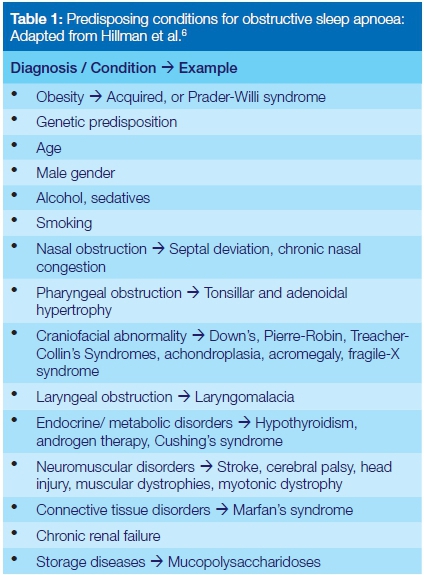
Airway collapse typically occurs at points of narrowing and/or flaccidity. In the case of children with tonsillar hypertrophy a higher chance of obstruction exists. The area of the upper airway most commonly prone to collapse is the velopharynx, as may be shown radiologically with enflurane anaesthesia and under propofol total intravenous anaesthesia.77Table 1 is an adapted summary of patients predisposed to developing obstructive sleep apnoea.6
Other features predisposing to airway obstruction, especially in paediatric patients involve: a relatively large occiput, a large tongue and operator-induced obstruction, ie: the surgeon or dentist depressing the mandible while operating.
The STOP-BANG questionnaire consists of eight-items and has been validated for the screening of patients for obstructive sleep apnoea (OSA).8910
An important distinction should be made between patients with airway obstruction and those with respiratory depression, which is a reduction in the patient's central drive to breathe/ventilate.11116
Prompt identification of upper airway obstruction forms the mainstay of treatment. The next step in the management of an obstructed patient involves correct positioning: "sniffing the morning air" position is achieved by elevating the shoulders slightly, causing flexion of the neck and extension of the head. This keeps the plane of the mid face parallel to the bed. Simple airway manœuvers like lifting the chin or a slight jaw thrust usually solve the problem. When these don't work, and the practitioner is sure that the patient is not suffering from central respiratory depression, other causes of upper airway obstruction should come to mind, namely laryngospasm or laryngeal oedema which is highly suggestive of anaphylaxis. Detail on the management of the latter two conditions has been discussed in a previous communication on Continuous Education. (SADJ volume 71, February and September 2016).
Should the above manœuvers fail to provide a patent airway, more advanced management, including positive pressure ventilation with a bag-mask device and endotracheal intubation or supraglottic airway support may be indicated. Prompt referral to a hospital facility is imperative.
What can sedation providers do to best prepare for managing airway obstruction?
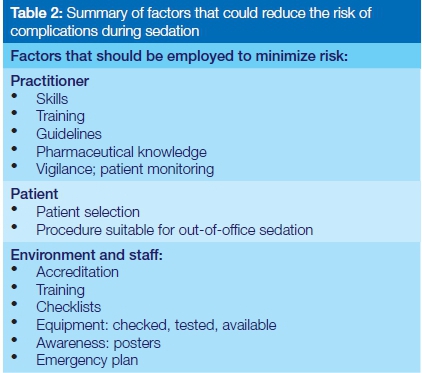
Patient selection, careful review of current and underlying medical conditions, and a detailed pre-operative assessment are fundamental.5Table 2 for more factors which govern our actions in protecting our patients from adverse events. Staff training and practitioner skills have been shown in the literature to improve rescue attempts when a patient develops a complication or inadvertently slips down the continuum to a deeper level of sedation than that intended.5
CONCLUSION
Complications arise mostly while providing any level of sedation or general anesthesia for patients who have significant medical compromise. Sentinel events can be prevented as far as possible by ensuring optimal pre-sedation assessment, optimal patient selection as well as attentive intra-operative monitoring and rescue support when indicated.12
Perioperative procedural sedation outcomes should be further explored in the South African milieu.
ACRONYMSOSA: obstructive sleep apnoea
OR: odds-ratio
References
-
1. Pearse RM, Harrison DA, James P, Watson D, Hinds C, Rhodes A, et al. Identification and characterisation of the high-risk surgical population in the United Kingdom. Crit Care [Internet]. 2006 [cited 2017 Jun 20];10(R81). Available from: http://ccforum.com/content/10/3/R81
» http://ccforum.com/content/10/3/R81 -
2. The International Surgical Outcomes Study Group. Global patient outcomes after elective surgery: prospective cohort study in 27 low-, middle- and high-income countries. Br J Anaesth [Internet]. Oxford University Press; 2016 Nov [cited 2017 Jun 20];117(5):601-9. Available from: https://academic.oup.com/bja/article-lookup/doi/10.1093/bja/aew316
» https://academic.oup.com/bja/article-lookup/doi/10.1093/bja/aew316 - 3. Society of South African Society of Anaesthesiologists Sedation Guidelines 2015 Guidelines for the safe use of procedural sedation and analgesia for diagnostic and therapeutic procedures in adults. 2015;21(2):1-38.
- 4. Gillies MA, Sander M, Shaw A, Wijeysundera DN, Myburgh J, Aldecoa C, et al. Current research priorities in perioperative intensive care medicine. Intensive Care Med. 2017 Jun 8;
- 5. Coté CJ, Wilson S, American Academy of Pediatrics AAO, American Academy Of Pediatric Dentistry AAOP, Law A, Ng D, et al. Guidelines for Monitoring and Management of Pediatric Patients Before, During, and After Sedation for Diagnostic and Therapeutic Procedures: Update 2016. Pediatrics. 2016;45(2):180-5.
- 6. Hillman DR, Platt PR, Eastwood PR. The upper airway during anaesthesia. Br J Anaesth. 2003;91 (1):31-9.
-
7. Eastwood PR, Szollosi I, Platt PR, Hillman DR. Collapsibility of the upper airway during anesthesia with isoflurane. Anesthesiology [Internet]. 2002 Oct [cited 2017 Jun 30];97(4):786-93. Available from: http://www.ncbi.nlm.nih.gov/pubmed/12357141
» http://www.ncbi.nlm.nih.gov/pubmed/12357141 - 8. Sangkum L, Klair I, Limsuwat C, Bent S, Myers L, Thammasitboon S. Incorporating body-type ( apple vs . pear) in STOP-BANG questionnaire improves its validity to detect OSA. Elsevier Inc.; 2017;(2016):6-11.
-
9. Chung F, Subramanyam R, Liao P, Sasaki E, Shapiro C, Sun Y. High STOP-BANG score indicates a high probability of obstructive sleep apnoea. Br J Anaesth [Internet]. Oxford University Press; 2012 May [cited 2017 Jun 2];108(5):768-75. Available from: http://www.ncbi.nlm.nih.gov/pubmed/22401881
» http://www.ncbi.nlm.nih.gov/pubmed/22401881 -
10. Kaw R, Chung F, Pasupuleti V, Mehta J, Gay PC, Hernandez A V. Meta-analysis of the association between obstructive sleep apnoea and postoperative outcome. Br J Anaesth [Internet]. Oxford University Press; 2012 Dec 1 [cited 2017 Jun 30];109(6):897-906. Available from: https://academic.oup.com/bja/article-lookup/doi/10.1093/bja/aes308
» https://academic.oup.com/bja/article-lookup/doi/10.1093/bja/aes308 - 11. Pattinson KTS. Opioids and the control of respiration. Br J Anaesth. 2008;100(6):747-58.
- 12. Becker DE. Preoperative medical evaluation: Part 1: general principles and cardiovascular considerations. Anesth Prog. 2009;56(3):92-102-4.
James A Roelofse
Private Bag X1, Tygerberg 7505
Tel: 021 937 3085, Cell: 083 458 242
E-mail: