Part 12. Dental images: Ensuring the understanding, acceptance and consent of and by patients to all possible usages
INTRODUCTION
Dentistry has not escaped this digital explosion, with social media usage and interactions being a part of everyday life for most practitioners and patients. In the clinical setting, photographs, radiographs and scans are taken for many reasons and serve different purposes. They can form part of the dental records to document the "before treatment" situation, to aid communication with colleagues when seeking advice, to show to students in educational settings, to illustrate treatment options to patients, to be available for publishing in dental journals as part of research or case studies, and on internet sites when sharing treatment outcomes with others.2324
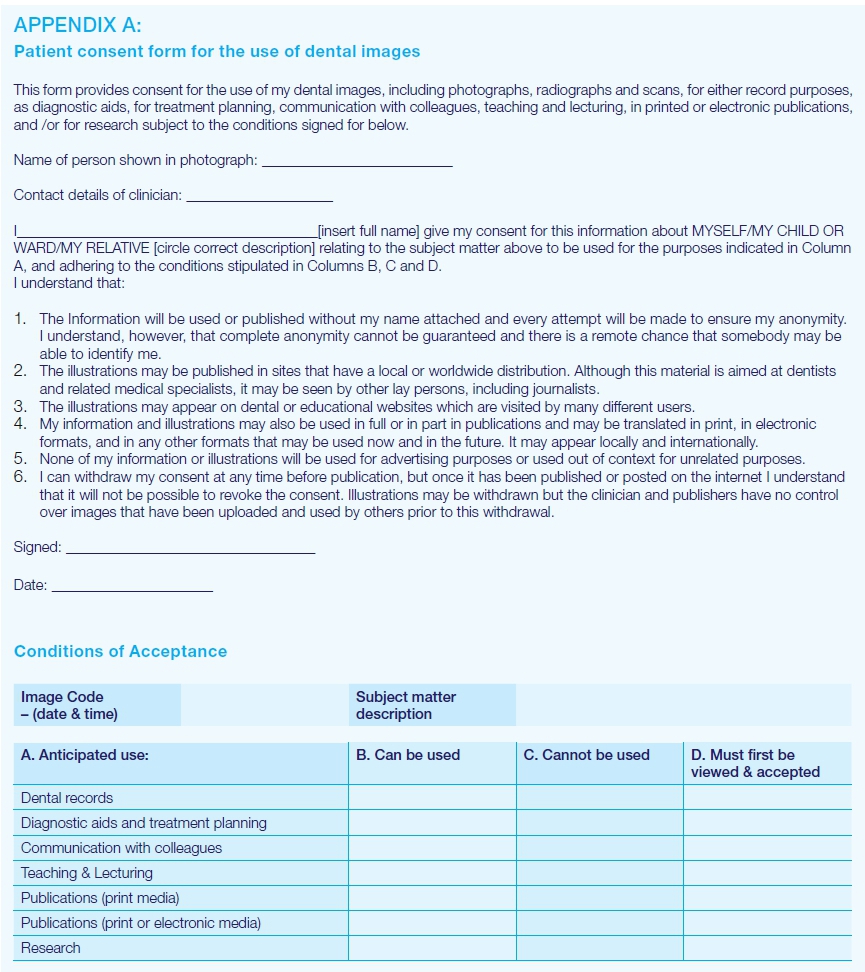
This paper will discuss the requirements of a valid consent process, and will present a draft patient consent form that may be adapted and used when consent is sought for the use of personal images in dentistry.
REQUIREMENTS FOR INFORMED CONSENTThis can be divided into dentist and patient factors. The National Health Act No 61 (2003) stipulates that the following information must be given to all patients: the range of diagnostic and treatment options available; the benefits, risks, costs and consequences of each; and the implications, risks and consequences if treatment is refused.566
There are three key elements involved in the consent process, concerning both the dentist and the patient:
1. Threshold elements entail that the patient is sufficiently competent to understand and decide, and can make the decision voluntarily
2. Information elements relate to the duty of the dentist to disclose all relevant information, to recommend an appropriate plan of action that will serve the patient's best interests and to ensure that the patient has clearly understood all of the information.
3. Consent elements refer to the patient's ability to decide for or against the treatment, and to then authorize the plan of action.75
DIFFERENCES BETWEEN CONSENT TO TREATMENT AND CONSENT TO USE OF PERSONAL INFORMATION / IMAGES
1. Consent to treatment
This requires the dentist to explain the proposed therapy, risks involved, time and cost implications, alternative options and the consequences of no treatment. This should take the form of a verbal discussion followed by written information, which the patient needs time to read and consider. In many instances consent is often "implied" and assumed by inference from the patient's actions even
though there was no actual explicit consent process. This may suffice for many routine dental procedures, such as examination and charting but will not provide protection for a dentist against legal actions if more extensive work has been done.3
"Expressed" consent is specific, and should be gained from a patient for each particular procedure that is not routine or which carries some form of risk. It may be given in either an oral or written form. The former is valid and may be adequate for minor work, but must still be witnessed and documented in the patient's records. Written consent is required for more extensive treatment. Although this may be used to defend a legal action, it does not automatically mean that the goals of informed consent have been met.344
2. Consent to use of information and/ or images
This differs somewhat from consent to treatment and involves clarification of scope and conditions of use.4 2222
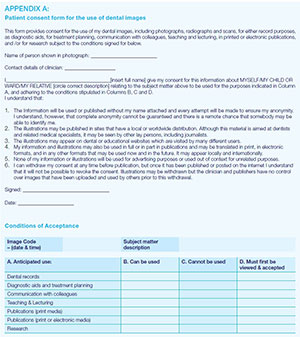
DRAFT CONSENT FORMA draft consent form for use in Dentistry has been developed. This can be adapted and used by clinicians according to their needs (see attachment). The aim was to keep it as clear and straightforward as possible, while at the same time giving patients the opportunity to specify in detail their desires. It makes provision for patients to choose and sign a once-off consent to the taking and use of all images for all or limited purposes (e.g. for records only, for lectures and teaching, in publications), to sign at each appointment for specific use of the images taken that day, or to request the opportunity to view each image before giving approval for its use. In the case of the first options, a once-off consent signature will suffice. For the other choices, patients will have to sign each block on the second page at each visit. This page can easily be duplicated as many times as needed. In all instances anonymity and protection of identity must be guaranteed.
At the same time the clinician should ensure that public use of images does not disclose enough personal information that would allow a third party to put the pieces together and to identify the patient.8
The option of choice should be clearly marked on the front of the record files to alert the clinician that consent may be needed each time a photograph is taken. Each image must also be clearly identified in the consent form. A good way to do this while still ensuring anonymity would be to code it using the date and time of capture, as these numbers will never be duplicated and are easy to collate with the files if accurate appointment books are kept.
CONCLUSIONS
Adaption of a specific image consent form will enhance the patient's trust of the patients in their dentists, and will help safeguard clinicians when they make use of these images, privately or publically for professional purposes. It also reinforces the principle of "Veracity" or truthfulness which relates to the concept that "professionals have a duty to be honest and trustworthy in their dealings with patients, including respecting the position of trust inherent in the dentist-patient relationship, communicating truthfully and without deception, and maintaining intellectual integrity at all times".9
References
-
1. Wired.com. As It Turns Out, a Picture Is Not Worth a Thousand Words. Accessed at: https://www.wired.com/.../2014/03/turns-picture-worth-thousand-words; Accessed on 01-03-2017.
» https://www.wired.com/.../2014/03/turns-picture-worth-thousand-words - 2. Cunniff C, Byrne JLB, Hudgins LM, et al. Informed consent for medical photographs. Genet Med. 2000;2(6):353-5.
- 3. Tahir MAM, Mason C, Hind V. Informed consent: optimism versus reqality. Br Dent J. 2002;193:221-4.
- 4. van Staden CW. Informed Consent to Treatment. Oxford, editor: Oxford; 2015.
- 5. Naidoo S, Moodley, K. Ethics and the Dental Team. Schaik V, editor. Hatfield, Pretoria: Van Schaik; 2009. 136.
- 6. Zion D, Gillam, L, Loff, B. The Declaration of Helsinki, CIOMS and the ethics of research on vulnerable populations. Nature Medicine. 2000;6(6):615-7.
- 7. Beauchamp T, Childress, JF. Principles of Biomedical Ethics. Oxford University Press, New York: 2001.
-
8. Pillai R. Continuous Care. Accessed at: www.continuouscare.io/healthcare-marketing-ethics-for-physicians-medical-practices2016; Accessed on : 01-03-2017.
» www.continuouscare.io/healthcare-marketing-ethics-for-physicians-medical-practices2016 -
9. ADA. Section 5 - Principle of Veracity ("Truthfulness") Accessed at: http://www.ada.org/en/about-the-ada/principles-of-ethics-code-of-professional-conduct/veracity; Accessed on: 24-10-2016.
» http://www.ada.org/en/about-the-ada/principles-of-ethics-code-of-professional-conduct/veracity