Mercury levels in wastewater samples at a South African dental school
Abstract
Dental amalgam is a commonly used restorative material in oral health care services in South Africa. It is composed of between 43-50% mercury. Over the past 40 years, advancing knowledge of mercury toxicity to the environment and life has led to concerns over the waste produced during the placement and removal of dental amalgam. The present study determined mercury levels in wastewater, described the application of the best management practices (BMPs) for dental amalgam use and investigated dental amalgam procurement patterns at the WITS Oral Health Centre, University of the Witwatersrand. The wastewater generated during the study period was diverted, collected and sampled. The samples were analysed for total mercury concentrations using USEPA method 245.7 - Cold Vapor Atomic Absorption Spectroscopy. A structured interview was used to investigate the application of the BMPs for dental amalgam use. The amalgam procurement records were accessed and analysed. The study found that the levels of mercury in wastewater samples ranged from 1.048mg/l to 108.762mg/l, there was an increasing procurement of dental amalgam over nine years and there was inadequate adherence to the BMPs. The mercury levels observed called for the urgent need to institute BMPs.
INTRODUCTION
Mercury is a recognised global environmental pollutant with various adverse health effects on animal and human life.1 2345
Dental amalgam is a commonly used restorative material in primary oral health care provision in South Africa.6789 10111213
In the MCM, dental amalgam is the only mercury-added product subject to a phase-down approach based on prevention, research for alternative materials and waste management practice.14,15 Dental amalgam is banned in Sweden, Norway and Denmark, and restrictions have been introduced in Japan, Germany, Finland, Bulgaria, Mongolia, Vietnam and Thailand.131617 1819202122
The present study aimed (i) to determine mercury levels in wastewater, (ii) to investigate the application of best management practices for dental amalgam use, and (iii) to describe the procurement patterns of dental amalgam at the WOHC.
MATERIALS AND METHODS
Study setting
The study was conducted at the WITS Oral Health Centre (WOHC) of the School of Oral Health Sciences, University of the Witwatersrand. Ethical clearance was obtained from the Human Research and Ethics Committee of the University of the Witwatersrand (Ethics number M170908) and permission to conduct the study at the centre was obtained from the Hospital Research and Risk Committee. The WOHC provides clinical services and training through four polyclinics - P1, P2, P3 and P4 - a multi-skills technique laboratory (MSTL) and various support sections. Polyclinic supervisors managed the polyclinics and the MSTL. The restorative procedures using dental amalgam were performed in the P1, P2, P3 and occasionally in the P4 and the MSTL. The wastewater generated during operations was evacuated by four 50mm main lines connected to vacuum pumps, two each for P1, P2, P3 and MSTL. The vacuum pumps used at WOHC were Midmark, Classic-Series® CV10 Wet-Ring twin. The P4 polyclinic was excluded from the study due to the unfavourable vacuum system layout. The procurement of supplies and materials necessary for training and clinical operations was managed by the Central Procurement Section (CPS).
Study design
A cross-sectional study design was used to determine the levels of mercury in wastewater samples, dental amalgam uses and the application of best management practices for dental amalgam use at the WOHC. The dental amalgam procurement trends were obtained retrospectively.
The determination of the level of mercury in wastewater and dental amalgam use
The study period for determining levels of mercury in wastewater and dental amalgam use was seven days. Wastewater collection was facilitated by diverting the wastewater flow using a collection apparatus made of a sampling valve installed perpendicular to the main vacuum pipe, a vacuum hose with a lower ball valve, and a 20L container. Eight collection systems were installed on the four main vacuum lines proximal to the suction pump stations and trialled for collection efficiency.
During the study, the collected wastewater was poured into a plastic basin and manually agitated to obtain a uniform mixture. A 500ml test sample was obtained from the collected wastewater from the basin using a measuring jar and was kept in polyethene bottles previously. This step was uniformly performed for each polyclinic and MSTL. The remaining wastewater was measured to determine the total amount of wastewater collected from each mainline per day.
The remaining collected wastewater was discharged to the main sewage line.
The control samples were 500ml "point-of-use water samples" collected in polyethene bottles from the steam distillers, which provide water used for irrigation/cooling in the dental chairs at polyclinics 1, 2 and 3, and from the three-way air/water syringe in the MSTL. The total number of samples obtained was 25 test samples and 25 control samples. The obtained samples were preserved by adding 10ml of 32% hydrochloric acid, followed by storage in a refrigerator at 4°C. The equipment used for test sample collection was thoroughly washed with SteriScrub soap containing chlorhexidine and water after each collection, rinsed with de-ionised water, dried and stored ready for next-day collection.
At the end of the study period, the 50 collected samples were removed from the refrigerator, placed in a cooler box filled with ice and transported to the Council for Scientific and Industrial Research (CSIR) - Water and Environment Laboratory in Pretoria for analysis. The total mercury levels in wastewater were determined through the US EPA method 245.7 - Cold Vapour Atomic Absorption Spectroscopy using a Hydra II Mercury Analyser. The use of dental amalgam was determined by observing restorative procedures performed in polyclinics 1, 2 and 3 and the MSTL during the study period. Information on the number of dental amalgam restorations removed or placed, the number of surfaces, the number and type of dental amalgam capsules and the amount of dental amalgam used was recorded in a data collection sheet.
Best management practices for dental amalgam use
The application of best management practices for dental amalgam use was determined through a structured interview with the clinic supervisors for polyclinics 1, 2, 3 and the technician. The interview questionnaire was based on the practical guide to integrating best management practices (WHO, 2010) into dental practice, with the main areas of focus including the use of amalgam capsules, retention and storage of amalgam waste, equipment maintenance, prevention of releases and disposal of dental amalgam waste. The interview was conducted on the sixth day of the study.
Dental amalgam procurement
The records of dental amalgam procured from April 2009 to March 2018 were accessed at the procurement office and central stores of the WOHC. The number of dental amalgam boxes issued, the number of capsules - ie the clinical utilisation unit - and the amount of dental amalgam calculated were entered into the data collection sheet.
Statistical analyses
The data was captured on a spreadsheet. Descriptive statistics were used to summarise the data. Trendline analysis was used to determine procurement trends. Spearman correlation analysis using Stata 15 was used to determine the correlation between dental amalgam used and mercury levels in wastewater. The level of significance was set at P<0.05.
RESULTS
Dental amalgam use and mercury levels in wastewater
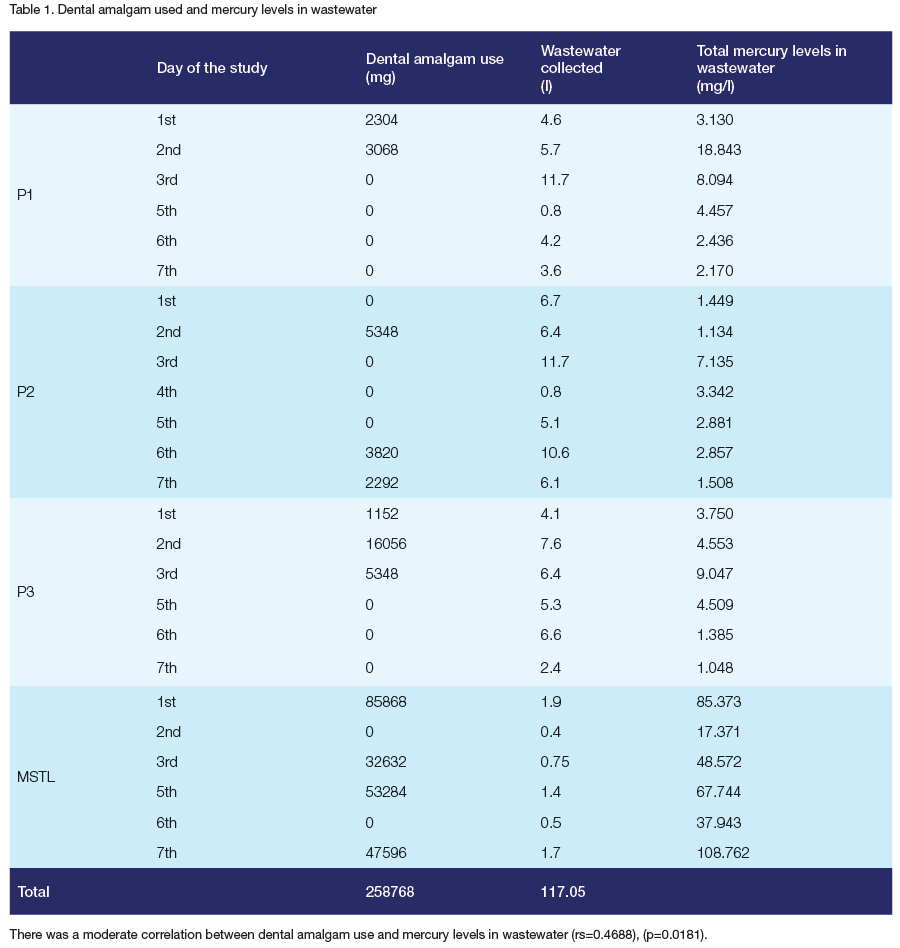
The number of patients seen at P1, P2, and P3 during the study was 820, of which 163 (20%) received restorative treatment. The dental amalgam restorative material used was the "Permite" brand, in pre-dosed capsules of one/two spill sizes with regular setting time. The number of dental amalgam procedures performed was 28, comprising the removal of 9 amalgam restorations with 17 surfaces and the placement of 19 amalgam placements with 29 surfaces. The number and type of amalgam capsules were 41 one-spill and 72 two-spill capsules. The amalgam restorative procedures were performed by the fourth-. and fifth-year students.
The MSTL was used on days 1, 3, 5 and 7 of the study. Fifty-seven restorations consisting of 69 surfaces were removed, and 106 restorations with 146 surfaces were placed. The number and type of amalgam capsules used were 67 one-spill capsules and 146 two-spill capsules. The total amount of dental amalgam used at WOHC during the study period was 258.8mg, of which 85% was used in the MSTL and 15% was used in the polyclinics.
Fifty samples were submitted to CSIR for total mercury analyses. The samples comprised 25 control samples and 25 wastewater samples. The levels of mercury in all control samples were <1.0 μmg/l, while the levels of mercury from the wastewater samples ranged from a minimum of 1,048 mg/l In P2 to a maximum of 108.762mg/l in MSTL. The median mercury level in wastewater samples was 4.457mg/l, with an interquartile range of 15.804mg/l (2.303mg/l - 15,804mg/l). Table 1 summarises the amount of dental amalgam used, collected wastewater and mercury levels in the P1, P2, P3 and MSTL.
The application of best management practices
The use of dental amalgam in the form of pre-capsulated alloys of various sizes was the only BMP for dental amalgam use applied in the three polyclinics and the MSTL. Other BMPs, including the use of marked, wide-mouthed, airtight containers for storage of non-contact amalgam, used capsules, contact amalgam, extracted teeth, traps and filters, were not practised in all three polyclinics and the MSTL. Moreover, the following BMPs - using amalgam separators in the wastewater system, using disinfectants and line cleaners that do not contain chlorine or bleach, and disposing of amalgam waste with a compliant recycler -were not employed.
Dental amalgam procurement
The dental amalgam restorative material procured by WOHC was the "Permite" brand, in pre-dosed capsules of one and two spill sizes with regular setting time. The pre-dosed capsules were packaged in a box of 50 capsules. The one-spill size capsule contained 400mg alloy and 364mg mercury, while the two-spill capsule contained 600mg alloy and 552mg mercury. Over the nine years from April 2009 to March 2018, WOHC procured 454 Permite dental amalgam boxes, which contained 22700 dental amalgam capsules, of which 51.8% were two-spill capsules and 48.2% were one-spill capsules.
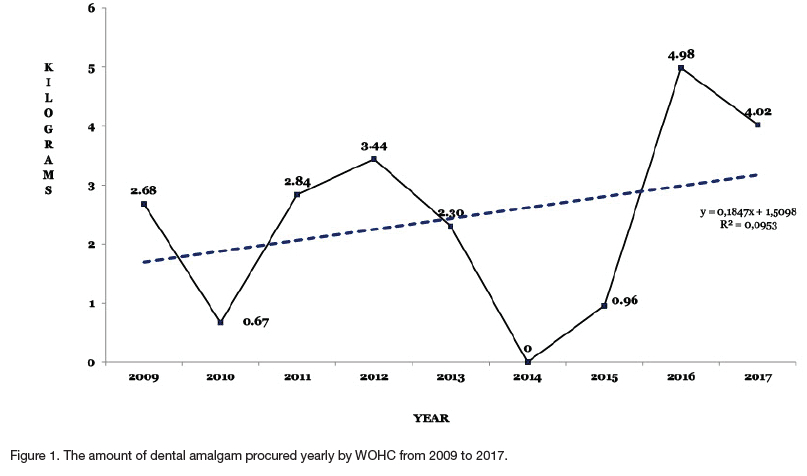
The pre-dosed dental amalgam capsules contained 21.91kg of dental amalgam, consisting of 11.43kg of alloy and 10.47kg of mercury. The median number of capsules procured was 700 for one-spill capsules and 1,500 for two-spill capsules. The trendline analysis revealed a slight increase in dental amalgam procured by the WOHC from the year 2009 to 2017 (0.1847, R2Figure 1).
DISCUSSION
The present study aimed to determine mercury levels in dental wastewater samples, investigate the application of BMPs for dental amalgam use and describe the dental amalgam procurement patterns at WOHC. The study's main findings were that the wastewater samples had a high mercury concentration, the BMPs for dental amalgam use were not adequately applied, and WOHC still procured and used dental amalgam for training and management of dental caries.
The mercury concentration in all wastewater samples was higher than the maximum concentration limit of 1.0mg/l allowed in any sewage, industrial effluent or other liquid discharged to the sewer by the City of Johannesburg Metropolitan Municipality Water services by-laws.23 24
The mercury levels in wastewater samples obtained from the polyclinics were lower than the MSTL by a factor of 10. The lower mercury levels in the polyclinics could be due to lower dental amalgam use and a higher number of procedures not using dental amalgam. A study from the United Arab Emirates similarly described the lower wastewater mercury concentration in clinics not offering or with lower numbers of dental amalgam treatments compared to those that offer primarily dental amalgam treatment.2526
The wastewater system layout at the WOHC necessitated the installation of the sampling apparatus proximal to the vacuum pump location in the main vacuum line for the polyclinics and MSTL. The wet-ring vacuum pumps used at the WOHC use water to lubricate and cool the pump housing seal and contain a trap that protects the pump from solids in the wastewater. In a typical eight-hour working day, the pump uses 1,089.6 litres of water.2725 24352829
The present study found that only a partial application of BMPs for dental amalgam use was adhered to, leading to contamination of the wastewater and the environment by mercury and other dental amalgam constituents. The inadequate application of the BMP is similar to that reported in other developing countries.30-32 This could be due to a lack of national guidelines. The current guidelines on managing healthcare risk waste in South Africa do not adequately meet the current standards in amalgam waste management.33
The provision for separating amalgam waste into contact and non-contact waste, amalgam spill kits, specification of amalgam waste containers, measures to mitigate wastewater mercury contamination, and disposal methods is lacking. The healthcare waste management regulations in South Africa state that establishments are responsible for the waste from the point of generation until its final treatment and disposal.34
There was a slight increase in dental amalgam procured during the study period. The increase in procurement was ascribed to an increased intake of first-year dental students, which doubled from 25 in 2011 to 50 in 2014. The variations in yearly procurement of dental amalgam observed in this study uncovered a need for accurate demand forecasting to prevent wastage and potential environmental contamination during long-term storage.
Dental amalgam restorative material continues to play an essential role in the pre-clinical training of dental students and the provision of restorative treatment at the WOHC. Procuring regular setting amalgam for pre-clinical training may contribute to the high amount of dental amalgam used in the MSTL. WOHC should consider the introduction of extended carving time (ECT) and slow carving (SC) dental amalgam formulations, which afford the operator a longer working time and could lower the amount of dental amalgam used for training.36
The limitations of the present study include its short duration due to budgetary constraints, the inability to establish different species of mercury, and the nature of mercury due to analytical incapability in laboratory services.
CONCLUSIONS
The study revealed that the wastewater samples from WOHC contained total mercury levels ranging from 1.048mg/l to 108.762mg/l. The levels of mercury in wastewater were above limits allowable by the City of Johannesburg Metropolitan Municipality Water Services by-laws. The study also demonstrated an increasing procurement of dental amalgam over a nine-year period, most of which is used for training, and inadequate adherence to the BMPs for dental amalgam use was also identified.
RECOMMENDATIONS• The Department of Health, the HCPSA, SABS and the dental community should develop, advocate and implement appropriate guidelines for managing dental amalgam waste in South Africa.
• The possibility of introducing the extended carving time (ECT) and slow carving (SC) dental amalgam formulations for restorative dentistry training should be investigated.
• An investigation on the cost-benefits analysis of dental amalgam, based on restorative treatment needs burden and the affordability through universal health coverage should be undertaken to inform the future training priorities and planning of waste management programmes.
Dental amalgam, mercury, dental amalgam waste, best management practices for dental amalgam use
Conflict of interest
The authors declare that the research was conducted without any commercial or financial relationships that could potentially create a conflict of interest.
Funding
The study was supported by the research endowment fund from the Faculty of Health Sciences, University of the Witwatersrand.
Acknowledgements
Stephen M. Sudi acknowledges Dr. J. Molepo and Prof L. Shangase's supervision and is grateful to the management of WOHC for permission to conduct the study.
REFERENCES
-
1. WHO. 10 chemicals of public health concern. 2020. Available from: https://www.who.int/news-room/photo-story/photo-story-detail/10-chemicals-of-public-health-concern
» https://www.who.int/news-room/photo-story/photo-story-detail/10-chemicals-of-public-health-concern -
2. Gworek B, Dmuchowski W, Baczewska-Dabrowska AH. Mercury in the terrestrial environment: a review. Environ Sci Eur. 2020 Oct 2;32(1):128. Available from: https://doi.org/10.1186/s12302-020-00401-x
» https://doi.org/10.1186/s12302-020-00401-x -
3. Beckers F, Rinklebe J. Cycling of mercury in the environment: Sources, fate, and human health implications: A review. Crit Rev Environ Sci Technol. 2017 May 3;47(9):693-794. Available from: https://www.tandfonline.com/doi/full/10.1080/10643389.2017.1326277
» https://www.tandfonline.com/doi/full/10.1080/10643389.2017.1326277 -
4. Wu YS, Osman AI, Hosny M, Elgarahy AM, Eltaweil AS, Rooney DW, et al. The Toxicity of Mercury and Its Chemical Compounds: Molecular Mechanisms and Environmental and Human Health Implications: A Comprehensive Review. ACS Omega. 2024 Feb 6;9(5):5100-26. Available from: https://pubs.acs.org/doi/10.1021/acsomega.3c07047
» https://pubs.acs.org/doi/10.1021/acsomega.3c07047 -
5. Eriksen HH, Perrez FX. The Minamata Convention: A Comprehensive Response to a Global Problem. Rev Eur Comp Int Environ Law. 2014 Jul;23(2):195-210. Available from: https://onlinelibrary.wiley.com/doi/10.1111/reel.12079
» https://onlinelibrary.wiley.com/doi/10.1111/reel.12079 - 6. Department of Health, South Africa. Norms, Standards and Practice Guidelines for Primary Oral Health Care. 2005
- 7. Sakaguchi R, Ferracane J, Powers J, editors. Chapter 10 - Restorative Materials: Metals. In: Craig's Restorative Dental Materials (14th Edition). Philadelphia: Elsevier; 2019. p. 171-208
-
8. ISO. ISO 24234:2021, Dentistry; Dental Amalgam. 2021. Available from: https://www.iso.org/standard/77495.html
» https://www.iso.org/standard/77495.html -
9. ISO. ISO 20749:2023, Dentistry; Pre-capsulated Amalgam. 2023. Available from: https://www.iso.org/standard/82859.html
» https://www.iso.org/standard/82859.html - 10. Forrai J. HISTORY OF AMALGAM IN DENTISTRY. Rev Clin Pesq Odontol Vol 3 No 1 2007. 2007;3(1):65-71
- 11. Hiltz M. The Environmental Impact of Dentistry. 2007;73(1)
- 12. Drummond JL, Cailas MD, Croke K. Mercury generation potential from dental waste amalgam. J Dent. 2003 Sep;31(7):493-501
-
13. United Nations Environment Programme. Lessons from Countries Phasing Down Dental Amalgam Use. 2016; Available from: https://wedocs.unep.org/20.500.11822/31212
» https://wedocs.unep.org/20.500.11822/31212 -
14. Fisher J, Varenne B, Narvaez D, Vickers C. The Minamata Convention andt he phase down of dental amalgam. Bull World Health Organ. 2018 Jun 1;96(6):436-8. Available from: https://www.ncbi.nlm.nih.gov/pmc/articles/PMC5996207/
» https://www.ncbi.nlm.nih.gov/pmc/articles/PMC5996207/ -
15. UNEP. Minamata Convention on Mercury: Text an dAnnexes .2023. Available from: https://minamataconvention.org/sites/default/files/documents/2023-10/Minamata-Convention-booklet-Oct2023-EN.pdf
» https://minamataconvention.org/sites/default/files/documents/2023-10/Minamata-Convention-booklet-Oct2023-EN.pdf -
16. Environment Canada. Performance Report: Pollution Prevention Notice for Dental Amalgam Waste. 2015 p. 1-9. Available from: https://publications.gc.ca/collections/collection_2016/eccc/En14-229-2015-eng.pdf
» https://publications.gc.ca/collections/collection_2016/eccc/En14-229-2015-eng.pdf - 17. EPA. Effluent Limitations Guidelines and Standards for the Dental Category. Environmental ProtectionAgency;2017
-
18. European Commission. Assessment of the feasibility of phasing-out dental amalgam. 2020 Jun. Available from:https://circabc.europa.eu/sd/a/4fd46a0f-54aa-48c6-8483-288ad3c1c281/Dental%20Amalgam%20feasbility%20study%20-%20Final%20Report.pdf
» https://circabc.europa.eu/sd/a/4fd46a0f-54aa-48c6-8483-288ad3c1c281/Dental%20Amalgam%20feasbility%20study%20-%20Final%20Report.pdf -
19. WHO. Report of the informal global WHO consultation with policymakers in dental public health, 2021: monitoring country progress in phasing down the use of dental amalgam. World Health Organization; 2021. Available from: https://iris.who.int/bitstream/handle/10665/348985/9789240038424-eng.pdf
» https://iris.who.int/bitstream/handle/10665/348985/9789240038424-eng.pdf - 20. Departments of Environmental Affairs, South Africa. Inventory of Mercury releases in South Africa. Pretoria: DepartmentofEnvironmentalAffairs;2011
-
21. WHO. Future use of materialsfor dental restoration. 2010.65 p. Available from: https://www.who.int/publications/i/item/9789241500647
» https://www.who.int/publications/i/item/9789241500647 -
22. SADA. Dental Amalgam-Position Statement.2014. Available from: https://www.sada.co.za/Dental_Amalgam
» https://www.sada.co.za/Dental_Amalgam -
23. City of Johannesburg Metropolitan Municipality. Water Services Bylaws 2023. 2023. Available from: https://joburg.org.za/documents_/Documents/By-Laws/2023/City
» https://joburg.org.za/documents_/Documents/By-Laws/2023/City - 24. Stone M, Pederson E, Kelly J, Ragain J, Karaway R, Auxer R, et al. The Management of Mercury in the Dental-Unit Wastewater Stream. Sci Rev Issues Impacting Dent. 2000 Jan 1;2
- 25. Kawas S, Abu-Yousef I, Kanan S, El-Kishawi M, Siddique A, Abdo N, et al. Analysis of Mercury in Wastewater of some Dental Clinics in United Arab Emirates. J Int Environ Appl Sci. 2008 Jan 1;3:21-8
- 26. Bindslev D. Dental amalgam - Environmental aspects. Adv Dent Res. 1992 Oct 1;6:125-30
-
27. midmark. Mechanical Room Equipment: Prospecting Guide.2019.Available from: https://cdn.vivarep.com/contrib/vivarep/mediapdf/2_4729_007081100AirVacProspectingGuideRev_D1119_20190308145008402.pdf
» https://cdn.vivarep.com/contrib/vivarep/mediapdf/2_4729_007081100AirVacProspectingGuideRev_D1119_20190308145008402.pdf -
28. Department of Water and Sanitation. National Norms and Standards for Domestic Water and Sanitation Services. 2017. Available from: https://www.gov.za/sites/default/files/gcis_document/201709/41100gon982.pdf
» https://www.gov.za/sites/default/files/gcis_document/201709/41100gon982.pdf - 29. Fryer J. Water Use in Vacuum Pump Systems & Viability for a Water Conservation Best Management Practice in California. 2012
-
30. United Nations Environment Programme. Promoting Dental Amalgam Phase-Down Measures Under the Minamata Convention and Other Initiatives for 'Especially Women, Children and Through Them, Future Generations'. Geneva, Switzerland; 2018. Available from: https://mercuryfreedentistry.net/wp-content/uploads/2018/06/workshop-report.pdf
» https://mercuryfreedentistry.net/wp-content/uploads/2018/06/workshop-report.pdf -
31. Ramesh KK, Ramesh M, Krishnan R. Management and Disposal of Mercury and Amalgam in the Dental Clinics of South India: A Cross-Sectional Study. J Pharm Bioallied Sci. 2019 May;11(Suppl 2):S151-5. Available from: https://www.ncbi.nlm.nih.gov/pmc/articles/PMC6555386/
» https://www.ncbi.nlm.nih.gov/pmc/articles/PMC6555386/ -
32. Oluwatosin Makanjuola J, Idah Ekowmenhenhen U, Lami Enone L, Chioma Umesi D, Mojirayo Ogundana O, Toyin Arotiba G. Mercury hygiene and biomedical waste management practices among dental health-care personnel in public hospitals in Lagos State, Nigeria. Afr Health Sci. 2021 Apr 16;21(1):457-69. Available from: https://www.ajol.info/index.php/ahs/article/view/206088
» https://www.ajol.info/index.php/ahs/article/view/206088 - 33. SABS Standards Division. SOUTH AFRICAN NATIONAL STANDARD 10248.3.2011. Management of healthcare risk waste from minor generators - Registered healthcare professionals and non health care professionals. pdf.pdf. 2011
-
34. The Department of Health. THE NATIONAL HEALTH ACT, 2003 (ACT NO. 61 of 2003) REGULATIONS RELATING TO HEALTH CARE WASTE MANAGEMENT IN HEALTH ESTABLISHMENTS [Internet]. No. R. 375 May 23, 2014. Available from: https://www.gov.za/sites/default/files/gcis_document/201409/37654rg10195gon375.pdf
» https://www.gov.za/sites/default/files/gcis_document/201409/37654rg10195gon375.pdf - 35. Department of Water and Sanitation. National Sanitation Policy 2016. 2016
-
36. SDI. PERMITE - HIGH STRENGTH, EASY CARVING ADMIX AMALGAM. 2024. Available from: https://www.sdi.com.au/pdfs/brochures/au/permite_sdi_brochures_au.pdf
» https://www.sdi.com.au/pdfs/brochures/au/permite_sdi_brochures_au.pdf

Author's contribution
1. Stephen M Sudi - conceptualisation, methodology, investigation, draft preparation (60%)
2. Sudeshni Naidoo - draft preparation, review and editing (40%)