An overview of COVID-19 infection in dental practices - a questionnaire survey
Abstract
INTRODUCTION: Dental nurses and practitioners are at high risk of exposure to COVID-19 due to physical proximity and exposure to body fluids during treatment. Dental practices have implemented multiple protective protocols to decrease COVID-19 transmission; however, it is difficult to evaluate how effective these measures are, as there is limited data on COVID-19 in dental practices. AIMS AND OBJECTIVES: To evaluate COVID-19 infection rates among dentists, dental staff, and patients in different countries through an online survey, with a primary focus on South Africa (SA). DESIGN: Cross-sectional online survey RESULTS: One hundred fifty-four participants from 52 countries answered the survey, 48.6% (n=561) from SA. COVID-19 infections were reported in 18.2% (n=210) of dental practices. Only 1.1% regarded the practice as the source of infection for dentists and staff who got infected. In total, 13.9% (n=160) treated COVID-19 patients. SA presented a higher infection rate (19% vs 13%, p=0.04) and more frequent treatment of COVID-19 patients than the other countries combined (17% vs 11%, p=0.006). CONCLUSION: These findings support the need to maintain strict infec tion control measures to decrease transmission of SARS-CoV-2 during the delivery of oral care.
INTRODUCTION
As the coronavirus disease pandemic unfolds with the second wave of infections, dental professionals have been faced with numerous challenges to maintain oral care delivery.12
While oral care is an essential part of healthcare, concerns have been raised about the transmission of the virus between dental practitioners, other dental staff members, and patients when undergoing dental procedures.3 4
The World Health Organization (WHO) has recommended the postponement of elective dental procedures to mitigate disease transmission. Their interim guideline to only perform urgent or emergency dental procedures is based on cross-infection potential through aerosols.3 5
Dental practices around the globe have implemented multiple protective protocols to decrease COVID-19 transmission, according to guidelines from the WHO,3 6789
The present study aimed at evaluating COVID-19 infections among dentists, dental staff, and patients in different countries through an online survey, with the main focus on South Africa. This study's results can contribute to a better understanding of the risks for transmission of coronavirus disease related to oral healthcare delivery.
MATERIAL AND METHODS
Study design
This study was designed as an anonymous cross-sectional online survey developed by the South African Implant and Aesthetic academy using Survey Monkey™ (SVMK Inc. San Mateo, CA, US). The questionnaire was available from 15th August 2020 to 15th September 2020, being composed of nine questions.
Questionnaire
An electronic informed consent to voluntarily participate in the study was embedded in the first question. Questions 2 and 3 concerned workplace type and physical location. In question 4, the profession of the respondent was recorded. Questions 5 to 9 were related to COVID-19 infections in the participant's dental practice, treatment of COVID-19 patients, and patient infection rate after visiting the practice.
Participant recruitment
A South African dental academy alumni group (total of 445 members, anonymized as per submission request) was invited to participate in the survey via mobile instant messing and were encouraged to share the survey with their peers.
Data analysis
The answers to the survey were automatically recorded by the SurveyMonkeyTM software and exported as Excel spreadsheets. Data were presented as absolute and relative frequency. The data was analyzed in STATA 15.1 (StataCorp LLC, Texas, US) according to the physical location. The chi-square test was used to analyze differences in frequencies for South African participants compared to other countries' participants. An alpha value below 0.05 was considered statistically significant.
RESULTS
Demographics
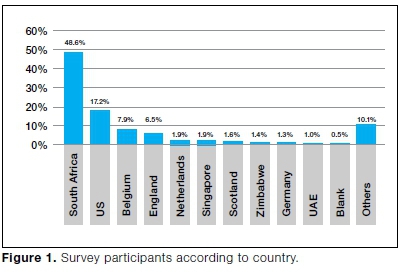
In total, 1154 participants representing 52 different countries answered the online survey. With regards to the location of the participant's dental practice, nearly half were located in South Africa (48.6%, n=561), followed by United States (17.2%, n=199), and Belgium (7.9%, n=91, Figure 1).
In total, 70.1% of the respondents were general dentists (n=809), 24.6% were specialist dentists (n=284), 2.2% were dental assistants or dental nurses, and the remaining 3.1% (n=36) represented other staff.
Regarding the workplace, the majority (89.4%, n=1032) worked at private dental clinics, 6.9% (n=79) worked both at private and public dental clinics, 2.7% (n=31) worked at public dental clinics, and 1.0% (n=12) had other work settings.
COVID-19 infection - dentists, dental assistants, and dental staff
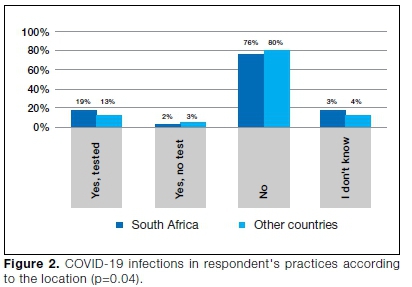
The majority of the participants reported no COVID-19 infections in their practices (78.2%, n=902). In total, 18.2% (n=210) reported COVID-19 infections in their practices, from which 88.5% (n=186) were confirmed by a laboratory test, and 11.5% (n=24) lacked diagnostic confirmation.
Less than 4% of the sample did not know if there were COVID-19 infections in their practices. When South Africa's responses were compared to the rest of the world (Figure 2), South Africa presented a higher infection rate than the other countries combined (19% versus 13%, p=0.04, Figure 2).
When asked about how the respondent or clinic staff acquired COVID-19 infection, 11.2% (n=137) answered 'outside the practice', 10.3% (n=119) did not know, 1.1% (n=13) answered 'inside the practice', and 77.4% report no infections.
COVID-19 infection - patients
Regarding COVID-19 infection of patients after visiting dental practices, 91.8% of respondents had no reported patient infection, 3.8% did not know, 3.6% reported having patients infected 1-2 weeks after visiting the practice, as confirmed by laboratory tests, and 0.8% reported unconfirmed patient infection.
According to the survey, 13.9% (n=160) of the participants reported treatment of laboratory-confirmed COVID -19 patients. When evaluated by location, 17% of South African respondents treated laboratory-confirmed COVID -19 patients compared to 11% of respondents from other countries (p=0.006).
There were no statistically significant differences in infection rates for respondents who reported treatment of confirmed cases in their practices (14%, n=22 infections reported by 160 participants) and those who did not treat confirmed COVID-19 patients (19%, n=188 infections reported by 994 participants, p=0.127).

DISCUSSION
The majority of the participants were dental practitioners who work in private practices, with nearly half being located in South Africa. In total, 18.2% of the participants reported COVID-19 infection in their practices, and the majority of infections were confirmed by a laboratory test (88.5%). Only 1.1% of the participants reported infection of dentists or dental staff acquired at the practice.
Regarding patient infection, 3.6% had patients infected 1-2 weeks after visiting the practice. It is important to reiterate that the infection's true origin cannot be confirmed, as transmission could have taken place outside the dental practices or anywhere else. Overall, 13.9% treated COVID-19 positive patients.
South Africa presented a higher infection rate and more frequent treatment of COVID-19 patients than all other countries combined. This is the first study to provide information on COVID-19 infections among the South African dental community to the best of our knowledge.
The occupational COVID-19 risk of dentists and dental staff has been estimated to be high due to the infective potential of saliva droplets and dental-generated aerosols.10 89
The prevalence rate of COVID-19 in the general population has been estimated to be around 2%.111213
Considering the general population infection rate of 2% for SARS-CoV-211, findings from this survey suggest that visiting a dental practice could increase the risk for infection, as 4.3% of participants reported patient infection after a visit to the dental practice. But these results should be interpreted with caution, since tracing the origin of COVID-19 infections is challenging and multiple risk factors have been implicated in the epidemiology of the coronavirus disease, including host defense, underlying health conditions, adherence to social distancing, exposure to infected individuals, age, and personal hygiene habits.14
Findings from this survey indicate that nearly 14% of dental practices had COVID-19 positive patients who needed dental treatment, which increases the occupational COVID-19 risk of the dentist and dental staff and highlights the need for strict infection control measures to protect the dental team. In a survey from Brazil, 5.3% of dentists reported treatment of COVID-19 patients.15
Although an explanation for the higher treatment of COVID -19 patients in South Africa cannot be readily found, the higher number of dentist per inhabitants in Brazil is twice as high as recommended by the WHO (1:753),1617
In this survey, only 1.1% of respondents attributed COVID -19 infections of dental practitioners and their staff to dental practices, which is low compared to the frequency of treatment of COVID-19 positive patients (13.9%). In addition, treatment of confirmed COVID-19 positive patients did not increase the reported infection rates for dentists and their staff, indicating that infection control protocols are being successfully followed when COVID-19 patients require emergency treatment.
The biggest challenge in dental settings is likely the asymptomatic carriers of the Coronavirus. Identification of infected and asymptomatic patients is essential to limit the infection risk of dental practitioners and staff. For this reason, accurate and affordable point-of-care diagnostic tests for SARS-CoV-2 that provide results within minutes, are warranted. This can facilitate the decision-making process related to clinical patient care, thus reducing the pressure on health professionals.1819
The infection rate among dental professionals can be affected by multiple factors that were not evaluated in the survey, such as using PPE and other infection control protocols, access to diagnostic tests, and the number of patients who visited the dental practice during the pandemic, among others. Results from this survey rely on the accuracy of COVID-19 diagnostic tests, which can be subject to false-negative and false-positive results, as highlighted in the survey study performed by the ADA. Lastly, even though respondents reported that most infections of dentists and dental staff were community-acquired, the actual source of COVID-19 infection is difficult to ascertain, as mentioned previously, making these findings difficult to interpret.20
Because of the infectious and inflammatory nature of ubiquitous dental diseases such as caries and periodontal disease,212223
CONCLUSIONS
The work environment of dental professionals leads to high exposure to respiratory diseases such as coronavirus disease. The COVID-19 infection rate in dental practices was higher than the general population's estimated rate but comparable to most reported rates for healthcare workers.
South Africa had more infections and more frequent treatment of COVID-19 patients. These results support the need for strict infection control measures in dental practices to decrease the risk of transmission of SARS -CoV-2 to the dental team and patients during oral care delivery.
References
-
1. Jamal M, Shah M, Almarzooqi SH, et al. Overview of transnational recommendations for COVID-19 transmission control in dental care settings. Oral Dis. 2020;00;1-10. doi: doi.org/10.1111/odi.13431.
» https://doi.org/10.1111/odi.13431 -
2. Peng X, Xu X, Li Y, Cheng L, Zhou X, Ren B. Transmission routes of 2019-nCoV and controls in dental practice. International Journal of Oral Science. 2020; 12: 1-6. doi: doi.org/10.1038/ s41368-020-0075-9.
» https://doi.org/10.1038/ s41368-020-0075-9 -
3. World Health Organization. Considerations for the provision of essential oral health services: Interim Guidance 2020, 3 August 2020. World Health Organization. https://apps.who.int/iris/handle/10665/333625. License: CC BY-NC-SA 3.0 IGO.
» https://apps.who.int/iris/handle/10665/333625 -
4. UK Office for National Statistics. Which occupations have the highest potential exposure to the coronavirus (COVID-19)? 2020. Available from: https://www.ons.gov.uk/employmentandlabourmarket/peopleinwork/employmentandemployeetypes/articles/ whichoccupationshavethehighestpotentialexposuretothecoronaviruscovid19/2020-05-11.
» https://www.ons.gov.uk/employmentandlabourmarket/peopleinwork/employmentandemployeetypes/articles/ whichoccupationshavethehighestpotentialexposuretothecoronaviruscovid19/2020-05-11 -
5. Brian Z, Weintraub JA. Oral Health and COVID-19: Increasing the need for prevention and access. Prev Chronic Dis. 1 Aug 2020; 17: 200266. doi: 10.5888/pcd17.200266.
» https://doi.org/10.5888/pcd17.200266 -
6. Centers for Disease Control and Prevention Guidance for Dental Settings. Interim Infection Prevention and Control Guidance for Dental Settings During the COVID-19 Response. 4 Dec 2020. Available from: https://www.cdc.gov/coronavirus/2019-ncov/hcp/dental-settings.html
» https://www.cdc.gov/coronavirus/2019-ncov/hcp/dental-settings.html -
7. American Dental Association. ADA COVID-19 Center for Dentists 2020. Available from: https://success.ada.org/en/practice-management/patientsinfectious-diseases-2019-novel-coronavirus.
» https://success.ada.org/en/practice-management/patientsinfectious-diseases-2019-novel-coronavirus -
8. Estrich CG, Mikkelsen M, Morrissey R, et al. Estimating COVID -19 prevalence and infection control practices among US dentists. J Am Dent Assoc. 2020;151(11):815-24. doi: 10.1016/j.adaj.2020.09.005.
» https://doi.org/10.1016/j.adaj.2020.09.005 -
9. Conselho Federal de Odontologia. Relatório - COVID-19 -Odontologia. 2020. Available from: https://website.cfo.org.br/wp-content/uploads/2020/07/Relatório-covid19-Odontologia-Cirurgioes-Dentistas-1.pdf.
» https://website.cfo.org.br/wp-content/uploads/2020/07/Relatório-covid19-Odontologia-Cirurgioes-Dentistas-1.pdf -
10. Li Y, Ren B, Peng X, et al. Saliva is a non-negligible factor in the spread of COVID-19. Molecular Oral Microbiology. 2020; 35: 141-5. doi: 10.1111/omi.12289.
» https://doi.org/10.1111/omi.12289 -
11. Toulis P. Estimation of Covid-19 Prevalence from Serology Tests: A Partial Identification Approach. J Econom. 2021; 220(1): 193-213. doi: 10.1016/j.jeconom.2020.10.005.
» https://doi.org/10.1016/j.jeconom.2020.10.005 -
12. Houlihan CF, Vora N, Byrne T, et al. Pandemic peak SARS -CoV-2 infection and seroconversion rates in London frontline health-care workers. The Lancet. 2020; 396: e6-7. doi: 10.1016 /S0140-6736(20)31484-7.
» https://doi.org/10.1016 /S0140-6736(20)31484-7 -
13. Gómez-Ochoa S, Franco O, Rojas LZ, et al. COVID-19 in health-care workers: a living systematic review and meta-analysis of prevalence, risk factors, clinical characteristics, and outcomes. Am J Epidemiol. 2020; 190(1): 161-75. doi: 10.1093 /aje/kwaa191 doi: 10.1111/idj.12332.
» https://doi.org/10.1093 /aje/kwaa191 -
14. Lakshmi Priyadarsini S, Suresh M. Factors influencing the epi-demiological characteristics of pandemic COVID 19: A TISM approach. Int J Healthc Manag. 2020; 13(2): 89-98. doi: doi.org/10.1080/20479700.2020.1755804.
» https://doi.org/10.1080/20479700.2020.1755804 -
15. Moraes RR, Correa MB, Queiroz AB, et al. COVID-19 challenges to dentistry in the new pandemic epicenter: Brazil. PLoS One. 2020; 15(11): e0242251. doi: 10.1371/journal.pone.0242251.
» https://doi.org/10.1371/journal.pone.0242251 -
16. Casado PL, Quinelato V, Cataldo P, et al. Dental genetics in Brazil: Where we are. Molecular Genetics and Genomic Medicine. 2018; 6: 689-701. doi: 10.1002/mgg3.457.
» https://doi.org/10.1002/mgg3.457 - 17. Bhayat A, Chikte U. The changing demographic profile of dentists and dental specialists in South Africa: 2002-2015. Int Dent J. 2018; 68(2): 91-6.
-
18. Parupudi T, Panchagnula N, Muthukumar S, Prasad S. Evidence-based point-of-care technology development during the COVID-19 pandemic. Biotechniques. 2021; 70(1): 58-67. doi: 10.2144/btn-2020-0096.
» https://doi.org/10.2144/btn-2020-0096 -
19. Dinnes J, Deeks JJ, Adriano A, et al. Rapid, point-of-care antigen and molecular-based tests for diagnosis of SARS-CoV-2 infection. Cochrane Database Syst Rev. 2020; 8: CD013705. doi: 10.1002/14651858.CD013705.
» https://doi.org/10.1002/14651858.CD013705 -
20. Mbunge E. Integrating emerging technologies into COVID-19 contact tracing: Opportunities, challenges and pitfalls. Diabetes Metab Syndr Clin Res Rev. 2020; 14(6): 1631-6. doi: 10.1016/j.dsx.2020.08.029.
» https://doi.org/10.1016/j.dsx.2020.08.029 -
21. Dye BA. The Global Burden of Oral Disease: Research and Public Health Significance. J Dent Res. 2017; 96(4): 361-3. doi: 10.1177/0022034517693567.
» https://doi.org/10.1177/0022034517693567 -
22. Banakar M, Bagheri Lakarani K, Jafarpour D, Moayedi S, Banakar MH, Mohammadsadeghi A. COVID-19 transmission risk and protective protocols in dentistry: A systematic review. BMC Oral Health. 2020 Oct 8; 20(1): 275. doi: 10.1186/ s12903-020-01270-9.
» https://doi.org/10.1186/ s12903-020-01270-9 -
23. Korber B, Fischer WM, Gnanakaran S, et al. Tracking Changes in SARS-CoV-2 Spike: Evidence that D614G Increases Infec-tivity of the COVID-19 Virus. Cell. 20 Aug 2020; 182(4): 812-27. e19. doi: 10.1016/j.cell.2020.06.043.
» https://doi.org/10.1016/j.cell.2020.06.043
Howard Gluckman
The Implant Clinic, 39 Kloof Street, Gardens, 8001
Cape Town, South Africa.
Email:
Author contributions:
1 . Howard Gluckman: Conceptualization, methodology, data curation - 25%
2 . Carla C Pontes: Methodology, writing - original draft, review and editing, formal analysis - 25%
3 . Matthias Troelzsch: Project administration, validation, resources - 25%
4 . E Todd Scheyer: Project administration, validation, resources - 25%