Essential non-clinical skills and training required by dentists in South Africa
INTRODUCTION
Dentists possess clinical experience garnered within supervised clinical settings, primarily aimed at diagnosing, treating and preventing oral cavity related diseases.1 1234 5
The movement towards outcomes-based medical education was prompted by the escalating demand for heightened accountability across all facets of modern medical professions.66
Additionally, new dentists must perform a variety of administrative tasks, such as bookkeeping, financial forecasting, retirement planning, human resources, understanding insurance policies, purchasing equipment, keeping track of inventories and advertising. Dentists must be proficient in these areas to lead and manage a successful enterprise. Success in a private practice depends on excellent business and communication skills and self-discipline - aspects that often receive secondary attention in dental education.1
Leadership stands as a pivotal skill requisite for transforming the dental profession, spearheading innovation and navigating novel challenges. Recently, the number of leadership development programmes for dental practitioners has proliferated, attesting to a growing interest in developing this essential skill.78
Similarly, Patel et al.910111213141516
METHODS
The University X Research Ethics committee approved the study (352/2016).
Study design
This was a qualitative study. Senior managers (SMs) and recently qualified dentists, who are referred to as young dentists (YDs) in this study, were purposively sampled. Fifteen SMs were identified through referrals by oral health professionals, academics at the University X and internet searches. Dental professionals were registered with reputable public and private oral health organisations, including the Dental Professionals Association, SA Dental Association, SA Military Health Services, group practices (Intercare and Medicare), Public Health Services (National Department of Health and regional Tshwane district) and five private dentists. SMs represented the views of key oral health experts and professionals in SA because of their experience and position in the oral health field. YDs were sampled from the Young Dentists Council.
All 39 registered YDs were invited to participate in the study; of these, 11 consented to participate. The YDs graduated between 2002 and 2015 were younger than 35 years old and from the public (n = 5) and private (n = 6) sectors. Four of SA's nine provinces - Gauteng, KwaZulu-Natal, Mpumalanga and Western Cape - were represented. Participants were invited by telephone call or email. The study's title, purpose and expectations were all described. Only those interested in participating signed an informed consent form.
2.2 Data collection
Data were collected during semi-structured, one-on-one or telephonic interviews.17
2.3 Data analysis
To maintain anonymity, codes were assigned to each participant, namely SM01-SM14 (SMs) and YD01-YD11 (YDs). During the interviews, responses to the questions were audio-recorded verbatim, transcribed and then thematically analysed. Non-clinical skills were interpreted using the MLCF.13,16 We further calculated the frequency of responses to support the weight of each theme.
RESULTS
3.1 Non-clinical skills in dentistry
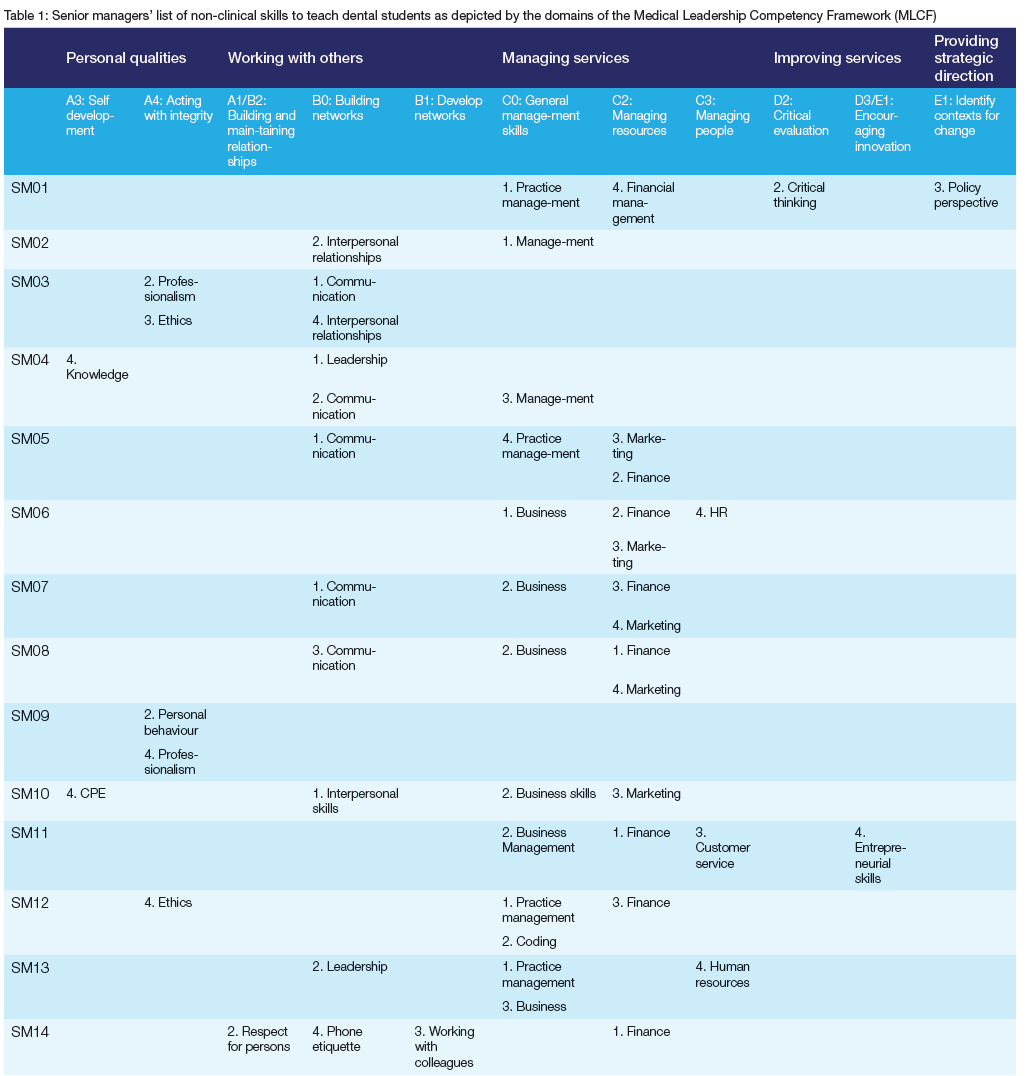
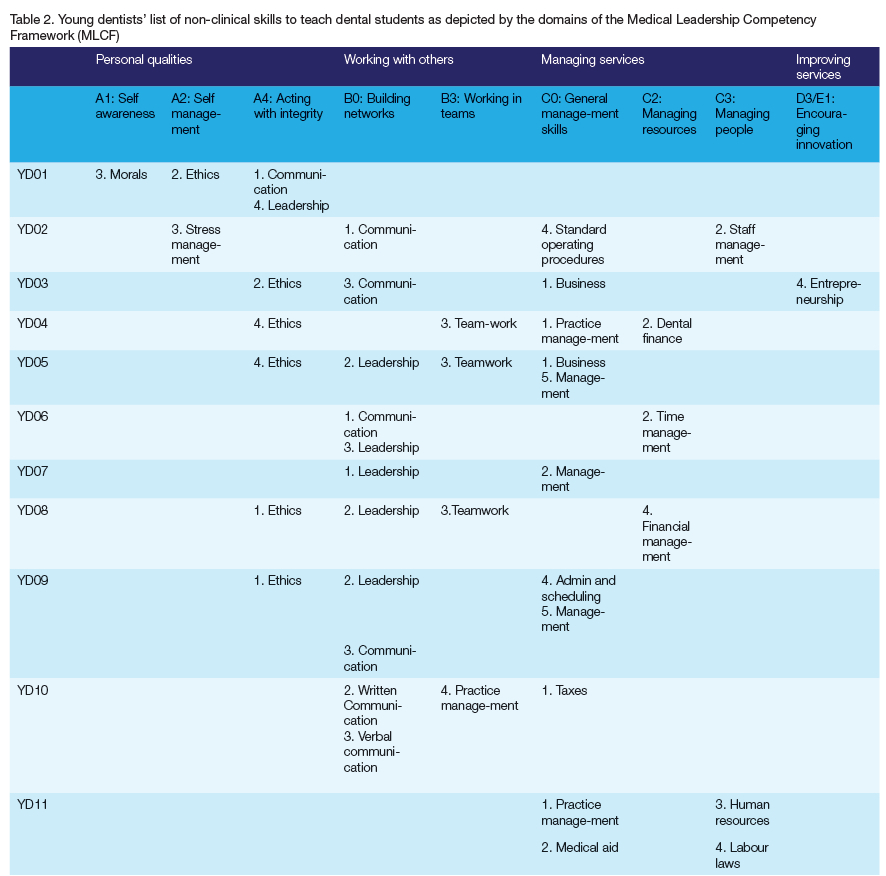
The SM and YD responses to the question on the four non-clinical skills required by dental students are summarised in Table 1 and 2. According to the adapted MLCF, their answers were categorised as shown below.
Fourteen SMs revealed 54 non-clinical skills. Of the 54 skills, 61.1% were within Domain C (managing services) (57.4%) and Domain D (improving services) (3.7%). Other skills fell within Domain A (personal qualities) (16.6%) and Domain B (working with others) (22.2%) (Table 1).
SMs rated critical non-clinical skills as follows: financial management (16.6%), business skills (11.1%), marketing skills (9.2%), communication (9.2%), practice management (7.4%), interpersonal relationship skills (5.5%), ethics (5.5%), professionalism (3.7%), leadership skills (3.7%), general management (3.7%), human resource management (3.7%) and others (3.6%) (Table 1). Working with others, respect, telephone etiquette, critical thinking, dental coding, entrepreneurship, knowledge, personal behaviour, continuous education and policy perspective skills were among the skills in the Others category.
The YDs identified four non-clinical domains and listed 43 skills as essential non-clinical skills to train dental students. Skills fell within Domain B (the ability to work with others) (37%) and Domain A (personal qualities) (19%), Domain C (managing services) (42%) and the least in Domain D (improving services) (2%).
During the interview, when asked to rate non-clinical skills, YDs reported communication (16%), ethics and morality (16%), leadership (14%), teamwork (7%), general practice management (7%), business skills (5%) and others (2%). Others included business ownership, administration, human resources, financial management, labour legislation, time management and standard operating procedures.
Participants stated the following:
"Big gap for advocacy for dentistry to be prioritised in health agenda. Therefore, we need leaders in dentistry who will collaborate dentistry with private stakeholders and boost the economy" (SM03)
"It is needed because it's important to be taught leadership to learn how to lead the team, then management to help to manage the business" (SM08)
"There is a high need. Challenges are being faced which requires a different approach in terms of management and leadership training" (YD03)
3.2 Delivery of management training in the South African context
Based on SM's responses, three broad themes emerged related to management training: (1) undergraduate level only, (2) undergraduate level with a postgraduate follow up, and (3) postgraduate level only.
Regarding theme one, four SMs agreed that management training should be taught at the undergraduate level. Although there is a lack of undergraduate training, there is a strong expectation that students should be taught management abilities as part of their undergraduate education. SM03 opined that management training should be delivered via short courses offered by business schools. Management training should include supply chain management, financial management, risk management and human resource management courses.
"The best time is in the final years where 4th/5th year students should be exposed to full functional setups, to be taught management skills" (SM08)
"It is best acquired in undergraduate study; should significantly include non-clinical skills mentioned above with equal focus on clinical skills" (SM01) "While in undergraduate level, presented by professional associations..." (SM10)
Five YDs agreed that the optimum period to teach managerial skills to dental professionals was during their undergraduate years.
"This should be part of the dental educational system from day one and I don't think it's professional for doctors or other dentists to teach management unless they are qualified in that regard. Someone with experience of management at the corporate level to be involved and not just for a year or two but training should be from the beginning" (YD10)
"As an undergraduate course at least by third year" (YD08) "Professionals should come train at the undergraduate level in the universities" (YD05)
"Definitely in undergraduate like in 4th year perhaps in the form of research before graduation" (YD04)
Regarding the second theme, six SMs agreed that management skills should be taught at the undergraduate level with a postgraduate level follow-up. Dentists who have their own practices will be more cognisant of their specific issues and will likely benefit from further postgraduate management training. Management training could take the form of continuous professional development (CPD) forums or presentations made by professional bodies.
"Introducing it as a course in the undergraduate level either within a year or as a six-month module and then continuous training in the postgraduate level" (SM13)
"Should be included in the undergraduate curriculum from a management company to be included as a module. Then follow up in the postgraduate level" (SM04)
"The days of someone standing in front and lecturing to practitioners/individuals are numbered. Most would prefer to educate themselves with online possibilities, which they can do after hours (less travelling). Female dentists for fear of personal safety will not travel to CPD meetings in the evenings. So this will allow all interested dental professionals to learn from the online materials in the safety of their homes" (SM12)
Five YDs agreed that managerial training should be delivered at all educational levels, from the undergraduate to the postgraduate phases. Management is a valuable skill that should be developed from early on in their career.
"Good to be delivered at all levels. High school, undergraduate and postgraduate levels. Not as a separate course but incorporated into the clinical courses" (YD01)
"Yes, sufficient lectures were given, however not appreciated because as a student I was more focused on the clinical aspect. So regardless of how well the university prepares the students with non-clinical skills it cannot be sufficient. In the postgraduate phase the professionals will need to appreciate the knowledge and skills learnt by adding more to them through extra training" (YD09)
Regarding theme three, four SMs agreed that the delivery of managerial training could best be delivered in the postgraduate training only.
"CPD courses at the postgraduate level will yield better responses" (SM06)
"Through postgraduate training but not long term like going back to school but rather short courses like CPD courses or online courses" (SM11)
" Through postgraduate courses more than the undergraduate level" (SM05)
Only one YD (YD02) agreed with this theme. "It should be practical based. Otherwise, the knowledge would be lost. Through internship training in the dental setting" (YD02)
3.3 Delivery of leadership training in the South African context
Six SMs felt that leadership skills ought to be taught primarily at the undergraduate phase.
"Very big challenge in the South African context. Many dentists gravitate towards private practice in an isolated environment not conducive for leadership development. Leadership is acquired over time primarily through mentorship and not just formal training. Deliberate mentorship: deliberate efforts to mentor students in universities by giving them responsibilities that nurture leadership" (SM01)
"Through the use of professional experts coming in to teach the students at the undergraduate level" (SM07)
"It's a skill that is taught through mentorship best in the undergraduate level" (SM08)
SM14 felt strongly that leadership is learnt by imitating and cannot necessarily be taught. Universities should be responsible for unpacking values, such as respect and equity, which South Africa holds as a nation.
Four YDs agreed that leadership skills should be taught at the undergraduate phase.
"Also in undergraduate level like management, leadership should be taught not only in the fourth year but throughout the dental study. It can be acquired but leadership training should be started very early in undergraduate level" (YD04)
"Through business leaders as experts coming to teach in a university classroom. Learning from a mentorship role programme in undergrad" (YD07)
"Leadership is best developed from a childhood stage where the mind starts to form. One should learn that other people matter as much as you do. Schools need to be improved and it needs to be introduced earlier where we learn how to be leaders in different ways at different times" (YD10)
Two SMs felt that leadership training should best be taught through the undergraduate phase into the postgraduate phase. One SM acknowledged that management and leadership are quite similar, and both should be taught in a formal environment, such as in an undergraduate institution. One SM believed that delivering leadership development at the undergraduate level would be very helpful in fostering information gained by coaching, mentoring and educating dentistry students as they progressed through their studies. Six YDs supported that leadership training should be offered from the undergraduate phase through to the postgraduate phase.
'Very early in undergraduate level such as in the 1st year and at the postgraduate level through the universities" (YD06)
"There should be greater motivation for leadership within the dental practice. It can be introduced as a major component of dental study and CPD courses for postgraduates" (YD02)
"Undergraduate level. Also, during postgraduate level, and then continuous learning" (YD03)
"Undergraduate basic knowledge with postgraduate more in-depth courses" (YD09) Six SMs agreed that only postgraduate-level leadership training should be provided to dental students.
"In the postgraduate level because, as students, we focus on clinical skills and may end up not needing it after qualification" (SM04)
"Through congresses and learning from outside of South Africa by inviting someone to come in and interact with dentists, doctors and businesspeople, so the variety will help nurture ideas. Also networking sessions to meet like-minded people not necessarily in the same line of industry to stimulate one's thinking" (SM11)
Lastly, only one YD (YD05) felt that leadership skills should be taught to dentists at the postgraduate phase only.
DISCUSSION
In this study, we asked SMs and YDs what they felt were the most important non-clinical skills needed by dentists in SA, and when these skills should be taught at SA universities. Participants expressed varying insights about when best to teach management and leadership skills, but all participants agreed that there is a dire need for management and leadership training.
Participants in this study highlighted the dire need for non-clinical skills, management and leadership training for dentists. Dentists inevitably end up leading their team18192021
In dental settings, non-clinical activities include self-management abilities, service management, professionalism, communication and teamwork.1322
These suggest that experienced SMs recognised the importance of these skill sets, particularly financial management. In contrast, YDs identified communication, leadership skills and ethics, practice management skills and business skills as the most vital non-clinical skills to teach dentists. These findings can be attributed to the fact that most of the YDs were just eight years out of school, and their main areas of interest were clinical care and related skills such as communication, leadership and ethics. This suggests that these YDs still need to learn the necessary skills to function satisfactorily at the next stage of the MLCF for managing services.
In our study, we included two groups of participants, namely SMs and YDs. These groups responded differently, likely reflecting recent changes in dental education. For example, SMs reported a lack of appreciable management training during their undergraduate studies to sufficiently prepare them for clinical practice. In contrast, YDs did receive some form of dental practice management training as part of their undergraduate curriculum but still felt unprepared for leadership roles. Dental professionals can be trained in leadership knowledge and skills,2312, 24, 2526-28 Such training would have remarkable benefits. Aside from improving dentists' ability to lead a dental team, such training might help educators to quickly recognise future leaders. The students would develop their own aspirations and grow into an awareness of their innate leadership abilities.19 9, 2930, 3132 28 289, 29
LIMITATIONS OF THE STUDYThe generalisability of the study may be affected due to the small sample size. It could, however, be argued that the key stakeholders who were consulted in this study were fairly representative of the incumbent organisational leadership in dentistry in SA. Young dentists also originated from multiple training institutions to give a perspective of their recent education.
CONCLUSION
Since dentists serve in a hybrid role as clinicians and managers who need to able to provide quality dental care and establish a profitable business, stakeholders in this study identified non-clinical skills that might be relevant to clinical treatment and practice management. To allow dentists in training to realise their leadership potential, participants unanimously agreed that management and leadership skills need to be introduced earlier in the curriculum and followed up at the postgraduate level.
Conflicts of interest
The authors have no conflicts of interest to disclose.
ACKNOWLEDGEMENT
We would like to acknowledge Dr Chery l Tosh (Science Editor, Faculty of Health Sciences, University of Pretoria) for her help with the editing of the manuscript.
REFERENCES
- 1. Barber M, Wiesen R, Arnold S, et al. Perceptions of business skill development by graduates of the University of Michigan Dental School. J Dent Educ 2011; 75(4): 505-17
- 2. Haslach SD, Aytepe Z, Kokkari A, et al. Country and gender differences in the motivation of dental students - An international comparison. Eur J Dent Educ 2018; 22(4): e724-e729
- 3. Manski RJ, Moeller JF, Chen H, et al. Dental usage under changing economic conditions. J Public Health Dent 2014; 74(1): 1-12
- 4. McClure CB, Ssemundsson SR. Effects of a national economic crisis on dental habits and checkup behaviors - a prospective cohort study. Community Dent Oral Epidemiol 2014; 42(2): 106-12
- 5. Marks A, Mertz E. Leadership development: A critical need in the dental safety net. San Francisco: University of California. Center for the Health Professions at UCSF. 2012
- 6. Frank JR, Snell L, Englander R, Holmboe ES, Icbme Collaborators. Implementing competency-based medical education: Moving forward. Med Teach 2017; 39(6): 568-73
- 7. Kalenderian E, Taichman RS, Skoulas A, et al. Developing the next generation of leaders in oral health. J Dent Educ 2013; 77(11): 1508-14
- 8. Wali O. Leadership skills in dental curriculum - a review. J Evol Med Dent Sci 2018; 7(42): 4584-88
- 9. Patel R, Eaton KA, Garcia A, et al. Factors influencing dental practitioner performance: A summary of recent literature review. Oral Health Dent Manag 2011; 10(3): 119-30
- 10. I reri S, Walshe K, Benson L, Mwanthi MA. A qualitative and quantitative study of medical leadership and management: experiences, competencies, and development needs of doctor managers in the United Kingdom. J Manag Marketing Healthc 2011; 4(1): 16-29
- 11. Levin RP. Business innovation in the dental practice. J Am Dent Assoc 2013; 144(2): 203-4
- 12. Seaman CL Leadership in dentistry: An empirical phenomenological study of practicing general dentists in South Central Idaho. University of Phoenix: 2008
- 13. Clark J, Armit K. Leadership competency for doctors: a framework. Leadersh Health Serv 2010; 23(2): 115-29
- 14. Van der Berg-Cloete SE, Snyman L, Postma TC, White JG. Dental students' perceptions of practice management and their career aspirations. Afr J Health Prof Educ 2015; 7(2): 194-8
- 15. Busari JO. Management and leadership development in healthcare and the challenges facing physician managers in clinical practice. Int J Clin Leadersh 2012; 17(4): 211-6
- 16. Van der Berg-Cloete SE, Snyman L, Postma TC, White JG. South African dental students' perceptions of most important nonclinical skills according to medical leadership competency framework. J Dent Educ 2016; 80(11): 1357-67
- 17. Gill P, Stewart K, Treasure E, Chadwick B. Methods of data collection in qualitative research: interviews and focus groups. Br Dent J 2008; 204(6): 291-5
- 18. Hebbal M, Ankola A, Murugaboopathy V, et al. Do Dentists Require Leadership Qualities? Can Med Edu J 2012; 3(1): e80
- 19. Morison S, McMullan C. Preparing for the future: challenges and opportunities for management and leadership skills. Br Dent J 2013; 214(1): E2-E2
- 20. Clark J, Armit K. Attainment of competency in management and leadership: no longer an optional extra for doctors. Clin Govern Int J 2008; 13(1): 35-42
- 21. Frymier AB, Shulman GM. "What's in it for me?" Increasing content relevance to enhance students' motivation. Commun Educ 1995; 44(1):40-50
- 22. Craven SH. Dentists as clinician managers: Leadership influences on dental team empowerment and engagement (Doctoral dissertation) Walden University, 2017
- 23. Miller DL, Umble KE, Frederick SL, Dinkin DR. Linking learning methods to outcomes in public health leadership development. Leadersh Health Serv 2007; 20(2): 97-123
- 24. Willeford R. 10 steps to a financially healthy practice, Part 1. Dent Econ 2006; 96(6): 22-6
- 25. Harkins D, Butz D, Taheri P. A new prescription for healthcare leadership. J Trauma Nurs 2006; 13(3): 126-30
- 26. Klaber RE, Roueché A, Hodgkinson R, Cass HD. A structured approach to planning a workbased leadership development programme for doctors in training. Int J Clin Leadersh 2008; 16(3): 121-9
- 27. Coltart CE, Cheung R, Ardolino A, et al. Leadership development for early career doctors. The Lancet 2012; 379(9828): 1847-9
- 28. Kabir C, Potty A, Sharma R. Current opportunities for the development of leadership skills for doctors. Int J Clin Leadersh 2008; 16(3): 115-9
- 29. Gallagher J, Wilson NH. The future dental work-force? BDJ 2009; 206(4): 195-9
- 30. Taichman RS, Parkinson JW, Nelson BA, et al. Leadership training for oral health professionals: a call to action. J Dent Educ 2012; 76(2): 185-91
- 31. Parsell G, Bligh J. Encouraging educational leadership. Med Educ (Oxford. Print) 2000; 34(3): 199-200
- 32. White JG, Kruger C, Snyman WD. Development and implementation of communication skills in dentistry: an example from South Africa. Eur J Dent Educ 2008; 12(1): 29-34
- 33. White JG. Interacting forces influencing private dental practice in South Africa: implications for dental education. SADJ 2008; 63(2): 80-5
- 34. Karimbux NY. Teaching dental practice management in a time of change. J Dent Educ 2015; 79(5): 463-4
- 35. Manogue M, McLoughlin J, Christersson C, et al. Curriculum structure, content, learning and assessment in European undergraduate dental education-update 2010. Eur J Dent Educ 2011; 15(3): 133-41

Author's contribution
1 . Michelle Olubunmi Tukuru 100%
2 . Dr L Snyman 100%
3 . Prof TC Postma 100%
4 . Prof SE van der Berg-Cloete 100%