Fracture of endodontic instruments - Part 1: Literature review on factors that influence instrument breakage
INTRODUCTION
Instrument fracture is a serious complication during endodontic treatment of teeth, having an adverse effect on the outcome of the nickel titanium (NiTi) treatment, especially if the fracture prevents apical access to the infected root canal. Despite the advent of NiTi files, the risk of fracture during the endodontic preparation of root canals, especially in severely curved canals, remains a serious concern. The fracture of NiTi files during preparation may result in a compromised prognosis for the tooth. In the presence of periapical lesions, instrument fracture may reduce the chances of successful healing.1
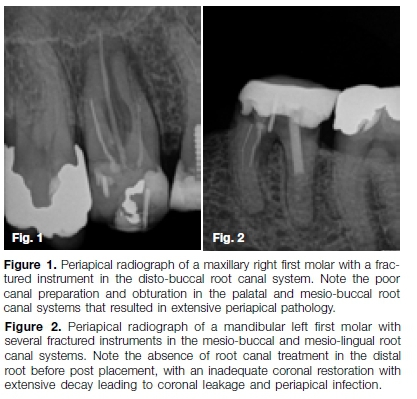
It is noticed clinically that when an instrument fractures in a root canal system, it is often associated with incomplete root canal obturation, ineffective coronal seal or poor definitive restorations (Figures 1 and 2). This further leads to micro-organisms penetrating the root canal system, indicating the development of a periapical lesion and treatment failure.2,3
Fractured endodontic instruments may include endodon-tic files, Gates-Glidden burs, lateral or finger spreaders or spiral fillers manufactured from stainless steel, NiTi or carbon steel.14,5 with the higher percentage representing fractures in molar teeth only.46
Rotary NiTi files are known to fracture without any visible signs of deformation and potential fracture, compared to the evident warning signs seen in traditional stainless steel files.7
New studies indicate that instrument fracture has many variables, the most crucial being the clinician's skill.8 9
As a result of their improved designs and cross-sections, endodontic instruments subjected to torsional and flex-ural loads may have an altered resistance to fracture.10,11 The low tensile strength and yield of NiTi instruments (compared to stainless steel instruments) results in a higher fracture risk at lower loads.128,13
The success of endodontic treatment may be influenced by the fracture of NiTi files. The last decade has seen instrument manufacturers make modifications to NiTi alloy to reduce the incidence of instrument fracture. The removal of a fractured endodontic file is technically challenging and time intensive, hence it is crucial to limit the probability of instrument fracture.14
There are conflicting results from studies on the overall outcomes and successes of endodontic treatment when a fractured endodontic instrument is left within the root canal. A study by Spili et al.1
The fracture of endodontic rotary instruments can be broadly classified into two types: fractures due to cyclic fatigue and fractures due to torsional fatigue.1516,17
Cyclic fatigue
Cyclic fatigue is a major cause of separation of NiTi rotary instruments during clinical use.16181920
Cyclic fatigue fracture occurs fundamentally as a result of overuse of the NiTi alloy. Other potential factors that contribute to metal alloy fatigue include changes due to thermal expansion and contraction, as well as corrosion.21 22
New concepts and designs in NiTi alloys, including thermomechanical improvements, have improved their cyclic fatigue resistance.2324258
Torsional fracture
Torsional fracture occurs when part of the instrument binds to the canal while the shank continues to rotate.26 21
Instrument manufacturing processes, designs and protocols can improve resistance to cyclic stress, but not to torsional stress since it is more dependent on the operator.272815
Numerous studies have stated that NiTi instruments with lower metal mass and small cross-sectional areas usually have lower torsional strengths.29-31 Conventional NiTi files have a higher fracture risk when exposed to torsional stresses at lower cyclic fatigue levels. NiTi instruments which have been previously used have a high fracture risk as a result of their reduced torsional stress resistance.
Factors influencing fracture resistance
1. Design and manufacture
Instrument design and cross-section are crucial factors in the resistance to fracture when the instrument is subjected to torsional and flexural loads.1032
Many methods such as heat treatment, electropolishing and alterations of the cross-section of files have been developed to prevent the fracture of NiTi rotary file instruments.3334
M-Wire is composed of 508 Nitinol, thermomechanically treated under specific tensile stresses and temperatures.35 36
A study of the metallurgical characterisation of M-Wire found that it contains deformed and twinned martensite, R-Phase and austenite crystalline phases. The deformed and micro-twinned martensite is responsible for the increased strength of the M-Wire compared to the conventional super-elastic wire without martensitic structure.37
Numerous metallurgical laboratory techniques have demonstrated that M-Wire contains the austenite phase with small amounts of martensite and R-Phase, thus rendering M-Wire more flexible and resistant to cyclic fatigue than conventional NiTi files.38-40
Endodontic instruments manufactured with M-Wire exhibited better cyclic fatigue resistance than conventional NiTi alloys.3819
A study by Bonessio et al.41
M-Wire was shown to be more flexible and harder than conventional NiTi wire, with superior physical and mechanical properties.35,42
In 2010, rotary NiTi instruments were developed using a proprietary thermal process called Controlled Memory (CM) technology.4344
Studies have demonstrated that instruments manufactured with CM technology possess superior cyclic fatigue resistance and flexibility to conventional NiTi instruments, which can be attributed to their martensitic state.45,46
In a study comparing the cyclic fatigue properties of Proflexendo (Nexden, Houston, TX, USA), manufactured using CM-Wire, to Profile Vortex (Dentsply Tulsa Dental, Tulsa, OK, USA) and ProTaper Universal (Dentsply Sirona, Ballaigues, Switzerland) manufactured with M-Wire, the Proflexendo exhibited significantly greater cyclic fatigue resistance. The Proflexendo demonstrated almost 500% more resistance to cyclic fatigue than the M-Wire instruments.47
Galal48
A study by Shen et al.49
The distinctive gold appearance of WaveOne Gold (Dent-sply Sirona) endodontic instruments is due to the heat treatment technology applied post-manufacture. The raw NiTi is heated and slowly cooled, a process which - the manufacturer claims - improves the strength and flexibility of the instruments.50
The heat treatment modifies the transformation temperatures (austenitic start and austenitic finish), resulting in increased strength and flexibility of the instrument.51
The manufacturer claims that this process improves the flexibility and strength of gold wire instruments.50 52
2. Operator experience
Operator experience is a factor that cannot be disregarded in the incidence of instrument fractures. Yared et al.535455
Numerous factors such as the design and manufacturing process, operator experience, number of uses, instrumentation technique and root canal anatomy have been implicated in the fracture of endodontic instruments.56
There is a perception that NiTi instruments fracture more often than stainless steel instruments. However, the fracture incidence is comparable when NiTi files are used injudiciously. Pre-emptive measures such as good technique, the experience of the clinician, case selection and limiting file re-use have been demonstrated to reduce the incidence of fractures.21
In numerous cases, the fracture of rotary NiTi endo-dontic instruments occurs as a result of excessive or improper use,15,57 highlighting the importance of education and training in rotary NiTi instrument use.6,58 A study by Mandel et al.56
3. Number of uses
The most crucial factor leading to the fracture of an instrument is metal fatigue, representative of the number of cycles an instrument can resist under a certain load.27 59
In 2006, Plotino et al.60
There are a few studies which suggest that rotary instruments can be re-used in up to ten canals.5425,61 Arens et al.62
It is recommended that endodontic instruments are used once only to reduce the chances of instrument fracture due to cyclic fatigue and eliminate cross-contamination. Another reason is the impossibility of ensuring complete cleaning and sterilisation of instruments, hence the possible presence of prion protein.63
4. Root canal anatomy
The success of endodontic therapy depends on thorough chemical and mechanical disinfection of the canals and the complete three-dimensional obturation of the root canal system. Knowledge of the anatomy of the root canal system is essential,6430
Canal curvature is a crucial factor that affects instrument separation, with severe curvatures exerting greater stresses on instruments. An increase in the severity of the curve radius and angle around which an instrument rotates will reduce the lifespan of the instrument.65
The variable anatomy of C-shaped canal systems may lead to challenges in debridement and obturation of the canals.3166
5. Irrigation and lubricants
The success of endodontic treatment is based on effective shaping and disinfection of canals followed by three-dimensional obturation of the root canal system.67
Sodium hypochlorite (NaOCl) can cause corrosion of NiTi instruments by removing nickel from the surface, causing micropitting.6869
A study by Yguel-Henry and Von Stebut7071
The results indicate that a paste type lubricant is less effective than aqueous solutions, showing undesirable effects when used with U-shaped cross-sectioned rotary instruments. A reduction in torque and force was observed when lubrication with aqueous solutions was used in root canals.
A 2006 study by Berutti et al.72
A study by Uslu et al.73
6. Electrical endodontic motors
The type of electrical endodontic motor plays an influential role in the outcome achieved with endodontic instruments. Mechanical limitations of electric motors arise when converting the direction of rotation, resulting in acceleration and deceleration in both directions. It is crucial to select an appropriate electric motor for each type of file system.30
Low-torque or controlled-torque endodontic motors capable of individually adjusted torque limits for individual files reduce the risk of instrument fracture by keeping the file working below the limit of file elasticity, without exceeding the file-specific torque limit.
The auto-reverse function is a great safety feature; however, a certain amount of force is required to stop the rotation of the instrument, disengage it from the initial path and rotate it in the opposing direction. This force is stored within the instrument memory; hence with repeated activations of the auto-reverse function, more memory is stored, resulting in a reduction in the lifespan of the instrument.74
High-torque motors increase the risk of instrument fracture as the file-specific torque limit is often exceeded. The use of low-torque instrumentation demonstrated an increase in operators' tactile sensation and mental awareness of rotary instrumentation.75
7. Continuous rotary motion
The biggest challenge in using rotary NiTi instruments has been separating files during use, which can be attributed to their use in continuous rotation.765,77
A study by Gabel et al.78
The advent of rotary NiTi endodontic instruments has improved the efficiency of endodontic treatment with regard to accuracy, risk reduction and procedural time.13
A study by Da Frota et al.79
8. Reciprocation motion
Reciprocating motion has been used for many years in endodontics.8081
In reciprocal motion, the degree of rotation differs in the CW and CCW directions. There is a higher degree of rotation in the CCW direction, which is the cutting direction, allowing for the progression of the instrument in the canal and dentine removal. There is a smaller degree of rotation in the CW direction, allowing for the instrument to unlock and safely move through the canal, hence reducing the risk of instrument separation.82
In reciprocating motion there is reduced risk of torsio-nal fracture, which can be attributed to the angle of the CCW rotation which is intended to be smaller than the elastic limit of the instrument.3483
It is recommended that single-file reciprocating instruments are used in only two or three root canals, depending on the complexity of the canal anatomy. Hence, the cyclic fatigue test for reciprocating instruments is vital.86
The endurance limit of NiTi files may be defined as the level of torsional stress a file may be subjected to over infinite cycles without failure.87
This mechanism of stress is supplementary to the cyclic fatigue that is created within a curved root canal. Partial or asymmetrical reciprocation is the movement where the angle of rotation is limited in the cutting verse under the endurance limit of the instrument in which the angle of rotation is higher in the cutting verse than that of the angle of rotation in the opposite non-cutting verse.88
Reciprocation offers many advantages over continuous rotation, such as a reduction of torsional and flexural stress on the instrument, reduced incidence of instruments binding to the canal walls, decreased risk of fracture and a reduction in the number of cycles during preparation of the root canal.8990
In 2010, You et al.91
A literature review by Ferreira et al.9230
The results show that both reciprocating file systems demonstrate a significantly higher torsional and cyclic fatigue resistance than the ProTaper Universal F2 file. Topguoglu et al.9394
Reciprocating movement is able to prevent constant torque and continuous rotary force on the root canal wall, thus reducing dentinal damage.9596
In a study by Gavini et al.9791
A study by Kwak et al.98
A study by De Deus et al.99
A study by Gambarini et al.23
9. Glide path
A glide path is a smooth radicular tunnel extending from the canal orifice to the radiographic canal terminus or exit as determined by an electronic apex locator.103 104
The objective of a glide path in canal preparation is to produce a canal diameter which is the same size as, or a size bigger than, the first rotary instrument introduced.104,105
Various techniques and instruments have been advocated for the glide path preparation, such as manual preparation with stainless steel K-Files, a combination of stainless steel K-Files and a reciprocating hand piece, the use of a smaller tapered motor-driven NiTi rotary instrument or the use of hand files followed by rotary NiTi glide path files.72,109-111
In teeth with severely curved or constricted canals, using hand files has been shown to be more time-consuming.112113
In 2013, Cassim and Van der Vyver114104
The preparation of a glide path prior to the introduction of a greater tapered instrument with a large tip diameter is advocated when using NiTi rotary instruments, as it reduces the occurrence of both types of fracture.116,117 The presence of a glide path allows the instrument to function under less torsional stress, with reduced risk of canal transportation. Glide path preparation with rotary instruments is faster, with less debris extrusion, than preparation with hand instru-ments.115,118,119
CASE REPORT
A 58-year-old male presented with a history of a fractured instrument in the mesio-buccal root canal of his mandibular left first molar. A periapical radiograph confirmed a fractured file located in the midroot region of the root (Figure 3a). A sagittal view of a cone beam computed tomography (CBCT) confirmed the location but demonstrated that the fragment was located just below the maximum curvature of the root canal system (Figure 3b). The mesio-lingual and mesio- and disto-buccal root canal systems were patent and could be negotiated to full working length (Figure 3c).
It was decided to use the EndoCowboy (Körhrer Medical Engineering) to extract the fractured file from the root canal (Figure 3d). Figure 3e depicts the coronal aspect of fractured fragment in the mesio-buccal root canal system under 12X magnification. A size 15 Endosonare file (Dentsply Sirona) mounted in a U-File holder (Endo Kit E12, NSK) driven by a Satelec P-5 ultrasonic Scaler (Satelec) was used to trough around and expose the coronal aspect of the fragment.
The EndoCowboy (Körhrer Medical Engineering), preloaded with the standard 0.12 mm wire in a 0.5 mm cannula, was introduced into the root canal, the preformed lasso was positioned around the separated instrument, the lasso closed and the fractured fragment (Figure 3f) extracted from the root canal using a pulling action. Figure 3g shows the final obturation result after treatment of all the root canal systems.
References
- 1. Spili P, Parashos P, Messer HH. The Impact of Instrument Fracture on Outcome of Endodontic Treatment. J Endod. 2005; 31(12): 845-50.
- 2. Öztan M. Endodontic treatment of teeth associated with a large periapical lesion. Int Endod. J. 2002; 35(1): 73-8.
- 3. Soares JA, Brito-Júnior M, Silveira FF, Nunes E, Santos SM. Favorable response of an extensive periapical lesion to root canal treatment. J Oral Sci. 2008; 50(1): 107-11.
- 4. Al-Fouzan KS. Incidence of rotary ProFile instrument fracture and the potential for bypassing in vivo. Int Endod. J. 2003; 36(12): 864-7.
- 5. Schäfer E, Schulz-Bongert U, Tulus G. Comparison of Hand Stainless Steel and Nickel Titanium Rotary Instrumentation: A Clinical Study. J Endod. 2004; 30(6): 432-5.
- 6. Parashos P, Messer HH. Questionnaire survey on the use of rotary nickel-titanium endodontic instruments by Australian dentists. Int Endod J. 2004; 37(4): 249-59.
- 7. Zuolo ML, Walton RE. Instrument deterioration with usage: nickel-titanium versus stainless steel. Quintessence international 1997; 28(6): 397-402.
- 8. Parashos P, Gordon I, Messer HH. Factors influencing defects of rotary nickel-titanium endodontic instruments after clinical use. J Endod. Oct 2004; 30(10): 722-5.
- 9. Arens FC, Hoen MM, Steiman HR, Dietz GC Jr. Evaluation of single-use rotary nickel-titanium instruments. J Endod. 2003; 29(10): 664-6.
- 10. Xu X, Eng M, Zheng Y, Eng D. Comparative Study of Torsional and Bending Properties for Six Models of NickelTitanium Root Canal Instruments with Different Cross-Sec tions. J Endod. 2006; 32(4): 372-5.
- 11. Berutti E, Chiandussi G, Gaviglio I, Ibba A. Comparative analysis of torsional and bending stresses in two mathematical models of nickel-titanium rotary instruments: ProTaper versus ProFile. J Endod. 2003; 29(1): 15-9.
- 12. Anusavice KJ. Phillips' Science of Dental Materials. 11th ed. Philadelphia: Saunders; 2003.
- 13. Parashos P, Messer HH. Rotary NiTi Instrument Fracture and its Consequences. J Endod. 2006; 32(11): 1031 -43.
- 14. McGuigan MB, Louca C, Duncan HF. Endodontic instrument fracture: causes and prevention. Br Dent J. 2013; 214(7): 341-8.
- 15. Sattapan B, Nervo GJ, Palamara JEA, Messer HH. Defects in Rotary Nickel-Titanium Files After Clinical Use. J Endod. 2000; 26(3): 161-5.
- 16. Cheung GSP, Peng B, Bian Z, Shen Y, Darvell BW. Defects in ProTaper S1 instruments after clinical use: fractographic examination. Int Endod J. 2005; 38(11): 802-9.
- 17. Shen Y, Cheung GS, Bian Z, Peng B. Comparison of Defects in ProFile and ProTaper Systems after Clinical Use. J Endod. 2006; 32(1): 61-5.
- 18. Bouska J, Justman B, Williamson A, DeLong C, Qian F. Resistance to Cyclic Fatigue Failure of a New Endodontic Rotary File. J Endod. 2012; 38(5): 667-9.
- 19. Zupanc J, Vahdat-Pajouh N, Schäfer E. New thermomecha-nically treated NiTi alloys - a review. Int Endod J. 2018; 51(10): 1088-103.
- 20. Algahtani F, Huang X, Haapasalo M, et al. Fatigue resistance of ProTaper gold exposed to high-concentration sodium hypochlorite in double curvature artificial canal. Bio-active Materials. 2019; 4: 245-8.
- 21. Boutsioukis C, Lambrianidis T. Factors Affecting Intracanal Instrument Fracture. Management of Fractured Endodontic Instruments: Springer; 2018: 31-60.
- 22. Kitchens GG, Jr., Liewehr FR, Moon PC. The effect of operational speed on the fracture of nickel-titanium rotary instruments. J Endod. 2007; 33(1): 52-4.
- 23. Gambarini G, Plotino G, Sannino G, et al. Cyclic fatigue of instruments for endodontic glide path. Odontology. 2015; 103(1): 56-60.
- 24. Grande NM, Plotino G, Pecci R, Bedini R, Malagnino VA, Somma F. Cyclic fatigue resistance and three-dimensional analysis of instruments from two nickel-titanium rotary systems. Int Endod J. 2006; 39(10): 755-63.
- 25. Pruett JP, Clement DJ, Carnes DL. Cyclic fatigue testing of nickel-titanium endodontic instruments. J Endod. 1997; 23(2): 77-85.
- 26. Setzer FC, Böhme CP. Influence of Combined Cyclic Fatigue and Torsional Stress on the Fracture Point of NickelTitanium Rotary Instruments. J Endod. 2013; 39(1): 133-7.
- 27. Gutmann JL, Gao Y. Alteration in the inherent metallic and surface properties of nickel-titanium root canal instruments to enhance performance, durability and safety: a focused review. Int Endod J. 2012; 45(2): 113-128.
- 28. Jonker CH, De Wet FA, Van der Vyver PJ. The influence of glide path preparation on the failure rate of WaveOne reciprocating instruments: research. South African Dental Journal. 2014; 69(6): 266-9.
- 29. Baek SH, Lee CJ, Versluis A, Kim BM, Lee W, Kim HC. Comparison of torsional stiffness of nickel-titanium rotary files with different geometric characteristics. J Endod. 2011; 37(9): 1283-6.
- 30. Kim HC, Kwak SW, Cheung GS, Ko DH, Chung SM, Lee W. Cyclic fatigue and torsional resistance of two new nickeltitanium instruments used in reciprocation motion: Reciproc versus WaveOne. J Endod. 2012; 38(4): 541-4.
- 31. Zheng Q, Zhang L, Zhou X, et al. C-shaped root canal system in mandibular second molars in a Chinese population evaluated by cone-beam computed tomography. Int Endod J. 2011; 44(9): 857-62.
- 32. Cheung GSP, Zhang EW, Zheng YF. A numerical method for predicting the bending fatigue life of NiTi and stainless steel root canal instruments. Int Endod J. 2011; 44(4): 357-61.
- 33. Peters OA, de Azevedo Bahia MG, Pereira ESJ. Contemporary Root Canal Preparation: Innovations in Biomechanics. Dent Clin North Am. 2017; 61(1): 37- 58.
- 34. Gambarini G, Plotino G, Grande NM, Al-Sudani D, De Luca M, Testarelli L. Mechanical properties of nickeltitanium rotary instruments produced with a new manufacturing technique. Int Endod J. 2011; 44(4): 337-41.
- 35. Johnson E, Lloyd A, Kuttler S, Namerow K. Comparison between a Novel Nickel-Titanium Alloy and 508 Nitinol on the Cyclic Fatigue Life of ProFile 25/.04 Rotary Instruments. J Endod. 2008; 34(11): 1406-9.
- 36. Shen Y, Tra C, Hieawy A, Wang Z, Haapasalo M. Effect of Torsional and Fatigue Preloading on HyFlex EDM Files. J Endod. 2018; 44(4): 643-7.
- 37. Alapati SB, Brantley WA, Iijima M, et al. Metallurgical Characterization of a New Nickel-Titanium Wire for Rotary Endodontic Instruments. J Endod. 2009; 35(11): 1589-93.
- 38. Ye J, Gao Y. Metallurgical Characterization of M-Wire Nickel-Titanium Shape Memory Alloy Used for Endodon-tic Rotary Instruments during Low-cycle Fatigue. J Endod. 2012; 38(1): 105-7.
- 39. Pereira ES, Peixoto IF, Viana AC, et al. Physical and mechanical properties of a thermomechanically treated NiTi wire used in the manufacture of rotary endodontic instruments. Int Endod J. 2012; 45(5): 469-74.
- 40. Alapati SB, Brantley WA, Iijima M, et al. Metallurgical characterization of a new nickel-titanium wire for rotary endodontic instruments. J Endod. 2009; 35(11): 1589-93.
- 41. Bonessio N, Pereira ES, Lomiento G, et al. Validated finite element analyses of WaveOne Endodontic Instruments: a comparison between M-Wire and NiTi alloys. Int Endod J. 2015; 48(5): 441-50.
- 42. Pereira ESJ, Gomes RO, Leroy AMF, et al. Mechanical behavior of M-Wire and conventional NiTi wire used to manufacture rotary endodontic instruments. Dent Mater. 2013; 29(12): 318-24.
- 43. Acosta ECP, Resende PD, Peixoto IFdC, Pereira ÉSJ, Buono VTL, Bahia MGdA. Influence of cyclic flexural deformation on the torsional resistance of controlled memory and conventional nickel-titanium instruments. J Endod. 2017; 43(4): 613-8.
- 44. Inojosa IDFDAJ, Lopes HP, Pereira PLR, et al. Fatigue resistance of endodontic instruments manufactured in NiTi CM Wire and in conventional NiTi alloy with eletrochemical treatment. 2018; 66(2): 111-6.
- 45. Braga LCM, Silva ACF, Buono VTL, de Azevedo Bahia MG. Impact of heat treatments on the fatigue resistance of different rotary nickel-titanium instruments. J Endod. 2014; 40(9): 1494-7.
- 46. Shen Y, Zhou H-mP, Zheng Y, Campbell L, Peng B, Haapasalo M. Metallurgical characterization of controlled memory wire nickel-titanium rotary instruments. J Endod. 2011; 37(11): 1566-71.
- 47. AlShwaimi E. Cyclic fatigue resistance of a novel rotary file manufactured using controlled memory Ni-Ti technology compared to a file made from M-wire file. Int Endod J. 2018; 51(1): 112-7.
- 48. Galal M. Metallurgical effect on the mechanical behavior of rotary endodontic files using finite element analysis. Bulletin of the National Research Centre. 2019; 43(1): 1-5.
- 49. Shen Y, Qian W, Abtin H, Gao Y, Haapasalo M. Fatigue testing of controlled memory wire nickel-titanium rotary instruments. J Endod. 2011; 37(7): 997-1001.
- 50. Adigüzel M, Capar ID. Comparison of Cyclic Fatigue Resistance of WaveOne and WaveOne Gold Small, Primary, and Large Instruments. J Endod. 2017; 43(4): 623-7.
- 51. Webber J. Shaping canals with confidence: WaveOne GOLD single-file reciprocating system. Roots International Magazine. 2015; 1: 28-33.
- 52. Elnaghy AM, Elsaka SE. Effect of sodium hypochlorite and saline on cyclic fatigue resistance of WaveOne Gold and Reciproc reciprocating instruments. Int Endod J. 2017; 50(10): 991- 8.
- 53. Yared G, Bou Dagher F, Machtou P. Influence of rotational speed, torque and operator's proficiency on ProFile failures. Int Endod J. 2001; 34(1): 47-53.
- 54. Yared G, Kulkarni G. Failure of ProFile Ni-Ti instruments used by an inexperienced operator under access limitations. Int Endod J. 2002; 35(6): 536-41.
- 55. Mesgouez C, Rilliard F, Matossian L, Nassiri K, Mandel E. Influence of operator experience on canal preparation time when using the rotary Ni-Ti ProFile system in simulated curved canals. Int Endod J. 2003; 36(3): 161-5.
- 56. Mandel E, Adib-Yazdi M, Benhamou LM, Lachkar T, Mesgouez C, Sobel M. Rotary Ni-Ti profile systems for preparing curved canals in resin blocks: influence of operator on instrument breakage. Int Endod J. 1999; 32(6): 436-43.
- 57. Gambarini G. Cyclic fatigue of ProFile rotary instruments after prolonged clinical use. Int. Endod J. Jul 2001; 34(5): 386-9.
- 58. Yared GM, Dagher FE, Machtou P, Kulkarni GK. Influence of rotational speed, torque and operator proficiency on failure of Greater Taper files. Int Endod J. 2002; 35(1): 7-12.
- 59. Shen Y, Coil JM, McLean AGR, Hemerling DL, Haapasalo M. Defects in Nickel-Titanium Instruments after Clinical Use. Part 5: Single Use From Endodontic Specialty Practices. J Endod. 2009; 35(10): 1363-7.
- 60. Plotino G, Grande NM, Sorci E, Malagnino VA, Somma F. A comparison of cyclic fatigue between used and new M two Ni-Ti rotary instruments. Int Endod J. 2006; 39(9): 716-23.
- 61. Bahia MGA, Martins RC, Gonzalez BM, Buono VTL. Physical and mechanical characterization and the influence of cyclic loading on the behaviour of nickel-titanium wires employed in the manufacture of rotary endodontic instruments. Int Endod J. 2005; 38(11): 795-801.
- 62. Arens FC, Hoen MM, Steiman HR, Dietz GC, Jr. Evaluation of Single-use Rotary Nickel-titanium Instruments. J Endod. 2003; 29(10): 664-6.
- 63. Schneider K, Korkmaz YK, Addicks K, Lang H, Raab WHM. Prion protein (prp) in human teeth: An unprecedented pointer to prp's function. J Endod. 2007; 33(2): 110-3.
- 64. Gupta SK, Saxena P. Proposal for a simple and effective diagrammatic representation of root canal configuration for better communication amongst oral radiologists and clinicians. J Oral Biol Craniofac Res. 2016; 6(1): 59-65.
- 65. Wu J, Lei G, Yan M, Yu Y, Yu J, Zhang G. Instrument separation analysis of multi-used ProTaper Universal rotary system during root canal therapy. J Endod. 2011; 37(6): 758-63.
- 66. Plotino G, Grande NM, Mazza C, Petrovic R, Testarelli L, Gambarini G. Influence of size and taper of artificial canals on the trajectory of NiTi rotary instruments in cyclic fatigue studies. Oral surg, oral med, oral pathol, oral radiol, and endod. 2010; 109(1): 60-6.
- 67. Hülsmann M, Peters OA, Dummer PMH. Mechanical preparation of root canals: shaping goals, techniques and means. Endod Topics. 2005; 10(1): 30-76.
- 68. Prasad PS, Sam JE, Kumar A, Kannan. The effect of 5% sodium hypochlorite, 17% EDTA and triphala on two different rotary Ni-Ti instruments: An AFM and EDS analysis. JCD. 2014; 17(5): 462-6.
- 69. Dartar Oztan M, Akman AA, Zaimoglu L, Bilgig S. Corrosion rates of stainless-steel files in different irrigating solutions. Int Endod J. 2002; 35(8): 655-9.
- 70. Yguel-Henry S, von Stebut J. Cutting efficiency loss of root canal instruments due to bulk plastic deformation, surface damage, and wear. J Endod. 1994; 20(8): 367-72.
- 71. Peters OA, Boessler C, Zehnder M. Effect of liquid and paste-type lubricants on torque values during simulated rotary root canal instrumentation. Int Endod J. 2005; 38(4): 223-9.
- 72. Berutti E, Angelini E, Rigolone M, Migliaretti G, Pasqualini D. Influence of sodium hypochlorite on fracture properties and corrosion of ProTaper Rotary instruments. Int Endod J. 2006; 39(9): 693-9.
- 73. Uslu G, Özyürek T, Yilmaz K, Plotino G. Effect of Dynamic Immersion in Sodium Hypochlorite and EDTA Solutions on Cyclic Fatigue Resistance of WaveOne and WaveOne Gold Reciprocating Nickel-titanium Files. J Endod. 2018; 44(5): 834-7.
- 74. Castellucci A, West JD. Endodontics Volume 2. 1st edition Florence: Edizioni Odontoiatriche Il Tridente. 2005.
- 75. Gambarini G. Rationale for the use of low-torque endodon-tic motors in root canal instrumentation. Dent. Traumatol. 2000; 16(3): 95-100.
- 76. Walia H, Brantley WA, Gerstein H. An initial investigation of the bending and torsional properties of nitinol root canal files. J Endod. 1988; 14(7): 346-51.
- 77. Hamid HR, Gluskin AH, Peters OA, Peters C. Rotary Versus Reciprocation Root Canal Preparation: Initial Clinical Quality Assessment in a Novice Clinician Cohort. J Endod. 2018; 44(8): 1257- 62.
- 78. Gabel WP, Hoen M, Robert Steiman H, Pink FE, Dietz R. Effect of rotational speed on nickel-titanium file distortion. J Endod. 1999; 25(11): 752-4.
- 79. da Frota MF, Espir CG, Berbert FL, et al. Comparison of cyclic fatigue and torsional resistance in reciprocating single-file systems and continuous rotary instrumentation systems. J Oral Sci. 2014; 56(4): 269-75.
- 80. Grande NM, Ahmed HMA, Cohen S, Bukiet Fdr, Plotino GSUoRRI. Current Assessment of Reciprocation in Endo-dontic Preparation: A Comprehensive Review - Part I: Historic Perspectives and Current Applications. J Endod. 2015; 41(11): 1778-83.
- 81. Wan J, Rasimick BJ, Musikant BL, Deutsch AS. A comparison of cyclic fatigue resistance in reciprocating and rotary nickel-titanium instruments. Aus Endod J. 2011; 37(3): 122-7.
- 82. Pedullä E, Grande NM, Plotino G, Gambarini G, Rapisar-da EDoESUoRRI. Influence of Continuous or Reciprocating Motion on Cyclic Fatigue Resistance of 4 Different Nickel-Titanium Rotary Instruments. J Endod. 2013; 39(2): 258-61.
- 83. Prabhakar AR, Yavagal C, Dixit K, Naik SV. Reciprocating vs. Rotary Instrumentation in Pediatric Endodontics: Cone Beam Computed Tomographic Analysis of Deciduous Root Canals using Two Single-file Systems. Int J Clin Pediatr Dent. 2016; 9(1): 45-9.
- 84. Yared G. Canal preparation using only one Ni-Ti rotary instrument: preliminary observations. Int Endod J. Apr 2008; 41(4): 339-44.
- 85. Shenouda M, Segari W, Zakhari S. Evaluation of deformation and fracture of three single-file NiTi rotary instruments: ProTaper F2, WaveOne Primary and OneShape in simulated curved canals. Journal of IMAB 2018; 24: 2014-s9.
- 86. Yilmaz K, Özyürek T, Uslu G. Comparision of Cyclic Fatigue Resistance of One Curve, Hyflex EDM, WaveOne Gold and Reciproc Blue Nickel-Titanium Rotary Files at Intra-canal Temperature. Cumhuriyet Dental Journal. 2019; 22: 42-7.
- 87. Best S, Watson P, Pilliar R, Kulkarni GGK, Yared G. Torsion-al fatigue and endurance limit of a size 30.06 ProFile rotary instrument. Int Endod J. 2004; 37(6): 370-3.
- 88. Pedullä E, Lo Savio F, Boninelli S, et al. Influence of cyclic torsional preloading on cyclic fatigue resistance of nickeltitanium instruments. Int Endod J. 2015; 48(11): 1043-50.
- 89. Bürklein S, Schäfer ECIAitSoDUoMnMnG. Apically Extruded Debris with Reciprocating Single-File and Full-sequence Rotary Instrumentation Systems. J Endod. 2012; 38(6): 850-2.
- 90. Rubio J, Zarzosa JI, Pallares A. A Comparative Study of Cyclic Fatigue of 10 Different Types of Endodontic Instruments: an in Vitro Study. 2019; 53(1): 28-36.
- 91. You SY, Bae KS, Baek SH, Kum KY, Shon WJ, Lee W. Lifespan of one nickel-titanium rotary file with reciprocating motion in curved root canals. J Endod. 2010; 36(12): 1991- 4.
- 92. Ferreira F, Adeodato C, Barbosa I, Aboud L, Scelza P, Zaccaro Scelza M. Movement kinematics and cyclic fatigue of NiTi rotary instruments: a systematic review. Int Endod J. Feb 2017; 50(2): 143-52.
- 93. Topguoglu H, Düzgün S, Akti A, Topguoglu G. Laboratory comparison of cyclic fatigue resistance of WaveOne Gold, Reciproc and WaveOne files in canals with a double curvature. Int Endod J. 2017; 50(7): 713-7.
- 94. De-Deus G, Moreira EJL, Lopes HP, Elias CN. Extended cyclic fatigue life of F2 ProTaper instruments used in reciprocating movement. Int Endod J. 2010; 43(12): 1063-8.
- 95. Karatas E, Gunduz HA, Kirici DO, Arslan H, Topcu MC, Yeter KY. Dentinal crack formation during root canal preparations by the twisted file adaptive, ProTaper Next, Pro-Taper Universal, and WaveOne instruments. J Endod. 2015; 41(2): 261- 4.
- 96. van der Vyver PJ, Jonker C. Reciprocating instruments in endodontics: a review of the literature. SADJ. 2014; 69(9): 404-9.
- 97. Gavini G, Caldeira CL, Akisue E, Candeiro GTDM, Kawakami DAS. Resistance to Flexural Fatigue of Recip-roc R25 Files under Continuous Rotation and Reciprocating Movement. J Endod. 2012; 38(5): 684-7.
- 98. Kwak SW, Cheung GS, Ha JH, Kim SK, Lee H, Kim HC. Preference of undergraduate students after first experience on nickel-titanium endodontic instruments. Restorative dentistry & endodontics. 2016; 41(3): 176-181.
- 99. De-Deus G, Silva EJ, Marins J, et al. Lack of causal relationship between dentinal microcracks and root canal preparation with reciprocation systems. J Endod. 2014; 40(9): 1447-50.
- 100.Castello-Escriva R, Alegre-Domingo T, Faus-Matoses V, Roman-Richon S, Faus-Llacer VJ. In vitro comparison of cyclic fatigue resistance of ProTaper, WaveOne, and Twisted Files. J Endod. 2012; 38(11): 1521-4.
- 101. Rubini AG, Sannino G, Pongione G, et al. Influence of file motion on cyclic fatigue of new nickel titanium instruments. Ann Stomatol (Roma). 2013; 4(1): 149-51.
- 102. Cunha RS, Junaid A, Ensinas P, Nudera W, Bueno CE. Assessment of the separation incidence of reciprocating WaveOne files: a prospective clinical study. J Endod 2014; 40(7): 922-4.
- 103. West J. Endodontic Update 2006. JERD. 2006; 18(5): 280-300.
- 104. Berutti E, Negro AR, Lendini M, Pasqualini D. Influence of manual preflaring and torque on the failure rate of Pro-Taper rotary instruments. J Endod. 2004; 30(4): 228-30.
- 105.Patiño PV, Biedma BM, Liébana CR, Cantatore G, Bahillo JG. The Influence of a Manual Glide Path on the Separation Rate of NiTi Rotary Instruments. J Endod. 2005; 31(2): 114-6.
- 106. Peters OA. Current Challenges and Concepts in the Preparation of Root Canal Systems: A Review. J Endod. 2004; 30(8): 559-67.
- 107.Roland DD, Andelin WE, Browning DF, Hsu GH, Torabinejad M. The effect of preflaring on the rates of separation for 0.04 taper nickel titanium rotary instruments. J Endod. 2002; 28(7): 543-5.
- 108. Blum JY, Machtou P, Ruddle C, Micallef JP. Analysis of mechanical preparations in extracted teeth using ProTaper rotary instruments: value of the safety quotient. J Endod. 2003; 29(9): 567- 75.
- 109. Nakagawa RKL, Alves JL, Buono VTL, Bahia MGA. Flexibility and torsional behaviour of rotary nickel-titanium Path-File, RaCe ISO 10, Scout RaCe and stainless steel K-File hand instruments. Int Endod J. 2014; 47(3): 290 - 7.
- 110.Walsch H. The hybrid concept of nickel-titanium rotary instrumentation. Vol 482004.
- 111. Gianluca G. The K3 rotary nickel titanium instrument system. Endodontic Topics. 2005; 10(1): 179-82.
- 112. D'Amario M, Baldi M, Petricca R, De Angelis F, El Abed R, D'Arcangelo C. Evaluation of a new nickel-titanium system to create the glide path in root canal preparation of curved canals. J Endod. 2013; 39(12): 1581- 4.
- 113. Berutti E, Cantatore G, Castellucci A, et al. Use of nickeltitanium rotary PathFile to create the glide path: comparison with manual preflaring in simulated root canals. J Endod. 2009; 35(3): 408-12.
- 114. Cassim I, Van der Vyver P. An in vitro comparison of different techniques for glide path preparation. SADJ. 2015; 70(10): 452 -6.
- 115. Vorster M, van der Vyver PJ, Paleker F. Influence of Glide Path Preparation on the Canal Shaping Times of WaveOne Gold in Curved Mandibular Molar Canals. J Endod. 2018; 44(5): 853- 5.
- 116. Ruddle CJ, Machtou P, West JD. Endodontic canal preparation: innovations in glide path management and shaping canals. Dent Today. 2014; 33(7): 118 - 23.
- 117. West JD. The endodontic Glidepath: "Secret to rotary safety". Dent Today. 2010; 29(9): 86,88,90-3.
- 118. Cheung GSP, Liu CSY. A Retrospective Study of Endo-dontic Treatment Outcome between Nickel-Titanium Rotary and Stainless Steel Hand Filing Techniques. J Endod. 2009; 35(7): 938-43.
- 119. Paleker F, van der Vyver PJ. Comparison of Canal Transportation and Centering Ability of K-files, ProGlider File, and G-Files: A Micro-Computed Tomography Study of Curved Root Canals. J Endod. 2016; 42(7): 1105-9.
Martin Vorster
Department of Odontology, School of Dentistry
University of Pretoria, Gauteng, South Africa
Email:

1 . Maheshan Pillay: Scientific writing and editing - 40%
2 . Martin Vorster: Scientific writing and editing - 30%
3 . Peet J van der Vyver: Scientific writing and editing - 30%