Embracing new technology, with caution
Abstract
Dental manufacturers frequently present clinicians with new "cutting edge" materials, devices or technology. These usually come with great promise for bettering the status quo in their practices, and of putting them ahead of their colleagues in the market place. However before succumbing to the advertorial hype, and abandoning their old practices, materials or equipment, practitioners need to evaluate the new offering against the "gold standard" if one exists. This entails comparing it to "the benchmark" practice / product that is routinely used under reasonable conditions, and answering a number of clinically and scientifically pertinent questions. If they are then confident it has been through extensive trials, the results have been analysed with appropriate tests by independent investigators, and the reporting thereof is accurate, reliable, repeatable, sensitive, specific and clinically applicable, they may consider making practice changes. While it is admirable for clinicians to be open minded and willing to embrace and adapt to modern technology, this should only be done if the change has been proven superior to reliable routine practices. It is incumbent on all practitioners to keep abreast of current trends through the many platforms available. They should also strive towards being life-long learners who are curious, open minded, flexible, willing to learn new skills, and open to adapting their work to embrace advances. This will hopefully lead to practitioners having more fruitful careers, and equip them to provide the best possible service and care to their patients.
INTRODUCTION
How many ways are there to peel an orange and what does this topic have to do with dentistry? The answer to both those questions is "Probably a lot more than you think", as you will discover in this paper where the former will be juxtaposed and compared to the practice of dentistry. Both peeling and orange, and carrying out a dental procedure are tasks with objectives that require physical intervention to result in desired outcomes. Both may be carried out in a number of ways, using different materials and techniques, requiring various skills, having specific time and financial costs, and each with associated advantages, disadvantages, indications for use and operator preferences.
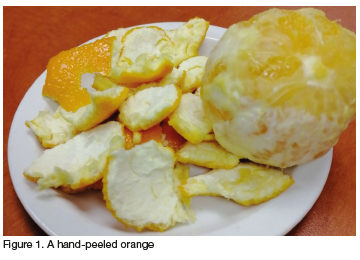
PEELING AN ORANGEThe objectives of peeling an orange are to remove the rind along with as much pith as possible, while at the same time preserving the structure and integrity of the delicate underlying fruit. The conventional hand peeling method has been carried out for centuries, and has remained in use due to its simplicity and reliance on basic skills and equipment (in this case hands). It does however require time, effort, a certain amount of manual dexterity, and follows steps that can vary with each person. It can be messy and may require the peeler to go back over sections to remove small residual remnants of rind or pith. The outcomes are generally satisfactory. However, the procedure also creates debris which differs in amount and size of rind pieces removed, seldom creates a smooth surface finish, and may not produce the most aesthetically pleasing peeled orange. The end result is largely dependant on the type and size of the orange, its condition at the beginning of the procedure and the operator's style and dexterity. It can be a laborious and time consuming process, leaving one to wonder if the effort justifies the outcome (Figure 1).
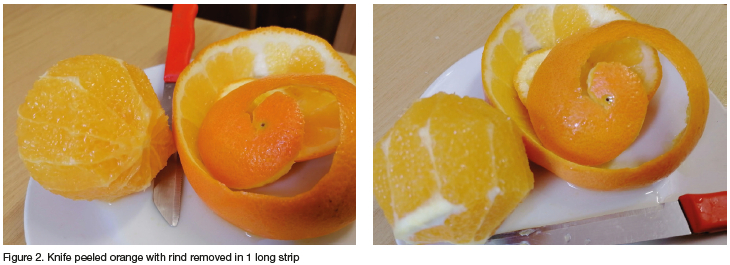
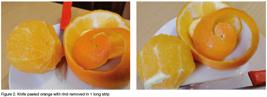
With time and improved technology, new equipment was introduced to the culinary market. Sharp knives were marketed as multi-purpose gadgets that claimed to save time, be easy to use, be clean and comfortable to work with, remove peels and pith efficiently, and generate less debris. They gained widespread use not only for peeling oranges, but also for a myriad of other domestic purposes. All knives had a basic design of handle and sharp cutting blade and were initially costly to purchase. The expense seemed justified as the procedure was relatively easy and effortless in comparison to hand peeling, didn't take much skill or practice to master, allowed the entire peel and pith to be cut off in a few strips that were easy to discard, and generally saved a lot of time (Figure 2). As their popularity grew so did technology and soon the markets were flooded with knives. The handles and blades came in different materials, colours, sizes and shapes, and were often "custom designed" for specific purposes. Knives looked set to become the "best-practice" orange peelers on the market and many people purchased them. Sadly, with time and use it became evident that the cutting process had certain drawbacks and some unwanted side effects. There was a lot of fluid spillage, many operators sustained finger injuries, they often cut too deeply into the fruit resulting in loss of the valuable fruit substance, and sometimes even damaged the underlying pulp. In addition, many of the early blades corroded from the acidic juices, and both the knife users and the fruit recipients began to complain and to even look for safer options that would also result in less damage.
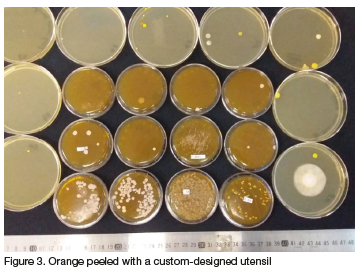
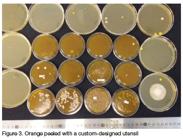
Some innovative thinkers devised a new gadget specifically for peeling oranges and certain other fruits. The idea was to create a utensil that was functional, efficient, corrosion resistant, durable, easy to clean, cheap to manufacture and affordable. The new synthetic gadget had some of the knives features such as a comfortable handle and a slick cutting tip, but did away with the potentially dangerous blade. It was marketed by the manufacturers who did countrywide road shows where they generally gave an introductory talk, a live demonstration, and a short hands-on training session for interested purchasers. Features included a hooked tip to score the fruit a predetermined depth, and to cut down along planned and equally spaced vertical lines, this ensured that all pieces of rind were similarly sized and evenly thick. The curved body portion hugged the contours of the fruit as it gently separated the peel away without causing any damage to the underlying fruit. It resulted in a neat smooth finish, minimal debris, and had an added bonus of vertical grooves along which the orange could be opened (Figure 3). Introductory packages often came at good prices with "additional extras" included to sweeten the deal. These gadgets did indeed serve their intended purpose and at a much reduced price. Results were good, predictable, and the damage and debris much less. However, they had their limitations being designed for only a few specific applications, and it was incumbent of the operator to know when and where to use it.
RELEVANCE TO DENTISTRY
The above scenarios may seem far removed from dentistry, and the reader will be forgiven for asking "What does this topic have to do with me and my practice? The answer to both those questions is "Probably a lot more than you think".
Go back and re-read the narratives, but this time view the orange as a tooth, and the peeling process akin to cutting a crown preparation, where the peel is the enamel, and the fruit is the dentine and pulp. Just as early orange peeling was a slow and laborious task, so too were many early dental procedures. Tooth preparations progressed from being cut with hand instruments to slow foot driven drills, to the super-fast high-speed air turbines and hand pieces in use today. Similarly, the drilling burs evolved in terms of material, strength, size, shape, and cutting efficiency. Nowadays, clinicians can chose form a wide variety of burs each suited to a specific purpose and stage of procedure. They also have a whole gamut of hand pieces, bur kits, dental materials, and adjunctive equipment as part of their daily armamentarium.
In a similar vein to the orange peeling analogy, dental manufacturers frequently present clinicians with new "cutting edge" materials, devices or technology. These usually come with great promise for bettering the status quo in their practices, and of putting them ahead of their colleagues in the market place. However before succumbing to the advertorial hype practitioners needs to take time and make an effort to do some basic investigating themselves. They should evaluate the new offering against the "gold standard" if one exists. This entails comparing it to "the benchmark" practice / product that is routinely used under reasonable conditions.12
Thus when clinicians are presented with any new product they need to critically evaluate the associated literature presented to them by the manufacturers or sales representatives, and ask a number of pertinent questions. This includes inquiring: If the product has been tested in a laboratory? Were tests standardised and carried out according to approved protocols? What were the results of the testing? Is it biologically safe for use in patients? Is it safe for use by clinicians? Were the trials company sponsored as this can lead to an element or researcher bias?3
Thereafter, if a practitioner decides to invest in the new product or to make any substantial changes in their routine work, they should proceed with caution. If they see that it is not performing as ideally as promised or anticipated they have a "duty to care" for their patients and to assess the situation in an unbiased manner. This may involve evaluation of the intervention as well as a degree of self- reflection to ensure that the shortcomings are not due to their own inadequacy or lack of training and skills. Thereafter they may need to report their observations to the manufacturers as well as to alert colleagues.
In medical research, Good Clinical Practice (GCP) guidelines have been established to protect patients' rights, and to ensure their safety throughout any clinical trial period, including scheduled follow up evaluation.54-6 This feedback may take place in informal discussions, in small working groups, via correspondence with manufacturers and regulatory bodies, or through publication in dental newsletters and journals. They should also stop using the new regime immediately regardless of how much they have invested in the initial outlay. It would be unethical to continue to use up stock or keep working with the equipment merely to justify its expense. Practitioners may also be afraid to make their observations public in case the manufacturers accuse them of slander. This fear may be allayed if they publish their findings as observations, and ask colleagues to report if they have had any similar experiences.7
CONCLUSION
Over the years many new products have come onto the dental market promising features such as superior strength, better bonding, reduced tooth sensitivity, enamel remineralisation, multi-purpose uses, easy manipulation, good taste, long shelf life, superior aesthetics, and a range of other desirable features. Some lived up to their promises, others were replaced by updated versions or different products, many ended up in the back of store rooms, or were completely discarded. The latter generally disappeared from sight and use, except perhaps for mention in materials textbooks, (which should be read with the awareness that they become rapidly dated). This paper highlights the need for clinicians to keep abreast of current trends and innovations in dentistry, to read trustworthy scientific literature, and to ensure that before they embark on any new treatment modality they are confident it has been through extensive trials, the results have been analysed with appropriate tests by independent investigators, and the reporting thereof is accurate, reliable, repeatable, sensitive, specific and clinically applicable."8
REFERENCES
- 1. Versi, E. "Gold standard" is it an appropriate term? BMJ. 1992:305(6846)"187
-
2. Cardosa RJR, Pereira LM, Iversen MD & Ramos AL. What is gold standard and what is ground truth? Dental Press J Orthod. 2014 Sep-Oct; 19(5): 27-30.doi: 10.1590/2176-9451.19.5.027-030.ebo
» https://doi.org/10.1590/2176-9451.19.5.027-030.ebo - 3. Edmonds WA, Kennedy TD. An Applied Guide to Research Designs: Quantitative, Qualitative, and Mixed Methods: Sage Publications; 2016.
- 4. Vijayananthan A, Nawawi O. The Importance of Good Clinical Practice Guidelines and its Role in Clinical Trials. Biomed Imaging Interv J. 2008;4(1):e5.
-
5. South African Good Clinical Practice: Clinical Trial Guidelines Pretoria, South Africa: Department of Health [Internet]. 2020 [3:[Available from: https://www.sahpra.org.za/clinical-trials/.
» https://www.sahpra.org.za/clinical-trials/ - 6. World Health O. Handbook for Good Clinical Research Practice (GCP): Guidance for Implementation. Geneva: World Health Organization; 2005.
- 7. Sykes LM,Evans WG & Doolabh R. How do they know what they know? Learning to be critical when reading scientific papers. SADJ: 2017:Vol 72: 8:
- 8. Bossuyt PM, Reitsma JB, Bruns DE, et al. Towards complete and accurate reporting of studies of diagnostic accuracy: the STARD initiative. Standards for Reporting of Diagnostic Accuracy. Clin Chem. 2003;49:1-6.

Authors contribution:
1. Leanne M Sykes: Primary author 90%;
2. Vinesh Bookhan : Second author 10%