Comparison of capsule-mixed versus hand-mixed glass ionomer cements. Part 1: compressive strength and surface hardness
Abstract
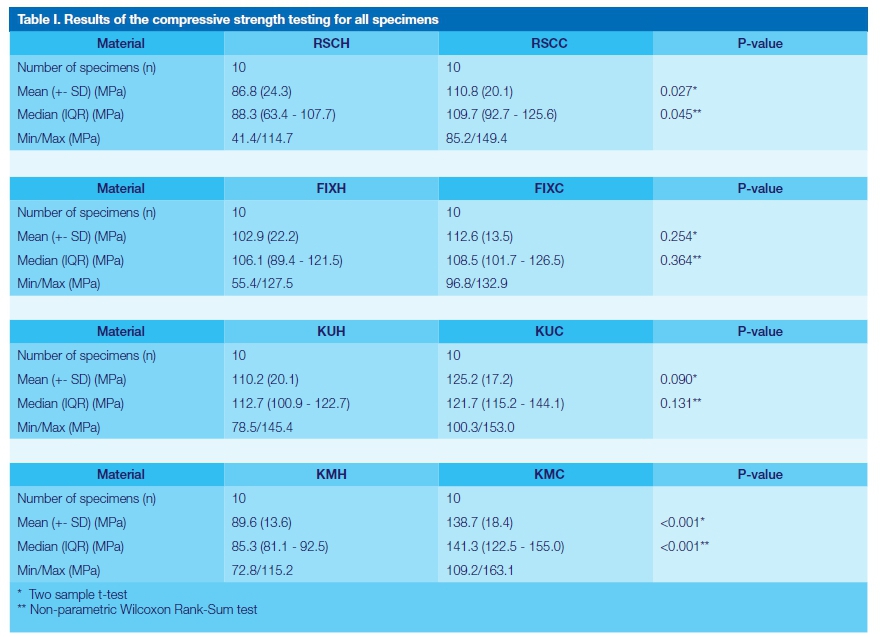
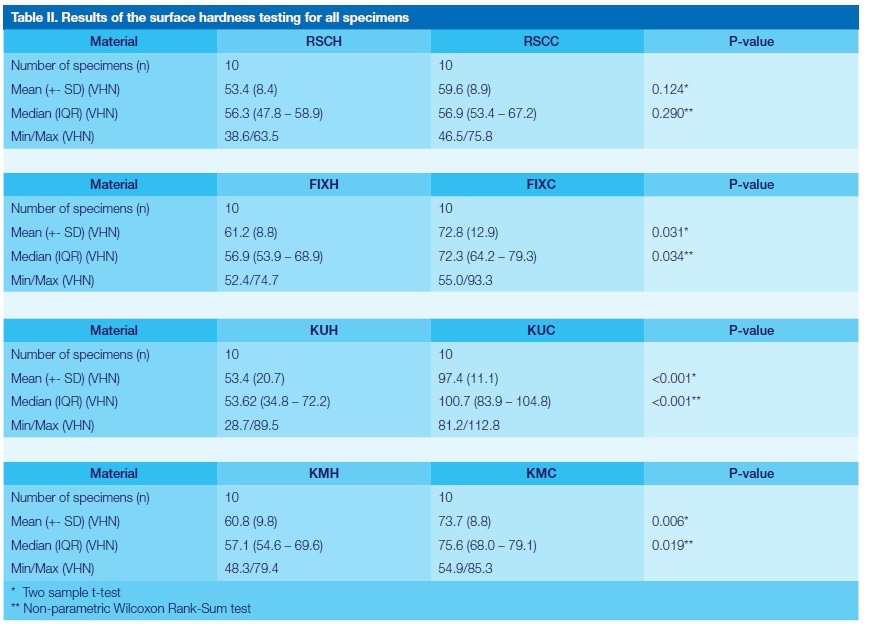
INTRODUCTION: Dental restorative glass ionomer cements (GIC) are available as hand-mixed or capsulated products. Capsulation facilitates uniform ratios of powder to liquid, that should result in an optimal end-product. If this is evident, the degree to which capsulated GIC are mechanically stronger will aid in deciding when to use them instead of the hand-mixed variety. OBJECTIVES: The compressive strength and surface hardness of hand-mixed GIC were compared to capsule-mixed equivalents. METHODS: Eighty samples were manufactured from hand-mixed GIC: Riva Self Cure; Fuji IX GP; Ketac Universal, Ketac Molar Easymix, and equivalent capsule-mixed GIC: Riva Self Cure; Fuji IX GP; Ketac Universal Aplicap and Ketac Molar Aplicap Compressive fracture strength was tested using a universal testing apparatus. Surface hardness was measured with a Vickers digital micro-hardness tester. RESULTS: Significant differences were found between the compressive strength of RSCH and RSCC (P = 0.027), and, between KMH and KMC (P < 0.001). Significant differences in surface hardness were found between FIXH and FIXC (P = 0.031), KUH and KUC (P < 0.001), as well as KMH and KMC (P = 0.006). CONCLUSION: Three capsulated forms of GIC (RSCC, KUC, KMC) demonstrated superior mechanical properties. Capsulated GIC offer advantages which may translate to clinical application.
Capsule-mix; Compressive strength; Glass ionomer cement; Hand-mix; Surface hardness