Prevalence and risk factors of missed appointment among paediatric patients after minor oral surgical procedures in a tertiary hospital in Southern Nigeria
Abstract
BACKGROUND: Missed appointments are common in paediatric dentistry, yet not many studies have explored its prevalence and associated factors AIM: To determine the prevalence of missed appointments and the associated factors METHODS: This prospective study design recruited all consecutive paediatric patients that presented for minor oral surgical procedures from 1st July 2020 to 30th June 2021. Data collected was the age of patients, gender, parents' educational level, distance from the clinic, type of minor oral surgical procedures and missed appointments. Descriptive and inferential statistics were performed. Chi-square test of association was used to determine the association between study participants' age, sex, parents' educational level, the distance from the clinic, and the prevalence of missed dental appointments. Binary logistic regression was used to determine the predictors. Data was analysed using the Statistical Package of Social Science (SPSS) version 26 (IBM, Chicago, IL, USA). A p-value of less than 0.05 was considered significant RESULT: A total of 182 paediatric dental patients, age ranged from 0.5 to 16 years and with a mean age of 8.55+3.88 participated. Most (60.4%) of the patients were females and 46.2% of them were of school age. Most of the parents had a tertiary level of education and lived within 7 to 12 kilometers from the clinic. The prevalence of missed appointments was 54.9% and the most performed minor oral surgical procedure was primary tooth extraction. The relationship between age group, minor surgical procedures with missed appointments was statistically significant (P<0.05). Binary logistic regression analysis revealed that the type of surgical procedure was the only independent predictor of missed appointments (p<0.05 CONCLUSION: The prevalence of missed appointments in this study is remarkably high. Although the age of the patients and the type of procedure was associated with the prevalence of missed appointment, it was only the type of surgical procedure that was a significant risk factor for missed appointment
Missed dental appointments; Minor oral surgical procedures; Pediatric dentistry; risk factor
INTRODUCTION
Contemporary management recommends that a child's first dental visit should take place within six months of the eruption of the first primary tooth but no later than 12 months of age.12
Missed appointments (MAs) are defined as appointments for which the patient did not show up, or did not call in to cancel or reschedule.345
Missed-appointment rates in the literature vary and could be as high as 80%.6789109,11,12 Socio-demographic factors associated with the MAs include sex and age.911,12 Detman and Gorzka,13
Though missed appointments have been well studied in other fields of medical specialties in Nigeria14,15,16,17,18 it appears no studies have been done in Paediatric dentistry. Thus, the present study was conducted with the objective to determine the prevalence of MAs over a period of 1 year at the Paediatric Dental Clinic of the University of Benin Teaching Hospital and also assess the factors associated with missed appointments. It is hoped that the findings in this study will aid the paediatric dentist and oral and maxillofacial surgeon to identify and educate parents/accompanying adults on the need to honour appointments for possible reinforcement of post-operative instructions.
MATERIAL AND METHODS
This prospective cross-sectional study was conducted at the Department of Pediatric Dentistry, University of Benin Teaching Hospital, Benin City, Nigeria. All consecutive patients that presented for treatment with minor surgical procedures were recruited from 1st July 2020 to 30th June 2021. Excluded from the study were patients undergoing non-surgical procedures, and those not willing to participate in the study. After the informed consent and the minor surgical procedures were performed, the parents/guardians were instructed to bring their children/wards to the hospital for check-ups which is the routine policy of our hospital. This instruction was emphasised at the post-operative instructions session. Data collected was the age of patients, gender, parents' educational level, and distance from clinic. Other data collected was the type of minor oral surgical procedure and missed appointment. Descriptive and inferential statistics were performed. Categorical data were summarised in percentages while continuous data was presented in range and means. Chisquare test of association was to determine association between study participants' age, sex, parents' educational level, distance from clinic, and prevalence of missed dental appointments. Binary logistic regression was used to determine the predictors. Data were analysed using the Statistical Package of Social Science (SPSS) version 26 (IBM, Chicago, IL, USA). P-value of less than 0.05 was considered significant.
RESULTS
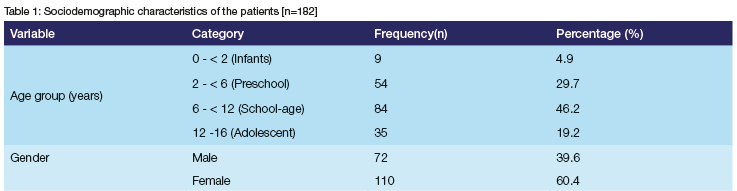
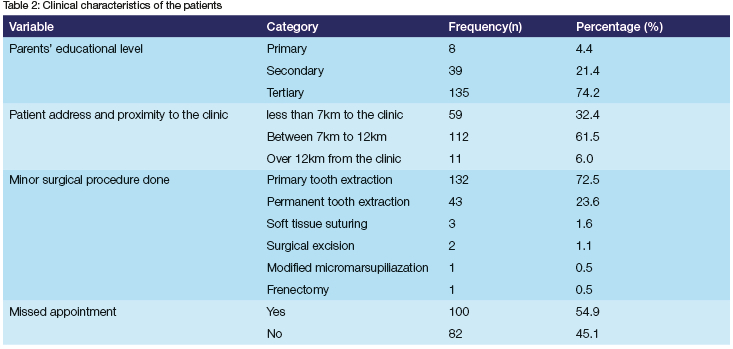
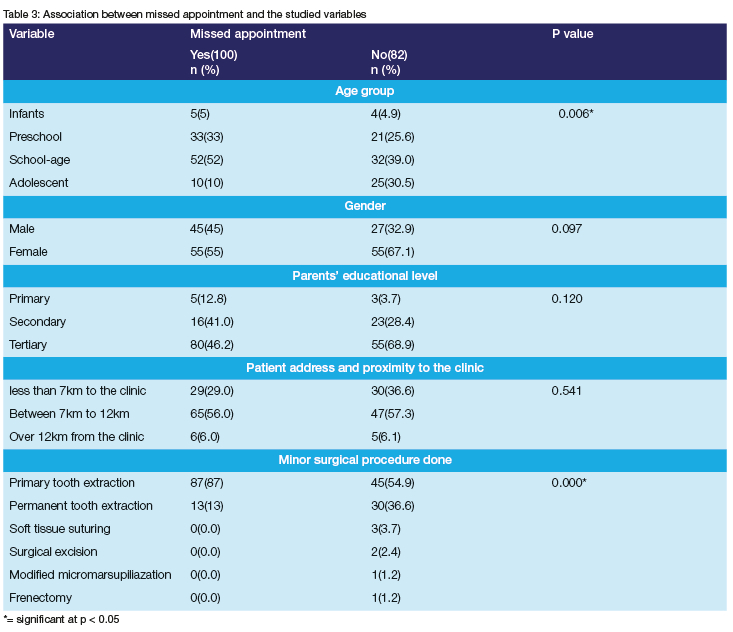
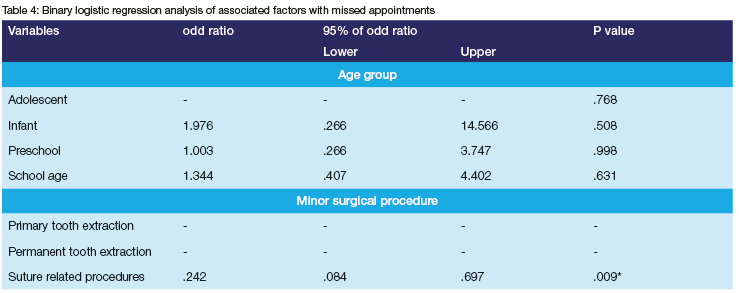
A total of 182 paediatric dental patients were seen in the period under review. The age range of the patients was from 0.5 to 16 years and with a mean age of 8.55+3.88. Table 1 shows the demographic characteristics of the study participants. Most (60.4%) of the patients were females and 46.2% of them were of school-age. Table 2 shows the clinical characteristics of the patients. The majority (74.2%) of the parents had a tertiary level of education while most (61.5%) of them reside at a distance of between 7km and 12km from the hospital. The prevalence of missed appointments was 54.9% and the most (72.5%) performed minor oral surgical procedure was primary tooth extraction. Table 3 shows the association between missed appointmentsand the studied variables. The age of the patients and the type of minor surgical procedures were significantly associated with the prevalence of missed appointments (P<0.05). Table 4 shows the binary logistic regression analysis of associated factors with MAs. The type of minor surgical procedures was the only variable that independently predicted the odd of missed appointment. [OR=0.242; 95%C.I = 0.08-0.70, P=0.009].
DISCUSSION
The prevalence and risk factors of oral minor surgical procedures among paediatric patients in a Nigerian tertiary hospital was prospectively studied. Missed appointment is a major public health burden for both the patients and the health providers as it affect the optimum treatment outcome and ultimately the patient's quality of life.
The prevalence of minor oral surgical procedures in this study was 54.9% and this was comparable to that reported by Bhatia et al,,319 9
There was as association between the age of the patients and the prevalence of missed appointments in the present study. However it fails to independently predict the risk of missed appointments when subjected to logistic regression analysis. This findings in our study agrees with that by Bhatia et al,,3923
The type of oral minor surgical procedure was the only factor that independently predicted MA among the covariates subjected to logistic regression in the present study. Some Nigerian authors have reported tooth extraction as the most common treatment procedure carried out in the paediatric dental clinic.24,25 The present study revealed that primary tooth extraction is the most performed paediatric minor surgical procedure and also accounts for the highest proportion of MA. The rationale behind the high proportion of MA in our study may be connected to the uneventful healing of the extraction sites following the extractions of primary teeth which are less invasive to that of the permanent teeth. It could also be due to the adherence to our post-operative instructions which would have helped to accelerate the healing of the extraction site. The paediatric minor surgical procedures in our study with absolutely no MAs included procedures that were suture related and it accounted as a predictive factor responsible for not missing an appointment. The reason for this finding could be due the presence of a foreign substance, like the suture material in the oral cavity, which must have propelled the patient to honour the appointment.
In this study, the limitation was that it only focused on patients that had only minor oral surgical procedures and there is need for further study to assess with all paediatric dental treatment procedures. Furthermore, the findings of this study should be interpreted with caution since it is a single centre study as there may be need for multicentre study in future.
CONCLUSION
The prevalence of missed appointments in this study is remarkably high. Although the age of the patients and the type of procedure was associated with prevalence of missed appointments, it was only the type of procedure that was a significant risk factor of missed appointment.
REFERENCES
- 1. Mileva SP, Kondeva VK. Age and reasons for the first dental visit. Folia Med (Plovdiv). 2010 ;52(4):56-61
- 2. American Academy of Pediatric Dentistry. Oral health policies. Pediatr Dent. 1999; 21:18-37.
- 3. Bhatia R, C Vora E, Panda A. Pediatric dental appointments no-show: rates and reasons. Int J Clin Pediatr Dent. 2018; 11:171-176
- 4. AlSadhan SA. Frequency of missed and cancelled appointments in King Saud University orthodontic clinic. King Saud. Univ J Dent Sci. 2013; 4:77-80.
- 5. Okolie PN, Saheeb BD, Obuekwe ON, Edetanlen EB. Effects of surgical trauma on peripheral white blood cell count following major oral and maxillofacial surgical procedures. Afr. J. Health Sci. 2022 35(5): 1-9.
- 6. Kheirkhah P, Feng Q, Travis LM et al,, Prevalence, predictors and economic consequences of no-shows. BMC Heal Serv Res. 2016; 16:13.
- 7. Aggarwal A, Davies J, Sullivan R. "Nudge" and the epidemic of missed appointments: Can behavioural policies provide a solution for missed appointments in the health service? J Health Organ Manag. 2016; 30: 558-564
- 8. Schweinberger MH, Roukis TS. Wound complications. Clin Podiatr Med Surg. 2009; 26:1-10
- 9. Prabhu A, Krishnakumar R, Bhushan S, Karthikeyan M. Prevalence and factors associated with missed appointments in pediatric dental office : A Retrospective Analysis. 2019;10(2):55-59.
- 10. Lalloo R MJ. Appointment attendance at a remote rural dental training facility in Australia. BMC Oral Health. 2013; 13:(36)1-8
- 11. Gallucci G, Swartz W HF. Impact of the wait for an initial appointment on the rate of kept appointments at a mental health center. Psychiatr Serv. 2005; 56:344-346.
- 12. Wigen TI, Skaret EWN. Dental avoidance behaviour in parent and child as risk indicators for caries in 5 year old children. Int J Paediatr Dent. 2009; 19:431-437.
- 13. Detman L, Gorzka P. A Study of Missed Appointments in a Florida. Public Heal Dep. 2015; 1(1):1-22.
- 14. Si A, Morakinyo O, Ao L, Bo J, Jo O. Prevalence and correlates of missed first appointments among outpatients at a psychiatric hospital in Nigeria. Ann Med Health Sci Res 2014; 4: 763-768
- 15. Omokanye SA, Adeleke IT, Adekanye AO, et al,, Missed appointment at specialist outpatient clinics : The Federal Medical Centre, Bida, Northern Nigeria experience. Int J Biol. Pharm Sci Arch 2021, 01: 133-144
- 16. Onyejaka N. Appointment failure among dental patients attending a government dental centre in Enugu, Nigeria. Pesquisa Brasileira em Odontopediatria e Clinica Integrada 2018, 18(1):e4004
- 17. Godpower CM, Salihu TT, Ibrahim A, et al,, Prevalence and predictors of clinic appointment non-adherence among adults with poorly controlled hypertension in a primary care setting. Ghana Med J 2021; 55(4): 248-256
- 18. Omorogbe OS, Orhue OK, Osayande E. Evaluation of patients' compliance to recall visits after tooth extraction at the Dental Centre, University of Benin Teaching Hospital (UBTH): A two-year retrospective study. Niger J Dent Res. 2022; 7:45-52.
- 19. Machado AT, Werneck MAF, Lucas SD, Abreu MH. Who did not appear? First dental visit absences in secondary care in a major Brazilian city: a cross-sectional study. Ciência & Saúde Coletiva. 2015; 20: 289-298
- 20. Paige L, Mansell W. To attend or not attend? A critical review of the factors impacting on initial appointment attendance from an approach-avoidance perspective. J Ment Heal. 2013; 22:72-82
- 21. AlKanderi A AH. Factors associated with failed dental appointments: a retrospective cross sectional study. J Dent Educ. 73(9):1118-1124.
- 22. Skaret E, Raadal M, Kvale G, Berg E. Missed and cancelled appointments among 12-18-year-olds in the Norwegian Public Dental Service. Eur J Oral Sci. 1998; 106:1006-1012.
- 23. Bos A, Hoogstraten J, Prahl-Andersen B. Failed appointments in an orthodontic clinic. Am J Orthod Dentofac Orthop. 2005; 127:355-357.
- 24. Ogordi PU, Ajimen S. Treatment and care trends at the paedodontics clinic of a teaching hospital. J Paediatr Dent Res Pract. 2021; 2:8-15.
- 25. Ashiwaju MO, Folayan MO, Sote EO. Pattern of tooth extraction in children attending tertiary health care centers in Nigeria: a prospective study. J Clin Pediatr Dent. 2011; 36:107-110
Dr PU Ogordi
Address: Paediatric Dentistry, Department of Preventive Dentistry, University of Benin, Benin City, Edo State, Nigeria.
Email: