Participants' preferred choice of practitioner for orofacial symptoms
Abstract
BACKGROUND: Patients seeking treatment from general medical practitioners (GP) may be unaware or ill-informed that dentists are the more appropriate professionals to manage their orofacial symptoms, being able to diagnose and treat, or, if deemed necessary, appropriately refer. AIMS: To: (1) determine from a group of patients (n = 37) their initial preference of health care provider, when seeking treatment for orofacial symptoms (2) establish their awareness of the appropriate proficiency of the dentist, and, (3) determine the referral pathway before patients attended the Tygerberg Oral Medicine Clinic. METHODS: A cross sectional study design; quantitative data was collected by a modified previously published Bell-questionnaire with closed-ended questions. RESULTS: 53.8% of patients preferred a dentist to attend to a mouth or jaw problem and 46.1%, a GP. When clinical scenarios were posed, all directly related to the scope of practice of the dental practitioner, it was of concern that 47.3% chose the GP and 52.67% chose the dentist. CONCLUSION: Patients initially chose the GP for many orofacial diseases, although they indicated at the Oral Medicine clinic that the dentist had the most relevant knowledge. Participants did not associate some of the orofacial symptoms with the training of dentists.
Orofacial symptoms; dentist; general medical practitioner (GP); proficiency; participant referral
INTRODUCTION
A common goal of the health care sector is to serve the public with the best possible care.123
Most patients who seek medical attention from their general medical practitioners (GP) for orofacial diseases are either unaware or ill-informed of the fact that the dentist is the more appropriate professional for treating the oral presentation of symptoms, with a subsequent referral if deemed necessary.455
Many oral conditions are tooth-related and many systemic conditions may have a dental dimension, as an influence or manifestation. Although qualified dentists successfully manage orofacial conditions, many patients first consult their GP's, who then refer them to a hospital or an ear-nose-and-throat specialist (ENT) instead of a dentist.6
The public often holds the view that dentists only fill cavities in teeth and provide dentures and that all other oral problems are the domain of a medical doctor.789
A dental consultation should include screening and treatment.101112
A study investigated current practices detecting lesions and referral of patients by general medical practitioners.6 6
Another study revealed that the clear-out majority of both GPs and dentists selected Oral Medicine and Oral and Maxillofacial Surgery as their preferred points of referral for participants with suspected oral cancer. It was also evident that dentists selected Oral Medicine Specialists (Periodontist) more often than Maxillofacial and Oral Surgery specialists as their preferred point of referral.13141314
A study aimed to determine participants' preference of medical or dental practitioners for a variety of dental and non-dental orofacial symptoms was conducted. It investigated' the perceptions of participants of the training, experience, and skills of medical and dental practitioners in treating orofacial symptoms.12 12
After reviewing the above literature, it was evident that patients were often not aware of the broad education of dentists and the wide scope of dental practice.129
RESEARCH AIM1. To determine the initial preferential choice of participants for health care providers to manage orofacial symptoms.
2. To establish the awareness of participants of the proficiency of the dentist for orofacial symptoms.
3. To determine the referral pathway followed by participants before attending the Tygerberg Oral Medicine Clinic at the Dental Faculty of the University of the Western Cape.
-
DEFINITION OF KEY TERMS
Proficiency
For purposes of this study, the meaning of clinical proficiency will denote the following: "a dentist who is competent in decision-making, clinical reasoning and judgement to develop a differential, provisional or definitive diagnosis by interpreting and correlating findings from the history, clinical and radiographic examination and other diagnostic tests, taking into account the social and cultural background of the individual. The dentist will also be competent to participate in the diagnosis and proper referral of the participant with life-threatening oral mucosal diseases".9
Patient
Term used in the literature denoting individuals receiving medical and/or dental treatment.
Participant
Individuals receiving treatment at the Tygerberg Oral Medicine Clinic and who partook in the study.
MATERIAL AND METHODS
Research design
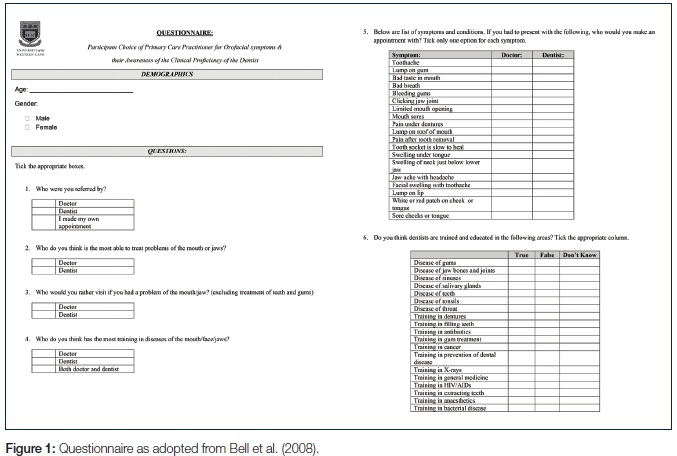
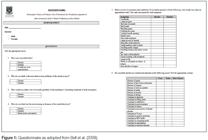
This was a cross sectional study design; quantitative data was collected through the use of a modified previously established and published Bell-questionnaire12Figure 1). The participants (n=37) were requested to answer various questions on their perception of the preference and ability regarding from which practitioner they would prefer receiving treatment (GP or dentist). Various orofacial disease scenarios were tabulated and the participant was requested to indicate whether they would visit the dentist or the GP. The last component was the participant perception of the knowledge that the dentist has regarding various orofacial and other non-dental scenarios. A 'don't know' option was provided, since dentistry has a wide scope of practice and the participant might not have had profound knowledge of all the non-dental training dentists receive.
Study population
The UWC Oral Medicine clinic treats 360 new participants on average each year and the final sample size for this study represented ±10% of the new participant pool. 55 randomly selected participants attending the Tygerberg Oral Medicine clinic were included in this study. There were eight participants referred by specialists (ENT and Dermatologists) and for this study, these questionnaires were excluded. Three participants were below 18 years of age and the responses from their parents were not accepted as representing the participants' perception and were therefore excluded. Seven questionnaires were rejected due to participants having two choices marked in lieu of one choice. The questionnaires were handed out to all 55 participants who were waiting in the reception area prior to their appointment. A total of 37 correctly completed questionnaires were accepted after the aforementioned exclusions. Data management and statistical analysis were executed with the use of Microsoft Excel.
RESULTS AND FINDINGS
Participant choice of primary practitioner for orofacial symptoms.
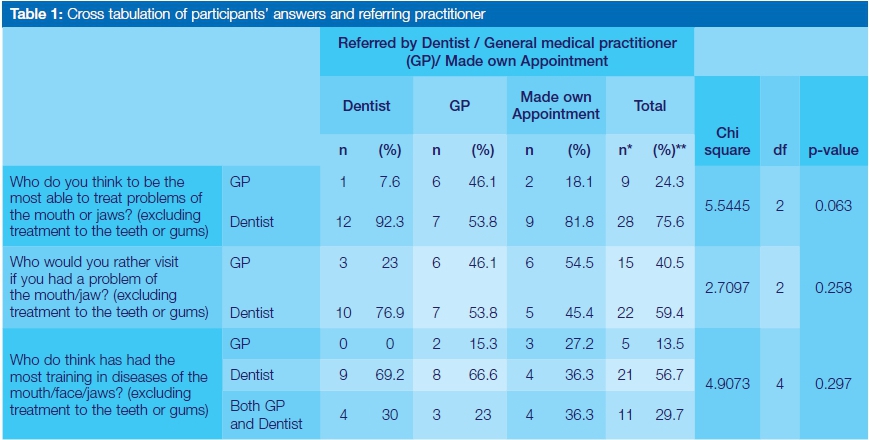
Cross tabulations of the results were made. The responses to the questions posed in the questionnaire were evaluated in a 2X3 contingency table with the Pearson Chi-square test and two degrees of freedom in order to obtain the p-value. A p<0.05 was considered significant. The questions evaluated in the 2x3 were: "Who do you think to be the most able to treat problems of the mouth or jaws?" and "Who would you rather visit if you had a problem of the mouth/jaw? (excluding treatment to the teeth or gums)". For the question "Who do you think has had the most training in diseases of the mouth/face/ jaws? (excluding treatment to the teeth or gums)", a 3X3 contingency table was used (Table 1).
For the tabulation of results in Tables 1 and 2, the hypothesis was tested on the probabilities of choosing the GP rather than the dentist, in the three referring categories (referred by dentist, GP or own appointment made). The p-value yielded by the Chi-square test was greater than 0.05 (0.063).
Regarding the estimated probability of choosing the dentist as "the most able" practitioner, the participants referred by dentists and those who made their own appointments, are more likely to select the dentist. The probability of choosing the dentist was 12/13=0.92 (Dentist referral); 7/13=0.54 (GP referral) and 9/11=0.82 (Own appointment made). Participants referred from their GP are less likely to choose the dentist as "the most able practitioner".
Table 1 outlines a cross tabulation of the participant's responses and their referring practitioner. 53.8 % of patients indicated that they would rather visit a dentist if they had a mouth or jaw problem and 46.1% said they would rather visit a GP. The p-value of 0.258 indicated that there is no significant difference between choosing the medical practitioner over the dentist (for participants who were referred from the GP).
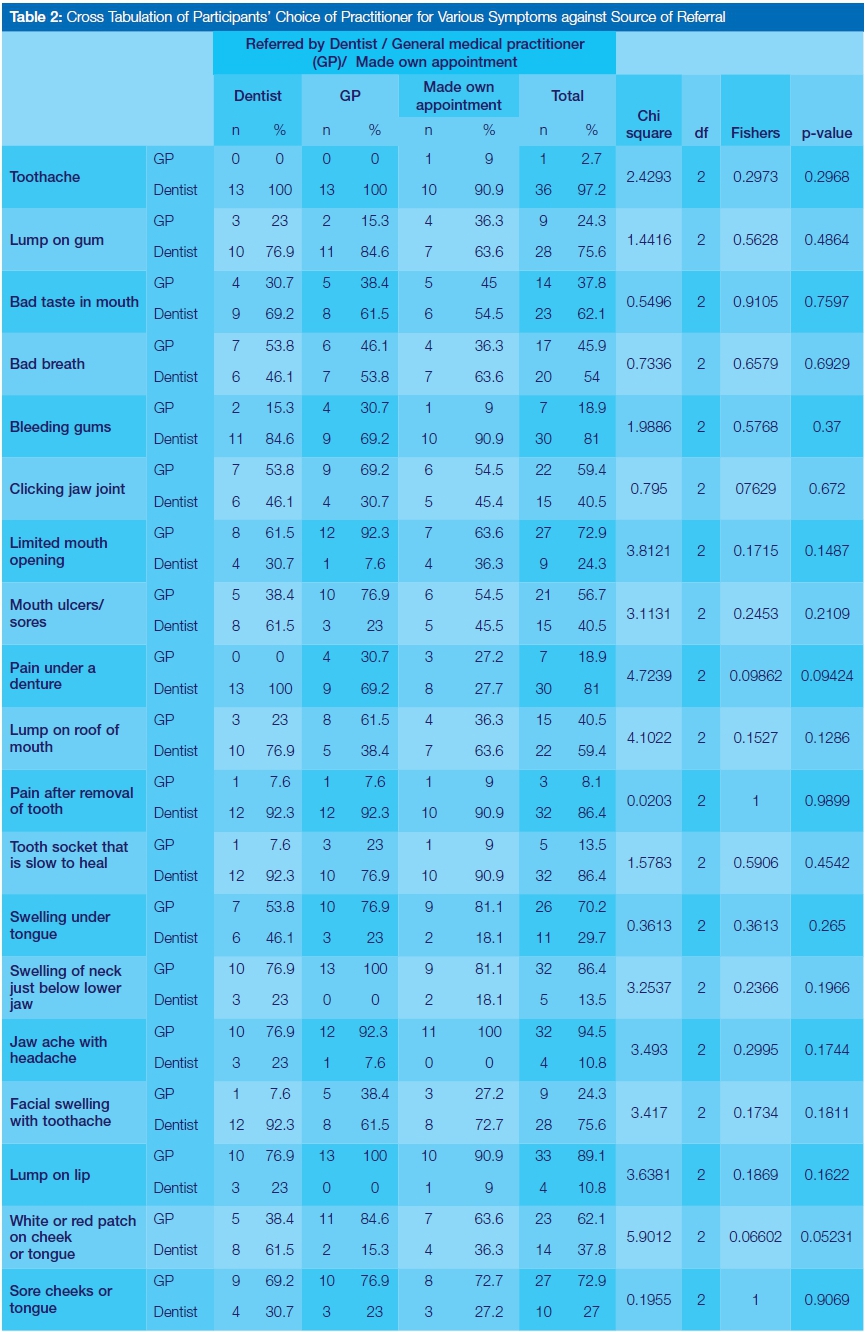
Participants were presented with a variety of orofacial symptoms and were asked who they would consult for these symptoms (Table 2). In most cases, for the obvious dental problems (such as toothache, lump on gum, bad taste in the mouth, bad breath, bleeding gums, pain under dentures, complications of tooth removal and toothache associated with facial swelling) participants chose to consult their dentist. For other orofacial symptoms, and symptoms that included extraoral involvement (such as clicking jaw joints, limited mouth opening, mouth ulcers, tongue swellings, neck swellings, jaw ache with headaches, lump on lip), participants chose to consult their GP. This can be linked to the likelihood that participants consider all these problems to fall out of the scope of dentistry.
However, Table 2 indicated a lack of consistency between the choice of primary care practitioner for the orofacial symptoms listed. The results for the observations as per Table 2 were done in 3X2 contingency tables. The Pearson Chi-square was determined for every question asked (e.g. lump on gum, bad breath, etc.). These results were verified by the Fisher exact test as the frequencies were small and obtaining a p-value from Chi-square might have been inaccurate. The Fisher exact test resulted in the same conclusion as the Chi-square values.
Table 2 represented results that indicated a lack of significant difference between the choice of practitioner and referral source. The p-value obtained from Chi-square above 0.05 confirmed the result. If a dentist referred a participant, the participant is more likely to select the dentist as the treating practitioner. The same trend exists for participants referred from GPs.
Participant awareness of the proficiency of the dentist
With regard to participants that chose their medical doctor as the primary practitioner it was important to note that 53.8% of participants thought that the dentist is most able to treat problems of the mouth or jaws (Table 1). 66.6% of participants regarded dentists as having the most training in diseases of the mouth, face or jaws and 23% of these participants agreed that both the doctor and dentist have training in diseases of the mouth, face or jaws (Table 1).
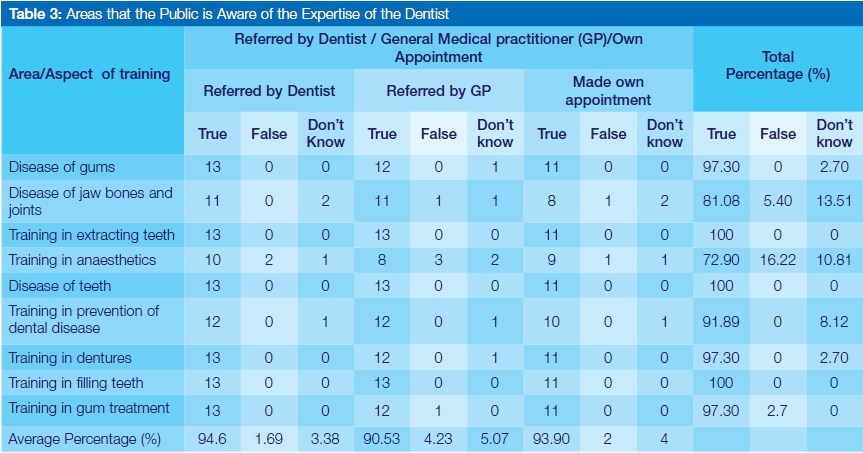
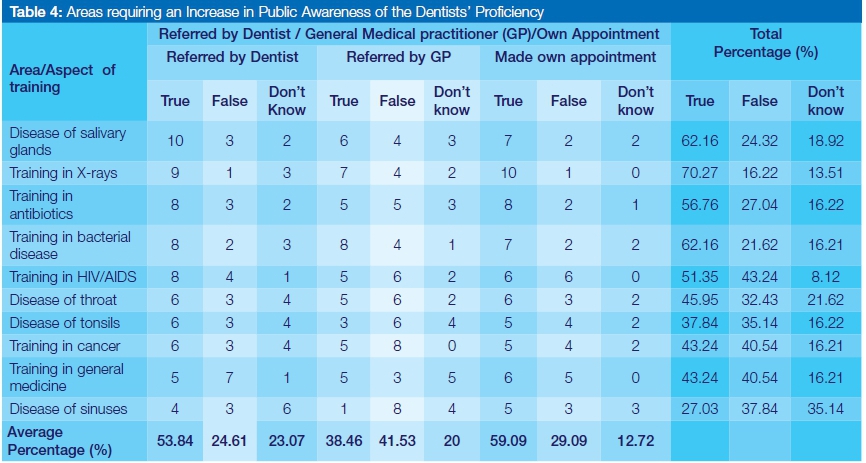
The participants' awareness of the proficiency of the dentist was determined by investigating their knowledge regarding the training dentists underwent to understand various diseases and procedures (Table 3 and 4). When referring to Table 3, participants had consensus that the dentist had education in diseases of the gums, jaw bones and joints; training in extracting teeth; training in anaesthetics; diseases of teeth, training in prevention of dental disease; training in dentures; training in filling teeth and training in gum treatment. The results were consistent for all the participants irrespective of whether they made their own appointments or referred from the dentist or medical practitioner. A large percentage (90.53%) of participants referred from the medical practitioner confirmed that they thought the dentist had the most training in those conditions, yet from Table 1, 46.1% of participants would still rather visit their medical practitioner if they had a problem related to the mouth/jaw/face.
Table 4 lists areas of training where the participants were uncertain of the expertise of the dentist. There was no consensus of the results indicating a misperception and/ or uncertainty of the proficiency of the dental practitioner. Notably, of the total participants, only 51.35% and 43.24% were aware of the training dentists have in HIV/AIDS and cancer, respectively. The percentage of participants indicating that they "do not know" and "false", indicates that the scope of practice of dental practitioners requires more attention regarding education and information provided to participants.
The referral pathway of participants attending the Tygerberg Oral Medicine clinic
The results showed that 35.1% of participants attending the Tygerberg Oral Medicine Clinic were referred from their medical practitioner and that 35.1% were referred from their dentist. 29.7% of participants had made their own appointment. From the initial study population of 55 participants, eight participants were referred by specialists (ENT and Dermatologists). Although these questionnaires were excluded from the final sample size, the significance of the referral source remains. Clearly defined referral pathways for all health professionals have shown a reduction in delay of diagnosis and definitive treatment.
DISCUSSION
In this study, an equal percentage of participants were referred from their medical doctor (35.1%) and their dentist (35.1%) to the UWC Oral Medicine Clinic at Tygerberg. Irrespective of the referral source, the participants still thought the dentist was the most able to treat problems of the mouth and jaws (53.8%). In terms of questions posed in Table 1, the trend was that participants referred by the dentist were more likely to choose the dentist as the preferred practitioner (92.3%; 76.9% and 69.2%). The same trend exists for those participants who were referred from their doctor and those that made their own appointment, but to a lesser degree than the dentist referrals. This can indicate a possible relationship between the referral source and accessibility, as participants referred from their GP may have found it easier to make an appointment with their doctor, as there may also be a doctor patient trust relationship already present. Nevertheless, patient preference of their primary pracitioner for orofacial symptoms and who they thought were most able to treat orofacial problems is largely dependent on their perception of the dentist.12,15 There is a perception that dentists only "perform routine extractions and fillings".71516
Table 2 presented clinical scenarios and the participants' perception of which practitioner they would prefer to visit. The following scenarios and the participants' choice of GP or dentist being very similar is concerning (GP/ Dentist: Bad breath 45.9/54; clicking of the jaw 59.4/40.5: mouth ulcers/sores 56.7/40.5 and lump on the roof of the mouth 40.5/59.4). These data indicate that participants were aware of the capabilities of the dentist to treat problems related to the teeth and gums. However, their choice of primary practitioner for orofacial problems of non-dental origin is not clearly established as being either the GP or the dentist. These results obtained from the individual scenarios (Table 2) regarding the choices made is relevant considering that overall 75.6% of these participants indicated in that the dentist was most able to treat problems of the mouth and jaw (excluding the teeth and gums) versus the GP (Table 1). This could mean that the patient is not aware of the full scope of practice of a dental practitioner or that patients do have more faith in the ability of GPs over dental practitioners.12
The more obvious scenarios like toothache (2.7/97.2); bleeding gums (18.9/81); pain under a denture (18.9/81); pain after tooth removal (8.1/86.4); tooth socket not healing (13.5/86.4) and facial swelling with toothache (24.3/75.6) were predominantly chosen with the dentist as the treating practitioner. The possibility that the public still views dentists as only filling cavities and extracting teeth,7
When all the percentages of the various clinical scenarios from Table 2 are calculated, it becomes apparent that 47.3% chose the medical practitioner and 52.67% chose the dentist as the treating practitioner. This is concerning considering that the clinical scenarios depicted in Table 2 are all directly related to the scope of practice for the dental practitioner.
One of the most likely encounters with oral lesions is that of oral ulcers. A randomized study determined where members of the Israeli public may seek advice on mouth ulcers.4Table 2). These results clearly indicate the lack of participant awareness regarding dentists having significantly more training and knowledge regarding the diagnosis and management of mouth ulcers than most medical or pharmaceutical practitioners.4
The participants' awareness of the proficiency of the dentist was determined by investigating their knowledge regarding the training dentists underwent to understand various diseases and procedures (Table 3 and 4).
Most participants were aware of the teaching offered in managing the common tasks of the dentist such as training in filling teeth (100%), training in dentures (97.3%), training in gum treatment (97.3%) and training in extracting teeth (100%). However, only a minor proportion of participants were aware of the training dentists have in HIV/AIDS (51.35%) and cancer (43.24%).
Participants were unaware of the extent of dental training. These extended areas included: diseases of the sinuses, salivary glands, throat, tonsils, antibiotics, cancer, x-rays, general medicine, HIV/AIDS and bacterial disease. Similarly, in a study carried out by Scully et al., patients failed to regard dentists as being trained in general medicine, cancer and HIV/AIDS.1710
59.4% of participants chose to consult a GP for a clicking jaw joint; however, 81.08% of participants agreed that dentists received adequate training in diseases of the jaw bones and joints. Participants lacked the ability to understand and associate some of the orofacial symptoms with their concepts of the training of the dentist. The possibility that the public still views dentists as only filling cavities and extracting teeth,7
Participant awareness and education regarding the capabilities of their dentist needs to be created to ensure better access to oral healthcare. Many participants were unaware of the proficiency in diagnosing and managing orofacial diseases of even a newly qualified dentist.9 106,18 The delay to detect and definitively treat pre-malignant and cancer lesions can have a negative effect on the presenting symptoms of the oral condition.19
Emphasizing the impact of collaboration between the medical and dental professions will greatly improve both oral and systemic health. Participants with medical conditions such as HIV/AIDS, diabetes, rheumatoid arthritis and Sjogren's syndrome, to highlight a few, would benefit from such collaboration.1813
It is important to start at the fundamental level of university to allow for integration of modules and learning.181218
CONCLUSION
Participants at the Tygerberg Oral Medicine Clinic, who despite being referred from their GP, agreed that the dentist is more capable in treating orofacial symptoms. They perceived dentists to be well trained in obvious dental problems such as toothache, bleeding gums, extractions, and fillings. However, for non-dental problems or problems that manifested extra- and peri-orally such as jaw pain, neck swellings and lumps on the lips, participants indicated GPs to be better trained.
The participant choice of primary practitioner for orofacial symptoms is influenced by their awareness and perception of the proficiency of the dentist and in turn this affects their referral pathway.
It can be concluded that participants are unaware of the fact that the dentist is proficient in diagnosing and managing orofacial diseases as well as identifying oral manifestations of systemic disease. The idea that the expertise of the dentist is limited to extracting and filling teeth needs to be transformed to include diagnosing and treating orofacial disease.
LIMITATIONS OF THE STUDYLimitations of the study included the fact that the specialist Oral Medicine clinic at Tygerberg OHC treats a relatively small number of new patients compared with the undiagnosed disease burden. Language barriers may have limited the study due to incorrect completed questionnaires in English only and some limited assistance in Afrikaans. The socio-economic status could limit the comprehension in understanding some terms, despite participants being English speaking and there was a possibility that the information was misinterpreted. The sample bias of patients also may have limited the study, as the patients were influenced by the fact that they had appointments at the Oral Medicine clinic. Age (>25 yrs vs < 25 yrs) and gender subgroups (Females vs Males) analyses were not recorded, since the sample size was too small to draw from the comparisons between referral sources.
CONCLUDING REMARKS AND RECOMENDATIONS
The limitations do not diminish the rationale that public awareness about the scope, skills, training and therapies available from trained dentists should be promoted. Improved patient education regarding the proficiencies of the dentist is required. This should be cultivated and taught by dentists and other health care workers in practice. This research provides a pragmatic baseline for future research. This topic should be researched further with a larger sample size and in a more neutral setting.
ETHICAL CONSIDERATIONSThe study population included participants attending the Tygerberg Oral Medicine clinic at the UWC Dental Faculty. No incentives were offered for participation. Ethical consideration for the research study was obtained from the Dental Research Committee of the University of the Western Cape.
The anonymity of all participants was ensured by allocated record numbers and written informed consent was obtained prior to their participation in the survey. An information sheet and consent form was distributed to the participants providing a brief background and reason for the study. The results obtained from the study will be used for educational and research purposes only.
Conflict of Interest: None declared.
ACRONYMSGP: General Medical Practitioner
References
- 1. Formicola AJ, Stavisky J, Lewy R. Cultural Competency: Dentistry and Medicine, Learning from one another. Journal of Dental Education 2003; 67(8): 869-75.
- 2. Adams T. Dentistry and Medical dominance. Social Science and Medicine 1999; 48(1): 407- 20.
- 3. Lavigne SE. Your mouth - portal to your body. Canadian Jounral of Dental Hygiene 2004; 38(3): 114-34.
- 4. Gill Y, Scully C. Mouth ulcers: a study of where members of the general publlic might seek advice. British Dental Journal 2007; 202(E16): 1-3.
- 5. Mansour MH, Cox SC. Participants presenting to the general practitioner with pain of dental origin. Medical Journal of Australia 2006; 185(2); 64-7.
- 6. Macpherson LM, McCann MF, Gibson J, Binnie VI, Stephen KW. The role of primary healthcare professionals in oral cancer prevention and detection. British Dental Journal 2003; 195(5): 278-81.
- 7. McCann PJ, Sweeney MP, Gibbson J, Bagg J. Training in oral disease, diagnosis and treatment for medical students and doctors in the United Kingdom. British Journal of Oral and Maxillofacial Surgery 2005; 43(1): 61-4.
-
8. HPCSA [Internet]. Regulations defining the scope of the profession of dentistry - Government Gazette 31958; [updated 2009 Mar 6; accessed 2016 Nov 15]. Available from: http://www.hpcsa.co.za/uploads/editor/UserFiles/REGULATIONS%20DEFINING%20THE% 20SCOPE%20 OF%20THE%20PROFESSION%20OF%20DENTISTRY.pdf
» http://www.hpcsa.co.za/uploads/editor/UserFiles/REGULATIONS%20DEFINING%20THE% 20SCOPE%20 OF%20THE%20PROFESSION%20OF%20DENTISTRY.pdf - 9. Plasschaert AJ, Holbrook WP, Delap E, Martinez C, Walmsley AD. Profile and competences for the European Dentist. European Journal of Dental Education 2005; 9(1): 98-107.
- 10. McLeod NM, Saeed NR, Ali EA. Oral Cancer: Delays in referral and diagnosis persist. British Dental Journal 2005; 198(11): 681-4.
- 11. Angela C, Neville BW, Krayer JW, Gonsalves WC. Oral manifestations of systemic disease. American Family Physician 2010; 82(11); 1381-8.
- 12. Bell GW, Smith GL, Rodgers JM, Flynn RW, Malone CH. Participant choice of primary care practitioner for orofacial symptoms. British Dental Journal 2008; 204(12): 669-73.
- 13. Carter LM, Ogden GR. Oral cancer awareness of general medical and general dental practitioners. British Dental Journal 2007; 203(10); 1-5.
- 14. Schmidt-Westhausen AM, Bornstein MM. Oral Medicine: Interdisciplinary collaboration between medicine and dentistry. Springer Medizin Verlag 2011; 1-9.
- 15. Liu M. The Dentist / Participant Relationship: The Role of Dental Anxiety. [Thesis] Claremont McKenna College; 2011.
- 16. Eitner S, Wichmann M, Paulsen A, Holst S. Dental anxiety - an epidemiological study on its clinical correlation and effects on oral health. Journal of Oral Rehabilitation 2006; 33(1); 588-93.
- 17. Scully C, Bell C, Porter K, Porter S. Views of dental participants about the education and practice of dentists. Community Dentistry and Oral Epidemiology 1994; 22(1): 112-3.
- 18. Migliorati CA, Madrid C. The interface between oral and systemic health: the need for more collaboration. Clinical Microbiology and Infection 2007; 13(4): 11-6.
- 19. Van Heerden WFP, van Zyl AW. The role of the dentist in the early detection of oral cancer.South African Dental Journal 2011, 66(8): S1- S4.
Suvarna Indermun
Department of Oral Medicine and Periodontics, Faculty of Dentistry
University of the Western Cape
Private Bag X1, Tygerberg, 7505 South Africa
Cell: 082 789 0672
E-mail: