The psychosocial effect of the COVID-19 national lockdown on Dentistry and Oral Hygiene students
Abstract
INTRODUCTION: The COVID-19 lockdown has had a psychological and social impact on dental students globally. AIM: To determine the psychosocial effect on students enrolled in dentistry and oral hygiene courses at UWC. OBJECTIVES: To determine the psychosocial effects (living conditions, levels of anxiety, fear of COVID-19, and food security levels) experienced by students during the lockdown. DESIGN: A descriptive, cross-sectional study using a quantitative approach was used. METHODS: A randomised sample (n=250), stratified by sex and academic year group, comprising undergraduate oral hygiene BOH total students = 90 and dentistry BDS total students = 450 (UWC, 2020) was used. Data was gathered via an online survey, (Google Forms). Survey questions included the GAD-7, FCV-19S questionnaire, and Food Security scales. RESULTS: The data were analysed using Epi Info 7. The response rate was 36% (n=90); 69.67% were female; the mean age was 22.34 (SD = 2.66); 91% lived with their parents during lockdown. Students' main sources of funding were parents (47%), NSFAS or bursary (42%) and self-funded (11%). Substantial psychosocial effects with high anxiety (33%), fear of COVID-19 (47.3 %), and a lesser effect for food insecurity (FI) (5.49%) was reported. CONCLUSIONS: The study showed that the COVID-19 pandemic has contributed to psychosocial effects in a discipline that under 'normal" conditions is experienced as stressful. This requires educational institutions to develop a targeted approach through relevant support systems that would identify vulnerable students at critical times.
COVID-19 lockdown; anxiety; fear of COVID-19; food insecurity; dental students; oral health, hygiene students; psychosocial factors
INTRODUCTION
The COVID-19 pandemic resulted in an immediate lockdown for an extended period for universities globally, followed by intermittent access as levels of lockdown fluctuated. In South Africa, the lockdown was initiated in March 2020, with students' return to campuses scaffolded as per the levels of lockdown imposed at a national level. The resultant disruption in academic activities has reportedly impacted living conditions, academic performance, food security, and the mental health of students,1-6 resulting in increased anxiety and psychological distress.1,4,6,7 Psychosocial factors affecting students are multifaceted even under "normal pre-COVID conditions". Dimensions of these factors range from socio-economic, environmental to psychological factors.8
Psychological distress is particularly evident in students in the health sciences including medical, dental, and oral hygiene students during their academic and professional years.9-12 Experiences in dental education are reportedly more stressful than in medical education.910,12 A systematic review of stress among dental students reported that stress is mainly due to the demanding nature of the training and that elevated stress may have adverse effects on the health and well-being of students.1113
COVID-19 related studies regarding dental students found differences across different contexts with high levels of anxiety reported by Hakami et al.914et al and Khanagar and Alfadley.15 1611
Compromised food security is increasingly becoming a feature contributing to student anxiety among university students. 17,18 In recognition of economic challenges that may inhibit university access, the South African government implemented a structural support program for poor students by establishing the National Student Financial Aid Scheme (NSFAS). This initiative saw a fivefold increase in student loans between 1995 and 2005.1919 1,5
It is within this constantly shifting landscape that teachers engage students in online learning environments characterised by a marked variation in technological access, parental support, and academic expectations.20
METHODS
Study design: This was a descriptive, cross-sectional study using a quantitative approach.
Study population and sample: A randomised sample (n=250), stratified by sex and academic year group was selected, comprising undergraduate oral hygiene BOH total students = 90 and dentistry BDS total students = 450 enrolled at UWC in 2020. Randomisation, by means of a computer-based randomised generator, and using class lists as a sampling frame was done to increase the power of the study and to limit selection bias. Students were grouped into junior (BOH1, BOH2, BDS1, BDS2) and senior (BOH3, BDS3, BDS4, BDS5) based on their clinical exposure at the time of the study. Junior students were deemed as preclinical and senior students as clinical.
Inclusion criteria: All undergraduate students registered in the BDS and BOH programmes in 2020 were included in this study.
Materials: In September 2020 the data were gathered by employing an online survey, using Google Forms. The questionnaire consisted primarily of closed-ended questions with several open-ended questions that allowed for elaboration on closed-ended questions posed.
Variables measured: These included student demographic information such as age, gender, place of residence, living conditions, and experiences of psychosocial stress. Living conditions, including experiences of food insecurity, were recorded on a validated, 10-item food security scale.21 21
1. Fear of Coronavirus-19 scale (FCV-19S), a valid tool for assessing fear of COVID-19.22
2. Generalized Anxiety Disorder 7-item (GAD-7) scale,23
3. Food insecurity was measured using two different food insecurity measures, namely: A single-question measure, adapted by Hughes et al (2011) (for university students from the Australian National Nutrition Survey), and a more sensitive 10-item food security scale (a multi-question measure) from the United States Department of Agriculture Community Food Security Assessment Toolkit, adapted by Hughes et al (2011) for university students.21
Respondents were classified as:
• food insecure if they answered "yes" question1 in the food security questionnaire.
• having low food security, or being food insecure "without hunger", if they answered "often true" or "sometimes true" to statements 2-4 in the food security questionnaire.
• having low food security, or being food insecure "without hunger", if they answered "sometimes not enough to eat" or "often not enough to eat" in response to statement 5 in the food security questionnaire.
• being very food insecure, or being food insecure "with hunger", if they answered "yes" to any of the questions 6-9 in the food security questionnaire.
Data was exported to Microsoft Excel 2019 and then statistical analysis was done by using Epi Info 7. Statistical analysis included using students' t-tests to compare the means of different groups in the sample to determine a statistically significant difference. Chi-square and Kruskal-Wallis tests were used to test for associations.
Ethical statement
An electronic link was emailed to selected students to enable them to access the online questionnaire accompanied by an information sheet explaining the purpose of the study, the voluntary nature thereof, anonymity and confidentiality, and their right to withdraw at any time without negative consequences. Information with relevant contact details about psychological support and food security assistance for students was included. Three reminders were sent out and students could only complete the questionnaire once. The study protocol was registered with the Biomedical Research and Ethics Committee (BM 20/8/1) of the University of the Western Cape.
RESULTS
Student demographics
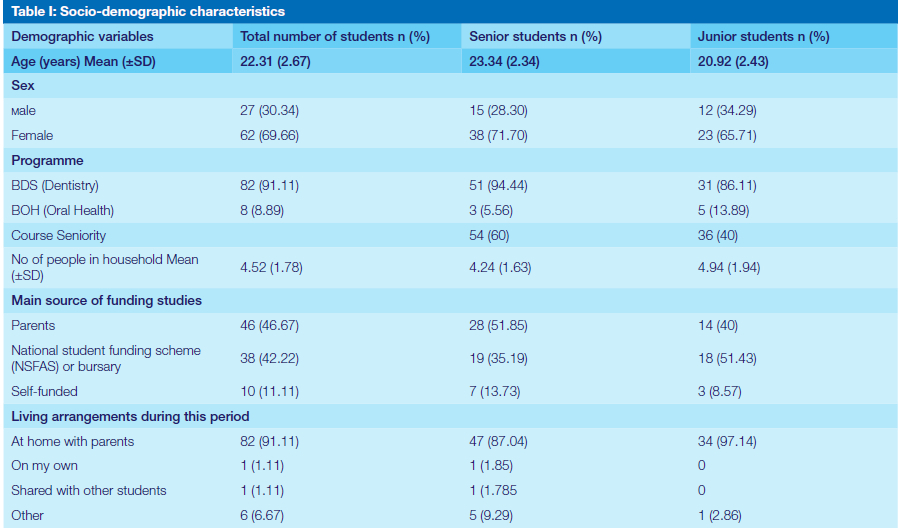
The response rate was 36% (n=90) with the majority (69.67%) (n = 62) of participants being female with a mean age of 22.34 years. Students were grouped into junior (pre-clinical) and senior (clinical) years (Table 1). The majority (65%) of participants were staying in the Western Cape province at the time when the national lockdown was implemented and almost all (91%) stayed at their homes with parents or family members (Table I). The tables illustrate examples of the questions and responses of the different scales.
Living conditions
Students could identify more than one source of support during the COVID-19 pandemic. Parents were reportedly the main source of support to most students (n=85), followed by friends (n=72), other students (n=47), and social media (n=36). More than half (59.3%) reported having duties besides their studies which included household chores, family commitments, community support, and some had part-time employment. From the findings in Table I, NSFAS was the main source of funding in the junior years whereas parents were the main source of funding in the senior years. Self-funding increased from the junior to senior years.
Almost three-quarters of students (73.3%) indicated that they were able to keep up with their studies with the remainder responding negatively to this question. On the question of having sufficient money for study and living expenses and their capacity to cope, 46% had enough money and coped very well, half (50.5%) had just enough money for study and living expenses and coped fairly well, and 3.3% did not have enough money and did not cope.
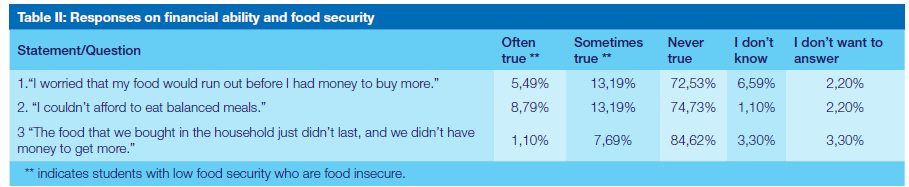
Participants' response to statements related to food security during the COVID-19 lockdown is summarised in Table II below. 5% of participants indicated that there were times that they ran out of food and could not afford to buy any more food during the COVID-19 lockdown (Question 1). Almost 20% were worried that their food would run out before they had money to buy more and almost a quarter (22%) could not afford to eat a balanced meal.
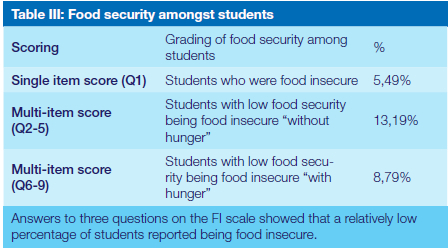
Respondents were classified as having low food security, or being food insecure "without hunger", if they answered "often true" or "sometimes true" to any of the statements in Table II (Table II illustrates 3 of the 10 items in the scale and presents an overview of the 10-item scale). An analysis of levels of food security among students is summarized in Table III.
Fear of Coronavirus-19 Scale (FCV-19S)
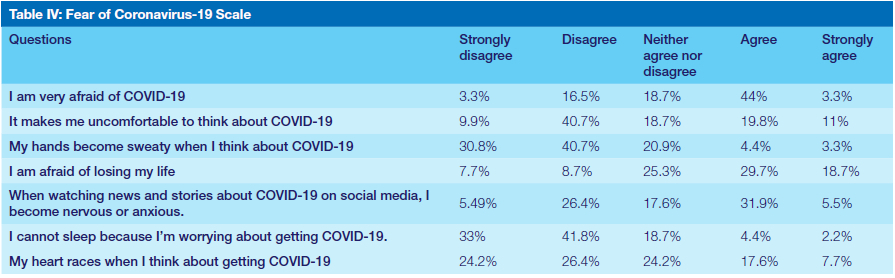
Table IV shows student responses to 7 questions of the Fear of Coronavirus-19 scale.

The results showed a fear of the disease and fear of loss of life due to the disease by a substantial number of students. Nearly half (47%) were very afraid of COVID-19. Approximately 30% felt uncomfortable when thinking about COVID-19. Almost half (48.4%) were afraid of losing their life because of COVID-19, while around 37% indicated that they became nervous or anxious when watching news and stories about COVID-19. Roughly 25% agreed that their heart was racing when thinking about getting COVID-19.
There were no significant differences between sex, study year or program and fear of COVID-19.Females and oral hygiene students scored higher than male and dental students in their fear of COVID-19 but the results were not statistically significant.
Generalized Anxiety Disorder 7-item (GAD-7) scale
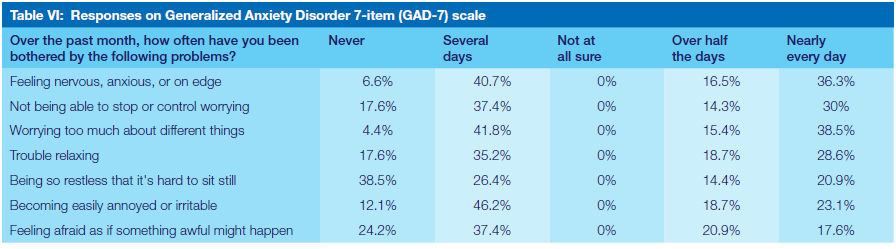
Students completed questions dealing with general anxiety disorder on a 7-item scale instrument. Table VI reports on 7 questions from the GAD-7 scale. More than a third (36.3%-38.5%) of students reported experiencing nervousness or feeling on edge and worrying too much nearly every day. Between 20% and 30% report not being able to control worrying, having trouble relaxing, being so restless that it was hard to sit still and becoming easily annoyed nearly every day. Just under 20% reported feeling as if something awful might happen almost every day. Based on the questions on feelings of anxiety, 19% of the sample indicated that they had no difficulty at all doing their work, taking care of things at home, or getting along with other people. Almost half reported that they found it somewhat difficult, 20% found it very difficult and 12%, extremely difficult.
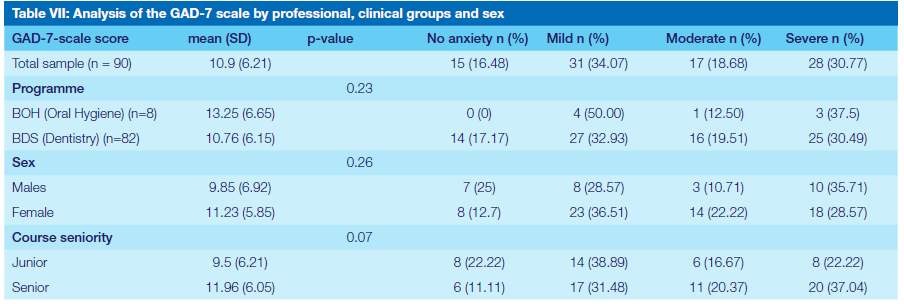
No statistically significant differences in the GAD score were found by professional groups (0.23), clinical groups (0.07) or sex (0.26). However, mild to severe anxiety was experienced by 100% of the oral hygiene students, whereas 82.93% of dental students scored in that range. Females' mean scores (11.23) were higher than males' mean scores (9.85). More senior students (88,89%) scored mild to severe anxiety compared to junior students (77,78%).
Nearly a third (31.87%) of the study sample found it very difficult and extremely difficult to do their work, take care of things at home, or get along with other people.
DISCUSSION
Research on the physiological and psychological reactions to the pandemic suggests that various psychosocial vulnerability factors may play a role, including individual difference variables such as the intolerance of uncertainty, perceived vulnerability to disease, anxiety, and food insecurity.2424
Findings from a previous study on UWC oral hygiene (BOH) students found that factors associated with financial difficulties and lack of basic needs were additional stressors for first-year students.12
A study conducted in Saudi Arabia to assess the psychological impact of the pandemic on dental students found that female students, students who lived alone, and students in the beginning years of dental college were more likely to experience mental health issues.925251
The almost instantaneous closure of Universities resulted in emergency remote teaching (ERT). ERT offers rapidly developed temporary instructional support in a crisis without pre-planned resources or infrastructure.20
Social capital, embedded in the relationships that develop at an individual or group level contributes to personal and interpersonal resources.26
The levels of food insecurity experienced by participants in this study were substantially lower than reported in international studies2,17 and South African literature.17172 198
While the present study found that 47% of students were afraid of Covid-19, a study by de Souza et al.277,9,10,12,28 In a study by Majeed et al.13
Approximately 33% of the sample in the present study indicated that they experienced severe anxiety, while 50% experienced a moderate level of anxiety. These findings are consistent with a study conducted in Saudi Arabia on the psychological impact of the COVID-19 pandemic on dental students by Hakami et al.9u found high (26.54%) and very high (24.26%) levels of anxiety among Romanian dental students which is consistent with the findings of our study. Cao et al.11528
Higher anxiety was recorded in senior students in our study, possibly due to being in the clinical setting as opposed to junior students who had online teaching. Hakami et al.9
The experiences of stress and anxiety in students in this study is a matter of concern, considering that these professions are inherently stressful.11111125
CONCLUSION
Results of this study indicated that the COVID-19 national lockdown affected dentistry and oral hygiene students in terms of anxiety. Students reported significant experiences of stress, yet most were able to cope with their studies. Living with parents or at home did not appear to be as much a protective factor as reported in the literature. However, living at home or with parents did appear to contribute to student resilience in coping with their studies. The study further showed that the COVID-19 pandemic has added to psychosocial effects in a discipline that under 'normal" conditions is experienced as stressful. Given that various psychosocial vulnerabilities contribute to the students' anxiety and stress, the authors are cautioned to make assumptions and conclusions regarding isolating the impact of COVID-19 on the psychosocial effect of dental students. It is however clear that the COVID-19 impact on dental education highlights the importance of holistic student support that embeds the mental health and well-being of the students.
Recommendations
Students in this study appeared to cope with their studies despite experiencing substantial stress and anxiety, possibly due to their resilience and support structures. However, these effects may have long term effects on their well-being. The multiplicity of stressors such as financial concerns, food insecurity, psychological stressors, and unsuitable study environment highlights the need for support by parents, fellow students, academic staff, and the university. Considering the inherent stressors of the professions in this study, we recommend that skills to empower students for the challenges of their professional training be embedded in the curriculum and that these be targeted to the specific challenges that students face over their academic program. Such an initiative, provided by suitably trained professionals may enrich the curriculum and encourage holistic development of graduates able to manage stressors associated with the professions. This requires educational institutions to develop a targeted approach through relevant support systems that would identify vulnerable students at critical times of their study.
Limitations of the study
The fact that the sample for this study only represents one university's dental students restricts the generalisation of the results. The small sample of oral hygiene (BOH) students who responded to the study may also have skewed the results for oral hygiene students in the study.
Addendum A
The term "Lockdown" refers to the National Lockdown gazetted by the National Government implemented from the 26th March and applies to all levels (Gazette 43168 of 26 March 2020).
REFERENCES
-
1. Cao W, Fang Z, Hou G, Han M, Xu X, Dong J. The psychological impact of the COVID-19 epidemic on college students in China. Psychiatry Res. 2020 May; 287:112934. doi: 10.1016/j.psychres.2020.112934. Epub 2020 Mar 20.
» https://doi.org/10.1016/j.psychres.2020.112934 - 2. Defeyter G, Stretesky P, Long M, Furey S, Reynolds C, Dodds A, et al. Food Insecurity and Lived Experience of Students (FILES). 2020; London, UK: Parliament.
-
3. Elmer T, Mepham K, Stadtfeld C. Students under lockdown: Comparisons of students' social networks and mental health before and during the COVID-19 crisis in Switzerland. 2020; PLoS ONE 15(7): e0236337. https://doi.org/10.1371/journal.pone.0236337
» https://doi.org/10.1371/journal.pone.0236337 -
4. Li Y, Wang Y, Jiang J, Valdimarsdóttir UA, Fall K, Fang F, Song H, et al. Psychological distress among health professional students during the COVID-19 outbreak. DOI: https://doi.org/10.1017/S0033291720001555 Published online by Cambridge University Press: 11 May 2020
» https://doi.org/10.1017/S0033291720001555 -
5. Kontoangelos K, Economou M, Papageorgiou C. Mental Health Effects of COVID-19 Pandemia: A Review of Clinical and Psychological Traits. Review Article. Psychiatry Investigation. 2020;17(6):491-505. Published online: June 15, 2020 DOI: https://doi.org/10.30773/pi.2020.0161
» https://doi.org/10.30773/pi.2020.0161 -
6. Odriozola-González P, Planchuelo-Gómez A, JesúsIrurtia M, Luis-García R. Psychological effects of the COVID-19 outbreak and lockdown among students and workers of a Spanish university. Psychiatry Research; 2020 Aug;290: 113108. https://doi.org/10.1016/j.psychres.2020.113108
» https://doi.org/10.1016/j.psychres.2020.113108 -
7. Akinkugbe AA, Garcia DT, Smith CS, Brickhouse TH, Mosavel M. A descriptive pilot study of the immediate impacts of COVID-19 on dental and dental hygiene students' readiness and 7wellness. Journal of Dental Education. 2021; 85(3):401-410. https://doi.org/10.1002/jdd.12456
» https://doi.org/10.1002/jdd.12456 - 8. Zyl-Schalekamp CV, Mthombeni P. Social-background factors affecting the academic success of first-year sociology students at the University of Johannesburg, South Africa. Journal of Sociology and Social Anthropology. 2015 Jan 1;6(1):31-44.
-
9. Hakami Z, Khanagar SB, Vishwanathaiah S, Hakami A, Bokhari AM, Jabali AH, et al. Psychological impact of the coronavirus disease 2019 (COVID-19) pandemic on dental students: A nationwide study. Journal of Dental Education. 2021;85(4):494-503. https://doi.org/10.1002/jdd.12470\
» https://doi.org/10.1002/jdd.12470\ - 10. Wilson VJ, Rayner CA, Gordon NA, Shaikh AB, Crombie K, Yasin-Harnekar S. Perceived stress among dental students at the University of the Western Cape. South African Dental Journal. 2015 Jul 1;70(6):255-9.
- 11. Elani, H. W., Allison, P. J., Kumar, R. A., Mancini, L., Lambrou, A., & Bedos, C. (2014). A systematic review of stress in dental students. Journal of dental education, 78(2), 226-242.
- 12. Gordon NA, Rayner CA, Wilson VJ, Crombie K, Shaikh AB, Yasin-Harnekar S. Perceived stressors of oral hygiene students in the dental environment. African Journal of Health Professions Education. 2016;8(1):20-4.
- 13. Majeed MM, Salim Z, Shaikh AH, Ramzan Z, Bhatia MR, Rafique S. A comparative study to evaluate COVID-19 related anxiety and fear among medical doctors and dental surgeons. Ethiopian Medical Journal. 2020; 59(2).
-
14. Iosif L, Tâncu AMC, Didilescu AC, Imre M, G"albinas, u BM, Ilinca, R. Self-Perceived Impact of COVID-19 Pandemic by Dental Students in Bucharest. Int. J. Environ. Res. Public Health. 2021;18; 5249. https://doi.org/10.3390/ijerph18105249
» https://doi.org/10.3390/ijerph18105249 - 15. Khanagar SB, Alfadley A. Psychological Impact of the COVID-19 Pandemic on Dental Interns in Riyadh, Saudi Arabia: A Cross-sectional Survey. Int J Clin Pediatr Dent. 2020;13(5):508-512.
-
16. Wang C, Zhao H. The Impact of COVID-19 on Anxiety in Chinese University Students. Front. Psychol. 22 May 2020. | https://doi.org/10.3389/fpsyg.2020.01168
» https://doi.org/10.3389/fpsyg.2020.01168 - 17. Van der Berg L, Ruebenheimer J. Food security among students at the University of the Free State, South Africa, S Afr J Clin Nutr. 2015;28(4):160-169.
- 18. Bruening M, Argo K, Payne-Sturges D, Laska M. The struggle is real: A systematic review of food insecurity on post-secondary campuses. J. Acad. Nutr. Diet. 2017;117:1767-1791.
- 19. Firfirey N, Carolissen R. 'I keep myself clean... at least when you see me, you don't know I am poor': student experiences of poverty in South African higher education. South African Journal of Higher Education. 2010 Jan 1;24(6):987-1002.
- 20. Whittle C, Tiwari S, Yan S, Williams J. Emergency remote teaching environment: a conceptual framework for responsive online teaching in crises. Information and Learning Sciences. 2020 Jun 29.
- 21. Hughes R, Serebryanikova I, Donaldson K, Leveritt M. Student food insecurity: the skeleton in the university closet. Nutr Diet. 2011;68(1):27-32.
- 22. Ahorsu DK, Lin CY, Imani V, Saffari M, Griffiths MD, Pakpour A H. The Fear of COVID-19 Scale: Development and Initial Validation. International Journal of Mental Health and Addiction. 2020; 1-9JE
- 23. Mossman SA, Luft MJ, Schroeder HK, Varney ST, Fleck DE, Barzman DH, et al. The Generalized Anxiety Disorder 7-item (GAD-7) scale in adolescents with generalized anxiety disorder: signal detection and validation. Ann Clin Psychiatry. 2017 Nov;29(4):227-234A.
- 24. Fawaz M, Samaha A. E-learning: Depression, anxiety, and stress symptomatology among Lebanese university students during COVID-19 quarantine. In Nursing forum 2021 Jan (Vol. 56, No. 1, pp. 52-57).
- 25. Chaturvedi K, Vishwakarma DK, Singh N. COVID-19 and its impact on education, social life and mental health of students: A survey. Children and youth services review. 2021 Feb 1;121:105866
- 26. Mazzoni E, Iannone M. From high school to university: Impact of social networking sites on social capital in the transitions of emerging adults. British Journal of Educational Technology. 2014 Mar;45(2):303-15.
- 27. de Souza SL, Laureano IC, Cavalcanti AL. Estão os estudantes de odontologia com medo do Coronavirus? Um estudo piloto utilizando a escala de medo da COVID-19. Revista de Ciências Médicas e Biológicas. 2021 May 5;20(1):28-32.
-
28. Lingawi HS, Ibtesam K. Afifi IK. COVID-19 Associated Stress Among Dental Students. The Open Dentistry Journal. 2020; 14:554-562. DOI:10.2174/1874210602014010554
» https://doi.org/10.2174/1874210602014010554
Author contributions:
1 . Reneda Basson: 25%
2 . Dirk Smit: 25%
3 . Ronel D Maart: 25%
4 . Natalie Gordon: 25%