Teething symptoms and management during infancy - A narrative review
Abstract
Even though teething is a normal part of infant development, surprisingly, little is known about the causes and management of its signs and symptoms. Due to the paucity of knowledge in this area, the purpose of this review was to provide clarity on teething symptoms and management options. A PRISMA flow chart revealed 13 studies that were reviewed which reported on teething symptoms and signs as well as treatment and management options. The databases searched were EMBASE, Medline, PubMed, Google Scholar and the Cochrane Library. The review showed that although conventional and generic treatment options are constantly in use, there remains no concrete evidence to prove signs and symptoms of teething nor evidence to disprove it. However, in this review, symptoms such as irritability, increased salivation, runny nose, loss of appetite, diarrhoea, rash, sleep disturbance and gum rubbing were most apparent. Further studies are needed to ascertain these findings objectively and conclusively. Future research is also required to understand and investigate the efficacy of treatment methods and approaches among children with teething symptoms.
Teething; infancy; symptoms; treatment; review
BACKGROUND
The effect of teething on infant health has been debated for at least 5000 years, and traditional beliefs on the issue have still not been entirely supported by scientific literature.1
It is widely believed that pain and other discomfort associated with tooth eruption among infants should and can be managed by pharmacological and non-pharmacological means, but this has yet to be proven.2 3,4
Teething disturbances are transient but may recur repeatedly during 4 to 36 months of age. Evidence regarding teething signs and symptoms are mostly subjective comments from parents, childcare workers and/or health professionals.2,5-12
Generally, studies on teething have been small, retrospective, descriptive and cross-sectional in nature. Studies of larger cohorts132 14-18
Examples of these alternate causes are well documented in the literature,19-24 and include meningitis, bacterial infections, and herpes simplex virus infections. The latter are painful in their own right.20-23
Teething disturbances may also be caused by development changes, including the decline of maternal antibodies,25-27 while wakefulness and night crying may be due to separation anxiety from a parent or attention seeking.
AIMEven though teething is a normal part of infant development, surprisingly, little is known about the causes and management of its signs and symptoms. Due to the paucity of knowledge in this area, the purpose of this review was to provide clarity on teething symptoms and management options.
METHODS
A systematic review was conducted according to the Preferred Reporting Items for Systematic Reviews and Meta-Analyses (PRISMA) guidelines.28
Data Sources and searches
While this was not intended to be a formal systematic review, a search strategy was used to identify the relevant literature. The databases searched were EMBASE, Medline, PubMed, Google Scholar and the Cochrane Library with the keyword search of "teething", "teething symptoms", "teething signs", "teething management", "teething treatment", and "teething children".
A preliminary scoping exercise was undertaken. It indicated that the studies available were too heterogeneous to permit a systematic review or meta-analysis of the interventions developed to tackle the number of children who presented with teething symptoms, eruptions or extractions. Therefore, a narrative review of the literature over a 20-year period (1999-2019) was conducted.
Studies were selected that considered child patients only (as teething symptoms mainly occur between six months and three years of age), had a defined intervention and methodology of patients who presented with varied teething symptoms, a treatment measure, management option or a measured outcome.
The titles and/or abstracts were reviewed to exclude any clearly irrelevant studies. The full texts of the remaining studies were then retrieved and read in full independently to determine whether the studies met the inclusion criteria or not.
Inclusion criteria
In the search, both primary sources and systematic reviews were prioritised as these synthesise the evidence and are at the top of the evidence-based literature as well as studies from the local context. As a second strategy, key scholars from the literature review and institutions were identified, and searched for their recent critical publications, as well as new authors citing them, and which references they had used.
Data extraction and synthesis
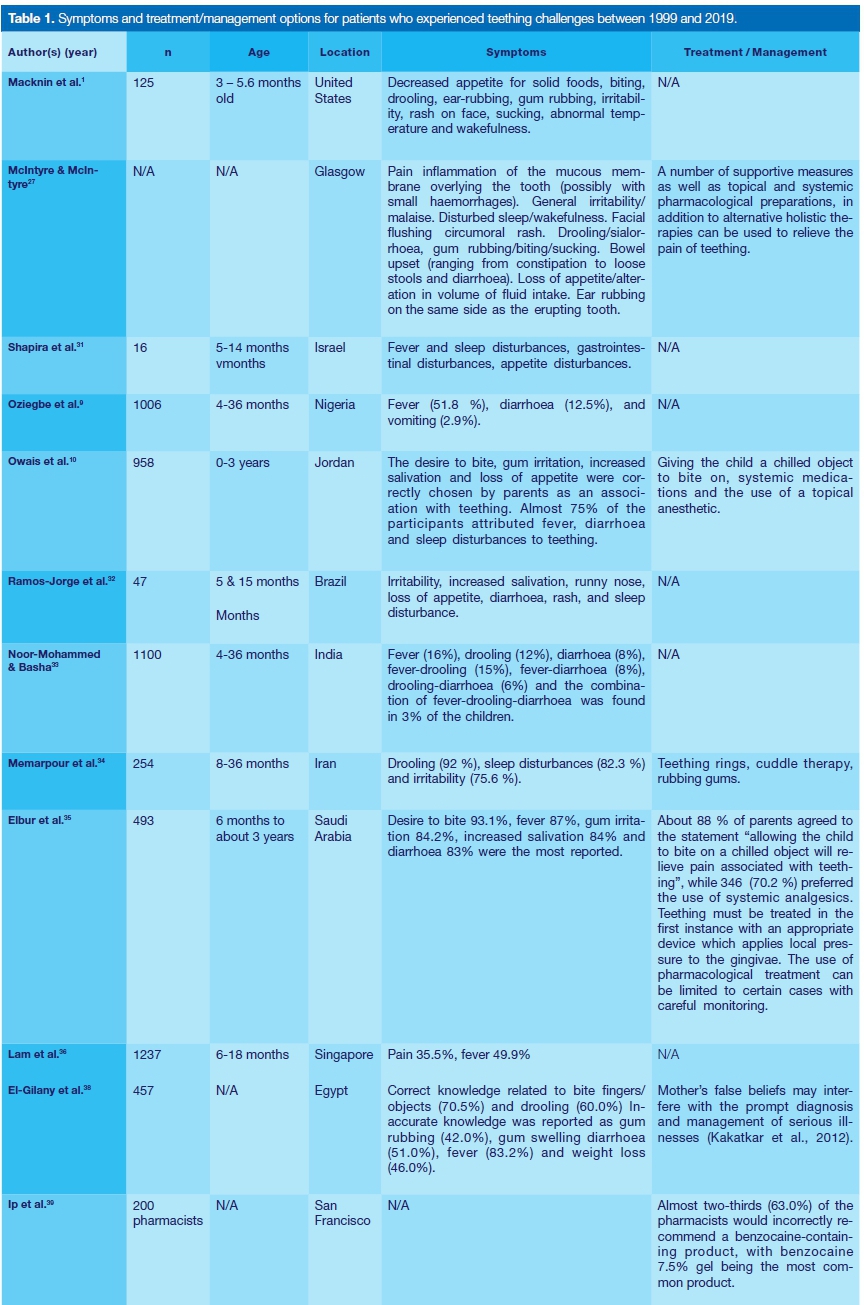
Using a standardised data extraction sheet, the following information (if available) was extracted and recorded from studies: authors and year of publication; sample size of participants; age or age range; location; symptoms and management or treatment options.
Quality assessment
The PRISMA guidelines were used to examine the quality of the studies. These include adequacy of study design; recruitment of sample; and findings. The quality of the studies was not summarised with a score, as this approach has been criticized for allocating equal weight to different aspects of metho-dology,2930
RESULTS
Study selection
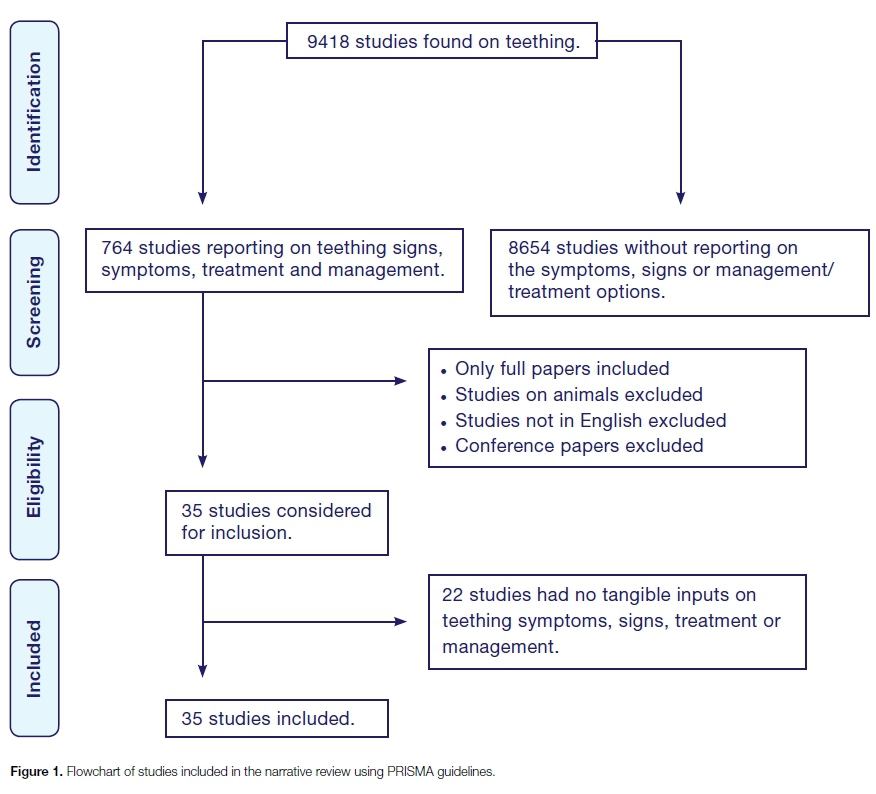
The flowchart is shown in Figure 1 for the study selection of which the literature search resulted in 9418 studies. After a review of their titles and abstracts, 764 studies met the inclusion criteria and were retrieved for full text reading.
Of these, 751 studies were excluded from the narrative review as they no longer met the inclusion criteria. A total of 13 studies were included in the review, and the extracted data are summarized in Table 1.
DISCUSSION
This narrative review investigated the available evidence about primary tooth eruption and local and systemic signs and symptoms, along with treatment and management options.
Signs and symptoms
It is now generally accepted that the eruption of the deciduous teeth is accompanied by a number of relatively minor symptoms (Table 1).27Table 1).27
In 2009, Oziegbe et al.,9
A total of 765 mothers (75.5%) reported systemic signs and symptoms in their children. Fever (51.8%), diarrhoea (12.5%), and vomiting (2.9%) were the most prevalent symptoms and signs reported after eruption. However, there was no association between teething and symptoms such as fever or diarrhoea.9
In another study, most of the children had one or more signs and symptoms during tooth eruption.34
These symptoms were more pronounced in low birth weight children.3434
Interestingly, in Singapore, significant early-life factors affecting the child's susceptibility to teething-related pain and fever were commonly reported among infants.36 via Caesarean section and infants that had elevated levels of prenatal plasma vitamin D.36
Much of the information gathered about teething is based on subjective parental information. According to Shapira et al.,3131
During the same period, a correlation was observed between high levels of IL-8 and gastrointestinal disturbances. High levels of Tumour Necrosis Factor (TNF) were also correlated with fever and sleep disturbances. The Gingival Crevicular Fluid (GCF) cytokines were correlated to some of the clinical symptoms of teething. IL-1ß and TNF are correlated with fever and sleep disturbances, IL-1ß and IL-8 with gastrointestinal disturbances, and IL-1ß with appetite disturbances.31
Their physiological or pathophysiological basis is not in doubt, butwhat they lead to in terms of discomfort is poorly understood. Partially, this is due to the confusion between the signs and symptoms. Symptoms are what a patient experience, but children getting their first few teeth can only communicate these through signs and signals that their caregivers can interpret.
An association has also been shown between general objective signs (drooling, fever, and diarrhoea) and the eruption of primary teeth with fever being the most prevalent sign followed by drooling and a fever-drooling combination.3333 33
Another study had results that demonstrated associations between teething and sleep disturbance, increased salivation, rash, runny nose, diarrhoea, loss of appetite, irritability, and a slight rise in temperature.32
The findings of this study contribute towards supporting the concept that teething is not associated with severe signs and symptoms. Therefore, health professionals involved in the care of infants should seek other causes before attributing severe signs and symptoms to teething.32
Based on the current limited evidence by Massignan et al.,37
For body temperature analyses, it was possible to evaluate that eruption of primary teeth is associated with a rise in temperature, but it was not characterized as fever. There are also results which showed a wide gap in knowledge and misconceptions with regards to the ascribed signs and symptoms and practices used to manage infant teething problems.35
Treatment and management options
Aside from teething signs and symptoms, there has been a number of recommended options suggested for management and treatment.
El-Gilany et al.,38
Relatives, friends and health care workers were the most frequent source of mothers' information about teething problems and their treatments. Deciduous tooth eruption has already been inaccurately associated with several health disorders, such as sleep disruption, ear and cheek itching, primary herpetic gingivostoma-titis, cough, croup, bronchitis, diarrhoea, fever, convulsions and (in severe cases) even death.
Objectively, Memarpour et al.,34
Teething rings and rubbing the gums reduced gingival irritation and finger sucking. in the present study.3 434
In 2018, Ip et al.,39
Limitations
This study has several limitations. The included studies were not specifically designed to answer prospectively the question as to what tangible symptoms and signs as well as treatment options there are for teething and, therefore, a large diversity in studies, study designs, patient categories with different diagnoses, definitions, subjective insights from parents and severity of teething were combined.
Some studies with a low sample number were also included as it matched the inclusion criteria either for children who presented with signs and symptoms of teething, or where there were adequate options for treatment and management of teething. Due to the limited number of studies included in the review, the findings from this study are not generalizable to a number of population groups and patient settings.
CONCLUSION
This review has shown that although conventional and generic treatment options are constantly in use, there still remains no concrete evidence to prove signs and symptoms of teething nor evidence to disprove it. However, in this review, symptoms such as irritability, increased salivation, runny nose, loss of appetite, diarrhoea, rash, sleep disturbance and gum rubbing were most apparent. Further studies are needed to ascertain these findings objectively and conclusively. Future research is also required to understand and investigate the efficacy of treatment methods and approaches among children with teething symptoms.
Funding
The authors have no financial interests to declare. No external funding given to the work.
Declaration
Authors have no potential conflict of interest to declare.
Compliance with ethical standards
This research is compliant with ethical research standards.
Ethical approval
Ethical approval for this type of study and formal consent is not required. This article does not contain any studies with humans or animals performed by any of the authors.
References
- 1. Macknin ML, Piedmonte M, Jacobs J, Skibinski C. Symptoms associated with infant teething: a prospective study. Pediatr. 2000; 105(4): 747-52.
- 2. Tsang AK. Teething, teething pain and teething remedies. Int Dent South Africa. 2010; 12(5): 48-61.
- 3. Marks, SC. The basic and applied biology of tooth eruption. Conn Tiss Res. 1995; 32(1-4): 149-57.
- 4. Wise GE, Marks SC, Zhao L. Effect of CSF-1 on in vivo expression of c-fos in the dental follicle during tooth eruption. Eur J Oral Sci. 1998; 106 (Suppl. 1): 397-400.
- 5. Peretz B, Ram D, Hermida L, Otero MM. (2003). Systemic manifestations during eruption of primary teeth in infants. J Dent Child (Chic). 2003; 70(2): 170-3.
- 6. Baykan Z, Shin F, Beyazova U, Ozcakar B, Baykan A. Experience of Turkish parents about their infants' teething. Child Care Health Dev. 2004; 30(4): 331-6.
- 7. Cunha RF, Pugliesi DM, Carvalho G, Dias L, Murata SS. Systemic and local teething disturbances: prevalence in a clinic for infants. J Dent Child. 2004; 71(1): 24-6.
- 8. Denloye O, Bankole OO, Aderinokun GA. Teething myths among community health officers. Odonto-Stomatol Trop. 2005; 28(109): 19-22.
- 9. Oziegbe EO, Folayan MO, Adekoya-Sofowora CA, Esan TA, Owotade FJ. Teething problems and parental beliefs in Nigeria. J Contemp Dent Pract. 2009; 10(4): 75-82.
- 10. Owais AI, Zawaideh F, Bataineh O. Challenging parents' myths regarding their children's teething. Int J Dent Hyg. 2010; 8(1): 28-34.
- 11. Wake M, Hesketh K., Lucas J. Teething and tooth eruption in infants: a cohort study. Pediatr. 2000; 106(6): 1374-479.
- 12. Markman L. Teething: facts and Action. Pediatr Rev. 2009; 30(8): e59-e64.
- 13. Tasanen A. General and local effects of the eruption of deciduous teeth. Ann Paediatr Fenn. 1968; 14(Suppl 29): 1- 40.
- 14. McDonald RE, Avery DR, Dean JA. Eruption of the teeth: local, systemic and congenital factors that influence the process. In: Dean JA, McDonald RE, Avery DR. (Eds). Dentistry for the child and adolescent. 9th ed. St Louis: Mosby. 2010. 155-76.
- 15. Wake M, Hesketh K. Teething symptoms: cross sectional survey of Ave groups of child health professionals. Brit Med J. 2002; 325: 814.
- 16. Sarrell EM, Horev Z, Cohen Z., Cohen HA. Parents' and medical personnels' beliefs about infant teething. Patient Educ Couns. 2005; 57(1): 122-5.
- 17. Seward MH. The treatment of teething in infants. Brit Dent J. 1972; 132: 33-6.
- 18. Jaber L, Cohen IJ, Mor A. Fever associated with teething. Arch Dis Child. 1992; 67(2): 233-4.
- 19. Swann IL. Teething complications, a persisting misconception. Postgrad Med J. 1979; 44(639): 24-5.
- 20. King DL, Steinhauer W, Garcia-Godoy F, Elkins, CJ. Herpetic gingivostomatitis and teething difficulties in infants. Pediatr Dent. 1992; 14: 82-5.
- 21. King DL. Teething revisited. Pediatr Dent. 1994; 16(3): 179-82.
- 22. Pruksananonda P, Hall CB, Insel RA, McIntyre K., Pellett PE, Long CE, Schnabel KC, Pincus PH, Stamey FR, Dambaugh TR. et al. Primary human herpesvirus 6 infection in young children. New Engl J Med. 1992; 326(22): 1445-50.
- 23. De Bolle L, Neasens L, De Clercq E. Update on human herpesvirus 6 biology, clinical features and therapy. Clin Microbiol Rev. 2005; 18(1): 217-45.
- 24. Zerr DM, Meier AS, Selke SS, Frenkel LM, Huang ML, Wald A, Rhoads MP, Nguy L, Bornemann R, Morrow RA, Corey L. A population-based study of primary human herpesvirus 6 infection. New Engl J Med. 2005; 352(8): 768-76.
- 25. Castiglia PT. Teething. J Pediatr Health Care. 1992; 6(3): 153-4.
- 26. Schechter NL. Management of common pain problems in the primary care pediatric setting. In: Schechter NL, Berde CB, Yaster M. (Eds). Pain in infants, children and adolescents. 2nd ed. Philadelphia: Lippincott Williams & Wilkins. 2003. 693-706.
- 27. McIntyre GT, McIntyre GM. Teething troubles? Brit Dent J. 2002; 192(5): 251-5.
- 28. Moher D, Liberati A, Tetzlaff J, Altman DG. PRISMA Group. Preferred reporting items for systematic reviews and meta-analyses: the PRISMA statement. PLoS Med. 2009; 6:e1000097.
- 29. Jüni P, Altman DG, Egger M. Systematic reviews in health care: assessing the quality of controlled clinical trials. Brit Med J. 2001; 323: 42-6.
- 30. Owens DK, Lohr KN, Atkins D. AHRQ series paper 5: grading the strength of a body of evidence when comparing medical interventions - agency for healthcare research and quality and the effective healthcare program. J Clin Epidemiol. 2010; 63: 513-23.
- 31. Shapira J, Berenstein-Ajzman G, Engelhard D, Cahan S, Kalickman I, Barak V. Cytokine levels in gingival crevicular fluid of erupting primary teeth correlated with systemic disturbances accompanying teething. Pediatr Dent. 2003; 25(5): 441- 8.
- 32. Ramos-Jorge J, Pordeus IA, Ramos-Jorge ML, Paiva SM. Prospective longitudinal study of signs and symptoms associated with primary tooth eruption. Pediatr. 2011; 128(3): 471- 6.
- 33. Noor-Mohammed R, Basha S. Teething disturbances; prevalence of objective manifestations in children under age 4 months to 36 months. Med Oral, Patol Oral Cir Bucal. 2012; 17(3): e491.
- 34. Memarpour M, Soltanimehr E, Eskandarian T. Signs and symptoms associated with primary tooth eruption: a clinical trial of nonpharmacological remedies. BMC Oral Health. 2015; 15(1): 88.
- 35. Elbur AI, Yousif MA, Albarraq AA, Abdallah MA. Parental knowledge and practices on infant teething, Taif, Saudi Arabia. BMC research notes. 2015; 8(1): 699.
- 36. Lam CU, Hsu CY, Yee R, Koh D, Lee YS, Chong MF, Cai M, Kwek K, Saw SM, Gluckman P, Chong YS. Early-life factors affect risk of pain and fever in infants during teething periods. Clin Oral Inv. 2016; 20(8): 1861-70.
- 37. Massignan C, Cardoso M, Porporatti AL, Aydinoz S, Canto GD, Mezzomo LA, Bolan M. Signs and symptoms of primary tooth eruption: a meta-analysis. Pediatr. 2016; 137(3): e20153501.
- 38. El-Gilany AH, Abusaad FE. Mothers' teething beliefs and treatment practices in Mansoura, Egypt. Saud Dent J. 2017; 29(4): 144-8.
- 39. Ip EJ, Patel PB, Chi JJ, Shah-Manek B, Lau B. What are pharmacists recommending for infant teething treatment? J Amer Pharm Ass. 2018; 58(1): 79-83.
- 40. Plutzer K, Spencer AJ, Keirse MJ. How first-time mothers perceive and deal with teething symptoms: a randomized controlled trial. Child: care, health and dev. 2012; 38(2): 292-9.
Yunus I Karjiker
Department of Maxillo-Facial and Oral Surgery
Faculty of Dentistry, University of the Western Cape
South Africa
Email:

1 . Yunus I Karjiker: Primary author - 60%
2 . Jean A Morkel: Secondary author - 40%