Evaluation of association between self-reported harmful Oral Habits and the Temporomandibular joint Disorders (TMD) amongst oral hygiene students
Abstract
INTRODUCTION: Engagement in harmful oral habits is one of the biggest initiating factors of Temporomandibular disorder (TMD) related signs and symptoms among individuals. University students are particularly at risk for developing TMD often due to a higher degree of engagement in harmful oral habits due to writing of examinations. The purpose of the study was to determine the association between self-reported harmful oral habits and the TMD related signs and symptoms amongst oral hygiene students at a training institution. METHODS: A cross-sectional analytic survey was carried out. A pretested-validated modified self-administered questionnaire about the engagement in oral habits that may be harmful to the Temporomandibular joint (TMJ) and the experience of TMD related symptoms was distributed to all oral hygiene students and additionally a clinical examination of the TMJ was performed to assess for signs and symptoms of TMD. Data analysis was done with SPSS version 30. Quantitative variables were summarised as proportions, frequencies, mean with standard deviations, ranges and percentages. Chi square test was used to evaluate the association between variables with the level of significance set at p≤ 0.05. RESULTS: The study had a response rate of 95.6% with ages ranging from 18 to 28 with the mean age of 20.6 (SD=1.97) Majority (84%) of the participants were female. Most 37 (84%) students had bad habits such as nail biting, chewing gum, resting chin on hands, cheek chewing, lip biting, clenching their teeth. Significantly more participants participated in these bad habits after exams than before exams, p=0.001. More than half (52.3%) reported to have a stiff/tired jaw, 31% had myofacial pain and 27.3% suffered headaches attributed to the TMJ before exams. The prevalence of TMD was found to be 59%. CONCLUSIONS: Most students had bad habits and the occurrence of this were done daily in many cases, as well as weekly and they were observed after and before exams suggesting that the habits could be seen to be increased during stressful times. The prevalence of TMD was higher than in many studies.
Temporomandibular disorder; Temporomandibular joint; harmful oral habits
INTRODUCTION
Temporomandibular joint (TMJ) is an important joint that allows people to eat, yawn, kiss and suck. This joint is described as ginglymoarthrodial joint as it allows both hinge and gliding movement.1213
In normal circumstances the articular disc remains between the articulating surfaces. Derangement between the position of the articular disc in relation to the articulating surfaces may result in clicking sound222
Temporomandibular disorder (TMD) can be defined as a condition in which the tempo-mandibular joint (TMJ) functions abnormally, resulting in clinical signs and symptoms experienced by the individual.44
Some literature define TMD as a heterogeneous group of psychophysiological disorders characterised by either orofacial pain or a dysfunction in chewing or even both simultaneously, which is caused by injury or inflammation of the temporomandibular joint and associated muscles, ligaments and nerves.526678988
It has been reported that bad oral habits are the biggest etiological factor in the development of the TMD,1010
The debate on the signs and symptoms for TMD have been going on since the 1900s. A review article on bruxism and TMD conducted by Kalamir et al., in 2006 illustrated that 172 relevant papers were found, where 101 found an association between bruxism and TMD but 71 did not.1111
Another oral habit that has been reported to be harmful to the masticatory muscle and the TMJ is chewing gum sticks.121212
A study conducted in 2016 by de Oliveira et al., among high school students of the ages 16-19 refer to the bad oral habits as parafunctional. After conducting a cross-sectional study, they reported a high prevalence of individuals with parafunctional habits (91.5%), being chewing gum the most common habit in the sample (65.9%), followed by chewing ice/ lollipops (57.4%) and lip sucking (53.5%).1351414
A study conducted by Conti et al., investigated the association between TMD signs and symptoms and engagement in harmful oral habits among high school and university students.222,14
Although TMD has been highly researched, the approach in conducting this study emphasises on oral health habits' contribution towards TMD.
The present study intends targeting all registered students in oral hygiene who are at different levels of their studies and therefore have different study responsibilities with increased workload as the level of the study goes up. The study compared this groups to assess which level had more of the TMD symptoms and will hopefully recommend or develop interventions should the results point out to an increased level of symptoms with increased workload. The aim of the study therefore was to investigate if there was an association between self-reported harmful Oral Habits and the temporomandibular joint disorders among oral hygiene students at a training institution in Pretoria. The objectives were to determine the prevalence and severity of TMD signs and symptoms, the prevalence and frequency of harmful oral habits, determine factors that are associated with TMD in this cohort and lastly the severity of TMD was compared before and after exams.
Methodology
Ethical approval was obtained from the University of Pretoria, Faculty of Health Sciences Ethics committee (732/2022). No personal details of the students were disclosed, and all information was strictly confidential and anonymous.
Study Design
A cross-sectional analytic survey was carried out on undergraduate oral hygiene students at University of Pretoria.
Patient/ Research Object Selection
The self-completed questionnaires about the engagement in oral habits that may be harmful to the TMJ and the experience of TMD related symptoms was distributed to all oral hygiene the School of Dentistry, University of Pretoria. The number of Oral hygiene students registered for 2023 was 46 which made the population of the study.
Measurements/ Data Collection
A pretested-validated modified self-administered questionnaire15
Students were assessed by an experienced specialist maxillofacial and oral surgeon a month before the midyear examination and a first month after the midyear recess/break for signs and symptoms of TMD. A stethoscope was used to assess the TMJ sounds.
The clinical signs and symptoms were compared. All participants were given a unique identifier used for both the questionnaire and the clinical examination. Diagnostic criteria for TMD (DCR/TMD) was used to assess the severity of the TMD.
Data Analysis
Data was collected using a data collection sheet. Data was then transferred into an excel spread sheet. Data analysis was done with SPSS version 30. Quantitative variables were summarised as proportions, frequencies, mean with their standard deviations, range and percentages. Chi square test was used to evaluate the association between variables: Level of significance was set at p≤ 0.05.
Results
The study had a response rate of 95,6% as 44 out of 46 students participated in the study. The ages ranged from 18 to 28 with the mean age of 20.6 (SD=1.97) and 37 (84%) participants were female with 7(16) being male. As far as year of study was concerned 20(46%) were in the first year, 12(27%) were in the second year and 12(27%) were in the third year.
To check the intra-examiner reliability the specialist re-examined every fifth patient and the kappa was found to be 80%
Intervention: Participants who presented with clicking TMJ sounds were referred for an x-ray and further management was implemented.
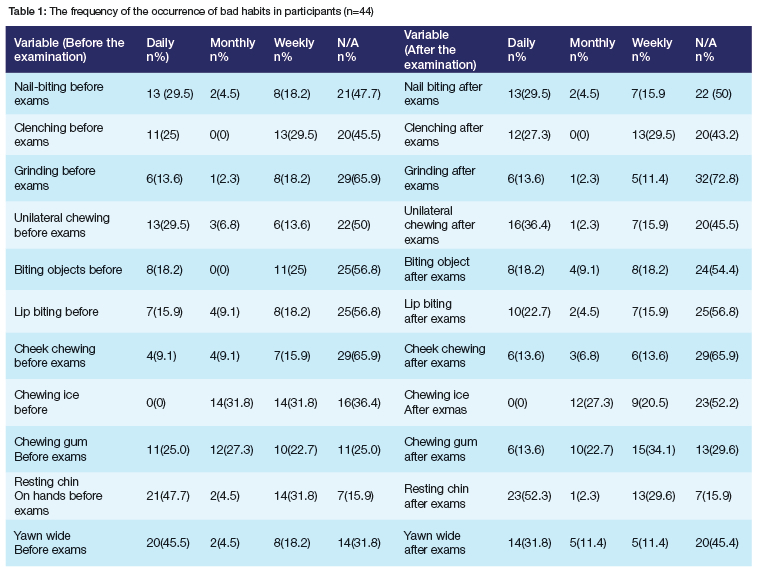
The majority of students had bad (harmful oral habits) habits such as nail biting, chewing gum, resting chin on hands, cheek chewing, lip biting, clenching their teeth and the occurrence of this were done daily in many cases and weekly and they were observed more after the examinations than before examination suggesting that the habits could be seen to be increased during stressful times.
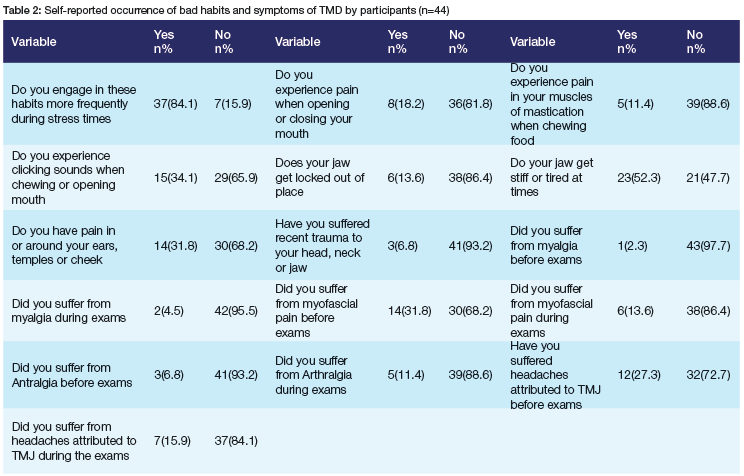
Self-reported occurrence of bad habits and symptoms of TMD are reported in Table 2 above.
In Table 2 above 84% of the participants reported that they practiced the bad habits more during stressful times. More than half (52.3%) reported to have a stiff/tired jaw, 31% had myofacial pain and 27,3% suffered headaches attributed to the Temporomandibular joint before exams
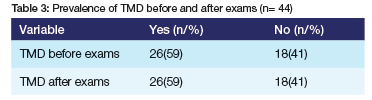
The table below depicts the prevalence of TMD before and after exams.
The prevalence of TMD was found to be 59% after the exams and before exams.
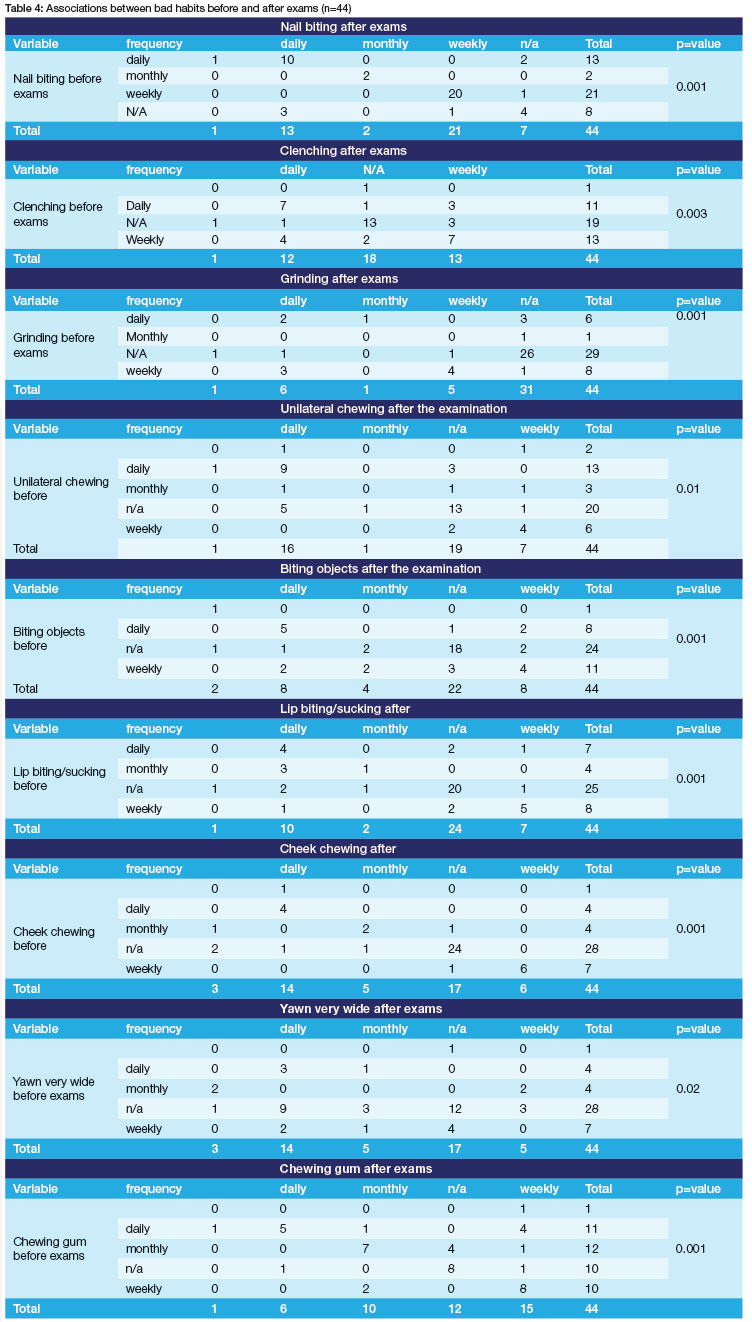
Table 4 below depicts the association of bad habits before and after exams
The majority of participants do not participate in bad habits but the associations have revealed the following for those who engage in the bad habits: Significantly more participants bit on their nails weekly after exams as opposed to before exams, (p=0.001). Significantly more participants clenched daily and weekly after the exams as opposed to before exams, p=0.003. Significantly more participants grinded their teeth daily and weekly after the exams as opposed to before exams, p=0.001. Significantly more participants chewed unilaterally after the exams daily as opposed to before the exams and so did those who bit on objects and the same was observed for lip sucking, p< 0.05. As for cheek chewing more participants practised the behaviour monthly, weekly and daily as opposed to before the exams, p< 0.05. As for gum chewing significantly more chewed gum weekly followed by monthly and daily, p=0.001. This is also the only variable where in general those who chewed the gum exceeded those who didn't chew the gum. Significantly more participants yawned widely daily after exams than before exams, p=0.02.
There was found to be no association between year of study and gender in the engagement in bad habits as well the frequency before and after exams, p>0.05.
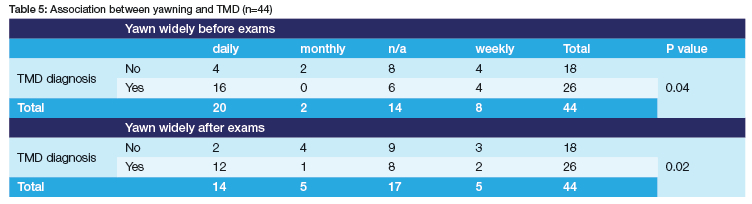
Association between TMD and yawning very wide is depicted in the table above.
Statistically more participants that yawn widely daily before and after exams are more likely to have a TMD diagnosis as opposed to those that yawns monthly or weekly, p=0.04 and 0.02 respectively. When the association between TMD diagnosis and other bad habits (grinding, chewing on objects, lip biting and sucking. etc.) was done there was found to be no association between TMD and bad habits, p > 0.05
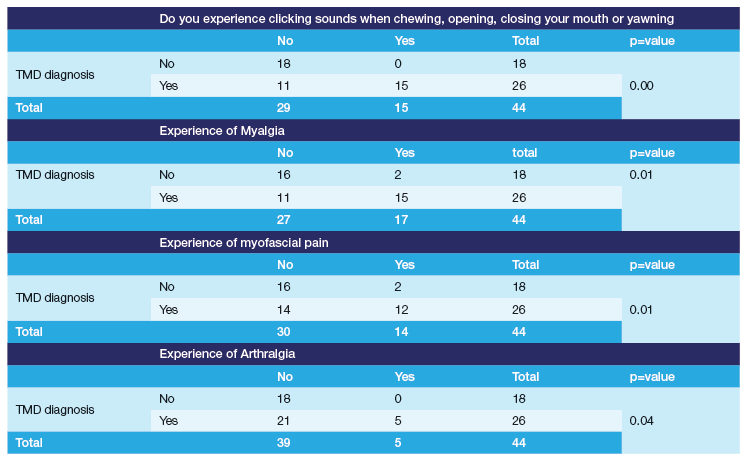
Association between symptoms of TMD (clicks, myalgia, arthralgia, and myofascial pain) and examination (n=44) in the table below.
The presence of clicking, myalgia, myofascial pain and arthralgia are significantly associated with TMD, p=0.00, 0.01, 0.01 and 0.04 respectively. The was also found to be no association between gender and year of study with TMD diagnosis, p>0.05.
Discussion
TMD are a complex set of disorders that can often lead to chronic pain. The major clinical presentation of these disorders is pain in the orofacial region of non-odontogenic origin. Since TMDs considerably affects daily functions and follow a biopsychosocial pattern of a disease, its prevention, early diagnosis, and therapeutic management are deemed necessary. In the modern era, studies are being carried out in varied population using Diagnostic Criteria for Temporomandibular Disorders (DC/TMD).16-17
In this study DC/TMD was used to diagnose TMD and determine its prevalence. Preparing and writing of the examination was the common psychosocial factor (Axis II) affecting the students.
A common observation made in the past studies was the majority of TMD among females and in the younger age groups. Previous studies have also pointed out the higher prevalence of TMD in university students, especially medical and dental undergraduates.18-19 A high prevalence of 59 % was noted in this study. Interestingly, this prevalence remained the same even after the examinations. This suggests that either examinations were not the predisposing factor or examination and other factors such as clinical demands and complex curriculum also played a significant role in students with TMD. The complex nature of dental curriculum and its presentation also pose increased amount of stress, anxiety, and distress for students.
The purpose of the study was to determine the association between self-reported harmful oral habits and the TMD related signs and symptoms amongst oral hygiene students at a training institution in Gauteng and the frequency of the students' engagement in harmful oral habits.
Previous studies employed only the TMD pain screener questionnaire with university students while other researchers used RDC/TMD for assessing the prevalence of TMD or used fonseca anamnestic index (FAI) in combination with various other questionnaires for classifying the TMD.18,17,20 The present study has an edge over other studies in Saudi Arabia, as it is first of its kind which has evaluated the male and female oral hygiene undergraduates for TMD using Diagnostic Criteria for Temporomandibular Disorders (DC/TMD), although males were few.
The DC/TMD is a diagnostic framework that provide a systematic approach to the diagnosis of TMD, allowing clinicians to make more informed decisions about treatment.21
The study by Srivastava conducted among undergraduates' dental students found the overall cross-sectional prevalence of TMD to be 36.99%.2020
Similar observation was reported by Zafar et al., wherein variation in the prevalence among the university students of different disciplines was found.2223
Studies conducted regarding the risk assessment on oral parafunctions in relation to TMD discovered that the most prevalent reported oral parafunctional habits included: teeth clenching and grinding, nail biting and chewing gum sticks.5,10 However, a study conducted by Michelotti et al found that nail biting was not a risk factor for any of the TMD subgroups (men and women) analysed, despite the fact that incisal clenching has been reported to reduce anterior joint space and to determine disc compression.14
There is a growing body of evidence that suggest that there are gender differences in the prevalence and presentation of TMD in adult 17,18,23 For example, women are more likely than men to seek treatment for TMD, and they are also more likely to report higher levels of pain and disability. There are a number of possible explanations for these gender differences. It might be related to social factors, hormonal factors, differences in pain sensitivity, as well as health-seeking behaviours. However, our study showed there was no association between gender and prevalence of TMD in our participants before and after exams.
CONCLUSIONS
The present study showed a high prevalence of TMD which was associated some of the harmful oral habits. The study also showed that examinations is not the only psychosocial factor predisposing factor students to TMD as the prevalence was the same before and after the exams.
LIMITATIONSThis study was limited by the cross-sectional study design and causality cannot be inferred. Response acquiescence is common in questionnaires that tend to determine habits that are considered taboo or have negative connotations. The study is also limited by the small sample size of the oral hygienists with a skewed distribution between males and females.
RECOMMENDATIONSDental students including oral hygienists in previous studies and in our study were shown to pose a higher risk of developing TMD, hence strategies such as early diagnosis and management of TMD need to be implemented so that they could improve prognosis and quality of student life. Additionally, academic counselling should be planned to assist students to cope with academic activities especially during exam time.
CONFLICT OF INTERESTThe authors declare there are no conflicts of interest
REFERENCES
- 1. Alomar X, Medrano J, Cabratosa J, Clavero JA, Lorente M, Serra I, Monill JM, Salvador A. Anatomy of the temporomandibular joint. In Seminars in Ultrasound, CT and MRI 2007 Jun 1 (Vol. 28, No. 3, pp. 170-183). WB Saunders
- 2. Conti PCR, Ferreira PM, Pegoraro LF, Conti JV, Salvador MCG. A cross-sectional study of the prevalence and etiology of signs and symptoms of temporomandibular disorders in high school and university students. 1996 July; 10(3): 254-62.
- 3. Magee, D. (2014). Orthopaedic Physical Assessment. 6th ed. Alberta, Canada: Elsevier, p.225.
- 4. Scrivani SJ, Keith DA, Kaban LB. Temporomandibular disorders. New England Journal Medicine. 2008 Dec 18;359(25):2693-705
- 5. Paulsen, F. (2013). Sobatta Atlas of Human Anatomy. 15th ed. Philadelphia: Elsevier Inc., pp.42-47.
- 6. Huang GJ, LeResche L, Critchlow CW, Martin MD, Drangsholt MT. Risk factors for diagnostic subgroups of painful temporomandibular disorders (TMD). J Dent Res. 2002; 81:284-288
- 7. Qiam F, Niazi A, Khan M, ur Rehman A. Frequency and severity of temporomandibular disorders amongst dental students of Khyber College of Dentistry. Pakistan Oral & Dental Journal. 2017 Sep 30;37(3):403-6.
- 8. Dworkin SF. The OPPERA study: Act One. J Pain 2011; 12(11 Suppl): T1−T3.
- 9. Durham J, Newton-John TR, Zakrzewska JM. Temporomandibular disorders. bmj. 2015 Mar 12;350
- 10. De Oliveira Melchior, M., Oliveira Mazzetto, M. and de Felício, C. (2012). Temporomandibular disorders and parafunctional oral habits: An anamnestic study. Dental press Journal of Orthodontics, 17(2), pp.83-9.
- 11. Kalamir A, Pollard H, Vitiello AL, Bonello R. TMD and the problem of bruxism. A review. Jbmt.2006 Nov6; (11): 183-93
- 12. Winocur E, Gavish A, Finkelshtein T, Halachmi M, Gazit E. Oral habits among adolescent girls and their association with symptoms of temporomandibular disorders. Journal of Oral Rehabilitation. 2001 Jul;28(7):624-9
- 13. Oliveira CB, Lima JA, Silva PL, Forte FD, Bonan PR, Batista AU. Temporomandibular disorders and oral habits in high-school adolescents: a public health issue? RGO-Revista Gaúcha de Odontologia. 2016 Jan; 64:08-16.
- 14. Michelotti, A., Cioffi, I., Festa, P., Scala, G. and Farella, M. (2010). Oral parafunctions as risk factors for diagnostic TMD subgroups. Journal of Oral Rehabilitation, [online] (37), pp.157-162.
- 15. Motghare V, Kumar J, Kamate S, Kushwaha S, Anand R, Gupta N et al. Association between harmful oral habits and signs and symptoms of temporomandibular joint disorders among adolescents. J Clin Dent Res. 2015 Aug 01; 9(8): 45-8
- 16. Palmer J and Durham J. 2021. Temporomandibular disorders. BJA Education, 21(2): 44e50
- 17. Minervini G 2023. Prevalence of temporomandibular disorders in children and adolescents evaluated with Diagnostic Criteria for Temporomandibular Disorders: A systematic review with meta-analysis
- 18. Karaman A and Sapan Z. 2023. Evaluation of temporomandibular disorders, quality of life, and oral habits among dentistry students
- 19. Valesan LF, Da-Cas CD, Réus JC, Denardin AC, Garanhani RR, Bonotto D, Januzzi E, de Souza BD. Prevalence of temporomandibular joint disorders: a systematic review and meta-analysis. Clinical oral investigations. 2021 Feb; 25:441-53.
- 20. Srivastava KC, 2021. Evaluation of temporomandibular disorders among dental students of Saudi Arabia using Diagnostic Criteria for Temporomandibular Disorders (DC/TMD): a cross-sectional study.
- 21. Schiffman E, Ohrbach R, Truelove E, Look J, Anderson G, Goulet JP, List T, Svensson P, Gonzalez Y, Lobbezoo F, Michelotti A. Diagnostic criteria for temporomandibular disorders (DC/TMD) for clinical and research applications: recommendations of the International RDC/TMD Consortium Network and Orofacial Pain Special Interest Group. Journal of oral & facial pain and headache. 2014;28(1):6
- 22. Zafar MS, Fareed WM, Taymour N, Khurshid Z, Khan AH. Self-reported frequency of temporomandibular disorders among undergraduate students at Taibah University. J Taibah Univ Med Sci. 2017;12(6):517-22.
- 23. Larkin N, Fricton V, Sangalli L, Prodoehl J, Fricton J. Prevalence and impact of signs and symptoms of temporomandibular disorders in dental students and faculty. Journal of Dental Education. 2024 Dec;88(12):1696-708.
Prof Candice van Wyk
Department of Community Dentistry, Faculty of Health Science, University of Pretoria, Pretoria, South Africa
Email: