Availability, indications for use and main ingredients of mouthwashes in six major supermarkets in Gauteng
Abstract
Patients often ask oral health care practitioners to recommend the "best" mouthwash for their specific needs and desires. Considering the vast array of products available, the number of television, radio and printed media advertisements, and the promotional campaigns from dental representatives, selecting and recommending a single product can be daunting. As a result, advice and selection are often based on personal preferences, and may not identify a mouthwash most suitable for the specific needs of a particular patient. This study was undertaken to investigate the range, availability, advertised indications and ingredients of all the mouthwashes on offer in six large supermarket chains in Gauteng. After identifying all the available over-the-counter mouthwashes on sale, a descriptive cross sectional study was undertaken. The advertised indications for use, active ingredients, mode of action and cost of the collected samples were compared. The results may help clinicians have a better understanding of the range, nature and characteristics of a selection from each brand enabling a recommendation of the most suitable product to meet each individual need.
INTRODUCTION
Mouthwashes are amongst the many oral hygiene products available to help patients maintain maximal oral health. Oral practitioners are regularly requested by patients to recommend the "best" mouthwash for their specific needs. Considering the wide variety of products available, it may be difficult for clinicians to give justifiable advice unless they are familiar with a selection of products, their indications for use, active ingredients, availability, contra-indications, and scientifically documented efficacy. This study was undertaken to collect and collate relevant information, and present it in a format that clinicians may consult and adapt into a similar reference table for their own purposes. This could then be used as a quick reference guide when advising on the most suitable rinse for each patient's needs.
Oral mouth rinses are amongst the oldest forms of dental hygiene techniques documented. Recipes for teeth whitening and halitosis-combating products date back as far as the ancient Egyptian, Greek, Roman and Chinese cultures.122222
In the late 1800's, the first official oral cleansing products, namely toothpastes, were invented. This was closely followed by the mass production of mouthwashes. Most of these contained alcohol to not only kill bacteria, but also improve their stability. Fortunately in modern products, the alcohol has generally been replaced with more effective bactericidal agents and preservatives. In addition, specialised rinses have been developed to address specific needs such as sensitive teeth, gingival inflammation, halitosis, calculus (tartar) build-up, caries susceptibility, demineralised teeth, and even products for use by children with braces, or those who seek more natural herbal products.3
Advocates of mouthwashes propose that they have many beneficial uses including: removal of excess food particles trapped between the teeth; softening food particles making them easier to clean and remove; protection of the oral cavity from harmful bacteria by physically removing them; inhibition of bacterial growth due to certain active ingredients; reduction of tooth or gingival sensitivity; elimination of plaque and calculus (tartar) build-up; and even tooth-whitening properties.4,5
Mouthwashes alone cannot achieve complete oral hygiene and need to be used in conjunction with regular visits to the dentist / oral hygienist, as well as a good daily brushing and flossing regime. Thus, their efficacy cannot be solely attributed to their constituent active ingredients.5
The oral biofilm is composed of gram positive and gram-negative bacteria, which produce the metabolites that ultimately lead to plaque build-up, caries, gingivitis and periodontitis. The use of antimicrobial mouth rinses has been proposed to reduce the levels of oral bacteria. As such, the daily use of an effective mouthwash may be a simple strategy to reduce oral microbe numbers, and could be beneficial for prevention of infection, or in patients with established gingivitis or periodontitis.6Streptococcus mutans, Staphylococcus aureus, and Candida albicans, the most common yeast associated with oral disease.75
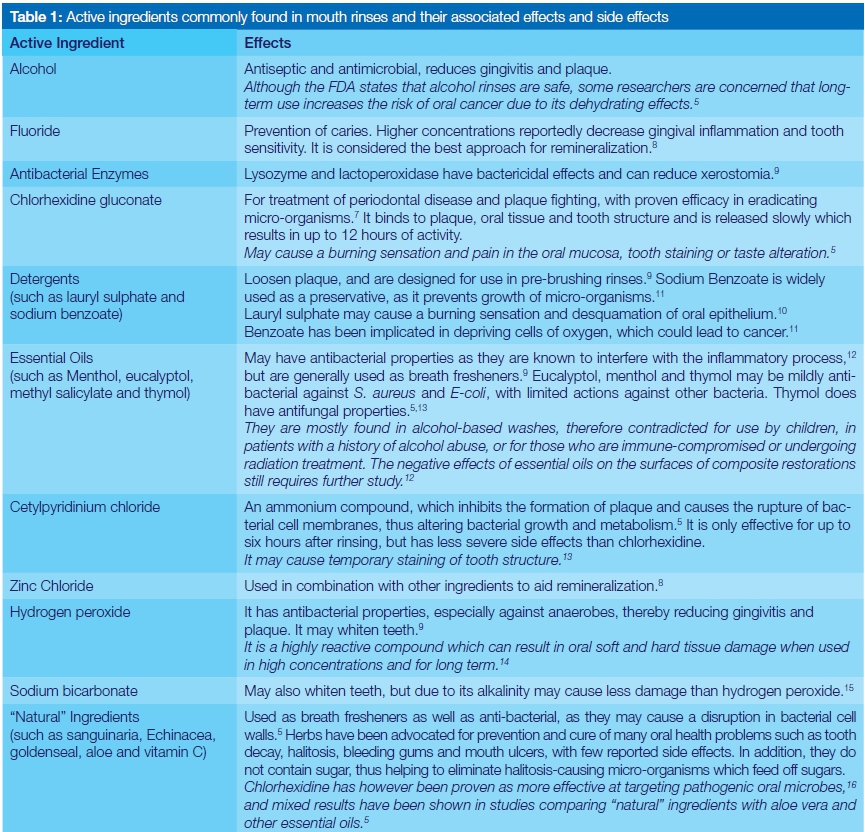
Mouthwashes may contain any combination of the following ingredients: active medicaments (e.g. antifungals, antiseptics, antibiotics, anti-inflammatories), astringents, inorganic elements (e.g. sodium fluoride, calcium), plaque-fighting agents, (e.g. chlorhexidine), breath fresheners and essential oils (e.g. menthol, thymol, eucalyptol), other active or inactive components (e.g. sodium hydroxide, sugars, artificial sweeteners), dilutants and solvents (e.g. deionized and demineralized water, alcohol, poloxamer), preservatives, colourants and flavourants.68
Many studies have shown fluoride mouthwashes reduce the incidence of caries in children, but it is questionable whether mouthwashes are cost effective, especially in South Africa. Perhaps the focus should rather be on prevention, with the adjunctive use of mouthwashes reserved for individuals with a high caries risk, and used in formulations that contain other remineralizing agents such as calcium and phosphate.8875715
A cross sectional study was undertaken to identify all the available OTC mouthwashes in six major supermarket chains in Gauteng, and to compare their indications for use, active ingredients, mode of action and cost. The results may help clinicians approach patients in a more holistic manner, and allow them to recommend the most suitable product for each individual patient, based on their specific needs.
Six of the largest supermarkets chains in Gauteng were selected for this study (Spar, Checkers, Pick 'n Pay, Clicks, Dischem and Makro). A list was compiled of all available mouthwashes, including bottle sizes and costs. They were grouped according to brands, noting the different variants within each brand, their main active ingredients, and alcohol content. For the analysis, the product labels were used to categorize each according to their advertised indications for use, as specified on their labels. Each product was then assigned to one of eleven categories, namely multi-purpose, kids, whitening, sensitive, tartar control, anti-bacterial, breath freshening, regular, long lasting, herbal, and gum protection.
It was difficult to carry out a cost analysis, as there were large variations in the prices between stores and in different product sizes, making a price/ml comparison impossible. Some chains only sold large sizes which were generally cheaper than the smaller bottles sold, and thus certain chains which stocked only large bottles appeared to be cheaper than their competitors who sold only the smaller sizes.
RESULTS
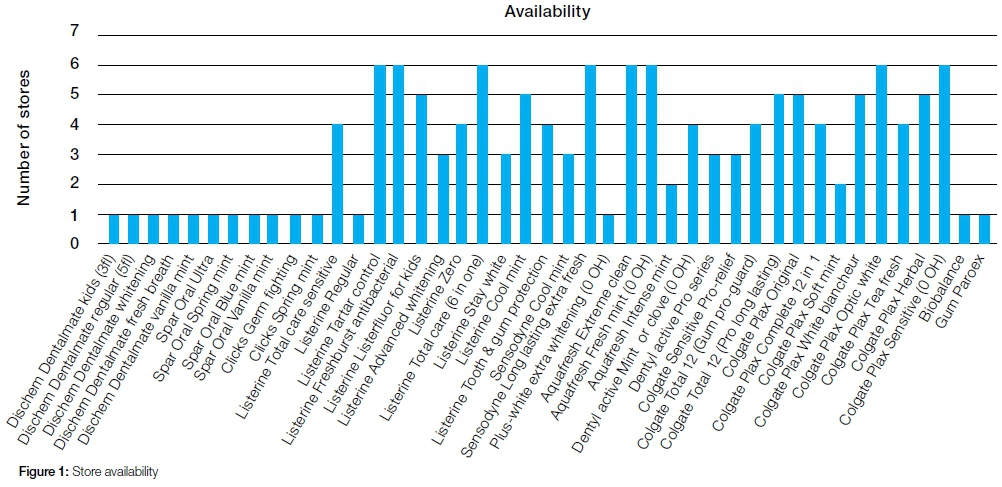
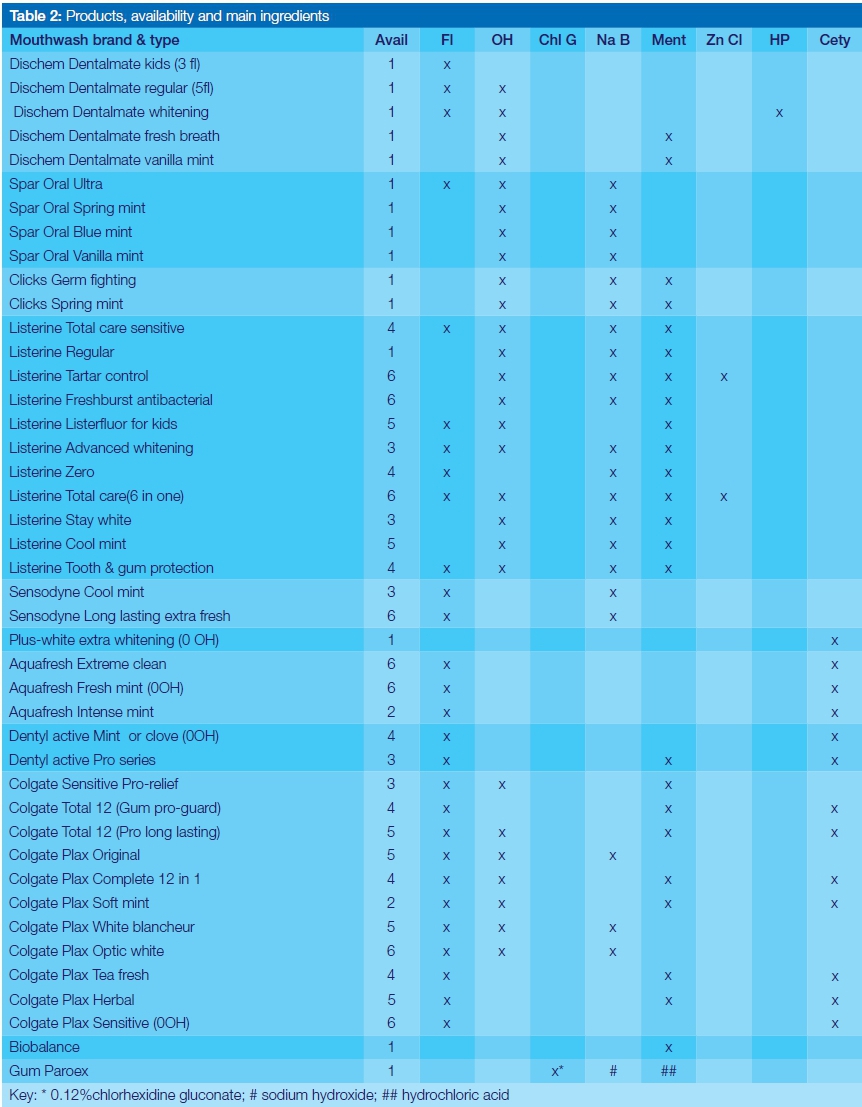
The results of this study show that in these six supermarkets alone, there was an enormous number and range of mouthwashes for consumers to choose from. In total there were 11 brands and 43 varieties, excluding different flavours within a type (Table 2). For the purpose of analysing the data, the mouthwashes were categorized into 11 groups according to the indications on their labels (Figure 1). However, when comparing the marketed specifications with the active ingredients it was interesting to note that most of the products had a very similar composition, with no extra unique constituents as may have been expected (Table 2). Of the six "whitening" products, only one, Dentalmate, the Dischem house brand, contained hydrogen peroxide for tooth whitening. There were three "herbal" mouth washes (Colgate Plax tea fresh, Colgate Plax herbal, Biobalance) yet only one, Biobalance, contained no active ingredients except menthol and essential oils which act as breath fresheners (Table 2). It was only available in Checkers. The other two both contained fluoride as well as cetylpyridinium chloride, and were widely available.
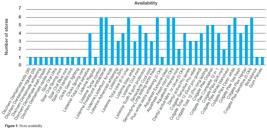
There was only one true anti-bacterial mouthwash, Gum paroex (Table 2), containing chlorhexidine gluconate as well as hydrochloric acid and sodium hydroxide. This too, was only available at Checkers. There were only two mouthwashes aimed specifically at children (Dentalmate kids and Listerine Listerfluor for kids). Both contained fluoride, but the latter also had alcohol. In total 27 of the 43 mouthwashes (63%) contained alcohol, while nine were marketed as breath fresheners (Table 2).
DISCUSSION
Dentalmate, the Dischem house brand, was the only whitening product to actually contain hydrogen peroxide for tooth whitening. This however may be seen as a positive aspect as studies have shown that hydrogen peroxide in high concentrations and used regularly can damage soft and hard tissue of the oral cavity, causing decreased enamel microhardness, and is therefore not recommended in a daily rinse.14,16,17 Interestingly, all the whitening products were more expensive than the regular mouthwashes, regardless of store or bottle size.
Biobalance is the only herbal product to contain no active ingredients except menthol and essential oils as breath fresheners (Table 2). Menthol is purported to have limited anti-bacterial properties,912

In Gum Paroex, the chlorhexidine gluconate is known to be efficient at removing bacteria and fighting periodontal disease.75181819
Both of the two mouthwashes for children contained fluoride, but it was a concern to note that the Listerine product also had alcohol. Topical fluoride is a beneficial aid in tooth remineralisation and caries prevention,820
Only 37% of the mouthwashes were alcohol free. It was originally added as a preservative and solvent, with limited antimicrobial and antiseptic properties that may help reduce gingivitis and plaque formation.55
For breath freshening, additives such as zinc chloride, cetylpyridinium chloride, essential oils and natural ingredients are used to combat halitosis.9,12 One product, Listerine Total care (6 in One), contained zinc chloride, menthol and fluoride which would make it an effective mouthwash to use against bad breath as well as for caries prevention. It was available in all six stores, making it a good all-round choice, except that it contained alcohol. Thirteen others also contained cetylpyridinium, but only eight of these also had menthol, none had zinc chloride, and three also contained alcohol. Only three of the thirteen were marketed as breath fresheners.
Triclosan is another antibacterial agent commonly added to many oral hygiene formulations, and is purported to be effective against Escherichia coli and Staphylococcus aureus. However, results of studies are contradictory as the concentrations and combinations with other ingredients in each product differ. In a toothpaste study, a combination of 0.5% triclosan and 1% zinc citrate resulted in greater plaque inhibition, than pastes containing zinc citrate or triclosan alone.2122232323
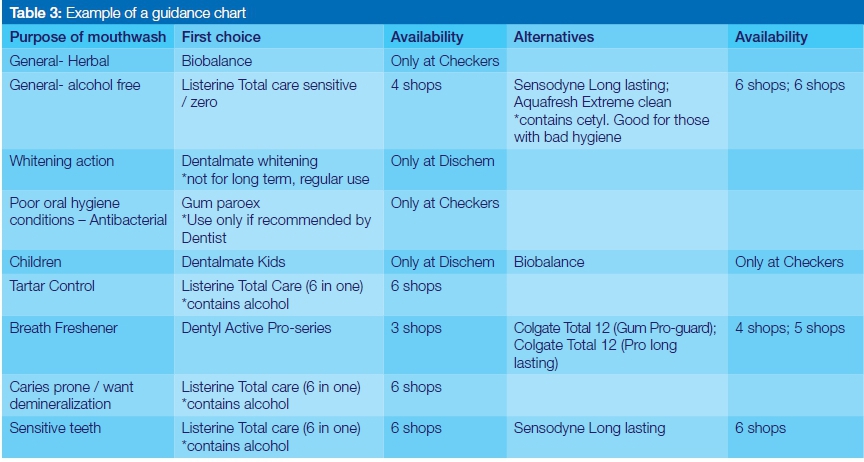
An example of how clinicians could adapt the data from this research and compile their own charts based on a select few products for each desired indication is given in Table 3. This can serve as a quick reference guide when advising patients. For example, a patient who wants a more "natural rinse", would be advised to use the herbal product (Biobalance), but should be informed that it has no other active ingredients. Good general purpose, alcohol free rinses include Listerine Total care sensitive, Listerine Zero, Sensodyne Long lasting and Aquafresh extreme clean. Dentalmate whitening and Dentalmate kids are the first choice for whitening and children respectively, while Gum Paroex would be suited for those needing added antibacterial action. Patients with caries, demineralised lesions or tooth sensitivity should use a mouthwash with fluoride and sodium benzoate (Listerine Total care (6 in One). It also contains zinc chloride making it beneficial for tartar control.24
Dentyl active Pro series and Colgate Total 12 (Gum Pro guard and Pro long lasting) could be used for breath freshening purposes, while those with very poor oral hygiene may benefit from a product containing fluoride and Cetylpyridinium Chloride. This compound is extremely efficient in eradication of bacteria and plaque, and although not as effective as chlorhexidine gluconate, has fewer side effects.
CONCLUSIONS
There is very little published data comparing the ingredients in OTC mouthwashes including their uses, efficacy, side effects, and interactions with other constituents. Most patients are unaware which products would best suit their needs and as seen by this study, could be easily confused by product labels and advertising. They may purchase mouthwashes with potentially harsh ingredients, posing the risk of un-recommended use, abuse and dangerous oral side effects. Often these rinses are used as a hygiene aid because they are quick and easy, yet their breath freshening properties could be masking the halitosis associated with poor oral hygiene, dental decay or an underlying systemic condition. This emphasises the important role dentists and oral hygienist play in recommending products and care that is suited to each patient's needs. However, the authors believe that rather than advocating any specific mouthwash, it may be more prudent for clinicians to educate their patients into following well balanced diets, limited oral exposure to sugars, alcohols and acids, and to teach them how to brush and floss correctly on a daily basis.
References
LITERATURE REVIEW
-
1. Oral-B. The history of mouth wash. [Online]; 2015 [cited 2015]. Available from: http://www.oralb.com/topics/history-of-mouthwash.aspx.
» http://www.oralb.com/topics/history-of-mouthwash.aspx -
2. Brinker SP. The Evolution of mouthwash. [Online]; 2014 [cited 2015]. Available from: http://cpsmagazine.com/?dental-team=the-evolution-of-mouthwash.
» http://cpsmagazine.com/?dental-team=the-evolution-of-mouthwash -
3. Prichard D. A brief history of mouthwash. [Online]; 2013 [cited 2015]. Available from: http://www.speareducation.com/spear-review/2012/12/a-brief-history-of-mouthwash.
» http://www.speareducation.com/spear-review/2012/12/a-brief-history-of-mouthwash -
4. All Smiles Dental. The Importance of Mouthwash in Oral Health. [Online].; 2014 [cited 2015]. Available from: http://allsmilesdentalpractice.com.au/the-importance-of-mouthwash-in-oral-health/.
» http://allsmilesdentalpractice.com.au/the-importance-of-mouthwash-in-oral-health/ - 5. Osso D, Kanani N. Antiseptic Mouth Rinses: an update on comparative effectiveness, risk and recommendations. The Journal of Dental Hygiene. 2013; 87(1):10-8.
- 6. Pereira EM, da Silva JL, Silva FF, De Luca MP, Ferreira EF, Lorentz TC, et al. Clinical Edvidence of the efficacy of a mouthwash containing propolis for the control of plaque and gingivitis: a phase II study. Evidence-Based Complimentary and Alternative Medicine. 2011; 1-7.
- 7. Aneja KR, Joshi R, Sharma C. The antimicrobial potential of ten often used mouthwashes against four dental caries pathogens. Jundishapur Journal of Microbiology. 2007; 3(1):15-27.
- 8. Zero DZ. Dentrifices, mouthwashes, and remineralization/caries arrestment strategies. BMC Oral Health. 2006; 6:9.
-
9. Berkeley Wellness. [Document].; 2012 [cited 2015]. Available from: http://www.berkeleywellness.com/self-care/over-counter-products/article/what-you-should-know-about-mouthwash.
» http://www.berkeleywellness.com/self-care/over-counter-products/article/what-you-should-know-about-mouthwash - 10. Babich H, Babich JP. Sodium lauryl sulfate and triclosan: in vitro cytotoxicity studies with gingival cells. Toxicology letters. 1997; 91(3):189-96.
- 11. Lenners BS, Vafai SB, Delaney NF, Clish CB, Deik AA, Pierce KA, et al. Effects of sodium benzoate, a widely used food preservative, on glucose homeostasis and metabolic profiles in humans. Mol Genet Metab. 2015; 114(1).
- 12. Marchetti E, Mummolo S, Di Mattia J, Casalena F, Di Martino S, Mattei A, et al. Efficiency of essential oil mouthwash with and without alcohol: a 3-day plaque accumulation model. Trials. 2011;12.
- 13. Masadeh MM, Gharaibeh SF, Alzoubi KH, Al-Azzam SI, Obeidat WM. Antimicrobial activity of common mouthwash solutions on multidrug-resistant bacterial biofilms. J Clin Med Res. 2013;5:389-94.
- 14. Walsh LJ. Safety issues relating to the use of hydrogen peroxide in dentistry. Aust Dent J. 2000; 45(4): 257-69.
- 15. Maart R, Grobler SR, Kruijsse HW, Osman Y, Patel N, Moodley D. The whitening effect of four different commercial denture cleansers on stained acrylic resin. SADJ. 2016; 71:106-11.
- 16. Majeed A, Farooq I, Grobler SR, Rossouw RJ. Tooth-bleaching: A review of the efficacy and adverse effects of various tooth whitening products. J Coll Physicians Surg Pak. 2015; 25: 891-6.
- 17. Grobler SR, Majeed A, Moola MH. Effects of various tooth-whitening products on enamel microhardness. SADJ. 2009; 64: 474-9.
- 18. Schmalz G, Arenholt-Bindslev D. Biocompatibility of Dental Materials Leipzig: Springer; 2009.Nagappan N, John J. Antimicrobial Effects of Herbal and Chlorhexidine Mouth rinse- a systematic review. JDMS. 2012; 2(4): 05-10.
-
19. National Center for Biotechnology Information. Pubmed Compound Database. [Online]. [cited 2015]. Available from: https://pubchem.ncbi.nlm.nih.gov/compound/14798.
» https://pubchem.ncbi.nlm.nih.gov/compound/14798 - 20. Wong MC, Glenny AM, Tsang BW, Lo EC, Worthington HV, Morinho VC. Topical fluoride as a cause of dental fluorosis in children. Cochrane database Syst Rev. 2010 Jan; 20(1).
- 21. Saxton CA. The effects of a dentrifice containing zinc citrate and 2, 4, 4 trichloro-2-hydroxydiphenyl ether. J. Periodontology, 1986; 57(9):555-61.
- 22. Nabi N., Mukerjee C., Schmid R., Gaffar A. In vitro and in vivo studies on triclosan / PVM/MA copolymer/ NaF combination as an anti-plaque agent. Am. J Dent. 1989; 2:197-206.
- 23. Tanomaru JM., Nascimento AP., Watanabe E., Matoba-Junior F., et.al. Antibacterial activity of four mouthrinses containing triclosan against salivary Staphylococcus aureus. Braz. J. Microbiol. 2008; 39 (3):569-72.
- 24. Komai M, Goto T, Suzuki H, Takeda T, Furukawa Y. Zinc deficiency and taste dysfunction; contribution of carbonic anhydrase, a zinc-metalloenzyme, to normal taste sensation. Biofactors. 2000; 12(1-4): 65-70.