Radiographic assessment of developing maxillary canine ectopia and its association with dental anomalies in the mixed dentition
Abstract
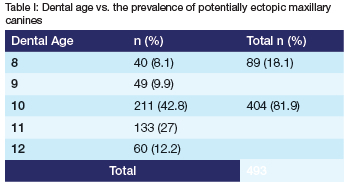
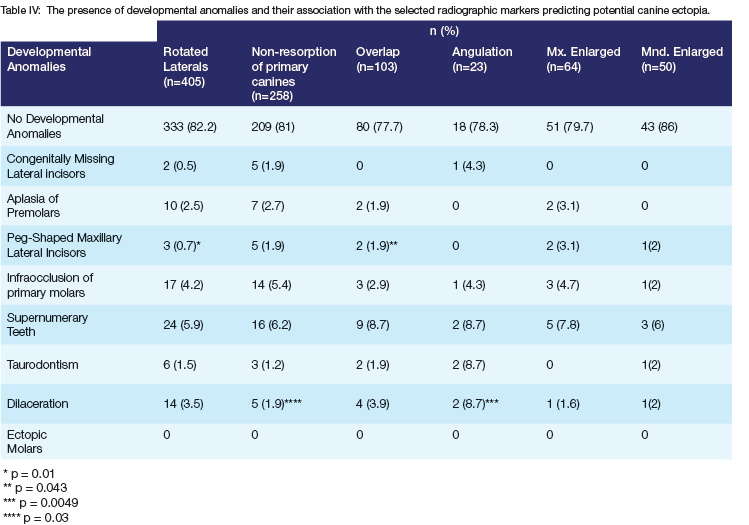
INTRODUCTION: Reciprocal associations have been found to exist between various dental anomalies.1-14 Maxillary canine ectopia may, however, occur in dentitions without any anomalies AIMS AND OBJECTIVES: The aim of the study was to establish the prevalence of dental anomalies in a sample of panoramic radiographs. The objective was to establish whether associations exist between canine ectopia and the presence of one or more of a range of selected developmental dental anomalies. A cross-sectional study was carried out on 574 mixed dentition panoramic radiographs in patients with a dental age ranging from 8 to 12 years RESULTS: Signs of potentially ectopic maxillary canines were evident in 85% of the radiographs and of these, 80.7% showed no evidence of the selected dental anomalies which were studied. The most prevalent association of potential canine ectopia and the anomalies studied was found with supernumerary teeth (6.5%), followed by infraocclusion of primary molars (4.5%). Peg-shaped lateral incisors showed a statistically significant association (p=0.043) with mesial overlap of the cusp tip of the maxillary canine and the root of the lateral incisor. Taurodontism was significantly associated with increased angulation of the developing canine (p=0.0049) and dilaceration showed a statistically significant association (p=0.03) with non- resorption of canines CONCLUSION: In cases where dental anomalies are present, the developing canines should be carefully monitored both clinically and radiographically
pre-eruptive canine ectopia; dental anomalies; interceptive orthodontics; mixed dentition; panoramic radiograph