Policy Analysis of South Africa's National Oral Health Policy and Strategy (2024-2034)
Abstract
South Africa (SA) faces a mounting OH crisis shaped by apartheid-era inequities, a quadruple disease burden, workforce shortages, and chronic under-investment. This article presents an analysis of SA's National Oral Health Policy and Strategy (NOHP) 2024-2034 using the Walt and Gilson Policy Triangle Framework. The policy content, context, actors, and processes to assess alignment with global best practice and feasibility of implementation were examined. The NOHP demonstrates strong conceptual alignment with the WHO Global Strategy and Action Plan on Oral Health (2023-2030) and the Minamata Convention, with emphasis on prevention, integration into primary health care, universal health coverage, and environmental stewardship. However, significant gaps threaten translation into practice, including funding constraints, workforce maldistribution, weak service integration, the omission of a targeted early childhood caries prevention strategy, and surveillance shortcomings driven by limited indicators. Actor mapping highlights diffuse leadership and uneven coordination across government levels, with fragile NGO capacity and under-leveraged public-private partnerships. Process analysis indicates broadly framed strategies without operational detail, risking fragmented implementation and weak accountability. A pragmatic implementation roadmap anchored in policy-capacity assessment, strengthened monitoring and evaluation with quality, standardised outcome indicators, and investment in prevention-oriented services is proposed to catalyse sustainable improvements in population OH.
oral health policy; oral health equity; oral health strategy; workforce; governance
1. INTRODUCTION
Oral health (OH) is an essential, yet often neglected aspect of overall health, with profound negative implications for individual well-being, health system efficiency, and population-level health equity. Globally, oral diseases affect approximately 3.5 billion people and are among the most prevalent noncommunicable (NCD) conditions, disproportionately impacting vulnerable and marginalised populations.12
South Africa (SA) is characterised by profound health inequalities, a quadruple burden of disease, and is facing an escalating OH crisis.345
This paper presents a comprehensive policy analysis of SA's NOHP&S, examining its alignment with global best practices, feasibility within the public health system, and barriers to implementation. Using the Walt and Gilson Policy Triangle Framework,67
2. POLICY ANALYSIS: SOUTH AFRICA'S NATIONAL OH POLICY AND STRATEGY (2024-34)
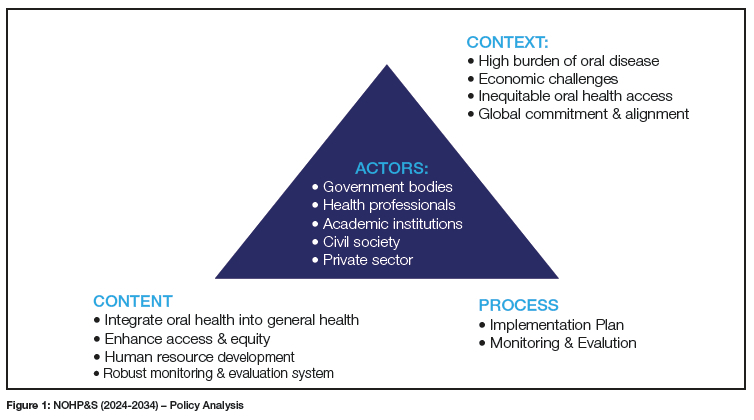
While acknowledging the state of OH in SA, the revised National Oral Health Policy and Strategy (NOHP&S) (2024-2034) provides a critical response to the country's rising oral disease burden. However, although the policy's vision is clear and ambitious, its implementation requires careful coordination and strong leadership to overcome health system challenges.
A policy analysis was necessary to determine whether SA's NOHP&S aligns with global best practices, to evaluate its feasibility within the current healthcare landscape, and identify barriers to successful implementation. Using the Walt and Gilson Policy Triangle Framework,6Figure 1.
2.1 Contextual analysis
2.1.1 Historical Context
South Africa's apartheid legacy resulted in a deeply inequitable, racially segregated health system. Under apartheid, Black people, who constitute 80% of SA's population, were subjected to systemic discrimination through segregation and racist laws. Oral health services were concentrated in the private sector and urban areas, resulting in severely limited access for the majority Black population in rural and township settings. Presently, 80% of South Africans rely on the overburdened public health system, yet 93% of oral health practitioners work in private practice serving only the 20% able to afford private care.7
South Africa's NOHP&S was developed to address the country's high burden of oral diseases, entrenched socioeconomic inequalities, and resource constraints that continue to hinder equitable access to OH care.3
2.1.2 High Burden of Oral Disease in SA
In its problem statements, the policy emphasises that the prevalence of oral diseases in SA remains alarmingly high, particularly among children and marginalised groups. Oral diseases such as dental caries, periodontal diseases, oral cancers, and trauma-related conditions continue to pose major public health challenges, while having limited access to timely diagnosis and treatment further exacerbate the crisis.3
Dental caries is widespread, affecting more than 60% of six-year-olds,931011
The policy further highlights the impacts of the OH complications of HIV/AIDS, with conditions such as oral candidiasis, Kaposi's sarcoma, and necrotising ulcerative gingivitis being more common among immunocompromised individuals. Therefore, this intersection between infectious diseases and OH underscores the need for integrated care models. Within the broader public health sector, policy trade-offs between efficiency and equity often result in OH being deprioritised in favour of high-profile health priorities such as HIV/AIDS, tuberculosis, and maternal-child health,412
2.1.3 Economic Challenges
The cost of treating oral diseases is among the highest healthcare expenditures worldwide, causing a significant financial burden for both governments and individuals.141310
Consequently, individuals, particularly the most vulnerable and those from lower-income groups, are often forced to delay or forgo essential OH care, contributing to worsening health outcomes and an increased burden on the broader healthcare system.143
2.1.4 Inequitable OH access
Rural and underserved communities in SA face the greatest barriers to OH care. The limited availability of OH professionals in the public sector,1015
There remains a significant urban-rural divide in the distribution of OH.1110
Infrastructure and resource limitations in secondary and tertiary OH services reinforce these disparities.1617
2.1.5 Global Commitments and Policy Alignment
To ensure that national interventions remain evidence-based, globally relevant, and adaptable to international best practices, the SA's NOHP&S aligns with key international public health priorities. A key influence on the policy is the WHO Global Strategy and Action Plan on Oral Health (2023-2030), that emphasises the integration of OH into general healthcare systems. This strategic approach underscores the importance of preventive and population-based interventions, aimed to reduce the prevalence of oral diseases and enhance access to quality care across all demographics.3
Additionally, SA's NOHP&S aligns with the Minamata Convention on Mercury,3
Collectively, this context demonstrates that while the NOHP&S is grounded in strong global principles and national priorities, its success depends on the health system's capacity to address persistent inequalities, resource limitations, and competing health demands. An understanding of these contextual dynamics is essential for evaluating whether the policy can be operationalised effectively and achieve its intended impact.
2.2 Policy Actors
Aligned to the comprehensive primary health care (PHC) approach, successful implementation of SA's NOHP&S relies on the involvement of multiple stakeholders, each of which play a crucial role in shaping and executing the policy.3
The SA National Department of Health is the central government authority with oversight on the development, implementation, and evaluation of the policy, and is responsible for resource allocation, monitoring progress, and ensuring that the strategy aligns with broader health system reforms, such as National Health Insurance (NHI).3318
Additionally, a wide range of health professionals, including dentists, dental therapists, oral hygienists, and community health workers, are tasked with service delivery as per the NOHP&S, to provide preventive and curative OH care, educate communities on oral hygiene, and manage oral diseases. However, a major stumbling block to this is the maldistribution of resources,310103
The policy proposes that Universities and Oral Health Training Institutions play an essential role in developing a workforce that meets SA's OH needs. These institutions are responsible for equipping future dental professionals with the necessary skills and expertise to work in diverse settings, including public healthcare facilities and rural areas. As a method of addressing the workforce shortages and maldistribution, the NOHP&S emphasises reforming dental education and training programmes to produce "fit-for-purpose" professionals capable of serving in high-need communities.316
Furthermore, the policy proposes that equitable access to OH services requires active engagement with civil society organisations and non-governmental organisations (NGOs) are required to facilitate with OH advocacy, education, and outreach programmes. These organisations are intended to bridge the gap between policy and implementation by raising awareness about OH, providing community-based interventions, and advocating for policy reforms that address systemic inequalities.320
The NOHP&S suggests engendering public-private partnerships to expand access to both preventive and curative OH services. The involvement of private dental practitioners, corporate sponsors, and healthcare providers are proposed to alleviate the strain on public health resources and improve service delivery.3
Moreover, despite the broad and inclusive involvement of various stakeholders, the effectiveness of such collaborations hinges on overcoming significant challenges in co-ordination, particularly across different levels of governance. Ensuring seamless collaboration between national, provincial, and district health departments remains a persistent hurdle, often leading to fragmented implementation and inefficiencies in service delivery, as evidenced in the implementation of the previous National Oral Health Policy.5
Additionally, stakeholder participation is often uneven, with grassroots organisations and community-based groups frequently having limited influence in decision-making processes, resulting in policies that do not address local needs. Another critical challenge lies in ensuring accountability among all actors involved in OH governance. Without clear mechanisms to align efforts and responsibilities, achieving the policy's overarching goal of universal access to OH care may prove difficult. Therefore, addressing these systemic coordination issues is crucial to fostering an integrated and efficient OH care system that is responsive, equitable, and sustainable.
2.3 Content Analysis: The NOHP&S (2024-2034) and Global Alignment
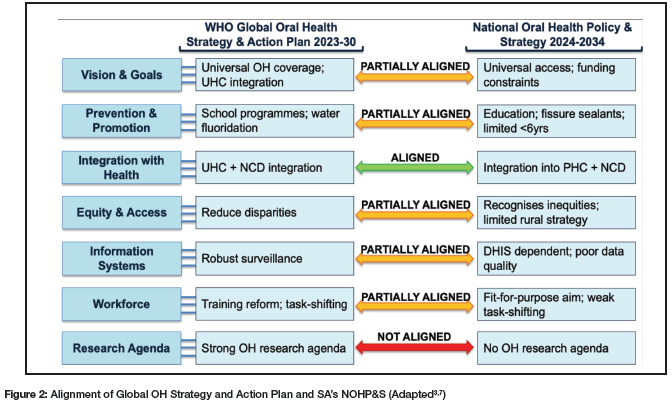
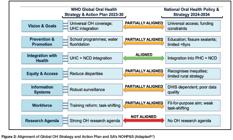
South Africa's NOHP&S indicates a strong commitment to aligning with international OH priorities, particularly those promoted by the WHO Global Strategy and Action Plan on Oral Health (2023-2030). A comparative assessment between the two frameworks highlights points of policy convergence, areas of partial alignment, and some critical implementation gaps. Figure 2 provides a critical comparison of the two frameworks and the narrative below interrogates the implications for policy effectiveness.
2.3.1 Vision, Goals and Paradigm Shift
Conceptually, the NOHP&S embraces the WHO's vision of universal access to essential OH care and the integration of OH within general health systems. Both frameworks promote a shift from curative, hospital-centric dentistry toward preventive, population-based approaches that aim to reduce oral disease burden while improving equity in access. The NOHP&S articulates four strategic goals that reflect this shift, highlighting the need for strengthened health system capacity, improved monitoring and evaluation, better workforce planning, and equitable service delivery.3410
2.3.2 Integration into PHC and UHC
The WHO strongly advocates for OH to be integrated into UHC and NCD prevention strategies, recognising the shared risk factors which underpin both systemic and oral diseases.7322
National public health measures such as the health promotion levy on sugar-sweetened beverages illustrate a broader commitment to WHO strategies aimed at reducing population-wide sugar consumption, subsequently lowering dental caries risk.2316
2.3.3 Prevention and Promotion of OH
Preventive services remain a fundamental pillar of both the WHO's Global Strategy and the NOHP&S. While SA has embraced school-based oral health interventions, the exclusion of children under six-years from the ISHP programme represents a major limitation, especially considering the high prevalence of early childhood caries and its detrimental impact on developmental outcomes.24,25 Furthermore, the lack of community water fluoridation, despite decades of policy endorsement, represents a missed opportunity to advance cost-effective caries prevention at scale. Additionally, preventive care remains overshadowed by the urgent treatment needs that are generated by late presentation and limited community-level resourcing. This demonstrates the tension between policy aspirations of the NOHP&S and ground-level realities.
2.3.4 Equity, Access and Service Delivery Structure
Equity is a core priority in both global and SA policy frameworks. However, gaps between policy commitment and service delivery remain significant. The NOHP&S outlines a tiered OH care model intended to streamline access between primary, secondary and tertiary OH services. However, in practice, infrastructure limitations, chronic equipment shortages and inefficient referral processes hinder continuity of care, especially in rural areas.10,16 Without targeted investment to strengthen rural and underserved regions, inequities in OH access will persist, thereby, constraining the NOHP&S's ability to meet its stated equity goals.
2.3.5 Oral Health Workforce Capacity
The NOHP&S acknowledges long-standing OH workforce shortages and proposes interventions to improve training outputs and a more "fit-for-purpose" workforce.311117
2.3.6 Oral Health Information Systems and Research Agenda
Monitoring and evaluation systems are another critical area of partial alignment. While the NOHP&S identifies the DHIS as the central system for national OH surveillance, existing output-based indicators, such as service volumes for extractions, restorations and fissure sealants,35
In contrast, the WHO advocates for strengthened surveillance with standardised indicators including DMFT, untreated decay rates, edentulousness, modifiable risk factors and access-related measures.26
The NOHP&S does however demonstrate strong alignment with the WHO Global Strategy in terms of the conceptual direction and strategic intent, particularly in its commitment to prevention, PHC integration and equity.3
2.4 Process Analysis: Implementation, monitoring and evaluation of the NOHP&S (2024-2034)
The NOHP&S (2024-2034) was developed through a consultative and collaborative process, engaging with a spectrum of stakeholders, including provincial health departments, professional associations, training institutions, and NGOs.3
Despite the structured approach of the NOHP&S, systemic inefficiencies in OH service delivery within SA's public OH clinics10318157
Beyond the fragmented service delivery in OH care, a major challenge in the implementation process is the reliance on cross- and inter-sectoral coordination, which has historically been a weak link in SA's healthcare system. Research by Skeen et al.,728
Moreover, at provincial and district levels, the absence of clearly defined OH leadership roles with the appropriate dental qualifications and authority presents an additional barrier to effective policy implementation. The NOHP&S does not explicitly outline mechanisms to support and strengthen OH leadership at these levels, leaving a significant gap in accountability and oversight. Additionally, fragmentation in governance weakens coordination between national, provincial, and district health authorities, move SA further away from achieving UHC and increases the risk of inconsistencies in policy execution, resource allocation, and service delivery.29
To track progress and ensure accountability, the NOHP&S established a monitoring and evaluation (M&E) framework, which outlines timelines for regular monitoring, mid-term reviews, and final evaluations for each goal and objective.33
Comprehensive M&E for health strategies, such as the NOHP&S, depends on a functional OH surveillance system which is integrated into a standardised and reliable OH information management system. OH in SA has long been ineffectively addressed, in large part due to the absence of a systematic surveillance strategy.4,5 Therefore, public health action, as envisioned in the NOHP&S, relies on linking surveillance data to planning, resource allocation, and policy revision. However, without contextually appropriate, standardised indicators, monitoring efforts risk becoming a procedural exercise rather than a transformative one.
3. POLICY CHALLENGES, GAPS AND BARRIERS
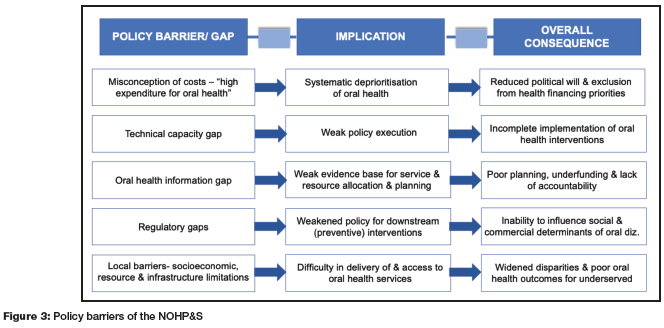
The integration of global OH initiatives into SA's NOHP&S is hindered by a complex set of structural and systemic challenges. These include misconceptions about cost, limited technical capacity, weak health information systems, regulatory deficits and longstanding socioeconomic inequalities. Collectively, these barriers have implications for the feasibility, effectiveness and equity of OH service delivery. Figure 3 outlines the relationship between key policy gaps, their implications on implementation and their broader systemic consequences.
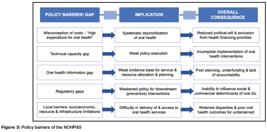
This figure illustrates the major policy barriers affecting oral health integration in SA's NOHP&S, the resulting implementation-level implications, and the broader consequences for health system performance and equity. The framework highlights that upstream policy weaknesses translates into downstream service delivery failures and population-level disparities. For example, the NOHP&S fails to address the affordability of essential preventive OH products, such as fluoridated toothpaste. South Africa ranks among the countries with the highest toothpaste costs relative to average income.30
Furthermore, a key obstacle is the resistance to change, which may arise at organisational, political, and technical levels, whereby stakeholders hesitate to embrace transformative shifts in health policy. Industry opposition compounds this challenge, particularly from sectors such as the sugar industry, which are resistant to public health efforts to reduce sugar consumption. Countries with strong commercial links to these industries may oppose health promotion policies aimed at reducing population sugar intake. Additionally, competition among advocacy groups could impede progress, whereby established health sectors may resist incorporating new disease prevention measures, with a fear that additional health priorities could divert funding away from their causes.2
CONCLUSION
Persistent socioeconomic disparities, resource constraints, and infrastructure limitations within SA's public health system15
A shift from aspiration to implementation urgently requires a clear implementation roadmap. This roadmap must be supported by a comprehensive policy capacity analysis that assesses the feasibility of implementation across governance, financing, human resources, infrastructure, data, and community engagement. This assessment will identify systemic weaknesses, highlight opportunities for integration, and ensure strategic resource allocation.31
REFERENCES
-
1. World Health Organization. Global oral health status report: towards universal health coverage for oral health by 2030. Geneva: WHO; 2022. Available from: https://www.who.int/publications/i/item/9789240061484
» https://www.who.int/publications/i/item/9789240061484 -
2. Benzian H, Daar A, Naidoo S. Redefining the non-communicable disease framework to a 6 × 6 approach: incorporating oral diseases and sugars. Lancet Public Health. 2023;8:e899-904. Available from: https://www.thelancet.com/journals/lanpub/article/PIIS2468-2667(23)00205-0/fulltext
» https://www.thelancet.com/journals/lanpub/article/PIIS2468-2667(23)00205-0/fulltext -
3. Department of Health (South Africa). National Oral Health Policy and Strategy 2024-2034. Pretoria: DoH; 2024. Available from: https://www.health.gov.za/wp-content/uploads/2024/12/NOHPS-for-website-122024.pdf
» https://www.health.gov.za/wp-content/uploads/2024/12/NOHPS-for-website-122024.pdf - 4. Author
- 5. Mukhari-Baloyi NA, Bhayat A, Madiba TK, Nkambule NR. A Review of the South African National Oral Health Policy. S Afr Dent J. 2021;76(9):551-7.
- 6. Walt G, Gilson L. Reforming the health sector in developing countries: the central role of policy analysis. Health Policy Plan. 1994;9(4):353-70.
-
7. World Health Organization. Global strategy and action plan on oral health 2023-2030. Geneva: WHO; 2023. Available from: https://www.who.int/publications/i/item/9789240090538
» https://www.who.int/publications/i/item/9789240090538 -
8. McIntyre D, Ataguba JE, Mabiri N. Health expenditure and finance in South Africa. World Bank; 2012. Available from: https://documents.worldbank.org/en/publication/documents-reports/documentdetail/549571468101363808/health-expenditure
» https://documents.worldbank.org/en/publication/documents-reports/documentdetail/549571468101363808/health-expenditure - 9. van Wyk PJ, van Wyk CW. Oral health in South Africa. Int Dent J. 2004;54(6):373-7.
- 10. Author
-
11. Bhayat A, Chikte U. Human Resources for Oral Health Care in South Africa: A 2018 Update. Int J Environ Res Public Health. 2019;16(10):1668. Available from: https://doi.org/10.3390/ijerph16101668
» https://doi.org/10.3390/ijerph16101668 - 12. Galea S, Vaughan R. Tradeoffs Between Equity and Efficiency at the Heart of Population Health Science: A Public Health of Consequence. Am J Public Health. 2019;109(4):541-2.
-
13. Ngubane MZ, Mndebele S, Kaseeram I. Economic growth, unemployment and poverty: Linear and non-linear evidence from South Africa. Heliyon. 2023;9:e20267. Available from: https://www.researchgate.net/publication/374120218
» https://www.researchgate.net/publication/374120218 - 14. Moodley I, Singh S. Exploring community-based training opportunities for dental therapy students in non-governmental private sectors in KwaZulu-Natal Province, South Africa. Afr J Health Prof Educ. 2018;10(3):176-82.
-
15. Maphumulo WT, Bhengu BR. Challenges of quality improvement in the healthcare of South Africa post-apartheid: A critical review. Curationis. 2019;42(1):a1901. Available from: https://www.ncbi.nlm.nih.gov/pmc/articles/PMC6556866/
» https://www.ncbi.nlm.nih.gov/pmc/articles/PMC6556866/ - 16. Motloba PD, Gwengu PRQ, Moipolai PD. Inaccessible specialised oral health services in South Africa-rationing policy uncertainty. S Afr Dent J. 2023;78(8):414-8.
-
17. McIntyre D, Chow CK. Waiting time as an indicator for health services under strain: a narrative review. Inquiry. 2020;57:0046958020910305. doi:10.1177/0046958020910305
» https://doi.org/10.1177/0046958020910305 - 18. Kruk ME, Gage AD, Arsenault C, Jordan K, Leslie HH, Roder-DeWan S, et al. High-quality health systems in the Sustainable Development Goals era: time for a revolution. Lancet Glob Health. 2018;6(11):e1196-e1252.
- 19. Tiwari R, Bhayat A, Chikte U. Forecasting for the need of dentists and specialists in South Africa until 2030. PLoS One. 2021;16(5):e0251238.
-
20. Maboya M, McKay T. The financial sustainability challenges facing the South African non-profit sector. J Transdiscipl Res S Afr. 2019;15(1):693. doi:10.4102/td.v15i1.693
» https://doi.org/10.4102/td.v15i1.693 -
21. South African Government. 2019/2020 South Africa Yearbook: Health. Pretoria: Department of Health; 2020. Available from: https://www.gcis.gov.za/sites/default/files/docs/resourcecentre/yearbook/Yearbook2020-9-Health.pdf
» https://www.gcis.gov.za/sites/default/files/docs/resourcecentre/yearbook/Yearbook2020-9-Health.pdf -
22. Molete M, Stewart A, Bosie E, Igumbor U. The policy implementation gap of school oral health programmes in Tshwane, South Africa: a qualitative case study. BMC Health Serv Res. 2020;20:338. Available from: https://bmchealthservres.biomedcentral.com/articles/10.1186/s12913-020-05122-8
» https://bmchealthservres.biomedcentral.com/articles/10.1186/s12913-020-05122-8 -
23. World Health Organization. Global oral health status report: Regional summary of the African region. Geneva: WHO; 2023. Available from: https://apps.who.int/iris/handle/10665/366662
» https://apps.who.int/iris/handle/10665/366662 - 24. Gaikwad SS, Gheware A, Kamatagi L, Pasumarthy S, Pawar V, Fatangare M. Dental Caries and its Relationship to Malocclusion in Permanent Dentition Among 12-15 Year Old School Going Children. J Int Oral Health. 2014;6(5):27.
-
25. Spodzieja K, Olczak-Kowalczyk D. Premature Loss of Deciduous Teeth as a Symptom of Systemic Disease: A Narrative Literature Review. Int J Environ Res Public Health. 2022;19(6):3386. Available from: https://www.mdpi.com/1660-4601/19/6/3386
» https://www.mdpi.com/1660-4601/19/6/3386 - 26. Watt RG, Daly B, Alison P, Macpherson LMD, Venturelli R, Listl S, et al. Ending the neglect of global oral health: time for radical action. Lancet. 2019;394:261-72.
- 27. Skeen S, Lund C, Kleintjes S, Flisher A; MHaPP Research Programme Consortium. Meeting the millennium development goals in Sub-Saharan Africa: what about mental health? Int Rev Psychiatry. 2010;22(6):624-31.
-
28. Vince JZ, Fudge M, Fullbrook L, Haward M. Understanding policy integration through an integrative capacity framework. Policy Soc. 2024:1-15. Available from: https://www.researchgate.net/publication/383032805
» https://www.researchgate.net/publication/383032805 -
29. Tshabalala, K. and Rispel, L.C., 2023. Piercing the veil on the functioning and effectiveness of district health system governance structures: perspectives from a South African province. Health Research Policy and Systems, 21(1). doi:https://doi.org/10.1186/s12961-023-01044-z.
» https://doi.org/10.1186/s12961-023-01044-z - 30. Gkekas A, Varenne B, Stauf N, Benzian H, Listl S. Affordability of essential medicines: The case of fluoride toothpaste in 78 countries. PLoS One. 2022;17(10):e0275111.
- 31. Wu X, Ramesh M, Howlett M. Policy capacity: A conceptual framework for understanding policy competences and capabilities. Policy Soc. 2015;34(3-4):165-71.

Conflict of Interest: The authors declare no conflict of interest.
Author Contributions
1. Nashna Rampersad: Conceptualisation, policy analysis, writing - original draft.
2. Sudeshni Naidoo: Writing - review and editing, policy analysis interpretation, critical revision.
3. Khabiso J. Ramphoma: Review and validation.
4. Dirk Smit: Referencing, and manuscript review.
All authors reviewed and approved the final version of the manuscript.