Knowledge and attitude of adolescents regarding e-cigarettes: A scoping review
Abstract
INTRODUCTION: The World Health Organization Framework Convention on Tobacco Control has informed countries to ban or regulate electronic cigarettes (e-cigarettes) because of their health adverse effects. Although e-cigarettes are regulated, their popularity has increased among teens OBJECTIVE: To review published articles on the knowledge and attitude of adolescents regarding e-cigarettes and whether their knowledge and attitude influence their use of e-cigarettes METHODS: Literature published from January 2012-11 March 2022 in the PubMed, Web of Science and PsycINFO databases were systematically reviewed using the SPIDER search strategy. We screened the full texts of 100 qualitative and quantitative studies that met the inclusion criteria. Of these, 68 studies were not eligible for review, leaving 32 articles: 21 quantitative studies and 11 qualitative studies RESULTS: Most adolescents believed that e-cigarettes were less harmful than traditional cigarettes. Adolescents used e-cigarettes out of curiosity and the different flavours. Their source of information came from friends, family and social media. Some adolescents believed that e-cigarettes were perfectly safe, and adolescents were influenced by tobacco companies' marketing campaigns CONCLUSION: Findings indicate that adolescents are aware of e-cigarettes; however, their perceptions of them differ. Some adolescents believe that e-cigarettes are safe, while others believe them to be harmful to health or remain unsure of their effects. Findings also revealed that adolescents' use of e-cigarettes is linked to their perceptions of them
INTRODUCTION
Electronic cigarettes (e-cigarettes) are battery-operated devices that contain a liquid that emits a vaporised solution when heated. They are sometimes referred to as "vapes", "e-cigs", "vape pens", "e-hookahs" and "electronic nicotine delivery systems". The e-liquid comprises nicotine and flavouring chemicals within a solvent, usually propylene glycol and/or glycerine.12
Over the past decade, the popularity of e-cigarettes among teenagers has soared. Globally, the uptake of e-cigarettes among adolescents has increased steadily, especially in high-income countries.3445,6 In the United Kingdom (UK), the regular use of e-cigarettes by adolescents is low, with only 11.2% of 11- to 17-year-olds having tried an e-cigarette in 2021.7 8 9
Although studies have shown that e-cigarettes may be an effective smoking cessation tool, they have caused more harm than good, especially among adolescents.41010, 11 1213
Adolescents are exposed to e-cigarette advertising through social media platforms such as Tik Tok, Instagram and Facebook. Wang et al.1415
To date, there is little data on the long-term health effects of e-cigarette use, and research investigating the adverse effects e-cigarettes is ongoing. The National Academies of Science, Engineering and Medicine released a report reviewing more than 800 studies on the health consequences of e-cigarettes.16161718
METHODS
Search strategy
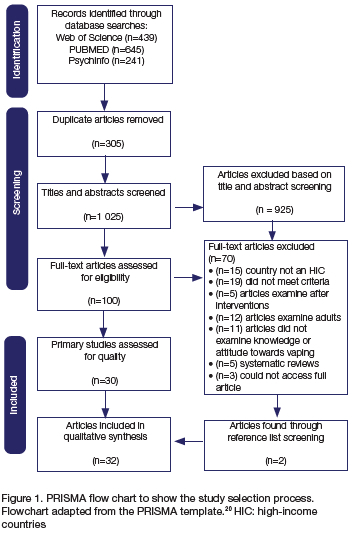
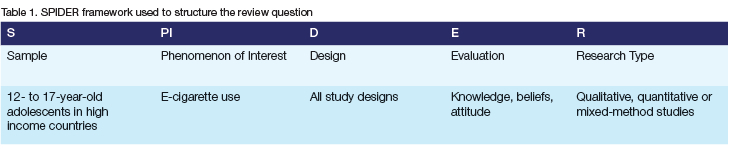
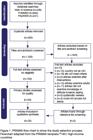
From 2-7 March 2022, a search was conducted on the PubMed, Web of Science and PsycINFO electronic databases. The SPIDER search strategy was used to conduct the systemic review19Table 1). The sample included adolescents aged 12-17 years in high-income countries. The phenomenon of interest was e-cigarette use. The knowledge and attitude of adolescents were evaluated, and the research type included qualitative, quantitative and mixed study designs. Literature reviews, systematic reviews, meta-analyses and editorials were excluded. The search strategy used was (E-cigarettes or e-cigarettes or vaping or electronic nicotine delivery system (ENDS)) AND (adolescent or youth or teenager) AND (knowledge or perception or beliefs or attitude or opinion). The term "high-income country" was not used in the search strategy because it gave limited results. The research focused on articles published between January 2012 and 11 March 2022. The search strategy results are presented in a Preferred Reporting Items for Systematic Reviews and Meta-Analyses (PRISMA) flow diagram22Figure 1).
Eligibility criteria and study selection
Eligible articles included peer reviewed primary research studies (quantitative, qualitative and mixed studies) published between January 2012 and March 2022. The World Bank defines high-income economies as those with a gross national income per capita of $12,696 or more.21
Data extraction
Data from the 32 articles were extracted and captured in a table in an Excel (Microsoft USA) spreadsheet. Information on the year of study, authors, country of study, type of research, study design, participants, sample size, sampling methods, recruitment, response rate, results and limitations were extracted from the articles.
Study selection and results
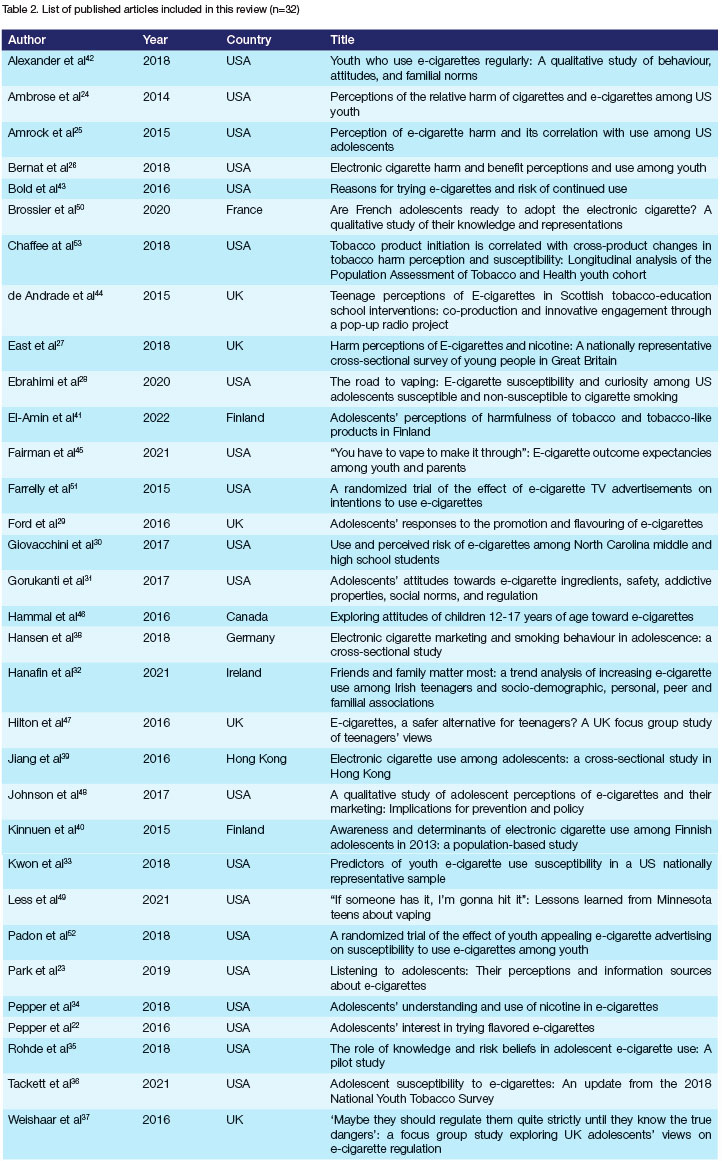
Thirty articles were included in the study. Two additional articles were identified from bibliographies.22, 23Table 2). Of the 32 studies, 19 were cross-sectional,22, 24-41 10 were qualitative studies,23, 42-50 two were randomised control studies51, 5232, 43, 53
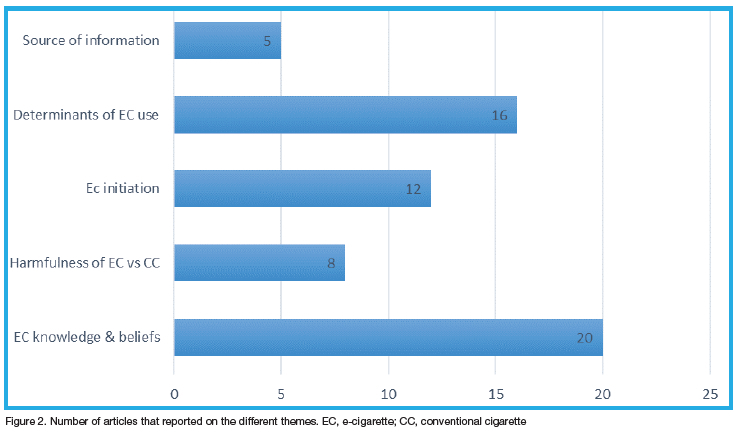
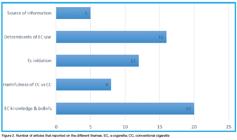
A thematical analysis was carried out to identify patterns in the research articles. Five themes emerged from the articles (Figure 2):
1. Source of e-cigarette information
2. Perceived harmfulness of e-cigarettes versus traditional cigarettes
3. E-cigarette initiation
4. Determinants of e-cigarette use
5. E-cigarette knowledge and beliefs
Source of information
Five studies discussed the source of e-cigarette information.27, 39, 40, 42, 4450
Determinants of e-cigarette use
The environment surrounding adolescents determines whether they are susceptible to e-cigarette use. Adolescents who were surrounded by friends who vape have a higher chance of joining than adolescents who were not surrounded by people who vape. When participants were asked what would help them to stop using e-cigarettes, they responded that they would stop vaping if they were "not being around friends who use them".4233434448 5150
E-cigarette initiation
Twelve studies explored the reason for initiating e-cigarettes.22, 23 28, 29, 32, 34, 42-45, 50, 53223942
Perceived harmfulness of e-cigarettes versus traditional cigarettes Eight studies reported that adolescents believed e-cigarettes were less harmful compared to traditional cigarettes.23-26, 46-48, 51 4424-26 A minority (2%-5%) of participants believed that e-cigarettes were more harmful. Between 10% and 50% did not know or were unsure of the harmful extent of e-cigarettes. E-cigarette users (71.8%) were more likely to report that e-cigarettes were less dangerous than traditional cigarettes while 31% of non-users were less likely to report that e-cigarettes were less dangerous.25
E-cigarette knowledge and beliefs
Twenty studies22-26,30-35, 37, 39-42, 44-47, 49,50 which reported on adolescents' knowledge of e-cigarettes was high (70%-85%) in all countries except for Canada. Most of the participants from Canada showed very little or no knowledge of e-cigarettes.4631
Nine studies reported on whether participants were aware of the nicotine content in e-cigarettes,22, 27,34, 39, 40-42, 44, 46222234, 4227, 44
Fourteen studies reported on the perceived benefits of e-cigarettes.22,26, 31, 36, 37, 42-50 Some participants said that e-cigarettes could be used as a smoking cessation tool, helping teens who struggle to quit smoking. Other participants described e-cigarettes as a coping mechanism to help reduce anxiety.26, 45, 492636, 46
DISCUSSION
It is evident from the reviewed articles that various factors influence e-cigarette use among adolescents. The belief that e-cigarettes are less harmful than traditional cigarettes was associated with e-cigarette use. E-cigarette users are more likely to self-report a positive perspective of e-cigarettes than non-users, this was shown in the studies conducted in the US.25, 26, 2738
This review shows that adolescents aged 12-17 in high-income countries have mixed perceptions regarding e-cigarettes. Most adolescents reported that e-cigarettes are less harmful than traditional cigarettes, and some adolescents believed e-cigarettes were not harmful. Adolescents also believed e-cigarettes contained artificial nicotine and were therefore less addictive and safer than traditional cigarettes.34, 42
Currently, public health has not reached consensus about whether e-cigarettes are less harmful than traditional cigarettes. Literature suggests that adolescents are not sure of how harmful e-cigarettes are, which might be due to this lack of public health consensus. More evidence suggests that e-cigarette use is linked to smoking addiction, especially in adolescents.545556575859,60 The risk profile of e-cigarettes is still evolving and it is a work in progress, but countries must consider that e-cigarettes pose a health risk and adolescents need to be informed about these health risks.
E-cigarette advertising conveys misinformation surrounding the safety of e-cigarettes to the public. Advertising companies design appealing content by portraying their devices as being fashionable and "cool" by using celebrities. Although companies state that they do not intend to advertise to the youth, their advertisements are appealing to the youth and impact their perception of devices.51506162
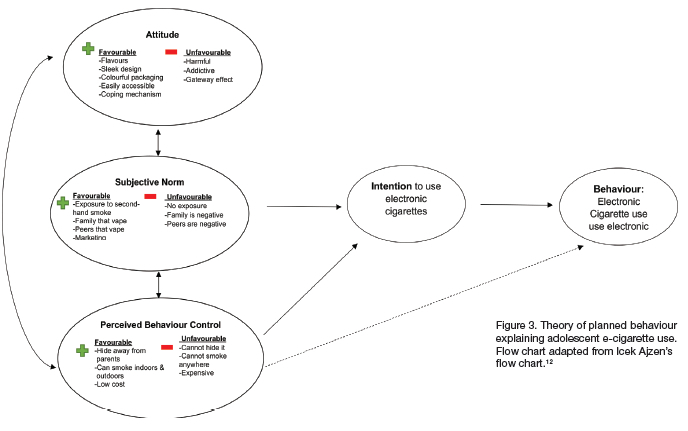
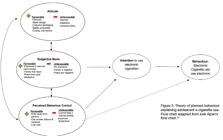
The TPB explains why adolescents use e-cigarettes (Figure 3). According to the TBP, perceptions play an important role on whether adolescents initiate e-cigarette use. Adolescents have a more favourable attitude towards e-cigarettes because of the vast array of flavours, especially sweet flavours. E-cigarettes also have a sleek design and colourful packaging, which influences adolescents' perceptions. E-cigarettes are easily accessible and are used as a coping method to help teens manage their stress and anxiety. Adolescents who have an unfavourable attitude believe that e-cigarettes are addictive and harmful or that e-cigarettes are a gateway to other risky behaviours. Adolescents are further pressured to start vaping if they are exposed to second-hand smoke and having their family and peers vape around them. E-cigarette marketing, including celebrities using e-cigarettes and doing tricks, also creates social pressure. Most adolescents who have family members or peers informing them of harmful effects do not initiate vaping. Non-motivational factors such as availability of resources and favourable opportunities to perform the behaviour represent the individual's control over the behaviour. Adolescents like that they can conceal e-cigarettes from their parents, unlike traditional cigarettes. Adolescents can use e-cigarettes indoors and outdoors. All these factors are determinants that either increase or decrease the intention to use an e-cigarette.
LIMITATIONS
The studies included in this review were conducted in France, Germany, the UK, Finland, Canada, Ireland and Hong Kong. Studies in other high-income countries such as Australia or New Zealand could not be identified. Studies from the US made up two-thirds of the total number of studies. The lack of studies from other countries limits our understanding of adolescents' knowledge and attitude toward e-cigarettes globally. Global information could help countries to develop interventions to stop e-cigarette use among adolescents. The scope was conducted by a single reviewer. Ideally, studies should be reviewed by two or more reviewers to reduce the risk of bias. Very few studies reported on the source of e-cigarette information. Future studies need to include questions on sources of information.
CONCLUSION
Findings indicate that adolescents are aware of e-cigarettes; however, their perceptions of them differ. Some adolescents believe that e-cigarettes are safe, while others believe them to be harmful to health or remain unsure of their effects. The study reveals that there is an association between adolescents' perceptions and e-cigarette use. Besides this association the exposure to e-cigarette advertising is significantly associated to e-cigarette use. Governments need to rethink regulations on e-cigarette advertising campaigns to reduce the number of adolescents initiating e-cigarette use. More research is needed to investigate the sources of e-cigarette information. This information will give public health officials an understanding of adolescent e-cigarette use so that misperceptions can be addressed to reduce the prevalence of e-cigarette use.
Declarations
Ethics approval
Ethical approval for this study was waived by the Queen Mary Ethics of Research committee.
All authors have contributed significantly, and all authors are in agreement with the manuscript.
Funding
This research did not receive any specific grant from funding agencies in the public, commercial or not-for-profit sectors.
Authors' contributions
1. Dr Rutendo Kudenga (primary researcher) 70%
2. Prof Martin Vorster (scientific writing) 20%
3. Justin Yang (scientific writing) 10%
Acknowledgements
Dr Cheryl Tosh (University of Pretoria) for editing
REFERENCES
- 1. National Center for Chronic Disease P, Health Promotion Office on S, Health. Publications and Reports of the Surgeon General. E-Cigarette Use Among Youth and Young Adults: A Report of the Surgeon General. Atlanta (GA): Centers for Disease Control and Prevention (US); 2016
-
2. Levy DT, Lindblom EN, Sweanor DT, et al. An economic analysis of the pre-deeming US market for nicotine vaping products. Tob Regul Sci. 2019;5(2):169-181. https://doi.org/10.18001/TRS.5.2.8
» https://doi.org/10.18001/TRS.5.2.8 -
3. Becker TD, Rice TR. Youth vaping: a review and update on global epidemiology, physical and behavioral health risks, and clinical considerations. Eur J Pediatr. 2022;181(2):453-462. https://doi.org/10.1007/s00431-021-04220-x
» https://doi.org/10.1007/s00431-021-04220-x -
4. Wang TW, Neff LJ, Park-Lee E, et al. E-cigarette use among middle and high school students - United States, 2020. MMWR Morb Mortal Wkly Rep. 2020;69(37):1310-1312. https://doi.org/10.15585/mmwr.mm6937e1
» https://doi.org/10.15585/mmwr.mm6937e1 -
5. US Department of Health and Human Services. Surgeon General's advisory on e-cigarette use among youth. Centres for Disease Control and Prevention; 2018. https://e-cigarettes.surgeongeneral.gov/documents/surgeon-generals-advisory-on-ecigarette-use-among-youth-2018.pdf. (accessed 22 February)
» https://e-cigarettes.surgeongeneral.gov/documents/surgeon-generals-advisory-on-ecigarette-use-among-youth-2018.pdf -
6. Food and Drug Administration. Statement from FDA Commissioner Scott Gottlieb, MD, on new steps to address epidemic of youth e-cigarette use. USA: Food and Drug Administration; 2018. https://www.fda.gov/news-events/press-announcements/statement-fda-commissioner-scott-gottlieb-md-new-steps-address-epidemic-youth-e-cigarette-use (accessed March 2 2023)
» https://www.fda.gov/news-events/press-announcements/statement-fda-commissioner-scott-gottlieb-md-new-steps-address-epidemic-youth-e-cigarette-use -
7. Action on Smoking and Health. Use of e-cigarettes among young people in Great Britain. 2021. https://ash.org.uk/wp-content/uploads/2021/07/Use-of-e-cigarettes-among-young-people-in-Great-Britain-2021.pdf (accessed 4 April)
» https://ash.org.uk/wp-content/uploads/2021/07/Use-of-e-cigarettes-among-young-people-in-Great-Britain-2021.pdf - 8. Guerin N, White V ASSAD 2017 Statistics & Trends: Australian secondary students' use of tobacco, alcohol, over-the-counter drugs, and illicit substances. 2020
-
9. Morean ME, Camenga DR, Bold KW, et al. Querying about the use of specific e-cigarette devices may enhance accurate measurement of e-cigarette prevalence rates among high school students. Nicotine Tob Res. 2020;22(5):833-837. https://doi.org/10.1093/ntr/nty240
» https://doi.org/10.1093/ntr/nty240 -
10. Soneji S, Barrington-Trimis JL, Wills TA, et al. Association between initial use of e-cigarettes and subsequent cigarette smoking among adolescents and young adults: A systematic review and meta-analysis. JAMA Pediatr. 2017;171(8):788-797. https://doi.org/10.1001/jamapediatrics.2017.1488
» https://doi.org/10.1001/jamapediatrics.2017.1488 -
11. Blaha M. 5 Vaping facts you need to know. Johns Hopkins Medicine; 2021. https://www.hopkinsmedicine.org/health/wellness-and-prevention/5-truths-you-need-to-know-about-vaping (accessed 4 April)
» https://www.hopkinsmedicine.org/health/wellness-and-prevention/5-truths-you-need-to-know-about-vaping -
12. Ajzen I. The theory of planned behavior. Organ Behav Hum Decis Process. 1991;50(2):179-211. https://doi.org/10.1016/0749-5978(91)90020-T
» https://doi.org/10.1016/0749-5978(91)90020-T -
13. Hershberger A, Connors M, Um M, Cyders MA. The theory of planned behavior and E-cig use: Impulsive personality, E-cig attitudes, and E-cig use. Int J Ment Health Addict. 2018;16(2):366-376. https://doi.org/10.1007/s11469-017-9783-6
» https://doi.org/10.1007/s11469-017-9783-6 -
14. Wang L, Chen J, Ho SY, et al. Exposure to e-cigarette advertising, attitudes, and use susceptibility in adolescents who had never used e-cigarettes or cigarettes. BMC Public Health. 2020;20(1):1349. https://doi.org/10.1186/s12889-020-09422-w
» https://doi.org/10.1186/s12889-020-09422-w -
15. World Health Organization. The Convention Secretariat. Information note on classification of novel and emerging tobacco products 2019. https://untobaccocontrol.org/impldb/wp-content/uploads/Info-Note_Novel-Classification_EN.pdf (accessed 15/11/2022)
» https://untobaccocontrol.org/impldb/wp-content/uploads/Info-Note_Novel-Classification_EN.pdf - 16. National Academies of Sciences Engineering and Medicine. Public health consequences of e-cigarettes. Washington, DC: National Academies Press; 2018
-
17. Eltorai AE, Choi AR, Eltorai AS. Impact of electronic cigarettes on various organ systems. Respir Care. 2019;64(3):328-336. https://doi.org/10.4187/respcare.06300
» https://doi.org/10.4187/respcare.06300 -
18. Centers for Disease Control and Prevention. Outbreak of lung injury associated with the use of e-cigarette, or vaping, products. 2021. https://www.cdc.gov/tobacco/basic_information/e-cigarettes/severe-lung-disease.html#epi-chart (accessed 02/04/2022)
» https://www.cdc.gov/tobacco/basic_information/e-cigarettes/severe-lung-disease.html#epi-chart -
19. Murdoch University. Systematic reviews-Research guide. 2022. https://libguides.murdoch.edu.au/systemati (accessed 1 April)
» https://libguides.murdoch.edu.au/systemati -
20. Page MJ, McKenzie JE, Bossuyt PM, et al. The PRISMA 2020 statement: an updated guideline for reporting systematic reviews. BMJ. 2021;372:n71. https://doi.org/10.1136/bmj.n71
» https://doi.org/10.1136/bmj.n71 -
21. World Bank. World Bank country and lending groups. 2022. https://datahelpdesk.worldbank.org/knowledgebase/articles/906519-world-bank-country-and-lending-groups (accessed 14 March)
» https://datahelpdesk.worldbank.org/knowledgebase/articles/906519-world-bank-country-and-lending-groups -
22. Pepper JK, Ribisl KM, Brewer NT. Adolescents' interest in trying flavoured e-cigarettes. Tob Control. 2016;25(Suppl 2):ii62-ii66. https://doi.org/10.1136/tobaccocontrol-2016-053174
» https://doi.org/10.1136/tobaccocontrol-2016-053174 -
23. Park E, Kwon M, Gaughan MR, Livingston JA, Chang YP. Listening to adolescents: Their perceptions and information sources about e-cigarettes. J Pediatr Nurs. 2019;48:82-91. https://doi.org/10.1016/j.pedn.2019.07.010
» https://doi.org/10.1016/j.pedn.2019.07.010 -
24. Ambrose BK, Rostron BL, Johnson SE, et al. Perceptions of the relative harm of cigarettes and e-cigarettes among US youth. Am J Prev Med. 2014;47(2):S53-S60. https://doi.org/10.1016/j.amepre.2014.04.016
» https://doi.org/10.1016/j.amepre.2014.04.016 -
25. Amrock SM, Zakhar J, Zhou S, Weitzman M. Perception of e-cigarette harm and its correlation with use among US adolescents. Nicotine Tob Res. 2015;17(3):330-336. https://doi.org/10.1093/ntr/ntu156
» https://doi.org/10.1093/ntr/ntu156 -
26. Bernat D, Gasquet N, Wilson KOD, Porter L, Choi K. Electronic cigarette harm and benefit perceptions and use among youth. Am J Prev Med. 2018;55(3):361-367. https://doi.org/10.1016/j.amepre.2018.04.043
» https://doi.org/10.1016/j.amepre.2018.04.043 -
27. East K, Brose LS, McNeill A, et al. Harm perceptions of electronic cigarettes and nicotine: A nationally representative cross-sectional survey of young people in Great Britain. Drug Alcohol Depend. 2018;192:257-263. https://doi.org/10.1016/j.drugalcdep.2018.08.016
» https://doi.org/10.1016/j.drugalcdep.2018.08.016 -
28. Ebrahimi Kalan M, McKelvey K, Ibrahimou B, Trucco EM, Ben Taleb Z. The road to vaping: e-cigarette susceptibility and curiosity among US adolescents susceptible and nonsusceptible to cigarette smoking. Health Educ Behav. 2020;47(5):696-705. https://doi.org/10.1177/1090198120943166
» https://doi.org/10.1177/1090198120943166 -
29. Ford A, MacKintosh AM, Bauld L, Moodie C, Hastings G. Adolescents' responses to the promotion and flavouring of e-cigarettes. Int J Pub Health. 2016;61(2):215-224. https://doi.org/10.1007/s00038-015-0769-5
» https://doi.org/10.1007/s00038-015-0769-5 -
30. Giovacchini CX, Pacek L, McClernon FJ, Que LG. Use and perceived risk of electronic cigarettes among North Carolina middle and high school students. NC Med J. 2017;78(1):7-13. https://doi.org/10.18043/ncm.78.1.7
» https://doi.org/10.18043/ncm.78.1.7 -
31. Gorukanti A, Delucchi K, Ling P, Fisher-Travis R, Halpern-Felsher B. Adolescents' attitudes towards e-cigarette ingredients, safety, addictive properties, social norms, and regulation. Prev Med. 2017;94:65-71. https://doi.org/10.1016/j.ypmed.2016.10.019
» https://doi.org/10.1016/j.ypmed.2016.10.019 -
32. Hanafin J, Sunday S, Clancy L. Friends and family matter most: a trend analysis of increasing e-cigarette use among Irish teenagers and socio-demographic, personal, peer and familial associations. BMC Public Health. 2021;21(1):1988. https://doi.org/10.1186/s12889-021-12113-9
» https://doi.org/10.1186/s12889-021-12113-9 -
33. Kwon E, Seo DC, Lin HC, Chen Z. Predictors of youth e-cigarette use susceptibility in a US nationally representative sample. Addict Behav. 2018;82:79-85. https://doi.org/10.1016/j.addbeh.2018.02.026
» https://doi.org/10.1016/j.addbeh.2018.02.026 -
34. Pepper JK, Farrelly MC, Watson KA. Adolescents' understanding and use of nicotine in e-cigarettes. Addict Behav. 2018;82:109-113. https://doi.org/10.1016/j.addbeh.2018.02.015
» https://doi.org/10.1016/j.addbeh.2018.02.015 -
35. Rohde JA, Noar SM, Horvitz C, et al. The role of knowledge and risk beliefs in adolescent e-cigarette use: A pilot study. Int J Environ Res Public Health. 2018;15(4):830. https://doi.org/10.3390/ijerph15040830
» https://doi.org/10.3390/ijerph15040830 -
36. Tackett AP, Keller-Hamilton B, Hébert ET, et al. Adolescent susceptibility to e-cigarettes: An update from the 2018 National Youth Tobacco Survey. Am J Health Promot. 2021;35(4):551-558. https://doi.org/10.1177/0890117120971121
» https://doi.org/10.1177/0890117120971121 -
37. Weishaar H, Trevisan F, Hilton S. 'Maybe they should regulate them quite strictly until they know the true dangers': a focus group study exploring UK adolescents' views on e-cigarette regulation. Addiction. 2016;111(9):1637-1645. https://doi.org/10.1111/add.13377
» https://doi.org/10.1111/add.13377 -
38. Hansen J, Hanewinkel R, Morgenstern M. Electronic cigarette marketing and smoking behaviour in adolescence: a cross-sectional study. ERJ Open Res. 2018;4(4):00155-02018. https://doi.org/10.1183/23120541.00155-2018
» https://doi.org/10.1183/23120541.00155-2018 -
39. Jiang N, Wang MP, Ho SY, Leung LT, Lam TH. Electronic cigarette use among adolescents: a cross-sectional study in Hong Kong. BMC Public Health. 2016;16(1):202. https://doi.org/10.1186/s12889-016-2719-4
» https://doi.org/10.1186/s12889-016-2719-4 -
40. Kinnunen JM, Ollila H, El-Amin SE-T, et al. Awareness and determinants of electronic cigarette use among Finnish adolescents in 2013: a population-based study. Tob Control. 2015;24(e4):e264-e270. https://doi.org/10.1136/tobaccocontrol-2013-051512
» https://doi.org/10.1136/tobaccocontrol-2013-051512 -
41. El-Amin S, Kinnunen JM, Rimpelä A. Adolescents' perceptions of harmfulness of tobacco and tobacco-like products in Finland. Int J Environ Res Public Health. 2022;19(3):1485. https://doi.org/10.3390/ijerph19031485
» https://doi.org/10.3390/ijerph19031485 -
42. Alexander JP, Williams P, Lee YO. Youth who use e-cigarettes regularly: A qualitative study of behavior, attitudes, and familial norms. Prev Med Rep. 2018;13:93-97. https://doi.org/10.1016/j.pmedr.2018.11.011
» https://doi.org/10.1016/j.pmedr.2018.11.011 -
43. Bold KW, Kong G, Cavallo DA, Camenga DR, Krishnan-Sarin S. Reasons for trying e-cigarettes and risk of continued use. Pediatrics. 2016;138(3):e20160895. https://doi.org/10.1542/peds.2016-0895
» https://doi.org/10.1542/peds.2016-0895 -
44. de Andrade M, Angus K, Hastings G. Teenage perceptions of electronic cigarettes in Scottish tobacco-education school interventions: co-production and innovative engagement through a pop-up radio project. Perspect Public Health. 2016;136(5):288-293. https://doi.org/10.1177/1757913915612109
» https://doi.org/10.1177/1757913915612109 -
45. Fairman RT, Weaver SR, Akani BC, Dixon K, Popova L. "You have to vape to make it through": E-cigarette outcome expectancies among youth and parents. Am J Health Behav. 2021;45(5):933-946. https://doi.org/10.5993/ajhb.45.5.13
» https://doi.org/10.5993/ajhb.45.5.13 -
46. Hammal F, Finegan BA. Exploring attitudes of children 12-17 years of age toward electronic cigarettes. J Community Health. 2016;41(5):962-968. https://doi.org/10.1007/s10900-016-0178-6
» https://doi.org/10.1007/s10900-016-0178-6 -
47. Hilton S, Weishaar H, Sweeting H, Trevisan F, Katikireddi SV E-cigarettes, a safer alternative for teenagers? A UK focus group study of teenagers' views. BMJ Open. 2016;6(11):e013271. https://doi.org/10.1136/bmjopen-2016-013271
» https://doi.org/10.1136/bmjopen-2016-013271 -
48. Johnson AC, Mays D, Hawkins KB, Denzel M, Tercyak KP. A qualitative study of adolescent perceptions of electronic cigarettes and their marketing: Implications for prevention and policy. Child Health Care. 2017;46(4):379-392. https://doi.org/10.1080/02739615.2016.1227937
» https://doi.org/10.1080/02739615.2016.1227937 -
49. Less EL, Mady M, Beckman KJ, Kingsbury JH. "If someone has it, I'm gonna hit it": Lessons learned from Minnesota teens about vaping. Health Promot Pract. 2021:15248399211045353. https://doi.org/10.1177/15248399211045353
» https://doi.org/10.1177/15248399211045353 -
50. Brossier M, Querre M, Regnier Denois V Are French adolescents ready to adopt the electronic cigarette? A qualitative study of their knowledge and representations. J Public Health. 2022;30:573-582. https://doi.org/10.1007/s10389-020-01326-8
» https://doi.org/10.1007/s10389-020-01326-8 -
51. Farrelly MC, Duke JC, Crankshaw EC, et al. A randomized trial of the effect of e-cigarette TV advertisements on intentions to use e-cigarettes. Am J Prev Med. 2015;49(5):686-693. https://doi.org/10.1016/j.amepre.2015.05.010
» https://doi.org/10.1016/j.amepre.2015.05.010 -
52. Padon AA, Lochbuehler K, Maloney EK, Cappella JN. A randomized trial of the effect of youth appealing to e-cigarette advertising on susceptibility to use e-cigarettes among youth. Nicotine Tob Res. 2018;20(8):954-961. https://doi.org/10.1093/ntr/ntx155
» https://doi.org/10.1093/ntr/ntx155 -
53. Chaffee BW, Cheng J. Tobacco product initiation is correlated with cross-product changes in tobacco harm perception and susceptibility: Longitudinal analysis of the Population Assessment of Tobacco and Health youth cohort. Prev Med. 2018;114:72-78. https://doi.org/10.1016/j.ypmed.2018.06.008
» https://doi.org/10.1016/j.ypmed.2018.06.008 -
54. Al-Hamdani M, Manly E. Smoking cessation or initiation: The paradox of vaping. Prev Med Rep. 2021;22:101363. https://doi.org/10.1016/j.pmedr.2021.101363
» https://doi.org/10.1016/j.pmedr.2021.101363 -
55. Balfour DJK, Benowitz NL, Colby SM, et al. Balancing consideration of the risks and benefits of e-cigarettes. Am J Public Health. 2021;111(9):1661-1672. https://doi.org/10.2105/ajph.2021.306416
» https://doi.org/10.2105/ajph.2021.306416 -
56. Villanti AC, Feirman SP, Niaura RS, et al. How do we determine the impact of e-cigarettes on cigarette smoking cessation or reduction? Review and recommendations for answering the research question with scientific rigor Addiction. 2018;113(3):391-404. https://doi.org/10.1111/add.14020
» https://doi.org/10.1111/add.14020 - 57. Boseley S. Public Health England maintains vaping is 95% less harmful than smoking. The Guardian. 2018 28 December 2018
-
58. Centers for Disease Control and Prevention. Adult smoking cessation - The use of e-cigarettes. 2020. https://www.cdc.gov/tobacco/data_statistics/sgr/2020-smoking-cessation/fact-sheets/adult-smoking-cessation-e-cigarettes-use/index.html (accessed 31 March)
» https://www.cdc.gov/tobacco/data_statistics/sgr/2020-smoking-cessation/fact-sheets/adult-smoking-cessation-e-cigarettes-use/index.html -
59. Flint SW, Jones AW. The irresponsible promotion of e-cigarettes and Swaptober. Lancet Respir Med. 2018;6(1):e3-e4. https://doi.org/10.1016/s2213-2600(17)30473-3
» https://doi.org/10.1016/s2213-2600(17)30473-3 -
60. Tactics T. E-cigarettes: Marketing. University of Bath; 2021. https://tobaccotactics.org/wiki/e-cigarettes-marketing/ (accessed 31 March)
» https://tobaccotactics.org/wiki/e-cigarettes-marketing/ - 61. Perrone M, Collins D. Juul to pay nearly $440M to settle states' probe into marketing of vaping products for teens. USA Today. 2022
-
62. Fairchild AL, Bayer R, Colgrove J. The renormalization of smoking? E-cigarettes and the tobacco "Endgame". N Eng J Med. 2013;370(4):293-295. https://doi.org/10.1056/NEJMp1313940
» https://doi.org/10.1056/NEJMp1313940