Penetration of hydrogen peroxide into the pulp chamber after conventional and laser-assisted bleaching
Abstract
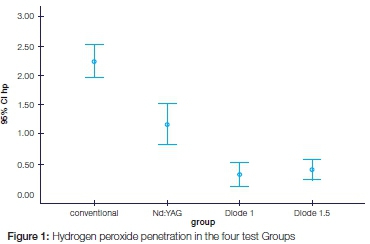
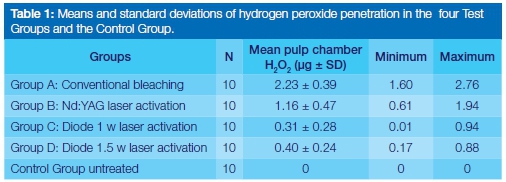
BACKGROUND: Bleaching is a conservative approach to improve tooth colour. Laser irradiation accelerates the process by activating the hydrogen peroxide (HP) bleaching agent. However, there is little data examining whether this might result in pulp injury by enhancing HP penetration and diffusion. This study measured HP penetration into the pulp chamber with different bleaching techniques. METHODS: Fifty extracted central maxillary incisors were collected, disinfected, root treated and stored in sterile saline solution. The pulp chambers were filled with an acetate buffer solution. Bleaching was performed with one of four methods: 1. Conventional in-office bleaching; and accelerated bleaching using 2. :yttrium-aluminium-garnet (Nd:YAG), 3. 1w Diode, and 4. 1.5w Diode lasers. A fifth control Group received no treatment. The buffer solution was drained and stained by colourimetric spectrophotometry to determine optical densities, which were analyzed by one-way ANOVA followed by Tukey honest significant difference (HSD) test. RESULTS: The greatest penetration occurred with the conventional in-office bleaching procedure (2.232 ± 0.39μg), while the least was seen with Diode (1w) laser-assisted bleaching (0.31 ± 0.28μg). : Provided the manufacturer's recommendations are followed, laser acceleration does not exacerbate penetration of HP into the pulp chamber.
hydrogen peroxide; tooth bleaching; Nd; YAG laser; Diode laser
 Thumbnail