Oral health workers' perspectives on systemic challenges and service disparities in denture services provision in selected districts of KwaZulu-Natal, South Africa
Abstract
INTRODUCTION: The access for care related to edentulism remains a challenge for aging and disadvantaged populations reliant on public oral health services in South Africa. There is limited data on the accessibility, availability, and quality of denture services in the districts of KwaZulu-Natal AIMS AND OBJECTIVES: This study explored denture services delivery in public oral health facilities in the Harry Gwala and eThekwini districts through semi-structured interviews with provincial health executives, public and private oral health workers STUDY DESIGN: An interpretivist qualitative research design METHODS: This study enrolled voluntary and purposively selected participants from both public and private oral health sectors (n=20). Participants from the public sector included provincial executive managers, managers of public dental facilities, dentists, dental therapists, dental technicians and dental assistants. Participants from the private oral health sector included dentists and dental therapists. Data was collected through a semi-structured interview consisting of three main categories: 1. The awareness of public denture services. 2. Inclusion of public denture services in the essential oral healthcare package and 3. The incorporation of denture services in the National Health Insurance (NHI) essential package. Data analysis was conducted using NVivo 15 Software for Qualitative Data Analysis, ending up with a list of codes and categories which resulted in the emergence of recurring themes RESULTS: Four themes emerged from data analysis, namely: Poor availability and access to oral health rehabilitative services; Limited financial and human resources; Challenges with the reprioritisation of oral health service provision in the public dental clinics; and Opportunities and barriers to denture service delivery. The findings revealed disparities in the availability and accessibility across the study sites, with a notable absence of denture services in rural areas and long waiting lists in the urban district CONCLUSION: This study highlights that despite existing infrastructure and trained personnel, denture service provision in KZN remains limited due to systemic challenges, including inadequate funding and shortages in both clinical and technical aspects
Tooth extraction; Edentulism; Prosthodontic services; Denture provision; Public oral health; Dental service disparities; Oral health policy; Access to dental care; Oral rehabilitation; Oral health inequities
INTRODUCTION
The fabrication and delivery of complete and partial dentures is considered a basic rehabilitative offering in South African context.1, 2 However, the delivery of these removable prosthodontic services is often constrained due to inadequate human and infrastructural resources, lack of materials and poor referral systems.345
KwaZulu-Natal (KZN) is one of the most populated provinces of South Africa which reflects substantial variation in access to healthcare services across its urban and rural districts. The eThekwini District, which encompasses the metropolitan area of Durban, is relatively better resourced in comparison to rural districts such as Harry Gwala, which is characterized by high poverty levels and limited healthcare infrastructure.6
The purpose of this study was to explore the current state of denture services delivered through public oral health facilities in the Harry Gwala and eThekwini districts through semi-structured interviews with provincial health executives, public oral health division managers, public and private oral health workers. Specifically, it sought to identify systemic challenges and service disparities. Findings from this research are intended to support evidence-based planning to ensure equitable and effective denture service delivery in KZN.
METHODS AND MATERIALS
Study design
This study employed an interpretivist qualitative research design.
Setting
This study was conducted in selected private and public oral health facilities of Harry Gwala and eThekwini districts, KwaZulu-Natal (KZN), South Africa.
Study participants
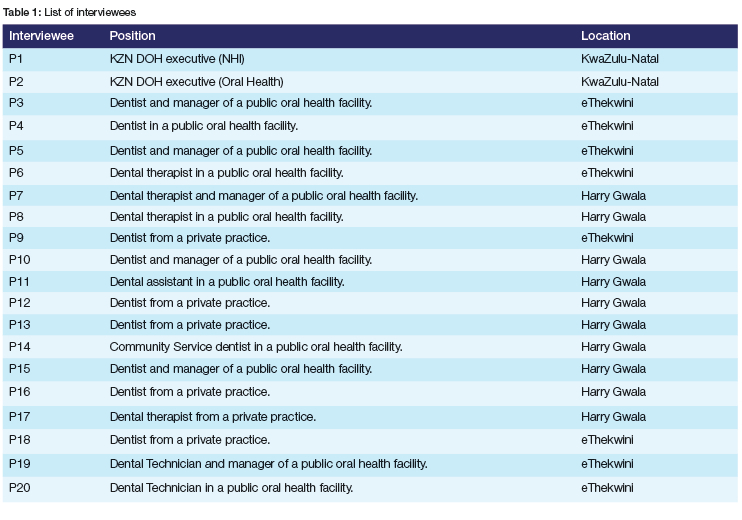
Participants in this study were selected from both public and private oral health sectors. Participants from the public sector included provincial executive managers, managers of public dental facilities, dentists, dental therapists, dental technicians and dental assistants. Participants from the private oral health sector included dentists and dental therapists. The selection criteria for public sector participants were based on their involvement in the daily service delivery of oral health services, which primarily focused on removable dentures. Private practitioners were selected based on their proximity to the same communities that are being serviced by the public oral health facilities. Executive health managers were included in the study so as to gain insight on systemic challenges, resource allocation, and overall service delivery structure and policy priorities.
Sample size
All study participants were purposely selected and invited to voluntarily participate in this study. A total of twenty participants consented and participated in this study, Table 1.
Data collection instrument
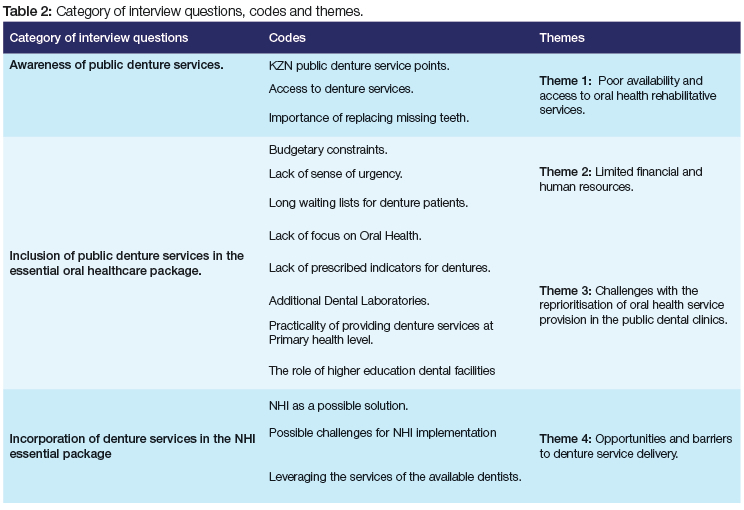
This study used a semi-structured interview to collect data. The interview schedule consisted of three main categories such as the awareness of public denture services, inclusion of public denture services in the essential oral healthcare package and the incorporation of denture services in the NHI essential package. These questions were preceded by introductory questions that required the interviewee to relate their scope of practice and responsibilities in their specific roles.
Data collection procedure
The executive managers, private and public oral health facilities' contact details were retrieved from public websites. Communication was entered into with the listed contact persons who guided the researcher to the relevant gatekeepers. The gatekeepers subsequently connected the researcher with the prospective participants for their voluntary consideration to participate in this study and matters of voluntary participation, anonymity and confidentiality were discussed. Interviews were scheduled with those who have consented to participate in this study at their preferred location. Two participants opted for an online video call via MS Teams and WhatsApp, to accommodate their busy schedules. The rest of the participants were interviewed face-to-face at their places of work. All interviews were recorded to allow for transcription and ease of analysis. The audio recording only ensued after permission was obtained from the interviewee and after they had signed the informed consent form. These interviews were conducted once-off for a duration of 30-60 minutes. The full interview transcripts were returned to participants for review as part of the member-checking process where participants were invited to verify the accuracy of their transcripts and to provide any clarifications, corrections, or additional comments they felt were necessary. This process allowed participants to confirm that their views had been accurately captured and contributed to enhancing the authenticity and trustworthiness of the data. Credibility was ensured through establishing confirmability by using direct quotations to convey the opinions of participants.
Ethical consideration
This research was approved by the Humanities and Social Sciences Research Ethics Committee (HSSREC) of the University of KwaZulu-Natal, with reference number: HSSREC/00000444/2019. Gatekeeper permission was obtained from the KZN Department of Health with reference number KZ_202001_020.
Data analysis
The data from interviews were analysed using thematic analysis which entailed data familiarisation and writing of familiarisation notes by reading through all transcripts and making annotations. Thereafter, the researcher systematically coded the data using NVivo 15 Software for Qualitative Data Analysis. The generated codes were reviewed and organised into categories based on addressing similar concepts of this study. These categories resulted in the emergence of initial themes which were later reviewed by revisiting the codes and the original transcripts to ascertain relevance and alignment with the objective of this study. The final activity was the writing up of the report, substantiating it with extracts of the interviewee's responses.
RESULTS
The analysed data resulted in the emergence of four themes in alignment with the objective of this study. The categories of interview questions were the awareness of public denture services, inclusion of public denture services in the essential oral healthcare package and the incorporation of denture services in the NHI essential package. The following themes emerged from data analysis (1) Poor availability and access to oral health rehabilitative services, (2) Limited financial and human resources, (3) Challenges with the reprioritisation of oral health service provision in the public dental clinics. and (4) Opportunities and barriers to denture service delivery, (Table 2).
Theme 1: Poor availability and access to oral health rehabilitative services.
Oral health practitioners interviewed in this study highlighted critical challenges related to the availability and access to basic denture services within the public healthcare system of KZN. While they were able to identify the existing public oral health facilities that offer denture services, they indicated that such services were non-existent in rural areas.
"I am not aware of any in the rural areas, and I am pretty sure there is nothing." (P16)
These responses necessitated probing into how the public oral health workers from the rural district address patients in need of oral rehabilitative services. The respondents indicated that they offer patient information on the available options to replace missing teeth and refer them to private dental practices.
"So after doing the extraction you only explain it to the patient that, okay, now we've done the extraction, this is how you're going to, okay, say if you want to close the gap these are the options that you have. If they can be able to put a bridge on, explain it to them, if they're not able to afford a bridge, you explain to them that there's something called a denture and you explain to them that it's a removable denture. But you can't give them exact price, but you can give them a rough estimate and say, okay, maybe move from dentist to dentist, you shop around, yes, R1 000 plus per tooth, maybe, I don't know." (P6)
Some private and public oral health workers from both districts mentioned that although they have referred patients to the known public denture service providers in Durban, they still do not receive these services.
"So, we just refer them, so some patients go there and they can't get the service. And they come back to us, for us to provide some sort of services to them. So obviously it's those that can afford something." (P9)
Respondents pointed out that there is a need to expand denture services into rural areas highlighting that this would be beneficial for under-served populations.
"So, bringing those services will really help and looking at the fact most people are unemployed and low economic factors and all those things. For instance, someone will come to you with an abscess and when you ask why did you wait for so long? they will say that they were waiting to get paid, and to get the social grant." (P7)
One interviewee expressed that such an implementation would make life easier because the denture services will be widespread, leading to the reduction of the long waiting lists in those facilities that are currently over-burdened by having to offer these services to all the referred patients who need of dentures.
These respondents' views were consistent with other participants' statements that highlighted the implications of a lack of rehabilitative services on an individual's oral health-related quality of life. Some interviewees expressed that not replacing missing natural teeth could compromise the proper functioning of the oral cavity, including dietary intake.
"If you have tooth loss you have a risk of the teeth collapsing. You have drifting and mobility. So, if anything, your tooth that is lost, that needs to be replaced by some form like either a denture, a bridge, you know a pontic, something to fill up the gap so you do not have drifting of the teeth. That is the basic purpose of a denture, besides aesthetics and confidence and that." (P5)
Given the implications of non-replacement of missing teeth, as stated by the respondents, it was imperative to explore the possibility of incorporating basic denture services into the essential oral healthcare package and the responses are presented in the next theme.
Theme 2: Limited financial and human resources.
Respondents highlighted several challenges that could hinder the inclusion of denture services into the essential oral healthcare package. Key issues raised included limited funding, shortages of dental materials and laboratory support.
"As I said before we do experience challenges with that, the program is actually in a grey area at the moment because of our challenges with the lab. So, at the moment they have an issue with the materials, they also, when you speak to them I am sure they are going to tell you that they have an issue procuring the materials." (P3)
Interviewees reported shortage of staff in the clinical setting which compromises service delivery regardless of their willingness to perform certain procedures, they end up overwhelmed with patient numbers.
"I think it is also, because we do not have enough staff. Yes. Enough staff to do the work, because sometimes we want to do scaling and maybe fillings, but it gets packed." (P14)
Respondents from the private sector indicated that their previous experiences of working in the public sector, was also characterized by shortages in the availability of dental materials, bad work ethics and prolonged delays in procurement processes to access essential resources. This reported lack of urgency, impacted negatively on service delivery and staff morale as well.
"Because yes, we couldn't do even the fillings, you get there, you ask for materials, you ask for stuff and then it will take a year for them to procure those things. By the time they come with those things, you've already given up, you're leaving that facility." (P12)
The experiences with the slow procurement systems were also supported by the managers of public oral health facilities who stated that repairs on critical equipment could sometime take up to a year.
"Because even with the scale and polish, we recently got this scaler, maybe last year. We had one which broke, they sent it for repairs, I think for the whole year we never got it back, because also those channels we have to go through the government, everything just takes long for whatever reason." (P15)
The reported budget restrictions and limited resources may have potentially resulted to the issue of long waiting lists for denture services, and this finding was consistent across private and public respondents, irrespective of the reporting district.
"Our waiting list at the moment is something like about six to seven years." (P3)
Theme 3: Challenges with the reprioritisation of oral health service provision in the public dental clinics.
Respondents from the public and private sectors voiced their opinions on the limited inclusion of denture services within the essential oral healthcare package. Participants also pointed to policy gaps and inconsistent prioritization of rehabilitative care in national and provincial strategies, attributing this to lack of oral health representatives in strategic positions at district level.
"But the thing is as I am saying, oral health care is not prioritized. I think that the challenge that we're facing with oral health, it might be represented maybe in the provincial thing but there is no representation in the district level, no one is there to look out for it." (P12)
They further expressed that this general lack of focus on oral health and lack of clear indicators for denture services is the result of the prescribed oral health targets that are focused on extractions to restorations ratios. Respondents added that they end up performing a lot of dental extractions largely to meet the performance indicators. One interviewee added that these oral health targets have little to no concern about following through with what happens to the patients after their teeth have been extracted.
"But they tell us that this is what we have to do, denture facilities are not part of our target requirement at the moment. The things that they are concerned about is the headcount, the extractions that we do, the number of extractions, the number of restorations, the number of outreach and community-based initiatives that we take part in and the ratio of extractions to restorations that we do. So those are the main indicators that we have but there are other services that we do offer here" (P3)
A respondent from the private sector voiced a strong opinion that dental schools play a big role in providing services to communities, by reflecting on their involvement with community dentistry while they were undergoing training. Thus, academic complexes were seen to be able to provide additional resources for the delivery of denture services.
"Even at school I did projects with the dentures, when I was a student, offering communities dentures, that was in Cape Town. Offering communities of Kraaifontein, volunteering for the projects to give dentures to a community." (P13)
One interviewee highlighted a systemic issue within oral and dental education, noting that the current approach places greater emphasis on training clinically oriented dental professionals with less focus on dental laboratory-based education. This necessitates the reassessment and reprioritization of national and provincial oral health objectives and targets.
Theme 4: Opportunities and barriers to denture service delivery.
Participants believed that additional dental laboratories at district level with a proper referral system would make things easier for the delivery of dentures services, because currently there is only one dental laboratory that is servicing the entire KZN province.
"So, we all need to be, if we had a district lab and all the facilities are working together then it makes it easier than saying okay, this facility is only allowed to use this thing, for instance. It needs to work together. Like a referral system, a proper referral system." (P10)
Respondents from the public sector suggested leveraging the services of the dentists that are already in the public health system to incorporate denture services without burdening the Department of Health financially. One interviewee voiced that while there are dentists already employed, there is a need to concurrently enhance the dental laboratory provisions.
"The main problem is going to be where the lab is, we sort that lab out and then we sort of incorporate everybody at all levels wherever there is a dentist employed, then we will not have this situation" (P3)
There was a shared belief that plastic dentures should be classified as a basic service which should be provided at primary health care level. One participant further expressed that the clinicians in the public oral health sector should be enabled to replace teeth that they have extracted, even if it is through dentures. This implies that recognizing dentures as essential would address the current imbalance that exists in the KZN public health systems where tooth extractions are prioritised over tooth replacement.
"I think plastic dentures should be, become a basic service because at the end of the day it is not, what is the word, it is not an invasive procedure it is just impressions. So, I think it should be classified at primary oral healthcare level because it is, as we are saying extractions, fillings, cleanings are basic service, when you extract a tooth you should be able to put a tooth back even though it is a denture not a crown or a bridge. It is something that would really help the patient in terms of as you said appearance, and just basic self-esteem." (P4)
With regards to the National Health Insurance (NHI) system, the majority of interviewees stated that they lack knowledge and understanding of the NHI programme in general, but particularly in the oral health context.
"I will be honest, I do not 100% know exactly how the NHI is going to work, what services they are planning to include or offer, because I know in certain countries they have limited services." (P10)
This reported lack of knowledge was attributed to a poor to non-existent consultative process with the people who are central to the programme's implementation.
"I do not know anything about NHI. No training, no workshop, nothing. We were not even told anything about it, we just know what we know from the news. And I do not think it would even be successful." (P15)
Most respondents believed that this lack of consultation could challenge the successful implementation of NHI in the public oral health space, highlighting that there is lack of buy-in from the people on the ground, who are central in the execution of the programme.
"They need to get a buy-in from dentistry itself to see how this model is actually going to work. So, and the people that are actually, it cannot be people that are sitting in an office somewhere. That is where most of these things are going to fail. If the people that are making the policies are going to be people that have been sitting in the office maybe for the last 15 years of their lives, they have lost touch with what is happening on the ground. The people that are making the decisions need to consult the people at the bottom to say that listen these are the challenges that we have there. So, at the top somebody can say NHI yes, put it in there and let them provide the service to everybody." (P3)
While most respondents, including public and private practitioners expressed that their lack of knowledge and buy-in into the NHI programme is due to the poor consultation by the province's officials, one participant believed that it is expected that it is expected for private practitioners to show signs of resistance because they provide paid for services and are running for-profit practices.
"Any reforms will attract some resistance because of many reasons. But we are coming from a background of health services being commodified. You are mentioning the private space. That space is driven by profit. Currently in South Africa for a public sector client, generally across the country the cost is about R5 000.00 per person out of the budget. But in the private sector that is servicing only that 14,15, 16%, the cost is about R20 000.00." (P1)
Some participants expressed that there is evidence of NHI failing in other countries that have implemented it before South Africa.
"So, if this is an ideal system the way it is proposed then you will, because in the United Kingdom they have it already and I have been to the United Kingdom and I have seen how it works, they also have their challenges because again waiting lists, again cost factors and again not being paid." (P4)
Unlike the respondents who had no knowledge about NHI, some respondents believed that there is a possibility to transfer and adapt the NHI implementation strategy of contracting private medical practitioners that has already been tested with the general practitioners into the private-public oral health space.
"I think if NHI can, because I know right now that in clinics they are able to contract private doctors to do a service. Maybe if they can use that similar approach okay they get private dentists to do denture service or whatnot. Because there are lab fees involved. Maybe that can work. But to set up the infrastructure like with us in the public sector and providing those resources, I think it would take time, not that it is not feasible, it can be done but it is going to be an exercise that will take a long time." (P2)
Another form of private-public partnership that was mentioned is that of private or commercial dental laboratories being contracted to augment the services that are being offered by the public dental laboratory for the provision of dentures. One participant expressed that their facility used to utilise private laboratory services but this was discontinued due to budget reductions following the impacts of the Covid-19 pandemic.
"So, we were doing denture services up until point of COVID, we had services shut down due to COVID itself and then afterwards budget constraints has stopped the service. Basically, we used to use a private lab where we were given a certain amount of budget per year in order to do treatment for, accommodate like forty patients with that budget." (P4)
Some respondents believed that there is a significant role that may be played by the NGOs in closing the existing gaps in service delivery, particularly in the future integration of basic dentures in the primary healthcare level.
"So, NGOs, if they were to come, it would help a lot. I think we're actually failing on the aims that we want to achieve. We are far back. So, it would definitely be helpful." (P8)
DISCUSSION
This study explored the current state of denture services provided by public health facilities in the Harry Gwala and eThekwini districts and found various resource constraints that resulted in poor denture service delivery, as expressed by provincial health executives, public oral health division managers, public and private oral health workers. They also expressed opportunities to remedy the current service delivery status.
The findings of this study indicate that there are disparities in the availability and accessibility of oral health rehabilitative services within the identified study sites, particularly highlighting the absence of denture services in rural areas. These findings are consistent with a number of studies that have also reported on rural-urban oral health disparities globally, where rural populations consistently experience reduced access to dental care compared to their urban counterparts.7, 8 This study also found that not having these services in rural areas resulted in the public oral health providers referring patients to the urban-based private practitioners. These referrals financially burden the patients because the process of obtaining dentures requires multiple consultations and would require them to spend on travelling multiple times.9, 10 These findings imply that the urban based services create a barrier of access for the rural communities due to cost factors and indicate lack of health-related social justice for the population that majorly depend on social grants while managing competing basic needs, particularly the elderly.1112, 13
Of greater concern is the notion reported by several respondents that while select urban facilities in the eThekwini district provide denture services, the referred patients are often met with long waiting lists which further exacerbates the cycle of unmet oral healthcare and not just rural areas. This strongly implies that there is a high demand placed on the few public oral health facilities that offer denture services. These findings correspond with current studies from other parts of South Africa, and this suggests that this is a widespread phenomenon in the country's public oral health facilities.141414-16
The findings of this study highlighted both functional and psychosocial impacts of untreated edentulism, linking tooth loss with compromised mastication, nutritional deficiencies, drifting of adjacent teeth, and reduced self-esteem. This aligns with other global studies that highlight the significant burden of tooth loss on oral health-related quality of life.17, 18 Despite this information being readily available to all major role players in the oral health space, oral rehabilitation remains under-prioritized in public sector planning and funding, particularly in rural settings of KZN. Some respondents believed that there's an opportunity to improve this situation by decentralizing dental laboratory services from the eThekwini district and establishing additional laboratories in several districts. This decentralization, combined with the creation of a well-coordinated referral system, was viewed as essential to alleviating the current issue of long waiting lists for dental laboratory-based prostheses. This aligns with the assertions by McGarry and Jacobson19
In addition to the constraints concerning the dental laboratory services, the findings revealed that routine procedures, including fillings and scaling, are sometimes suspended because of lack of consumables, a phenomenon previously documented in evaluations of public health system efficiency in South Africa.3, 20 The respondents further described critical infrastructure and equipment breakdowns, with some tools such as scalers remaining non-functional for over a year due to bureaucratic repair processes, which is consistent with recent reports from the KZN Health Department.21, 22 This finding reflects broader challenges in health system responsiveness, particularly in lower-resource settings where centralised procurement and maintenance systems are slow and often unresponsive and literature indicates that this is not unique to South Africa.23, 24 The extended delays in obtaining essential resources not only limit service delivery but also contribute to a culture of low morale and professional burnout, as reflected in the demotivation and resignation of oral health professionals from public service. These findings are consistent with studies identifying South Africa's significant oral health workforce shortages, particularly in rural areas, as a critical barrier to expanding the scope of public dental services.2526, 27 However, given the shortages reported above, these provisions need to be interrogated as currently they seem to be creating false hope for the destitute.
Another challenge is that most respondents did not understand the NHI and UHC framework in the South African context, with many reporting that their only exposure to the NHI bill had been through the media. This is contradictory to the findings of a recent national study by Muofhe, Makwakwa,282928, 30, 31 While the respondents cited lack of knowledge of the SA NHI system, they had a negative outlook towards it being successfully implemented. Surprisingly, this is consistent with the findings of the Muofhe, Makwakwa,28
Nevertheless, there were also participants who saw potential in adapting existing NHI mechanisms used in contracting private general practitioners, proposing that similar public-private partnerships could be extended to dental care. By contracting private dentists for denture provision, particularly in areas where public infrastructure is lacking, the government could expand service reach while avoiding the delays associated with building new facilities. This approach has been successfully employed in other health domains and is supported by literature advocating for hybrid models to bridge service delivery gaps in resource-constrained systems.3233202027
RECOMMENDATIONSAs seen in countries such as Brazil and China as endorsed by the WHO global oral health strategy, plastic removable dentures should be formally recognized as a basic service within the essential oral healthcare package, deliverable at primary healthcare level alongside extractions and restorations.
This study therefore recommends strengthening of stakeholder engagement in NHI implementation, ensuring that the rollout includes targeted consultation for oral health professionals. Engaging practitioners through workshops, forums, and clear communication strategies will build the necessary buy-in for effective implementation through a robust review of systemic challenges and service disparities reported in this study.
The Department of Health should prioritize the establishment of dental laboratories at the district level to reduce the existing bottlenecks in denture service delivery. These labs should be adequately staffed and resourced to process referrals from multiple clinics within their catchment areas.
There is a need for ongoing research to evaluate the long-term impacts of denture service access on oral health-related quality of life, patient satisfaction, and system efficiency. This evidence will be critical for refining policies and scaling interventions provincially and nationally.
STRENGTHS AND LIMITATIONSThe study provided valuable insights into the current state of denture services delivered through public oral health facilities in the Harry Gwala and eThekwini districts of KZN, identifying systemic challenges, resource constraints, and opportunities for strengthening denture services. However, this study's findings are context-specific and cannot not be generalisable beyond the selected districts in KZN and the study's population. The use of a qualitative interpretivist design, while suitable for exploring in-depth perspectives, limits the ability to quantify findings or establish causality representativeness due to the relatively small sample size. Participant selection, particularly from private practitioners located near public facilities, may have excluded broader private sector insights. Additionally, while including executive managers offered valuable systemic perspectives, their views may not fully reflect frontline service challenges.
CONCLUSION
The findings of this study highlighted that the provision of denture services remains limited due to the reported systemic issues such as reported inadequate financial investment, shortage of staff and inadequate dental laboratory services. More efforts are required in ensuring the success of the NHI's funding model in order to enhance equitable access to denture services and avoid continued poor oral rehabilitative services for the underserved communities.
REFERENCES
- 1. Bhayat A, Chikte U. Human Resources for Oral Health Care in South Africa: A 2018 Update. Int J Environ Res Public Health. 2019;16(10).
- 2. Mukhari-Baloyi NA, Bhayat A, Madiba TK, Nkambule NR. A review of the South African national oral health policy. South African Dental Journal. 2021;76(9):551-7.
- 3. Bhayat A, Madiba TK, Nkambule NR. A Three-year Audit of Dental Services at Primary Health Care Facilities in Gauteng, South Africa: 2017 to 2019. J Int Soc Prev Community Dent. 2020;10(4):452-7.
- 4. Gerritsen AE, Allen PF, Witter DJ, Bronkhorst EM, Creugers NH. Tooth loss and oral health-related quality of life: a systematic review and meta-analysis. Health Qual Life Outcomes. 2010;8(1):126.
- 5. Singh A, Antunes JLF, Peres MA. Socio-Economic Inequalities in Oral Health. In: Peres MA, Antunes JLF, Watt RG, editors. Oral Epidemiology. Textbooks in Contemporary Dentistry. Cham: Springer International Publishing; 2021. p. 279-94.
- 6. Neely AH, Ponshunmugam A. A qualitative approach to examining health care access in rural South Africa. Soc Sci Med. 2019;230:214-21.
- 7. Daniel RS, Udgiri R, Karadi R, Rangoli AM. Assessment of oral health practices and their impact on oral health status and quality of life: a cross-sectional study in rural North Karnataka. Discover Public Health. 2025;22(1):455.
- 8. Gheasi M, Ishikawa N, Kourtit K, Nijkamp P. A meta-analysis of human health differences in urban and rural environments. Letters in Spatial and Resource Sciences. 2019;12(3):167-86.
- 9. Molete MP, Yengopal V, Moorman J. Oral health needs and barriers to accessing care among the elderly in Johannesburg. Sadj. 2014;69(8):352, 4-7.
- 10. Ayo-Yusuf IJ, Naidoo S. Social gradient in the cost of oral pain and related dental service utilisation among South African adults. BMC Oral Health. 2016;16(1):117.
- 11. Motloba PD, Makwakwa N, Machete LM. Justice and oral health-implications for reform: Part Two. South African Dental Journal. 2019;74(4):208-11.
- 12. Gao Q, Wang X, Jiang Y, Chen W, Gao K, Shi Y. Oral health and nutrition: addressing disparities in socioeconomically disadvantaged older adults in rural China. BMC Public Health. 2025;25(1):977.
- 13. Wang M, Deng X, Chen H, Diao Y, Liu C, Gao J, et al. Frailty mediated the association between tooth loss and mortality in the oldest old individuals: a cohort study. Frontiers in Public Health. 2024;11:1285226.
- 14. Motloba DP, Gwengu PR-Q, Moipolai PD. Inaccessible specialised oral health services in South Africa-rationing policy uncertainty. South African Dental Journal. 2023;78(8):414-8.
- 15. Wood N. Rethinking resource optimisation in South African public dental service and education. South African Dental Journal. 2025;80(2):63-7.
- 16. Bhayat A, Madiba T, Nkambule N. A review of the South African national oral health policy. SADJ: journal of the South African Dental Association = tydskrif van die Suid-Afrikaanse Tandheelkundige Vereniging. 2021;76:551-7.
- 17. Ibigbami OI, Folayan MO, Oginni O, Lusher J, Sam-Agudu NA. Moderating effects of resilience and self-esteem on associations between self-reported oral health problems, quality of oral health, and mental health among adolescents and adults in Nigeria. PLoS One. 2023;18(5):e0285521.
- 18. de Oliveira Rocha A, Goebel MC, Cardoso K, Dos Anjos LM, Cardoso M, Vitali FC, et al. Does the early loss of primary teeth impact the oral health-related quality of life of children? A systematic review and meta-analysis. Clin Oral Investig. 2025;29(4):213.
- 19. McGarry TJ, Jacobson TE. The professions of dentistry and dental laboratory technology: improving the interface. J Am Dent Assoc. 2004;135(2):220-6.
- 20. Wood N. Reimagining dental care funding in South Africa: A call for equitable healthcare. South African Dental Association (SADA); 2024. p. 235-7.
- 21. KwaZulu-Natal Department of Health. Annual report 2021/22. KwaZulu-Natal Provincial Government; 2022.
- 22. KwaZulu-Natal Department of Health. Annual report 2022/23. KwaZulu-Natal Provincial Government; 2023.
- 23. Josephin S, Nzala S, Baboo KS. Evaluation of oral hygiene services in selected public health facilities in Lusaka district of Zambia. J Public Health Afr. 2018;9(2):820.
- 24. Nyamuryekung'e KK, Lahti SM, Tuominen RJ. The relative patient costs and availability of dental services, materials and equipment in public oral care facilities in Tanzania. BMC Oral Health. 2015;15:74.
- 25. Tiwari R, Bhayat A, Chikte U. Forecasting for the need of dentists and specialists in South Africa until 2030. PLoS One. 2021;16(5):e0251238.
- 26. Jiang CM, Chu CH, Duangthip D, Ettinger RL, Hugo FN, Kettratad-Pruksapong M, et al. Global Perspectives of Oral Health Policies and Oral Healthcare Schemes for Older Adult Populations. Front Oral Health. 2021;2:703526.
- 27. Chan AKY, Tamrakar M, Leung KCM, Jiang CM, Lo ECM, Chu CH. Oral Health Care of Older Adults in Hong Kong. Geriatrics (Basel). 2021;6(4).
- 28. Muofhe T, Makwakwa N, Motloba DP. Knowledge and perception of oral health professionals regarding the National Health Insurance. South African Dental Journal. 2023;78(9):432-6.
- 29. Malele-Kolisa Y. Unpacking the NHI Bill recently passed by parliament in May 2023: Implications for oral health. South African Dental Journal. 2023;78(9):467-.
- 30. Gilson L, Barasa E, Nxumalo N, Cleary S, Goudge J, Molyneux S, et al. Everyday resilience in district health systems: emerging insights from the front lines in Kenya and South Africa. BMJ Glob Health. 2017;2(2):e000224.
- 31. Javadi D, Tran N, Ghaffar A. Building a Workforce for Future Health Systems: Reflections from Health Policy and Systems Research. Health Serv Res. 2018;53 Suppl 2(Suppl Suppl 2):4024-33.
- 32. Taylor M, Masood M, Mnatzaganian G. Differences in complete denture longevity and replacement in public and private dental services: A propensity score-matched analysis of subsidised dentures in adult Australians across 20 years. Community Dent Oral Epidemiol. 2023;51(2):318-26.
- 33. KwaZulu-Natal Department of Health. Annual report 2019/20. KwaZulu-Natal Provincial Government; 2020.
Yonela Bandezi
Address: Discipline of Dentistry, School of Health Sciences University of KwaZulu-Natal, Private Bag X54001, Durban, 4000, South Africa
Tel: +27313732051; Email:

Authors' contribution
1. Y Bandezi: Study conceptualisation, data analysis, manuscript preparation, writing and final editing (70%).
2. S Singh: Data analysis, manuscript preparation and editing (30%).