Cone beam computer tomography imaging of temporomandibular joint for forensic identification: A scoping review
Abstract
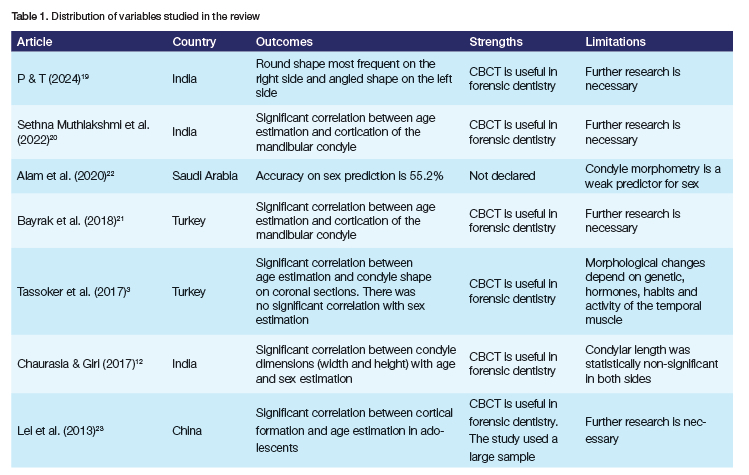
The temporomandibular joint (TMJ) is one of the most complex joints in the human body and it has been demonstrated to possess morphological features that are potentially valuable for forensic identification, both comparative and reconstructive. Cone beam computed tomography (CBCT) has exhibited increasing utilisation in dentistry due to its lower radiation dose, cost-effectiveness and expedited processing time. Given the substantial challenges encountered in forensic identification, we present a scoping review of TMJ studies for forensic identification through CBCT. From a total of 115 articles identified, seven were selected, all published between 2013 and 2024 by authors from Asian countries and without international collaborations. Several proposals for identification were ascertained, predominantly focused on reconstructive identification. Only one article postulated a comparative identification method. This indicates there is interest in utilising CBCT to study the TMJ for forensic identification; however, as there are no population validations, standardised protocols or technical capabilities for field work, further research is warranted.
Cone beam computed tomography; forensic identification; forensic dentistry; temporomandibular joint
 Thumbnail