A survey of car guards in Tshwane: Implications for private security policy and practice
Abstract
Car guards form an integral part of South Africa's urban landscape. This article reports on a survey of 144 car guards in Tshwane to identify the implications of their work for private security policy and practice. The profile of respondents reflects their low socio-economic status and marginalisation from the formal economy. The study found that some car guards struggle to survive financially because of the daily levies payable to car guard agencies and the managers of shopping centres. The results of the study suggest that, despite positive sentiments and advancements in policy and legislation, regulation of the formal car guarding industry remains constrained due to inadequate implementation and monitoring. The article offers insights into the factors affecting car guarding as a form of private security in South Africa.
Background characteristics of car guards
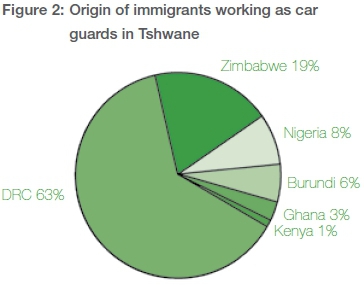
Car guards represent various types of people, although the disproportionate presence of immigrants is an important characteristic of the industry in highly urbanised areas. Evidence from Cape Town shows that a large number of car guards are refugees and migrants from the Democratic Republic of the Congo (DRC), Nigeria, Mozambique, Rwanda, Gabon and Malawi.28Figure 2). The families of immigrants who work as car guards rarely join them in South Africa and remittances are often sent home.29
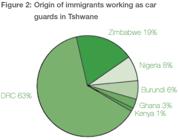
In a Cape Town study, car guards were mainly African, male and between the ages of 20 and 30 years.3031
The level of education among car guards varies, with notable differences between locals and immigrants. South African car guards have generally not continued their education beyond secondary school, while those from other countries often hold tertiary qualifications in the form of a diploma or degree.3233
The majority of car guards have wide-ranging previous work experience, with some having held formal positions in the service sector.3435
The bulk of respondents in the Tshwane study were male (99%). Only one female car guard was interviewed, which could be ascribed to the availability sampling method used in the study. Roughly half of respondents (49%) were single, while 47% were married and three each (2%) divorced or living together. Half the respondents (51%) lived with their families, while 38% lived alone and 11% lived with people they know. Of the respondents who lived with their families, two-thirds (68%) were the sole breadwinners, while 32% lived with at least one other person who was also working for an income.
The Cape Town study found that there are various ways in which car guards enter the industry. The majority of car guards in Cape Town became car guards with the help of friends and family, while others got car guard jobs via social networks.36 Results from the Tshwane study are similar: the majority (76%) of respondents became involved in car guarding through the help of family and friends, while the remaining 24% did so on their own.
The temporary and despondent nature of car guarding
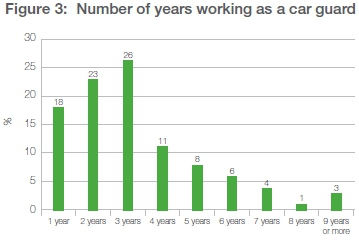
The majority of respondents (87%) in the Tshwane survey said that they work as car guards because they cannot find other employment. Not surprisingly, most respondents (85%) considered car guarding as temporary employment, with 89% of respondents indicating that they would leave the industry immediately if they could find alternative employment. The results underscore the stark reality of unemployment in South Africa, and the limited opportunities in and access to the formal job market. Furthermore, the transitory nature of formal car guarding is reflected in the finding that only one in three respondents (33%) worked as a car guard for more than three years (Figure 3).
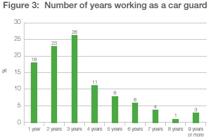
Despite working under harsh conditions, being on their feet on hot summer and cold winter days, the vast majority of respondents (94%) in the Tshwane study felt that they made a meaningful contribution to society. However, more than half (56.9%) stated that they merely survive from day to day. A total of 60% of respondents sometimes felt depressed, and one in ten (11%) always felt depressed. About 40% said that their main reason for feeling depressed was because they were working for a small income.
Crime reduction and responding to crime
The Empangeni study showed that the public generally values the crime prevention services provided by car guards.3738
The majority (79%) of respondents felt that car guarding is an important way to prevent vehicle-related crime in parking areas. In fact, car guarding is considered a more effective preventative measure than closed-circuit television and patrol cars.3940
Questions can rightfully be raised regarding the ability of car guards to manage criminal incidents. In the event of a criminal act, car guards have been advised to not physically challenge or engage the suspect but rather to raise alarm and call for help from other car guards, the police or members of the public.4142
Training and equipment of car guards
The Private Security Industry Regulations Act 2001 (Act 56 of 2001)4344
The Basic Conditions of Employment Act 1997 (Act 75 of 1997)454647
Legislation and policy frameworks
PSIRA controls private security and, in line with the Private Security Industry Regulations Act, all individuals who offer security services must be registered with the authority before they can offer their services.48495051
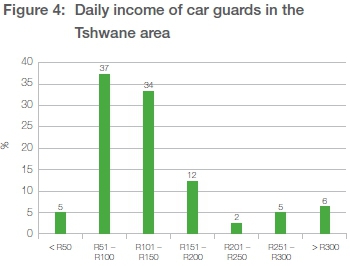
On 25 August 2009, the Basic Conditions of Employment Act was amended to include car guards under the Sectoral Determination for private security. According to the amended act, car guards fall within the category 'employees not elsewhere specified', and for the Pretoria and Johannesburg area the minimum wage was set at R2 519 per month.52Figure 4), which means that most manage to earn the minimum monthly wage -but this is not guaranteed by their employers.
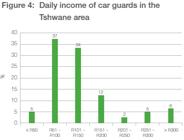
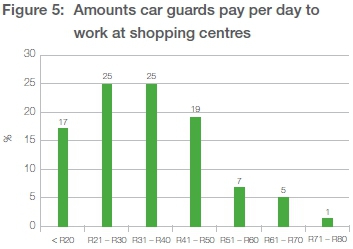
Some car guards might not reach the minimum monthly wage because they are required to pay a daily 'bay fee' to either car guarding agencies (78%) or directly to the managers of shopping centres (22%). Roughly a third of respondents (32%) paid more than R40 per day to work as a formal car guard (Figure 5). The 'bay fee' varies according to where a car guard is situated in the parking lot - those closer to the shops or the entrance of the shopping centre pay a higher fee compared to those who work further away. In addition to the daily 'bay fee', one in three respondents (36%) had to pay supplementary fees (mostly to hire clothing), ranging between R10 and R30 per day. Not surprisingly, the Employment Conditions Committee expressed concern about the financial exploitation of car guards.53
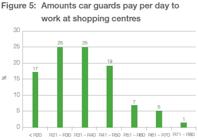
Apart from the regulations provided by PSIRA and the Sectoral Determination for private security in South Africa, some municipalities have taken additional steps to regulate the car guard industry. In Bloemfontein, a bylaw has been introduced that requires car guards to register with the Mangaung metropolitan municipality in order to obtain a valid car-guarding permit. The bylaw includes restrictions on the activities of car guards, and penalties for improper behaviour towards the public.5455
No information could be found regarding the regulation of car guards in the City of Tshwane municipal bylaws. As such, it comes as no surprise that very few respondents (7%) knew about legislation governing the car guard industry, or labour laws that guide and protect the rights of workers (16%). Three-quarters of respondents (75%) felt that car guarding should be regulated to protect their rights, while others (15%) wanted legislation to secure their income. The majority of respondents (75%) would like to have a say when laws affecting car guarding are formulated. Additionally, most respondents (72%) said they would like to form a workers' union to safeguard their interests and conditions of employment.
Conclusion
Vehicle-related crime in South Africa remains a cause of concern for drivers and law enforcement. Theoretically, car guarding has the potential to deter theft of and from vehicles because of the presence of a (capable) guardian to prevent criminal behaviour. The literature further suggests that the benefits of formal car guarding extend beyond vehicle safety to include advantages to business owners, workers and the infrastructure of shopping centres.
Car guarding is not only a response to vehicle-related crime, but also a response to poverty. Car guards represent the disenfranchised and marginalised in South African society: they are mostly African, male and relatively young, a profile that is characteristic of the unemployed in the country. Given their socio-economic realities, the prospects of car guards to gain employment in the formal economy remain constrained. The transitory nature and low income associated with car guarding may provide a temporary, albeit survivalist, reprieve for those who engage in it. Partnerships ought to be galvanised between the public sector (e.g. housing, social development and labour) and the private security industry to promote the social welfare, well-being and safety of formal car guards.
Legislation and policy has led to steps being taken to address the disjointed and unregulated nature of formal car guarding. Directives are provided on training, registration and the minimum income of car guards, among others. Nevertheless, it appears as if these advances are rendered largely ineffective by inadequate implementation and stewardship. For example, car guards are exploited financially, they lack labour protection, and their poor knowledge of matters pertaining to labour legislation and the rights of workers remains a concern. Moreover, it is evident that not all car guards obtained the necessary qualification from PSIRA, which calls into question the monitoring practices of private security authorities.
There are various role players in the formal car guarding industry. Policies are needed regarding the responsibilities of car guard agencies and the managers of shopping centres alike, specifically to address the exploitative levies that car guards are expected to pay. Considerations for policy and practice include:
- Recruiting and screening of aspirant car guards
- Strategies to invest in the human economy of car guards
- Providing an enabling environment for car guards to render security services
- Addressing criminal incidents and ensuring the safety of car guards
- Coordinating crime intelligence among stakeholders (including the police)
- Adhering to and applying relevant policies, labour legislation and municipal bylaws
- Monitoring car guard activities in relation to performance, needs and feedback from clients Lastly, policies are needed to clarify matters related to (undocumented) immigrants who work as formal car guards, vis-a-vis the legal requirements of work permits, residency status and registration with PSIRA. To this end, a partnership between the private security sector and the Department of Home Affairs is imperative.
References
-
1 South African Police Service (SAPS), RSA: April to March 2003 to 2013: provincial and national figures and ratios, 2013, http://www.saps.gov.za (accessed 7 April 2014).
» http://www.saps.gov.za -
2 C De Kock, The crime situation at national, provincial, area and station level, Crime Information Analysis Centre, 2000, http://www.crisa.org.za/volume1/crimesit.htm (accessed 7 April 2014); M Schönteich and A Louw, Crime trends in South Africa 1985-1998, paper commissioned by the Centre for the Study of Violence and Reconciliation as part of a review of the National Crime Prevention Strategy carried out for the Department of Safety and Security, June 1999, http://www.csvr.org.za/index.php/publications/1518-crime-trends- in-south-africa-1985-1998.html (accessed 7 April 2014); SAPS, Crime in the RSA for the period March 1994/1995 to 2003/2004, 2004, http://www.nicro.org.za/wp-content/uploads/2011/05/1994-2004-crime-stats.pdf (accessed 8 April 2014); SAPS, Annual report 2007/2008, http://www.saps.gov.za/about/stratframework/annualreports_arch.php (accessed 7 April 2014); SAPS, RSA: April to March 2003 to 2013: provincial and national figures and ratios, 2013, http://www.saps.gov.za (accessed 7 March 2014); SAPS, RSA: April to March 2004-2014: provincial and national figures andratios, 2014, http://www.saps.gov.za (accessed 18 March2015).
» 5 -
3 Statistics South Africa, Victims of crime survey 2013/2014, 55, http://www.statssa.gov.za (accessed 2 April 2014).
» http://www.statssa.gov.za - 4 Ibid., 55.
-
6 City of uMhlathuze, Bylaws relating to the control of parking attendants/car guards, Administrator's Notice 185, August 2000, www.umhlathuze.gov.za (accessed 18 February 2014);
» www.umhlathuze.gov.za -
TDJ Matutle, By-laws relating to parking attendants, Local Government Notice, 5, January 2006, http://www.enviroleg.co.za (accessed 8 February 2014);
» http://www.enviroleg.co.za - 7 PF Blaauw and LJ Bothma, Informal labour markets as a solution for unemployment in South Africa: a case study of car guards in Bloemfontein, SA Journal of Human Resource Management, 1:2, 2003, 40--44, 41.
-
8 Hatfield City Improvement District, Are car guards legal?, 2014, http://www.hatfieldcid.co.za/ (accessed 4 February 2014).
» http://www.hatfieldcid.co.za/ - 9 Benoit Dupont, Private security regimes: conceptualising the forces that shape the private delivery of security, Theoretical Criminology, 18:3, 2014, 263-281, 263.
- 10 IBM Corp, IBM SPSS Statistics for Windows, Version 22.0, Armonk: IBM Corp, 2013.
-
11 J Bernstein, Car watch: clocking informal parking attendants in Cape Town, Centre for Social Science Research, Social Surveys Unit, Working paper 55, 2003, http://cssr.uct.ac.za/sites/cssr.uct.ac.za/files/pubs/wp55.pdf (accessed 10 March 2014);
» http://cssr.uct.ac.za/sites/cssr.uct.ac.za/files/pubs/wp55.pdf - H McEwen and A Leiman, The car guards of Cape Town; a public good analysis, Southern Africa Labour and Development Research Unit, Paper 25, University of Cape Town, 2008, 5.
- 12 PF Blaauw and LJ Bothma, Informal labour markets as a solution for unemployment in South Africa: a case study of car guards in Bloemfontein, SA Journal of Human Resource Management, 1:2, 2003.
- 13 PJ Potgieter et al., Bivariate analysis of car guard activities as a crime prevention initiative, Acta Criminologica, 16:3, 2003, 35-44.
- 14 Katherine S Williams, Textbook on Criminology, 7th ed., Oxford: Oxford University Press, 2012, 312.
- 15 PJ Potgieter et al., Bivariate analysis of car guard activities as a crime prevention initiative, Acta Criminologica, 16:3, 2003.
- 16 Lawrence Cohen and Marcus Felson, Social change and crime rate trends, American Sociological Review, 44:4, 1979, 588-609, 589.
-
17 Nicholas Branic, Routine activities theory, http://webfiles.uci.edu (accessed 24 March 2015).
» http://webfiles.uci.edu -
18 Statistics South Africa, Quarterly labour force survey: quarter 4, 2014, http://www.statssa.gov.za/publications/P0211/P02114thQuarter2014.pdf (accessed 22 May 2015).
» http://www.statssa.gov.za/publications/P0211/P02114thQuarter2014.pdf - 19 PJ Potgieter et al., Bivariate analysis of car guard activities as a crime prevention initiative, Acta Criminologica, 16:3, 2003, 36.
- 20 H McEwen and A Leiman, The car guards of Cape Town; a public good analysis, Southern Africa Labour and Development Research Unit, Paper 25, University of Cape Town, 2008, 4.
-
21 Hatfield City Improvement District, Are car guards legal?, 2014, http://www.hatfieldcid.co.za/ (accessed 4 February 2014).
» http://www.hatfieldcid.co.za/ - 22 PJ Potgieter et al., Bivariate analysis of car guard activities as a crime prevention initiative, Acta Criminologica, 16:3, 2003, 35.
- 23 Private Security Industry Regulatory Authority, Consultation paper review of the annual fees 2015 for the private security industry, 2015, http://www.psira.co.za (accessed 20 March 2015).
- 24 A Minnaar, Private-public partnerships: private security, crime prevention and policing in South Africa, Acta Criminologica, 18:1, 2005, 85-110, 89-90.
-
25 Statistics South Africa, Victims of crime survey 2013/14, 49, http://www.statssa.gov.za (accessed 19 March 2015).
» http://www.statssa.gov.za - 26 Douw Gerbrand, The role of private security in crime prevention, PhD thesis, University of Zululand, 2002, 227.
- 27 Benoit Dupont, Private security regimes: conceptualising the forces that shape the private delivery of security, Theoretica Criminology, 18:3, 2014, 268.
- 28 J Bernstein, Car watch: clocking informal parking attendants in Cape Town, Centre for Social Science Research, Social Surveys Unit, Working paper 55, 2003, 18;
- H McEwen and A Leiman, The car guards of Cape Town; a public good analysis, Southern Africa Labour and Development Research Unit, Paper 25, University of Cape Town, 2008, 13.
- 29 Smart Dumba and Innocent Chirisa, The plight of illegal migrants in South Africa: a case study of Zimbabweans in Shoshanguve extension 4 & 5, International Journal of Politics and Good Governance, 1:1.2, 2010, 1-18, 15.
- 30 H McEwen and A Leiman, The car guards of Cape Town; a public good analysis, Southern Africa Labour and Development Research Unit, Paper 25, University of Cape Town, 2008, 12.
-
31 Statistics South Africa, Quarterly labour force survey: quarter 1, 2014, http://www.statssa.gov.za (accessed 3 June 2014).
» http://www.statssa.gov.za - 32 J Bernstein, Car watch: clocking informal parking attendants in Cape Town, Centre for Social Science Research, Social Surveys Unit, Working paper 55, 2003, 20.
- 33 H McEwen and A Leiman, The car guards of Cape Town; a public good analysis, Southern Africa Labour and Development Research Unit, Paper 25, University of Cape Town, 2008, 13;
- Smart Dumba and Innocent Chirisa, The plight of illegal migrants in South Africa: a case study of Zimbabweans in Shoshanguve extension 4 & 5, International Journal of Politics and Good Governance, 1:1.2, 2010, 1-18, 11.
- 34 PF Blaauw and LJ Bothma, Informal labour markets as a solution for unemployment in South Africa: a case study of car guards in Bloemfontein, SA Journal of Human Resource Management, 1:2, 2003, 42.
- 35 H McEwen and A Leiman, The car guards of Cape Town; a public good analysis, Southern Africa Labour and Development Research Unit, Paper 25, University of Cape Town, 2008, 13.
- 36 Ibid., 5, 14.
- 37 PJ Potgieter et al., Bivariate analysis of car guard activities as a crime prevention initiative, Acta Criminologica, 16:3, 2003, 45.
-
38 Fran Kirsten, Car guards still a nuisance, Knysna-Plett Herald, http://www.knysnaplettherald.com (accessed 25 March 2015);
» http://www.knysnaplettherald.com -
Greg Nicolson, Men in the street: of car guards and daily (poverty) grind, Daily Maverick, 17 March 2015, http://www.dailymaverick.co.za (accessed 25 March 2015).
» http://www.dailymaverick.co.za - 39 PJ Potgieter et al., Bivariate analysis of car guard activities as a crime prevention initiative, Acta Criminologica, 16:3, 2003, 39.
- 40 Hatfield City Improvement District, Are car guards legal?, 2014.
- 41 PJ Potgieter et al., Bivariate analysis of car guard activities as a crime prevention initiative, Acta Criminologica, 16:3, 2003. 40-41.
- 42 SAPA, Car guard heroes foil robbery, News24, 10 February 2014, http://www.news24.com/SouthAfrica/News/Car-guard-heroes-foil-robbery-20140210 (accessed 17 March 2014).
- 43 Private Security Industry Regulation Act 2001 (Act 56 of 2001), Pretoria: Government Gazette.
- 44 J Bernstein, Car watch: clocking informal parking attendants in Cape Town, Centre for Social Science Research, Social Surveys Unit, Working paper 55, 2003, 13.
- 45 Basic Conditions of Employment Act 1997 (Act 75 of 1997), Pretoria: Government Gazette.
- 46 PJ Potgieter et al., Bivariate analysis of car guard activities as a crime prevention initiative, Acta Criminologica, 16:3, 2003, 42.
- 47 J Bernstein, Car watch: clocking informal parking attendants in Cape Town, Centre for Social Science Research, Social Surveys Unit, Working paper 55, 2003.
- 48 Private Security Industry Regulation Act 2001 (Act 57 of 2001), Pretoria: Government Gazette.
- 49 Ibid.
- 50 Department of Labour, Report by the Employment Conditions Commission of Sectoral Determination 6: Private Security Sector, 2009, http://www.labour.gov.za (accessed 19 March 2015).
- 51 Ibid., 11-12.
- 52 Basic Conditions of Employment Act 1997 (Act 75 of 1997), Amendment of Sectoral Determination 6: Private Security Sector, Pretoria: Government Gazette.
- 53 Department of Labour, Report by the Employment Conditions Commission of Sectoral Determination 6: Private Security Sector, 15.
- 54 TDJ Matutle, By-laws relating to parking attendants, Local Government Notice, 5, January 2006, 3.