Unsustainable and unjust: Criminal justice policy and remand detention since 1994
The 'tough on crime' approach embodied in bail and sentencing law has had a profound impact on the trends around remand detention, including prison overcrowding of such an extent that it is estimated to have contributed to an additional 8 500 natural deaths in custody. Ultimately the policies have led, in practice, to an 'Alice in Wonderland' effect: fewer people are being tried and sentenced, while more than ever are denied their freedom without ever being tried in a court of law.
Unsustainable and unjust: Criminal justice policy and remand detention since 1994
Jean Redpath
Community Law Centre of the University of the Western Cape. She specialises in the analysis of data informing criminal justice system law reform in African countries.
ABSTRACTThe 'tough on crime' approach embodied in bail and sentencing law has had a profound impact on the trends around remand detention, including prison overcrowding of such an extent that it is estimated to have contributed to an additional 8 500 natural deaths in custody. Ultimately the policies have led, in practice, to an 'Alice in Wonderland' effect: fewer people are being tried and sentenced, while more than ever are denied their freedom without ever being tried in a court of law.
Over the period 1995-1998 South Africa embarked upon an unprecedented legislative programme. In 1998 alone, more than 120 laws were passed by the new democratic parliament. In the arena of criminal procedure and criminal law these laws were not in the direction of the reforms suggested by South Africa's Constitution and Bill of Rights, enacted in 1996; instead, they were intended to convey a 'tough on crime' approach. In a short space of time a number of protections for accused persons, many of which had been developed by the courts during apartheid to ameliorate the effects of unjust security detention laws, were simply swept away by legislative flat, encompassed in amendments to the Criminal Procedure Act (CPA).1 This article seeks to describe and analyse the 'tough on crime' policy approach, and to assess its impact.
The 'tough on crime' policy approach
During the apartheid years it was accepted that a bail application was a matter of urgency: after all, a person's freedom was at stake.2 But in 1997 the CPA was amended so that it explicitly provides in s50(6)(b) that an arrested person is not entitled to be brought to court after hours.3 Bringing bail applications after hours was a common practice in magistrate's courts before 1998, and prior to 1994 the courts on a number of occasions confirmed the right of an accused to bring a bail application within the 48 hours envisaged by the then section 50; some went so far as to say there was a duty on the part of the state to co-operate and make it possible for a bail application to take place.4 Commentators at the time voiced their dissatisfaction at the change, noting: 'The irony inherent in this reactionary measure is, of course, striking: a procedural human right deemed under the old order through creative and enlightened judicial interpretation has been summarily taken away by decree of the new order.'5
Protective limits on the length of time for which bail applications may be postponed for further investigation were undone in 1995.6 Section 50(7), which contained a time limit of a day on delaying bail applications for the purpose of further investigations, was deleted and replaced,7 and subsequently tweaked by the Amendment Act 62 of 2000, which provides for the postponement of a bail application for seven days at a time if the court, inter alia, thinks it has insufficient information to make a decision on bail, if the accused is going to be charged with a serious offence, or the court simply thinks it is in the interests of justice to do so.8
In addition to these procedural changes relating to when bail applications may be heard, a greater onus has been placed on the accused. The court hearing the bail application must be satisfied that the interest of justice are served by release, whereas previously the court had to be satisfied that the interests of justice are served by continued detention.9 In relation to accused persons charged with serious offences listed in Schedule 6,10 such as premeditatet murder and gang rape, bail has all but been ruled out. Section 60(11) places the onus on an accused charged with such an offence to adduce evidence to satisfy the court that exceptional circumstances exis which, in the interests of justice, permit release.11 This is called a 'reverse onus' and implies that if an accused charged with a Schedule 6 offence at the bail application provides no evidence, or provides unexceptional evidence in support of the contention that the interests of justice will be served by his release, he will not be released on bail.
In relation to Schedule 512 offences, which are serious offences such as murder and rape that have not been aggravated by additional factors (such as premeditation in the case of murder), the amendments require that 'the accused be detained in custody until he or she is dealt with in accordance with the law, unless the accused, having been given a reasonable opportunity to do so, adduces evidenc which satisfies the court that the interests of justice permit his or her release'. This formulation is slightly less onerous than that applicable to Schedule 6 offences.
The Constitutional Court found that the limitation inherent in s60(11) (exceptional circumstances for Schedule 6 offences) on section 35(1)(f) of the Constitution, which provides that 'everyone who is arrested for allegedly committing an offence has the right to be released from detention if the interests of justice permit, subject to reasonable conditions', was reasonable and justifiable in our current circumstances of widespread violent crime.13 The Court noted that 'the subsection does not say they must be circumstances above and beyond, and generally different from those enumerated ... an accused ... could establish the requirement by proving there are exceptional circumstances relating to his or her emotional condition that render it in the interests of justice that release on bail be ordered notwithstanding the gravity of the case'.14
It was also noted that 'the amendment was intended to make the obtaining of bail of accused persons who are charged with serious offences more difficult. It was not meant to make the obtaining of bail by these persons impossible'.15 Unfortunately, the provisions seem to have ensured that the possibility of bail in relation to Schedule 6 offences is likelier among those with expensive legal representation;16 for the vast majority accused of serious crimes, release is highly unlikely.17
A 2008 study predicted that the combined impact of these changes is 'likely to be a significant delay in the hearing of bail applications, an increase in postponements for further investigation, and a reduction in the number who are granted bail at first appearance'.18 The study did in fact And evidence of these trends in three courts investigated.19 However, many crime-weary South Africans appeared to welcome these amendments to bail law, as many believed at the time that 'criminals have too many rights'.20
In response to public perceptions of leniency in sentencing,21 tough sentences were also introduced in 1997.22 Counter-intuitively termed 'minimum sentencing', the legislation prescribing tough sentences for serious crime was a response to an earlier Constitutional Court judgement that had found the death penalty to be unconstitutional.23 At the time of this judgement, the public believed crime in South Africa had escalated24 and public sympathy was against the abolition of the death penalty.25 Consequently there was a need to demonstrate that government was 'tough on crime', and thus 'minimum' sentences of life imprisonment were legislated for crimes that previously might have incurred the death penalty. Other 'minimums' were also provided for. Minimums are applicable even in relation to first offenders, unlike the 'three strikes' law applicable in some US and Australian states. The minimum sentencing provisions commenced on 1 May 1998,26 and the initial period of their validity was only two years.27 After two years the provisions were explicitly renewed by the President with the agreement of the legislature.28 These minimum sentencing provisions were renewed on a number of occasions, and almost ten years later the renewal requirements were deleted, making minimum sentencing permanent.29 A summary of the minimum sentencing provisions and their applicable sentences appears in the tables below. Their introduction occasioned further amendments to the sentencing jurisdiction of the lower courts.


At the time of the introduction of minimum sentences only the high courts, which generally hear fewer than 1% of criminal cases, had the sentencing jurisdiction to impose many of these sentences. Consequently, soon after the minimum sentencing provisions came into effect, the sentencing jurisdiction of the regional courts was extended to 15 years' (from 10 years') imprisonment, and the district courts' jurisdiction was extended to three years' (from 12 months') imprisonment.32
A messy period of almost a decade (1998-2007) followed, during which regional courts were empowered to hear life imprisonment matters, but had to refer them to the high courts for sentencing. Incidentally, a parliamentary study found that in one in ten such cases the high court ended up acquitting the accused, who had been found guilty in the regional court.33 Ultimately the regional courts were empowered in December 2007 to hand down sentences of life imprisonment in these matters.34 The automatic right of appeal that went with these sentences was legislatively removed - possibly unintentionally - in April 2010.35
Some analysts predicted that this jurisdictional change would sharply increase the number of people convicted and sentenced to prison, simply because the regional courts have the capacity to hear many more cases than the high courts. The next section reveals that the number of people handed down long sentences has indeed increased - but not the total number convicted and sentenced year-on-year.
The impact of 'tough on crime' policy changes
The practical impact of the changed bail and sentencing framework was borne most obviously by the Department of Correctional Services (DCS).
This is immediately apparent in the figures for the total remand population by month. Between 1995 and 1996, after the first amendments, the number of people held pre-trial at month end increased by 50%, from around 20 000 to 30 000 people. By the end of April 1998 almost 43 000 people were held, compared to the almost 18 000 held in May 1995 - a staggering 138% increase in only three years. After the 1998 amendments came into effect, there was a further steep increase until April 2000, when a peak of almost 60 000 people held pre-trial was reached. In only Ave years the pre-trial population in prisons had tripled.

Since that peak, the pre-trial population has hovered around the 50 000 mark, with some seasonal dips to the 40 000 mark.
During the remand peak from 2000 to 2004, prisons were bursting at the seams, holding 170 000 to 190 000 people, a large proportion of whom were untried, in facilities designed for just over 100 000 people.37 Overcrowding leads to less than ideal conditions of detention, including the spread of communicable diseases. Unsurprisingly, these conditions of overcrowding led to a steep increase in the number of deaths from natural (i.e. not violent or accidental) causes.
Plotting the inmate population since 1995 in prisons against the rate of natural deaths per 100 000 inmates shows that not only does the number of deaths increase as the inmate population grows, but also the rate of death. At around a total population of 140 000, there is on average one death a year for every 250 inmates. Where total inmate populations are closer to 190 000 (largely because of the massive increase in remand inmates) there is closer to one death for every 110 inmates. In other words, a 35% increase in total population has more than doubled the rate of natural death. Using this relationship, it can be calculated that, had inmate populations remained at around 140 000, some 8 500 natural deaths would probably not have occurred in the period 1998 to 2011.39


The trend in natural deaths is likely to have been influenced by a high prevalence of HIV and tuberculosis. Anti-retroviral roll-out in prisons only began in 2006 at three sites,41 just after the peak in inmate population numbers over the 2003-2005 period. Official prison capacity by the end of February 2011 was only 118 154 - yet at one point during this period the number incarcerated tipped 190 000.
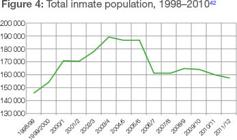
In response to excessive inmate numbers - see the graph above - the DCS motivated for presidential 'special remissions of sentences', leading to the early release of 33 972 sentenced prisoners during 2005.43 In addition, consideration of parole44 at the earliest possible parole date45 has now become the norm.46 This is increasingly essential as prisoners with longer sentences (in excess of ten years) continue to replace those with shorter sentences. By 2011 the number of prisoners with sentences of more than ten years had almost quadrupled, to more than 50 000.

Since 1994, imprisonment capacity has increased by approximately 20 000, which is still not nearly enough.48 However, the DCS has limited control49 over one of the key drivers of the size of the total inmate population - a high remand population, which is around twice the size it was in 1995.
The drivers of the remand population
What causes high remand populations? The number of remand detainees on any particular day is influenced by two trends - how many people are admitted to remand, and how long each of them remains in detention. What do the data say about how many people were admitted to remand detention?
The legislative changes discussed above were likely to have increased the number of people denied bail and admitted to remand. If arrests had remained constant or had increased, then the number admitted to remand should have increased, and analysis of the data shows that admissions rose considerably during the initial period of the new laws. In 1995/1996 just over 230 000 people were admitted on remand. This increased to almost 299 000 by the year 1999/2000 - in other words, four years later, 67 000 or 29% more people were admitted on remand than in 1995/1996. Another two years later 311 013 were admitted on remand. Subsequently, however, remand admissions dropped to the point where in 2010/11 there were fewer such admissions than there had been in 1995/6. What accounts for this trend?

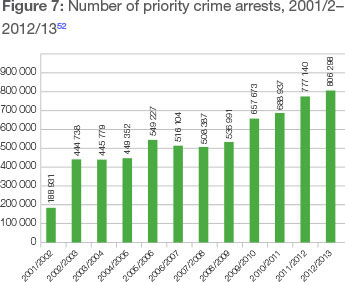
The question arises whether the drop in remand admissions down to 1995/6 levels is due to a drop in the number of arrests, particularly priority crime arrests, which are more likely to result in a denial of bail. This is not the case. Comparing 2002/3 - the peak of remand admissions - to 2010/11 shows a 55% increase in priority crime arrests (which are more likely to result in denial of bail), from 444 738 to 688 937.51 Consequently the drop in remand admissions cannot be attributed to a drop in arrests.

What has reduced is the extent to which such arrests translate into remand admission into prisons. In 2002/3 the remand admissions figure was 70% of the priority crime arrests figure (in the previous year there were more remand admissions than priority crime arrests). By 2008/9 the ratio of remand arrests had dropped to 53%; in 2010/11 it was only 33%. How can this be explained, given that the legislative framework in relation to bail remains strict?
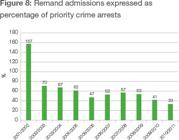
A possible explanation is that an increasing proportion of people are being held for extended periods in police cells, rather than in prisons - often because prisons refuse to take any more: a number of oversight visits by national and provincial Members of Parliament over the last decade mention police cells being used for prolonged remand detention because 'prisons are full'.53 Indeed, some prisons are holding more than double their approved capacity.54 The 2013 White Paper on Corrections and the White Paper on Remand Detention, however, seek to affirm that after 5 March 2012 the holding of remand detainees in police cells after first appearance is not legal.55
Using the 70% figure for 2002/3 (of priority arrests converted to remand admission) as a benchmark would suggest that a potential 250 000 people were probably admitted to police cells rather than to prison remand after first appearance in 2010/11. This is of great concern, given that police cells do not have facilities for the adequate care of detainees held for prolonged periods. Arrests continue to rise: in 2012/13 the SAPS reported 806 298 priority crime arrests and a further 876 476 'other' arrests.
The fact that the remand population in prisons remains high, despite the drop in admissions to prison on remand, must then relate to the duration of remand detention. One of the theorised effects of minimum sentencing for the pre-trial phase was that persons accused of such offences would be loath to plead guilty, given that the bar is now set so high on their potential punishment. This could lead to backlogs and general slowing of the system. Given that such persons would highly likely be denied bail under the bail amendments, they would also highly likely be incarcerated awaiting trial for an extended length of time. Their continued incarceration before the commencement of trial could, it was theorised, lull the state into taking its time in preparing a case against the accused.
In 1995, there were remand admissions of 230 000 and a remand population of around 20 000, suggesting that the average duration of detention in 1995 must have been around one month. By 2000, admissions of almost 300 000 and a remand population of 60 000 suggests that the average duration of detention must have doubled to around 2,4 months. In 2010/2011 there were 227 664 admissions but a population of around 46 500 -suggesting the average duration of detention has remained at around 2,4 months.
The back-of-the-envelope 'average duration' calculations above provide a putative average of the duration of detention. Averages are not the best measures of the 'central tendency' of a population that is asymmetrically distributed - in other words, populations where there is a fixed minimum for the measure at hand (in this case duration of detention cannot be less than zero) and a maximum that can increase in size indefinitely. The department has therefore provided 'snapshot' figures of the time spent in remand at a particular date over the period 2009-2012.

The number of people in custody on remand for more than three months comprised more than half of remand detainees as at March 2012. (Recall that the putative average in 1995 was one month.) The number in custody for more than a year comprised almost 18% in 2012 (or one in six remand inmates), whereas in 2009 this percentage was only 13% (one in eight). Indeed, by March 2012 some 5% (or one in 20) had spent more than two years in custody. In other words, all the longer time categories have experienced growth over the period 2009 to 2012, while all the shorter time categories have reduced in size, suggesting a general and continued lengthening of the duration of remand detention over this time period.

Is the remand trend justified by court outcomes?
In short then, the data show that fewer people are being admitted on remand to prisons, but for much longer time periods. Can it be assumed that such long pre-trial incarcerations on remand are ultimately justified by eventual convictions? Over the initial time period after the legislative changes the number of people sentenced to imprisonment and admitted to prisons did indeed rise 24% from 1995/6 to 2001/2 (see Figure 7). This coincided with the peak in the size of the total prison population over the period thereafter until the special remissions that occurred in 2005.
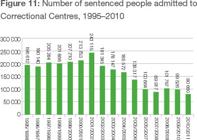
After the peak in 2001/2 there was a steady decrease in the number of sentenced admissions. Yearly remand admissions, by contrast, dropped below their 1995/6 levels only in 2010/11, while sentenced admissions did so in 2002/3 and decreased further thereafter. Yet, despite the drop in remand admissions, the remand population remains more than double the size it was in 1995.
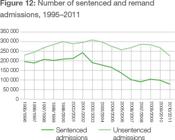
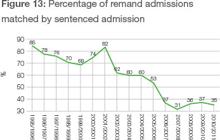
In 1995/6 the 230 000 remand admissions were matched by 200 000 sentenced admissions; in other words, there was an approximately 85% conversion of remand to sentenced imprisonment in 1995/6. Put differently, just over one person was sent to remand for every person convicted and imprisoned in the same year. By 2007/8 this had worsened to 31%; in 2010 the ratio was 35%. Almost three times as many people were sent to remand as were convicted in the last years for which data are available. In 2010/11, some 150 000 people were sent to prison on remand who were not subsequently imprisoned as a result of a conviction in the same year. The 'conversion rate' is likely to be far worse if remand detention in police cells is taken into account.
What has been driving the drop in sentenced admissions? Sentenced admissions are admissions of people who are convicted, and then sentenced to a term of imprisonment, rather than with a noncustodial sentence. Has the number of convictions dropped, or is it the extent to which sentences that include a term of imprisonment have dropped?
The National Prosecuting Authority Act, which created the National Prosecuting Authority (NPA), was promulgated in October 1998. Initially the newly formed NPA reported data on the finalisation of cases in the reporting period January to December; prior to that the individual provincial Attorneys-General did not report on their work in a uniform manner. The 2001/2 NPA Annual Report included data for 1999, 2000 and 2001 on the number of finalisations and the conviction rate.58
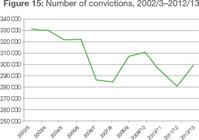
According to these data, convictions increased sharply over this time period, by 55%. From 2002/3 the reporting period changed to run from March to February each year.59 The further jump in convictions, comparing January to December 2001 with March 2002 to February 2003, of another 41% in a single year suggests there may have been a further change in reporting practices that occurred at the same time, that influenced the number of convictions recorded. Assuming there was no such change in reporting practices, the increase in convictions, comparing the year January to December 1999 to the year March 2002 to February 2003, was a staggering 117%.
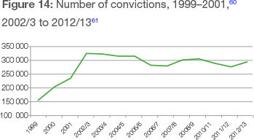
From 2002/3, however, the trend changes dramatically towards an overall decrease in the number of convictions. Consequently it appears that the reduction in the number of sentenced admissions is partly a result of the trend towards a reduction in the number of convictions apparent from 2002/3.
At the same time, however, there has been a commensurate reduction in the extent to which sentences of imprisonment accompany a guilty conviction. Over the period 1999 to 2001 there appear to have been more sentenced admissions than there were convictions. This may, as indicated above, also be the result of how convictions are recorded. Looking at data from 2002/3 onward, there is a steady downward trend in the extent to which convictions are matched by sentenced admissions, from almost 60% to less than 30%.
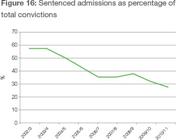
This suggests that convictions are increasingly accompanied by non-custodial sentences - or alternatively that convicted people are being sentenced to time already served on remand - the 'Alice in Wonderland' scenario: 'sentence first, verdict after'.62 What is clear is that the number of people held on remand in prisons is decreasing, the time for which they are held on remand in prisons is increasing, and the likelihood that they will ever be sentenced to a term of imprisonment is decreasing.
Conclusion
The 'tough on crime' policy approach embodied in the tightening of bail laws and lengthy minimum sentences has had, over the long term, an unanticipated impact. After an initial period in which the DCS bore the brunt of predicted and massive increases in the total prison population, there was a subsequent stabilisation.
Prior to stabilisation, the twin unsustainable bail and sentencing policies led to conditions of detention resulting in more deaths from natural causes due to overcrowding in just over a decade, than the number of death penalty deaths during the apartheid era.63
As a result the criminal justice system developed methods to ameliorate the impact of these unsustainable policies. Some prisons refused to accept any more remand detainees, and detainees were then held at police stations. The full extent to which this occurred and continues to occur, is unclear.
The criminal justice trends suggest that, in addition, the system has generally slowed down and cut back on the number of people it chooses to prosecute,64 the number it convicts, and the speed with which it does so, leading to a reduction in the number of people sentenced year-on-year.
The sentenced prison population is increasingly composed of those with longer sentences, but most will be released on parole at the earliest possible parole date.
In short, durations of remand detention have increased, convictions have decreased, an increasingly greater proportion of people are held on remand than will ever be convicted, and sentences are less likely than ever to contain a custodial component.
The 'tough on crime' approach has in practice turned into 'justice delayed and freedom denied'.
Notes1 Criminal Procedure Second Amendment Act 1995 (Act 75 of 1995); Criminal Procedure Second Amendment Act 1996 (Act 85 of 1996); Criminal Procedure Amendment Act 1996 (Act 86 of 1996); Abolition of Restrictions on the Jurisdiction of Courts Act 1996 (Act 88 of 1996); Criminal Procedure Amendment Act 1997 (Act 76 of 1997); Criminal Procedure Second Amendment Act 1997 (Act 85 of 1997); Criminal Law Amendment Act 1997 (Act 105 of 1997); Criminal Matters Amendment Act 1998 (Act 68 of 1998); Criminal Procedure Amendment Act 2001 (Act 17 of 2001); Criminal Procedure Second Amendment Act 2001 (Act 62 of 2001).
2 See cases cited in note 4 below.
3 Criminal Procedure Act, as amended by the Criminal Procedure Second Amendment Act 1997, Section 50(6)(b).
4 See Twayie v Minster van Justisie 1986 (2) SA 101 (O); S v Du Preez 1991 (2) SACR 372 (Ck); Novick v Minister of Law and Order 1993 (1) SACR 194 (W) 197.