Predicting the performance of ORB-SLAM3 on embedded platforms
Abstract
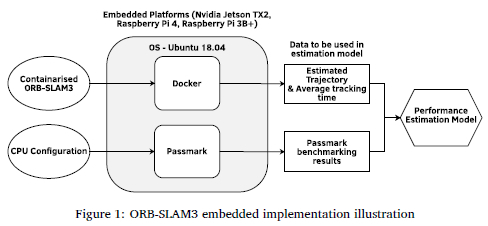
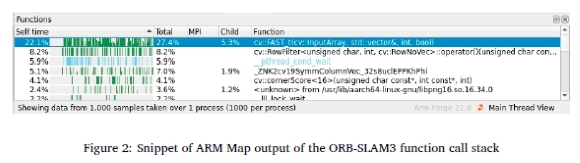
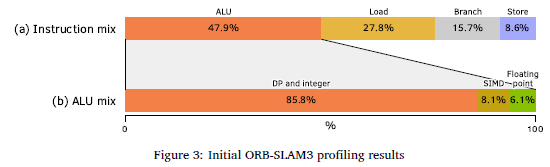
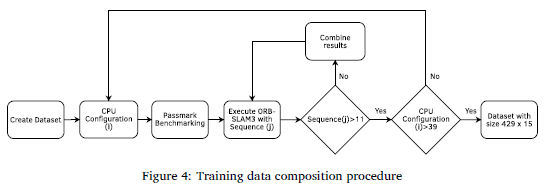
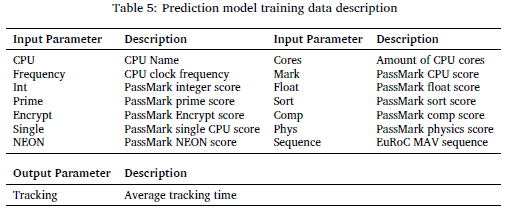
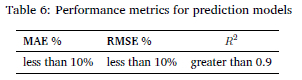
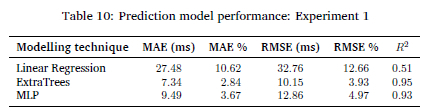
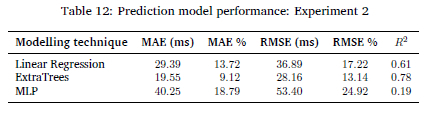
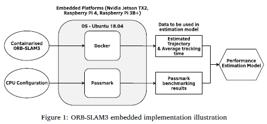
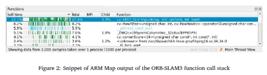
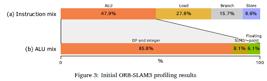
Simultaneous Localization and Mapping (SLAM) is a crucial component to the push towards full autonomy of robotic systems, yet it is computationally expensive and can rarely achieve real-time execution speeds on embedded platforms. Therefore, a need exists to evaluate the performance of SLAM algorithms in practical embedded environments - this paper addresses this need by creating prediction models to estimate the performance that ORB-SLAM3 can achieve on embedded platforms. The paper uses three embedded platforms: Nvidia Jetson TX2, Raspberry Pi 3B+ and the Raspberry Pi 4B, to generate a dataset that is used in training and testing performance prediction models. The process of profiling ORB-SLAM3 aids in the selection of inputs to the prediction model as well as benchmarking the embedded platforms' performances by using PassMark. The EuRoC micro aerial vehicle (MAV) dataset is used to generate the average tracking time that the embedded platforms can achieve when executing ORB-SLAM3, which is the target of the prediction model. The best-performing model has the following results 2.84%, 3.93%, and 0.95 for MAE, RMSE and R2 score respectively. The results show the feasibility of predicting the performance that SLAM applications can achieve on embedded platforms.
Monocular-Inertial SLAM; ORB-SLAM3; Embedded platform; Nvidia Jetson TX2; Raspberry Pi
 Thumbnail
 Thumbnail
 Thumbnail
 Thumbnail
 Thumbnail
 Thumbnail
 Thumbnail