
 Editorial: Summer of 2024
https://doi.org/10.18489/sacj.v36i2.20775
Editorial: Summer of 2024
Katherine M. Malan
Department of Decision Sciences, University of South Africa.
With this issue of SACJ, we are publishing seven research articles. For every one article that is accepted, there are another two that are rejected after review (not counting the manuscripts that are desk rejected). Assuming three reviews per article, this translates into 63 reviews conducted by peer reviewers to reach this point of publishing these seven manuscripts. We salute the reviewers of SACJ and our sterling team of associate editors for finding reviewers (knowing that we sometimes have to send out ten invitations before finding a single willing reviewer). We value your contributions and rely on your continued support in maintaining the high standard of SACJ.
Submission statistics
For information, we present the following updated statistics around submissions, acceptance rates and the processing time of articles.
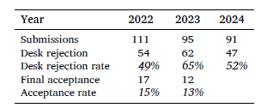
The figures above translate into an overall rejection rate of approximately 86%. This may seem high, but it can be attributed to the large number of submissions from all over the world due to the indexing of SACJ on Scopus. In comparison, South African Journal of Science, which is also indexed on the Web of Science (Science Citation Index), reported a rejection rate of 95% in 2023.
In terms of submission processing time, the median time to a first decision (desk reject / send to review) for 2023-2024 was 4 days and the median time to final decision for submissions sent to review (2022-2023) was 5 months.
Research in this issue
The research papers in this issue cover many areas of computing from Computer Science topics such as design patterns, teaching automata theory, and embedded computing, to IT and Information Systems topics such as career choice models, big data analytics, mobile technology and AI adoption. Authors of these papers are based at eight different higher education institutions in South Africa, showing that SACJ remains an important publication outlet for South African researchers.
• Formalizing solutions to network availability issues in low-resource environments: An offline storage design pattern for software systems by Agbeyangi and Suleman.
• Migrating teaching of automata theory to a digital platform by Jordaan, Timm and Marshall.
• An IT career choice model by Calitz, Cullen and Twani.
• Predicting the performance of ORB-SLAM3 on embedded platforms by Matthee, Uren, van Schoor and van Daalen.
• Big data analytics capabilities and the organisational performance of South African retailers by Welbotha and van den Berg.
• Exploring adoption dynamics: Mobile technology in agricultural information dissemination among smallholder farmers in Gokwe South District, Zimbabwe by Musungwini, van Zyl and Kroeze.
• Integrating the TOE framework and DOI theory to dissect and understand the key elements of AI adoption in sociotechnical systems by Smit, Eybers, van der Merwe, Wies, Human and Pielmeier. This is the first paper of a special issue of extended papers from the SAICSIT 2023 conference.
Thank you to all authors for submitting your manuscripts to SACJ and for entrusting us with your research!
Acknowledging editors and reviewers
The Academy of Science of South Africa (ASSAf) recently released a Statement on the Recognition of the Work of Editors and Peer Reviewers of Academic Journals and Books in South Africa. In the statement, ASSAf highlights the critical role that editors and peer reviewers play in maintaining academic standards in publishing and argues that universities and science councils should be doing more to recognise and value the tremendous work done by editors and peer reviewers - mostly as a voluntary service to the academic community.
