Factors that influence computer programming proficiency in higher education: A case study of Information Technology students
Abstract
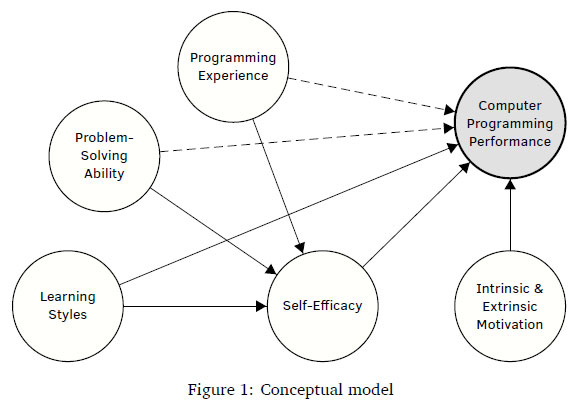
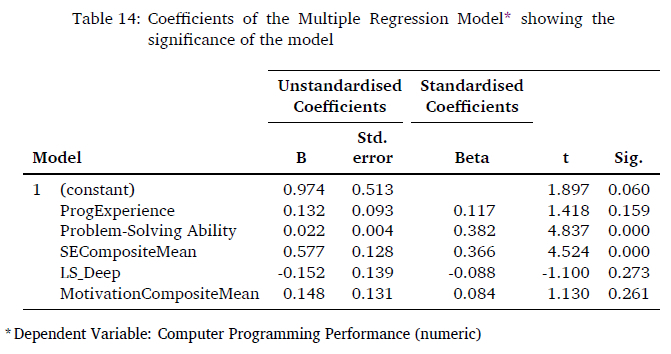
The industrial world has witnessed an increased demand for computing based skills due to the advent of robotics, artificial intelligence, and analytics. However, the learning of computer programming is challenging and requires an intensive cognitive effort to attain a high degree of skill and expertise. Given this phenomenon, this study undertook to ascertain the factors that influence proficiency in computer programming. The study adopted a quantitative approach and a survey research strategy, guided by a conceptual model. A survey questionnaire was designed as the primary source of data collection. The respondents comprised students who were enrolled for Information Systems and Technology (IT) courses at a higher education institution. The main factors that were identified as significant predictors of computer programming performance were Problem-Solving Ability and Self-Efficacy. The findings contribute to enhancing computer programming pedagogy, which could lead to enhanced student performance in assessment, and validation of the conceptual model. Categories · Social & programming topics ~ Professional topics · Computing Education ~ Computer science education/Information Technology/Information systems
Computer programming performance; Intrinsic and extrinsic motivation; Learning styles; Self-efficacy; Problem-solving ability
 Thumbnail
 Thumbnail
 Thumbnail
 Thumbnail
 Thumbnail
 Thumbnail
 Thumbnail
 Thumbnail