
 Editorial: Winter 2024 Update
Katharine M. Malan
Department of Decision Sciences, University of South Africa.
SACJ editorial team
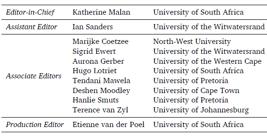
In the last year, Martin Olivier and Maureen Tanner resigned as associate editors, but we are pleased to announce that four new associate editors have joined the editorial team (Marijke Coetzee, Aurona Gerber, Tendani Mawela, and Terence van Zyl). Ian Sanders has moved into the role of assistant editor to take care of the copyediting of manuscripts before publication.
In the past, we distinguished between Information Systems and Computer Science associate editors, but going forward we will be dropping this distinction due to the fuzzy boundary between the disciplines. The current editorial team is as follows:
I am very grateful to all current and past members of the editorial team. Your service is critical to ensuring that SACJ continues to run effectively.
Submission statistics
For information, we present the following statistics around submissions, acceptance rates and the processing time of articles.
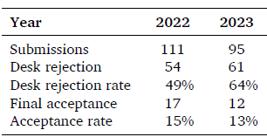
The figures above translate into a rejection rate of approximately 86%. This may seem high, but it can be attributed to the large number of submissions from all over the world due to the indexing of SACJ on Scopus. In comparison, South African Journal of Science, which is also indexed on the Web of Science (Science Citation Index), reported a rejection rate of 95% in 2023.
In terms of submission processing time, the median time to a first decision (desk reject / send to review) is 4 days and the median time to final decision for submissions sent to review is 5 months.
Research in this issue
The research papers in this issue cover a range of topics from agility, programming proficiency, AI adoption and cybersecurity learning capability, to curriculum design for knowledge management.
• A conceptual framework for agility in sociotechnical contexts by Lillie, Eybers and Gerber.
• Factors that influence computer programming proficiency in higher education: A case study of Information Technology students by Ranjeeth and Padayachee.
• Towards Human-AI Symbiosis: Designing an Artificial Intelligence Adoption Framework by Smit, Eybers and van der Merwe. This is the second paper of a special issue of extended papers from the SAICSIT 2022 conference handled by guest editor, Prof Aurona Gerber.
• Understanding the inertial forces impeding dynamic cybersecurity learning capabilities: The case of a South African healthcare software services firm by Nyakasoka and Naidoo. This paper is the third and final paper in the special issue of extended papers from the SAICSIT 2022 conference.
• Sensemaking and the Potential Future-focused Curriculum for Society 5.0 Knowledge Managers: A South African Perspective by Mearns, Meyer, Holmner, Marshall, Hattingh and Bester. This paper was presented at the Knowledge Management South Africa Imbizo 2023, and the post-conference review process was handled by Prof Hanlie Smuts.
In addition to the research papers, we also have a letter to the editor from our colleagues at the Glushkov Institute of Cybernetics of the National Academy of Sciences of Ukraine providing an update on their recent research endeavours. We hope this letter creates awareness of the commendable work of this group on e-rehabilitation technologies for military personnel in war-torn Ukraine.
