Big data analytics capabilities and the organisational performance of South African retailers
Abstract
Big data analytics provides a competitive advantage and growth opportunities for organisations. Recent studies identify the resources required to build big data analytics capability (BDAC) and its correlation with firm performance. This study extends this exploration by investigating the nexus between specific dimensions of big data analytics capabilities namely, Big Data Analytics Tangible Capabilities (BDATC), Big Data Analytics Human Capabilities (BDAHC), and Big Data Analytics Intangible Capabilities (BDAIC) and the organisational performance of South African retailers. Employing a descriptive research design, this study applied a quantitative survey administered to members of the Business Intelligence (BI) teams within selected South African retailers. The study's findings affirm a positive and significant impact of BDA capabilities (BDATC, BDAHC, and BDAIC) on the organisational performance of South African retailers, thereby supporting the three proposed hypotheses. In essence, this research underscores the indispensable nature of all primary dimensions of BDAC in optimising the organisational performance of retailers. The outcomes of this study indicate that cultivating these capabilities empowers retailers to enhance productivity, elevate sales revenue, improve profit margins, foster customer retention, and augment return on investment. Categories • Information systems ~ Information systems applications ~ Decision support systems ~ Data analytics
big data; big data analytics; organisational performance; retailers
1 INTRODUCTION
In an era characterised by a surge in data generation from diverse sources (Su et al., 2022), organisations find themselves navigating an increasingly complex landscape. From social media and government records to personal computers, mobile phones, and healthcare records, the volume and complexity of data are growing exponentially (Jha et al., 2020). Recognising the indispensable role of big data (BD), organisations are investing strategically to leverage its potential, considering it a crucial resource for enhancing performance and gaining a competitive edge (Akhtar et al., 2019). Furthermore, BD empowers organisations to decipher the intricacies of large datasets, marked by the five Vs of volume, velocity, variety, variability, and value to extract the insights essential for shaping effective business strategies (Alwan & Ku-Mahamud, 2020). Uncovering concealed patterns within extensive datasets requires the robust implementation of big data analytics, facilitating the extraction of high-quality information.
Big Data Analytics Capability (BDAC), enables the storing, processing, and analysing of extensive datasets to provide meaningful information to users (Sabharwal & Miah, 2021). Despite previous studies on BDAC and firm performance, a noticeable gap exists in understanding how BDAC specifically influences the organisational performance of South African retailers (Ridge et al., 2015; van Dyk & Belle, 2020). This study aims to address this gap, offering crucial insights for retailers seeking to maximise their performance in an increasingly data-driven landscape.
Organisational performance (OP) stands at the core of industrial enterprises' existence (Ba-belóvá et al., 2020). Defined as the ability of a firm to use its resources effectively and achieve results consistent with its objectives and goals (Ogbo et al., 2015), OP encompasses product market performance, financial performance, and shareholder return (Bhasin, 2020). As the retail industry expands into diverse markets (Ying et al., 2021), retailers play a pivotal role in providing access to a wide range of products. This study specifically delves into the South African retail landscape, where the growing economy sees retail groceries and supermarkets as key niches for growth. However, this growth is threatened by macroeconomic instability, geopolitical uncertainties, and the fast-paced evolution of technology (BDOSA, 2024). The study seeks to answer what the impact of big data analytics capabilities is on the organisational performance of selected South African retailers. To answer the research question, the impact of tangible, human and intangible capabilities and their significance on the organisational performance of retailers were tested using Spearman coefficient correlation.
The discussion commences with a review of the literature to provide an overview of BDA and BDAC and the impact thereof on firm performance. Thereafter the BDA capability resources are discussed to situate the research methodology and hypotheses followed by a discussion of the findings.
2.1 Overview of big data analytics (BDA)
Big data analytics is increasingly shaping the way organisations manage their decision-making processes, create new services and products, and gain competitive advantage (Mikalef et al., 2017). According to Najafabadi et al. (2015), big data analytics requires technologies and techniques that disclose hidden values from large and complex datasets through advanced analytics that involve complex applications. The main aim of BDA is to extract useful information from a large data set and convert it into comprehensive structures for further use (Balachandran & Prasad, 2017). There are mainly four types of analytics (predictive, prescriptive, diagnostic, and descriptive) which are often used for different types of data (Pathak, 2021).
Retailers can use big data analytics to gain new insights about their customers to inform decision-making around pricing and marketing (Najafabadi et al., 2015). Several studies have provided empirical evidence that there is a link between big data analytics and firm performance (Sekli & Vega, 2021; Shabbir & Gardezi, 2020). They identify various key factors that impact the adoption of big data analytics and enhance firm performance. These factors include individual aspects, organisational aspects, big data analytics capability, data-related aspects, business analytics capability, absorptive capacity, open innovation, and market orientation. Furthermore, BDA will allow organisations to navigate the challenges and opportunities faced by the expanded applications of artificial intelligence (AI) and machine learning to contribute to front-end offerings impacting the interface with customers, as well as back-end technologies that facilitate retail operations (Grewal et al., 2021).
2.2 Big data analytics capability (BDAC)
Big data analytics capability is the ability of an organisation to mobilise, deploy and utilise big data analytics resources effectively to enhance its performance (Sekli & Vega, 2021). It encompasses various elements such as human resources, technical skills, advanced technologies, and mathematical techniques to process large datasets for generating analytical reports and actionable insights (Akhtar et al., 2019; Munir et al., 2022). It is generally concerned with the ability of firms to leverage BDA to attain strategic objectives.
Furthermore, Akter et al. (2016) note that BDAC is often categorised into three primary dimensions i.e. BDA management capability, BDA technology capability, and BDA talent capability. BDA management capability involves making sound business decisions within a proper management framework, while BDA technology capability focuses on developing and deploying IT infrastructures. BDA talent capability refers to the ability of analytics professionals to perform tasks in the big data environment (Akter et al., 2016).
Several studies focused on investigating and understanding the concept of BDA capability. For instance, Garmaki et al. (2016) aimed to understand the impact of BDA capability on a firm's financial and market performance. They derive four BDA capability dimensions (infrastructure, management, relational, and personnel capabilities) from IT capability to better understand the current firm's abilities and their influence on performance. These four dimensions are further explained by eleven constructs: investment, BDA planning, coordination, connectivity, control, compatibility, modularity, relational knowledge, technical knowledge, business knowledge, and technology management knowledge.
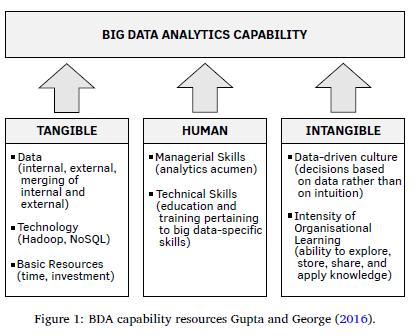
Similar to the BDA capability model created by Gupta and George (2016), others (Huang et al., 2022; Mikalef et al., 2017) draw on the resource-based theory of the firm (RBT) to identify the various resources needed to create a firm's BDA capability and to test the relationship between BDA capability and firm performance. Three types of resources are proposed including tangible resources (data, technology, and other basic resources), intangible resources (data-driven culture and organisational learning), and human resources (managerial and technical big data skills). The empirical results of these studies provide evidence that BDAC leads to high firm performance. This study adopts the BDA capability constructs from Gupta and George (2016) to test the research question and hypotheses.
2.3 Big data analytics capability and firm performance
Numerous studies have investigated the relationship between BDAC and firm performance, consistently finding a positive association. Gupta and George (2016) demonstrated that BDAC positively impacts both operational and market performance based on the resource-based theory of the firm. Similarly, Shabbir and Gardezi (2020) identified a positive influence of BDAC on OP in small and medium enterprises, with knowledge management practices partially mediating this relationship.
Wamba et al. (2017) and Akhtar et al. (2019) confirmed a positive relationship between BDAC and firm performance, with dynamic capabilities and the alignment of analytics capability with business strategy serving as mediating factors, respectively. Garmaki et al. (2016) found that BDAC, assessed through an IT capability model, positively impacts finance and market performance, with operational performance acting as a mediator. Anwar et al. (2018) revealed that big data capabilities significantly influence firm performance, with competitive advantage mediating this relationship. Wang et al. (2018) demonstrated the positive impact of BDAC on business value creation in healthcare industries. Additionally, Amankwah-Amoah and Adomako (2019) introduced a framework illustrating how different approaches to BDA adoption and implementation can affect firm performance across various domains.
The specific benefits to retailers include inter alia, greater customisation, personalised products, services and pricing models (Akhtar et al., 2019; Maheshwari et al., 2021), improved customer satisfaction and increased sales (Cuenca et al., 2021), price optimisation (Akter et al., 2016) and inventory management (Grewal et al., 2021). Predictive analytics also bring additional benefits like fraud minimisation and overall supply chain management (Maheshwari et al., 2021). Therefore, several studies proved that BDA capability and firm performance are positively related to different moderating and mediating variables.
To compete effectively, South African retailers must leverage BDA to differentiate themselves. This involves creating unique value propositions, offering localised products and providing personalised customer experiences. By embracing innovation and change through BDA, retailers can navigate evolving consumer trends and industry dynamics, ensuring their survival and success in this challenging environment (BDOSA, 2024).
2.4 BDA capability resources
Nowadays, organisations need to possess several resources to fully obtain the benefits that big data offers (Grewal et al., 2021). Even though limited research was conducted on BDA capability, some studies focused on understanding the resources needed to develop such a capability (Gupta & George, 2016; Huang et al., 2022; Mikalef et al., 2017; Munir et al., 2022; Su et al., 2022). Mikalef et al. (2017), note that an organisation needs a combination of tangible, intangible and human resources to build a big data analytics capability. These resources are fundamental in the formation of an organisation's overall BDA capability.
To date, most studies have discussed the processes and resources needed to deploy BDA but have provided little insight into how organisations can create a strong BDA capability (Gupta & George, 2016). Building on the foundations of the resource-based theory of the firm and several information technologies (IT) work, the main resources necessary to build a strong BDAC were identified. These resources are divided into three main groups: tangible resources (data, technology and basic resources), intangible resources (data-driven culture and organisational learning), and human resources (technical skills and managerial skills). Also, this study adopted the BDAC constructs proposed by (Gupta & George, 2016) to test the research questions and hypotheses. These constructs include seven resources drawn from the resource-based theory of the firm see Figure 1.
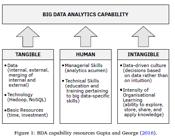
Tangible resources encompass organisational structures, physical assets, and financial resources, facilitating the rapid development, installation and support of necessary system components for big data analytics (Gupta & George, 2016). These resources include data, technology and basic resources, all vital for big data success (Mikalef et al., 2017). Data, as a crucial factor of production, can be categorised into internal and external sources, each contributing to organisational insights and decision-making (Gupta & George, 2016). A technological infrastructure capable of analysing, sharing and storing data is essential for handling massive and fast-moving datasets, with relational database management systems and extract, transform, and load (ETL) methods being common tools (Mikalef et al., 2017). Basic resources, such as investments and time allocation, are necessary for the persistence and success of big data initiatives (Gupta & George, 2016).
Human resources encompass the knowledge, experience and skills of employees, with managerial and technical skills being fundamental for big data analytics (Mikalef et al., 2017; Su et al., 2022). Technical skills, including competencies in data extraction, machine learning and statistical analysis, are acquired through formal education, training programs and practical experience (Gupta & George, 2016). Managerial skills, on the other hand, are developed over time within the organisation and involve interpreting and utilising insights extracted from big data for decision-making (Mikalef et al., 2017).
Intangible resources, such as data-driven culture and organisational learning, play a critical role in building BDAC (Mikalef et al., 2017). Organisational learning enables continuous improvement through knowledge and insights gained from big data analysis (Gupta & George, 2016). A data-driven culture emphasises data-based decision-making and experimentation, fostering an environment where insights outweigh opinions and failure leads to learning (Berndtsson et al., 2018). Such a culture is essential for successful big data implementation and organisational performance (Cao et al., 2015).
The review of the literature reveals that most of the studies on BDAC and organisational performance were conducted in Europe, the USA and Asia with a few exceptions in Africa. In addition, the above studies mostly focused on sectors such as banks, telecommunications, health care and automotive (Akhtar et al., 2019; Anwar et al., 2018; Garmaki et al., 2016; Mikalef et al., 2017; Wamba et al., 2017). This study is among the few studies that consider the retail sector of South Africa (Ridge et al., 2015; Sabharwal & Miah, 2021). This can serve as a framework for South African retailers utilising BDA to maximise their organisational performance.
3 RESEARCH MODEL AND RESEARCH HYPOTHESES
3.1 Research model
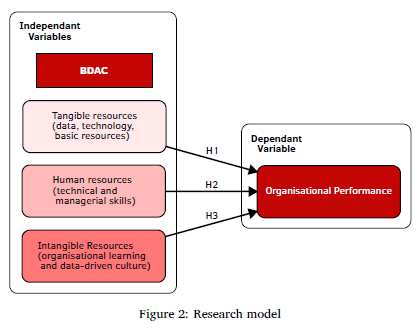
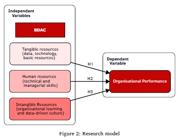
Drawing on BDA capabilities literature, this study proposes a research model as depicted in Figure 2. This model shows a pictorial description of the relationship between the independent variables (BDA tangible, human and intangible resources) and the dependent variable (organisational performance).
3.2 Research hypotheses
The proposed hypotheses for this study were:
Hypothesis 1 (H1) There is a positive and significant relationship between BDA's tangible capabilities and the organisational performance of selected South African retailers.
Hypothesis 2 (H2) There is a positive and significant relationship between BDA's human capabilities and the organisational performance of selected South African retailers.
Hypothesis 3 (H3) There is a positive and significant relationship between BDA's intangible capabilities and the organisational performance of selected South African retailers.
4 METHODOLOGY
This study adopted a descriptive research design through a quantitative approach to determine the relationship between the independent variables and the dependent variable (Ragab & Arisha, 2017). A questionnaire adopted from (Gupta & George, 2016) was used to collect the data.
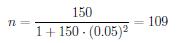
The population included employees of selected South African retailers. The target population was limited to the BI team members of the selected retailers. To reduce the size of the population, only retailers in Cape Town were targeted. The sample size was estimated to be 109 employees. There are various statistical methods for calculating sample size. The study used the formula developed by (Yamane, 1967) to calculate the sample size:
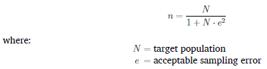
In calculating the estimated sample size, a 95% confidence interval and a 5% sampling error were used by the researcher. Therefore, using the above formula the sample size was obtained as:
The data analysis of this study consisted of two main parts: summarising the collected data (descriptive statistics) and determining the relationship between the dependent and the independent variable (Spearman Correlation). This was done using Excel and Statistical Package for Social Science (SPSS). Descriptive statistics are generally used to make research data summaries. Additionally, a correlation test was run to determine the relationship between the variables. According to Ali and Al-Hameed (2022), Spearman coefficient correlation is a coefficient that expresses the strength and direction of the relationship between two phenomena only. This type of correlation is generally used when the variables are measured on an ordinal scale, not normally distributed and when the sample size is small. Therefore, Spearman coefficient correlation was the appropriate correlation analysis for the study because it had a small sample size and discrete ordinal data (Likert scale data).
5 RESULTS AND FINDINGS
This section presents the analysed data and overall findings of the study. It is divided into findings on the response rate and the demographic characteristics of all the respondents followed by the reliability and validity of the statistics and lastly the descriptive statistics and the Spearman correlation results of the independent and dependent variables.
5.1 Response rate and demographic profile
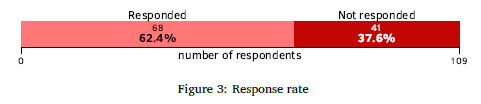
The study targeted 109 participants and received responses from 68 participants resulting in a 62.4% response rate which was satisfactory for the analysis according to (Yamane, 1967) who state that a 70% response rate is very good, 60% good and 50% adequate. The response rate of the study is presented in Figure 3.

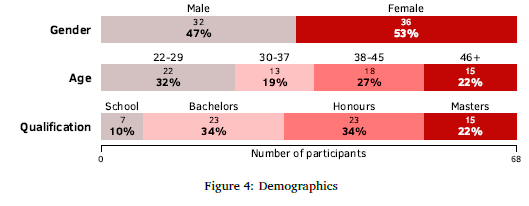
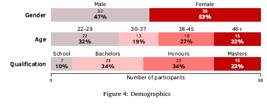
The results (as shown in Figure 4) revealed that (47%, n = 32) of the participants were female and (53%, n = 36) were male. It was promising to achieve a good distribution between male and female participants. The majority of the participants (32%) were in the younger age brackets (22-29 years). They were followed by those aged between 38-45 years (27%, n = 18) and 46+ (22%, n = 15). Lastly, those aged between 30-37 years represented a minority of 19.1%. The results revealed that the majority of the participants of this study were Honours degree holders (33.8%, n = 23) and Bachelor's degree holders (33.8%, n = 23). Holders of Master's degrees were represented by 22%. Lastly, secondary school holders represented a minority of 10%. Therefore, the above results show that most of the participants were well-educated.
5.2 Reliability and validity statistics
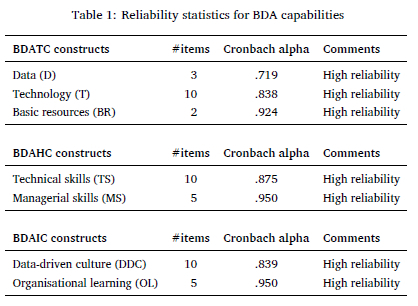
Reliability often refers to the consistency of study constructs to ensure the stability of the measuring instrument used and its consistency over time (Sürücü & Maslakçi, 2020). In this study, construct reliability was assessed using Cronbach's alpha. According to Taber (2018) Cronbach alpha is used to measure the consistency or reliability between several items, measurements or ratings. It is frequently used to test the stability of the assessment instrument of the study. Moreover, a construct is generally considered reliable when the alpha value is greater than 0.70 (Taherdoost, 2016). See Table 1 for a depiction of the reliability statistics for BDA capabilities.
Table 1 indicates that all BDA tangible capability constructs have a reliability score of 0.7 and above (high reliability). The findings revealed that data, technology and basic resources had a reliability score of .719, .838 and .924 respectively. Furthermore, the findings indicate that all BDA human capability constructs have a reliability score of 0.7 and above (high reliability). It revealed that technical skills and managerial skills had a reliability score of .875 and .950 respectively. Moreover, results revealed that data-driven culture had a Cronbach alpha of .839 and organisational learning had a Cronbach alpha of .909. This implies that all BDA intangible capability constructs were reliable.
Validity is often concerned with the meaningfulness and accuracy of study constructs. When research is highly valid, it implies that its results are consistent with reality (Bahariniya et al., 2021). There are mainly four types of validity namely, content validity, face validity construct validity and criterion validity (Taherdoost, 2016). This study adopted construct validity which is often defined as "the extent to which a research instrument (or tool) measures the intended construct" (Heale & Twycross, 2015, p. 66). According to Bahariniya et al. (2021), this type of validity is often evaluated by factor analysis. Factor analysis is usually considered a data reduction technique. It is often associated with factor loading which is defined as the correlation between the variable and the factor (Tavakol & Wetzel, 2020). According to Shrestha (2021), the variables with large loadings values >0.40 indicate that they are representative of the factor.
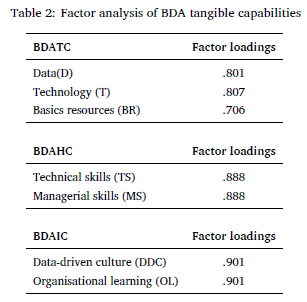
Summarised results in Table 2 indicate that the factor loads used in measuring BDA tangible capabilities ranged from 0.706 to 0.807. The results revealed that technology had the highest factor loading (.801) and basic resources had the lowest factor loading (.706). Additionally, results reveal that both technical skills and managerial skills had a factor loading of .888. Moreover, Table 2 reveals that both data-driven culture and organisational learning had a factor loading of .901.
Therefore, the analysis revealed that all the variables used to measure BDATC, BDAHC and BDAIC had a coefficient greater than 0.4. This implies that all the BDATC, BDAHC and BDAIC variables were feasible and significant to be used in data collection.
5.3 Spearman coefficient correlation between BDA capabilities and organisational performance
Spearman correlation was used to determine the relationship that exists between big data analytics tangible capabilities (BDATC), data analytics human capabilities (BDAHC), data analytics intangible capabilities (BDAIC) and the organisational performance (OP) of South African retailers.
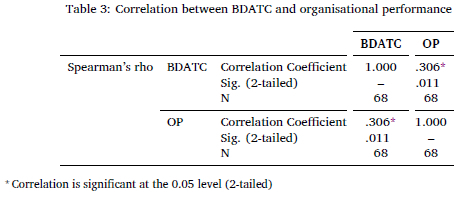
H1 assesses whether BDATC is positively and significantly related to the organisational performance of South African retailers. The relationship between BDATC and OP is displayed in Table 3. The results reveal a Spearman correlation of .306 and a probability sig. (2-tailed) of .011. This implies that there is a moderate positive correlation between BDATC and the organisational performance of South African retailers, which is statistically significant. Additionally, it indicates that as retailers increase their BDA tangible capabilities, their organisational performance increases as well. Therefore, H1 was supported.
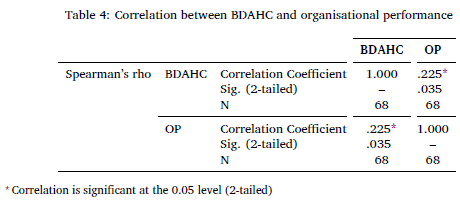
H2 evaluates whether BDAHC is positively and significantly related to the organisational performance of South African retailers. The relationship between BDAHC and OP is displayed in Table 4. The results reveal a Spearman correlation of .225 and a probability sig. (2-tailed) of .035. This implies that there is a significant positive correlation between BDATC and the organisational performance of South African retailers. In addition, results indicate that as retailers increase their BDA human capabilities, their organisational performance increases as well. Hence, H2 was supported.
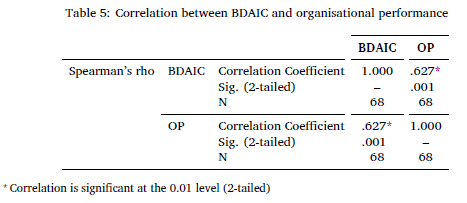
H3 assesses whether BDAIC is positively and significantly related to the organisational performance of South African retailers. The relationship between BDAIC and OP is displayed in Table 5. The results reveal that BDAIC is positively and significantly related to the organisational performance of South African retailers (r =.627, p =.001). This implies that there is a strong relationship between both, suggesting that an increase in the BDAIC of retailers will lead to an increase in their Organisational performance. Consequently, H3 was supported.
6 DISCUSSION
Several researchers have been working toward understanding BDA capability and examining its relationship with firm performance (Akhtar et al., 2019; Garmaki et al., 2016; Sekli & Vega, 2021; Wamba et al., 2017). Prior studies on this topic confirmed a positive relationship between BDAC and firm performance (Akhtar et al., 2019; Anwar et al., 2018; Gupta & George, 2016; Su et al., 2022). However, few studies have focused on understanding this relationship in retail sectors. Thus, this study aimed to fill this gap by examining the impact of BDA capabilities on the organisational performance of retailers. Empirical research was conducted and insights were provided on the relationship between BDAC and the organisational performance of South African retailers. Based on the findings from prior studies, three hypotheses were proposed.
Hypothesis 1 There is a positive and significant relationship between BDA's tangible capabilities and the organisational performance of selected South African retailers.
Firstly, it was assumed that BDA's tangible capabilities positively and significantly impact the organisational performance of South African retailers. The findings from the analyses revealed that there is a positive and significant relation between BDATC and the organisational performance of South African retailers (r =.306, p=.011). Hence, H1 was supported. This significant relationship shows that South African retailers should deploy BDA tangible resources to maximise their organisational performance. The above findings correspond to a study conducted by Su et al. (2022) whose results revealed that BDA tangible resources have a positive impact on organisational performance. Similarly, other studies confirmed a positive relationship between BDATC and organisational performance (Akhtar et al., 2019; Anwar et al., 2018; Ong & Chen, 2013). Moreover, the findings of the study revealed a positive impact of BDA's tangible capabilities (data, technology and basic resources) on selected South African retailers. Hence, all South African retailers should consider employing BDA tangible capabilities to enhance their organisational performance and competitive advantage and save their money and time. In addition, retailers should reinforce the performance of their BD analytics platforms in terms of compatibility, connectivity and modularity to maximise their organisational performance.
Hypothesis 2 There is a positive and significant relationship between BDA's human capabilities and the organisational performance of selected South African retailers.
Secondly, it was hypothesised that BDA's human capabilities have a positive and significant impact on the organisational performance of South African retailers. The results reveal that the relationship between BDA human capabilities and organisational performance was positive and significant (r =.225, p=.035). Consequently, H2 was supported. The above result is consistent with previous studies that found that BDA human capabilities enhance organisational performance (Tambe, 2014). For instance, Anwar et al. (2018) reported that BDA human capabilities significantly and positively impact the performance of an organisation. Similarly, Su et al. (2022) concluded that BDA human resources positively impact organisational performance.
Furthermore, the findings of the study revealed a positive impact of BDA human capabilities (technical skills and managerial skills) on selected South African retailers. Consequently, all South African retailers should consider deploying BDA human capabilities as this has a direct impact on organisational performance. Moreover, to maximise organisational performance through this capability, retailers should consider investing in the training of their staff to have a well-trained BDA team that is eager to be efficient, attentive and creative. Additionally, retailers should consider recruiting more technically trained senior managers with real BDA experience. Managers who understand how BDA works and hire people with the right knowledge and skills.
Hypothesis 3 There is a positive and significant relationship between BDA's intangible capabilities and the organisational performance of selected South African retailers.
Thirdly, it was hypothesised that BDA's intangible capabilities positively and significantly impact the organisational performance of South African retailers. The findings from the analyses reveal that BDAIC is positively and significantly correlated to the organisational performance of South African retailers (r =.627, p =.001). Thus, H3 was supported. The finding of this study corresponds to prior studies that examined the relationship between BDA intangible capabilities and organisational performance (Kamasak, 2017; Rua & Franca, 2017; Su et al., 2022). Additionally, Gupta and George (2016) provided evidence that BDA intangible resources significantly impact organisational performance.
Moreover, the findings of the study revealed a positive impact of BDA tangible capabilities (technical Skills and managerial skills) on selected South African retailers. Hence, South African retailers should consider employing BDA human capabilities to enhance their organisational performance. Furthermore, to maximise organisational performance through this capability, retailers should consider building a data-driven culture, enhancing data management skills, developing decision-making capabilities and expanding the various data-driven decision-making that combine intuition and analytical insights. In addition, retailers should encourage organisational learning to understand the dynamic and complex environment.
Therefore, the study concludes that all the BDAC primary dimensions (BDA tangible, BDA human, and BDA intangible capabilities) have a positive and significant impact on the organisational performance of South African retailers. This implies that the high market and operational performance of South African retailers is a result of well-deployed BDA tangible, intangible and human resources. In addition, this study provides retailers with evidence that the deployment of BDAC is essential for the improvement of organisational performance.
7 RECOMMENDATIONS
The essential resources for improving organisational performance include data, technology, basic resources, technical skills, managerial skills, data-driven culture and organisational learning. To maximise organisational performance through these capabilities, the following recommendations should be taken into consideration:
Integration of BDA into Operations Retailers should recognise the critical role of BDA in their operations, as it directly impacts organisational performance. This integration can enhance competitive advantage, streamline processes and result in significant cost and time savings. Furthermore, changing customer behaviour and the importance of customer orientation need to drive the integration of BDA in the SA retail sector, also cited by (Ridge et al., 2015). The global trends of e-commerce growth, omnichannel retailing and personalisation underscore this shift in customer behaviour (Deloitte, 2024).
Enhancement of Human Resources The study reveals that tangible and intangible capabilities are more strongly related to the organisational performance of South African retailers than human capabilities. This indicates a need to enhance human resources. Retailers should continuously assess and upgrade their BDA human skills by hiring individuals with the right expertise and investing in ongoing training and development. This needs to be underscored by a focused change management strategy to combat resistance to change.
Optimisation of BDA Platforms To maximise the benefit of BDA tangible capabilities, retailers should focus on improving their analytics platforms in terms of compatibility, connectivity and modularity. This ensures seamless integration and efficient data processing, essential for the digital infrastructure.
Investment in Training and Development Retailers should consistently invest in the training of their BDA teams to enhance their knowledge and skills. A well-trained team is essential for extracting meaningful insights from data and making informed business decisions.
Improvement of Intangible Capabilities Retailers should enhance the quality of investment, planning and coordination to fully leverage BDA intangible capabilities. This improvement will lead to better service quality and product innovation, contributing to overall organisational performance. Tailoring these strategies to South Africa's unique economic and cultural landscape will provide a competitive edge.
Real-Time Monitoring Retailers should implement real-time monitoring systems to keep track of competitors and customer behaviours. This proactive approach helps identify operational bottlenecks and deficiencies, allowing retailers to adapt to changes in the business and economic environment quickly.
8 CONCLUSION
The goal of this study was to determine the impact of BDA capabilities on the organisational performance of South African retailers. The study was guided by two main objectives. Firstly, a literature review was conducted to understand the impact of BDA capabilities on organisational performance. Secondly, empirical research was conducted to determine the impact of BDA tangible, intangible and human capabilities on the organisational performance of South African retailers.
Data were collected from South African retailers through an online questionnaire to measure the level to which BDA capabilities impact the improvement of their organisational performance. The collected data was then analysed through SPSS and a correlation test was conducted to determine whether the proposed hypotheses of the study were accepted or rejected. The study proposed three hypotheses.
Firstly, it was hypothesised that BDA tangible capabilities and the organisational performance of South African retailers are positively and significantly related. The findings of the study validate this hypothesis thus the research concludes that BDATC impacts the organisational performance of South African retailers. Additionally, this implies that the more retailers deploy BDA tangible resources, the higher their organisational performance.
Furthermore, the study proposed that a positive and significant association exists between BDA human capabilities and the organisational performance of South African retailers. The findings of the study provide evidence that this hypothesis is true thus the research concludes that BDAHC impacts the organisational performance of South African retailers. This implies that BDAHC is a key factor that should be considered by all retailers as they adopt big data analytics. It is evident that the use of BDA human resources is essential for increasing productivity, sales revenue, profit rate and return on investment.
Moreover, the study predicted that BDA intangible capabilities and the organisational performance of South African retailers are positively and significantly related. The results of the study provide validation of this relationship. Thus, the research concludes that BDAIC impacts the organisational performance of South African retailers. This implies that the more retailers deploy BDA intangible resources, the higher their organisational performance. In addition, this shows that BDAIC is of importance to South African retailers.
Overall, the study attempted to examine the impact of BDA capabilities on the organisational performance of retail industries in South Africa and the findings stated that these capabilities have a positive and significant impact on organisational performance. This study provides retailers with a deeper understanding of the various BDA capabilities and the key role they play in maximising organisational performance.
9 LIMITATIONS AND FURTHER RESEARCH
As with any other research, the study had a series of limitations. Firstly, this research was limited only to South African retailers. It is difficult to apply the results of this study to other industries such as manufacturing, banking, automobile, etc. Thus, future researchers can focus on different countries and different sectors using the same study model.
Secondly, the study targeted 109 respondents to take part in the research survey, only 68 responses were collected and deemed satisfactory for analysis. The sample was selected from the BI teams of the three largest retailers in South Africa as they were deemed to be the most knowlegable, however, this can pose a potentially biased view. Hence, future researchers can target larger sample sizes and other stakeholders from retail organisations to obtain a higher response rate which may lead to more pertinent results. Additionally, the study adopted a quantitative approach to analyse the collected data. Future researchers can adopt a mixed-method (quantitative-qualitative approach) to validate the proposed findings.
Thirdly, this study focused on investigating the impact of BDAC on the overall organisational performance and not a specific area. Hence, future researchers can investigate the impact of BDA capability within a specific department such as supply chain management, etc. Moreover, since most organisations are in the adoption and development process of BDAC, future researchers should consider improving this research by including other dimensions such as how BDAC relates to improved capabilities to implement and use Big Data Algorithmic Systems.
References
2 LITERATURE REVIEW
- Akhtar, P., Frynas, J. G., Mellahi, K., & Ullah, S. (2019). Big data-savvy teams' skills, big data-driven actions and business performance. British Journal of Management, 30(2), 252271. https://doi.org/10.1111/1467-8551.12333
- Akter, S., Wamba, S. F., Gunasekaran, A., Dubey, R., & Childe, S. J. (2016). How to improve firm performance using big data analytics capability and business strategy alignment? International Journal of Production Economics, 182, 113-131. https://doi.org/10.1016/j.ijpe.2016.08.018
- Ali, K., & Al-Hameed, A. (2022). Spearman's correlation coefficient in statistical analysis. International Journal of Nonlinear Analysis and Applications, 13(1), 3249-3255. https://doi.org/10.22075/IJNAA.2022.6079
- Alwan, H. B., & Ku-Mahamud, K. R. (2020). Big data: Definition, characteristics, life cycle, applications, and challenges. IOP Conference Series: Materials Science and Engineering, 769(1), 012007. https://doi.org/10.1088/1757-899X/769/1/012007
- Amankwah-Amoah, J., & Adomako, S. (2019). Big data analytics and business failures in data-rich environments: An organizing framework. Computers in Industry, 105, 204-212. https://doi.org/10.1016/j.compind.2018.12.015
- Anwar, M., Khan, S. Z., & Shah, S. Z. A. (2018). Big data capabilities and firm's performance: A mediating role of competitive advantage. Journal of Information & Knowledge Management, 17(04), 1850045. https://doi.org/10.1142/S0219649218500454
- Babelóvá, Z. G., Starecek, A., Koltnerová, K., & Cagáñová, D. (2020). Perceived organizational performance in recruiting and retaining employees with respect to diferent generational groups of employees and sustainable human resource management. Sustainability, 12(2), 574. https://doi.org/10.3390/SU12020574
- Bahariniya, S., Ezatiasar, M., & Madadizadeh, F. (2021). A brief review of the types of validity and reliability of scales in medical research. Journal of Community Health Research, 10(2), 100-102. https://doi.org/10.18502/JCHR.V10I2.6582
- Balachandran, B. M., & Prasad, S. (2017). Challenges and benefits of deploying big data analytics in the cloud for business intelligence. Procedía Computer Science, 112, 1112-1122. https://doi.org/10.1016/J.PROCS.2017.08.138
- BDOSA. (2024). What will be impacting shoppers and retailers as 2024 unfolds? [Accessed: 2 July 2024]. https://www.bdo.co.za/en-za/insights/2024/advisory/what-will-be-impacting-shoppers-and-retailers-as-2024-unfolds
- Berndtsson, M., Forsberg, D., Stein, D., & Svahn, T. (2018). Becoming a data-driven organisation. ECIS 2018 Proceedings, Research-in-Progress Papers, 43. https://aisel.aisnet.org/ecis2018_rip/43
- Bhasin, H. (2020). Organisational performance definition and factors [Accessed: 25 June 2023]. https://www.marketing91.com/organisational-performance/
- Cuenca, V., Urbina, M., Córdova, A., & Cuenca, E. (2021). Use and impact of big data in organizations. In M. Botto-Tobar, H. Cruz & A. Díaz Cadena (Eds.), Artificial intelligence, computer and software engineering advances (pp. 147-161). Springer International Publishing.
- Deloitte. (2024). Deloitte global retail outlook 2024: Navigating challenges and embracing opportunities - Insights from retail leaders around the world [Accessed: 1 July 2024]. https://www2.deloitte.com/content/dam/Deloitte/pl/Documents/Reports/Global-Retail-Outlook-2024.pdf
- Garmaki, M., Boughzala, I., & Wamba, S. F. (2016). The effect of big data analytics capability on firm performance. PACIS 2016 Proceedings, 301. https://aisel.aisnet.org/pacis2016/301
- Heale, R., & Twycross, A. (2015). Validity and reliability in quantitative studies. Evidence-Based Nursing, 18(3), 66-67. https://doi.org/10.1136/EB-2015-102129
- Maheshwari, S., Gautam, P., & Jaggi, C. K. (2021). Role of big data analytics in supply chain management: Current trends and future perspectives. International Journal of Production Research, 59(6), 1875-1900. https://doi.org/10.1080/00207543.2020.1793011
- Mikalef, P., Pappas, I. O., Krogstie, J., & Giannakos, M. (2017). Big data analytics capabilities: A systematic literature review and research agenda. Information Systems and e-Business Management 2017 16:3, 16(3), 547-578. https://doi.org/10.1007/s10257-017-0362-y
- Munir, S., Rasid, A., Aamir, M., & Ahmed, I. (2022). Big data analytics capabilities, innovation and organisational culture: Systematic literature review and future research agenda. 3C Tecnología, Special Issue February 2022, 209-235. https://doi.org/10.17993/3ctecno.2022.specialissue9
- Najafabadi, M. M., Villanustre, F., Khoshgoftaar, T. M., Seliya, N., Wald, R., & Muharemagic, E. (2015). Deep learning applications and challenges in big data analytics. Journal of Big Data, 2(1), 1-21. https://doi.org/10.1186/S40537-014-0007-7/METRICS
- Ogbo, A. I., Chibueze, N. F., Christopher, O. C., & Anthony, I. A. (2015). Impact of structure on organisational performance of selected technical and service firms in Nigeria. Corporate Ownership and Control, 13(1CONT10), 1278-1284. https://doi.org/10.22495/COCV13I1C10P13
- Ong, C. S., & Chen, P. (2013). Information technology capability-enabled performance, future performance, and value. Industrial Management and Data Systems, 113, 669-682. https://doi.org/10.1108/02635571311324133
- Pathak, R. (2021). What is big data analytics? Definition, advantages, and types [Accessed: 29 October 2024]. https://www.analyticssteps.com/blogs/what-big-data-analytics-definition-advantages-and-types
- Ragab, M. A., & Arisha, A. (2017). Research methodology in business: A starter's guide. Management and Organizational Studies, 5(1), 1. https://doi.org/10.5430/MOS.V5N1P1
- Ridge, M., Johnston, K. A., & O'Donovan, B. (2015). The use of big data analytics in the retail industries in South Africa. African Journal of Business Management, 9(19), 688-703. https://doi.org/10.5897/AJBM2015.7827
- Rua, O. L., & Franca, A. (2017). The linkage between intangible resources and export performance: The mediating effect of innovation. International Journal of Innovation, 5(3), 399-410. https://doi.org/10.5585/IJI.V5I3.190
- Sekli, G. F. M., & Vega, I. D. L. (2021). Adoption of big data analytics and its impact on organizational performance in higher education mediated by knowledge management. Journal of Open Innovation: Technology, Market, and Complexity, 7(4), 221. https://doi.org/10.3390/JOITMC7040221
- Shabbir, M. Q., & Gardezi, S. B. W. (2020). Application of big data analytics and organizational performance: The mediating role of knowledge management practices. Journal ofBig Data, 7(1), 1-17. https://doi.org/10.1186/S40537-020-00317-6
- Shrestha, N. (2021). Factor analysis as a tool for survey analysis. American Journal ofApplied Mathematics and Statistics, 9(1), 4-11. https://doi.org/10.12691/AJAMS-9-1-2
- Sürücü, L., & Maslakçi, A. (2020). Validity and reliability in quantitative research. Business & Management Studies: An International Journal, 8(3), 2694-2726. https://doi.org/10.15295/BMIJ.V8I3.1540
- Taber, K. S. (2018). The use of Cronbach's alpha when developing and reporting research instruments in science education. Research in Science Education, 48(6), 1273-1296. https://doi.org/10.1007/S11165-016-9602-2/TABLES/1
- Taherdoost, H. (2016). Sampling methods in research methodology; how to choose a sampling technique for research. SSRNElectronic Journal, 5, 18-27. https://doi.org/10.2139/SSRN.3205035
- Tambe, P. (2014). Big data investment, skills, and firm value. Management Science, 60(6), 1452-1469. https://doi.org/10.1287/MNSC.2014.1899
- Tavakol, M., & Wetzel, A. (2020). Factor analysis: A means for theory and instrument development in support of construct validity. International Journal of Medical Education, 11, 245-247. https://doi.org/10.5116/IJME.5F96.0F4A/RM
- van Dyk, R., & Belle, J. P. V. (2020). Drivers and challenges for digital transformation in the South African retail industry. Lecture Notes in Business Information Processing, 380 LNBIP, 42-62. https://doi.org/10.1007/978-3-030-43353-6_3
- Wamba, S. F., Gunasekaran, A., Akter, S., Ren, S. J.-f., Dubey, R., & Childe, S. J. (2017). Big data analytics and firm performance: Effects of dynamic capabilities. Journal of Business Research, 70, 356-365. https://doi.org/10.1016/j.jbusres.2016.08.009
- Wang, Y., Kung, L., & Byrd, T. A. (2018). Big data analytics: Understanding its capabilities and potential benefits for healthcare organizations. Technological Forecasting and Social Change, 126, 3-13. https://doi.org/10.1016/j.techfore.2015.12.019
- Yamane, T. (1967). Statistics, an introductory analysis (2nd ed.). New York: Harper & Row.
- Ying, S., Sindakis, S., Aggarwal, S., Chen, C., & Su, J. (2021). Managing big data in the retail industry of Singapore: Examining the impact on customer satisfaction and organizational performance. European Management Journal, 39(3), 390-400. https://doi.org/10.1016/J.EMJ.2020.04.001
Accepted: 15 September 2024
Online: 11 December 2024