Towards practical digital health designs: A single electronic health record for South Africa
Abstract
Since announcing the implementation of a single electronic health record for all South Africans, the government has not yet informed healthcare facilities of how this would be accomplished. The siloed South African healthcare system would have to be redesigned to accommodate a single electronic health record. A systematic literature review conducted across three databases returned 9 790 results. By applying ten filters, 22 documents were eventually retrieved for analysis. The analysis showed that existing research focuses on healthcare architectures from a theoretical perspective. Therefore, the literature review revealed a practically based research deficiency and a lack of theoretical studies merged with practical cases. Seeking to enhance the understanding of designing a single electronic health record, the documents were analysed using a qualitative inductive content analysis technique, revealing that a single electronic health record cannot be formulated using a fully centralised architecture as this is not practical. A fully decentralised architecture, such as blockchain, is equally infeasible because this requires significant changes to the existing systems and infrastructure and would require re-skilling system builders. Since the South African healthcare architecture is already decentralised, hybrid architecture incorporating edge computing with clusters of systems and information that connect using middleware should be considered. Categories • Applied Computing → Life and Medical Sciences → Healthcare information systems • Computer Systems Organization → Architectures → Distributed architectures
single electronic health record; centralised architecture; decentralised architecture; healthcare systems; blockchain; edge computing; hybrid architecture
1 INTRODUCTION
South Africa has proposed implementing a single electronic health record (EHR) for all citizens (Moonsamy, 2025; Ramaphosa, 2025). Such an implementation would require changes to the existing healthcare technology architecture to combine the relevant data from various sources to form an accurate and comprehensive view of a patient. Apart from major changes to the South African healthcare landscape, such as the implementation of SAP Health Information System (HIS) (Sobuwa, 2023), recent cybersecurity incidents (ITWEB, 2023, 2024; Kahn, 2024) necessitate safer and more future-proofed healthcare systems designs.
The two principal architectural design options are centralised and decentralised design. Much of the examined literature highlights the deficiencies of centralised designs, noting that they are single points of failure (Hussien et al., 2021; Miyachi & Mackey, 2021; X. Wang, 2022) and pose a security risk (Jayabalan & Jeyanthi, 2022). In contrast, decentralised architectures do not share the same security challenges as they offer several benefits, such as advanced security (Miyachi & Mackey, 2021; Zhu et al., 2024) and data-sharing capabilities (Guo et al., 2024). Existing research particularly focuses on the theoretical aspects of architectural designs. Nevertheless, practically speaking, existing technology landscapes must be considered along with the skill sets of the individuals involved.
This research paper is structured as follows: Section 2 provides the identification, filtering and results of the systematic literature review (SLR); this is followed by the research method in Section 3, which explains the application of the qualitative inductive content analysis; Section 4 presents the results of the data analysis and explains how the results relate to the single EHR; Section 5 proposes recommendations for designing the single EHR, followed by the conclusion.
Balsam and Mishra (2025) note the benefits of SLRs as being repeatable and conducive to identifying research deficits and identifying relevant literature based on inclusion and exclusion criteria. Phillips and Barker (2021) note that SLRs are transparent and provide a synthesis of existing relevant literature. Hence, this research followed the SLR methodology, supplemented by an adaptation of the Preferred Reporting Items for Systematic Reviews and Meta-Analyses (PRISMA) (Rethlefsen & Page, 2021) to report the search results graphically.
2.1 A SINGLE ELECTRONIC HEALTH RECORD
South Africa intends to introduce a single EHR for all South Africans (Moonsamy, 2025; Ramaphosa, 2025). A single EHR would provide accurate and real-time healthcare data to medical professionals, which, in turn, supports healthcare service delivery (Moonsamy, 2025). However, the highly fragmented South African healthcare landscape causes several challenges to implementing a single EHR:
1. The private and public healthcare sectors store their data separately (Moonsamy & Singh, 2024);
2. Systems struggle to share information due to interoperability issues (Tsegaye & Flowerday, 2021);
3. Data privacy must be considered (Tsegaye & Flowerday, 2021); and
4. Information security is a concern (Tsegaye & Flowerday, 2021).
Apart from the challenges to implementing a single EHR, the term "single electronic health record" has not yet been clearly defined within the South African healthcare context - to this author's knowledge. A single EHR might suggest a centralised system whereby all healthcare records are housed in a single physical location. Conversely, a single EHR could be implemented by logically grouping healthcare records through a decentralised mechanism. In the absence of a suitable definition, the author assumes that a single EHR refers to a logical grouping of healthcare records from several repositories forming a dynamic and comprehensive view of a patient.
Several authors have discussed centralised and decentralised designs from a theoretical perspective, meaning that existing systems and their associated challenges are not directly considered in the existing literature. Shamshad et al. (2020) suggest using blockchain technology to share healthcare information. C. Wang et al. (2024) discuss authorisation and access control through decentralisation for enhancing information security. However, South Africa and other developing countries have ageing Health Information Systems (HISs) that cannot be easily decentralised or migrated. Through a synthesis of existing literature, the author noted a deficiency of practically based research and an absence of theoretical studies merged with practical cases. This practicality insufficiency led to further investigation of existing ideas through the SLR discussed in Section 2.2.
2.2 LITERATURE SEARCH AND RESULTS
The study utilised three databases (EBSCO, ScienceDirect and Wiley) to search for existing literature on healthcare systems designs, as the author has institutional access to these resources. The following search string was used in the EBSCO and Wiley databases:
("Central electronic health record" OR "Central record" OR "Central storage" OR "Centralised electronic health record" OR "Centralised record" OR "Centralised storage" OR "Centralized electronic health record" OR "Centralized storage" OR "Centralized record" OR "Decentralised electronic health record" OR "Decentralised record" OR "Decentralised storage" OR "Decentralized electronic health record" OR "Decentralized record" OR "Decentralized storage" OR "Single view of patient" OR "Single view of patient record" OR "Single view of patient records")
Since the ScienceDirect database allows search strings with a maximum of eight Boolean operators, the author divided the search string into two strings and merged the results. Below are the separate search strings:
("Central electronic health record" OR "Central record" OR "Central storage" OR "Centralised electronic health record" OR "Centralised record" OR "Centralised storage" OR "Centralized electronic health record" OR "Centralized storage" OR "Centralized record")
("Decentralised electronic health record" OR "Decentralised record" OR "Decentralised storage" OR "Decentralized electronic health record" OR "Decentralized record" OR "Decentralized storage" OR "Single view of patient" OR "Single view of patient record" OR "Single view of patient records")
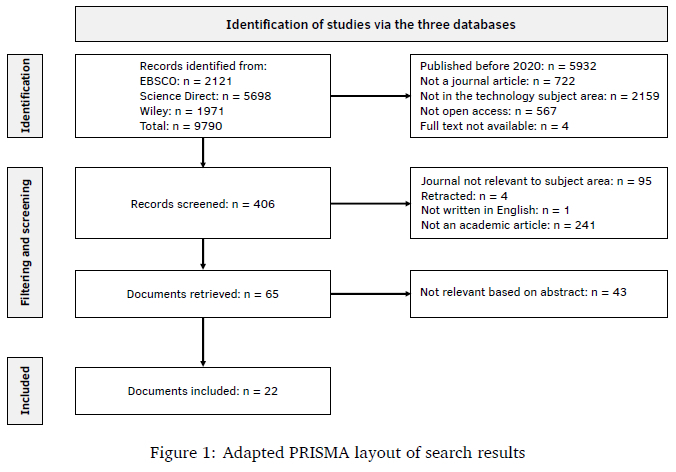
Figure 1 presents the results of the literature search.
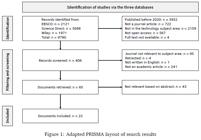
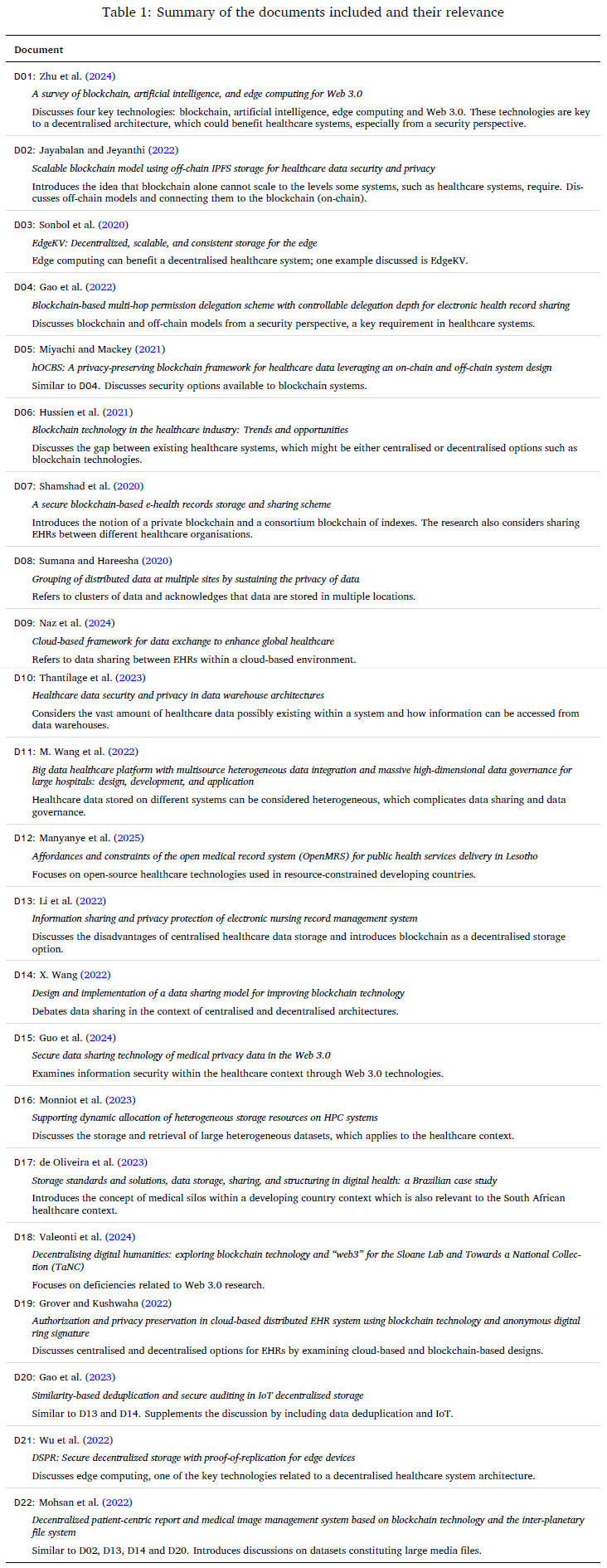
The searches yielded 9 790 records at the identification stage. The author applied ten filters to the search results (published since 2020, journals only, appropriate subject area, open access, full text, relevant journals, not retracted, English only, academic article only and relevant abstract), thereby excluding 99.77% of the records and retaining 22 documents for further investigation. Table 1 summarises the 22 studies identified for further review.
2.3 CENTRALISED VERSUS DECENTRALISED ARCHITECTURES
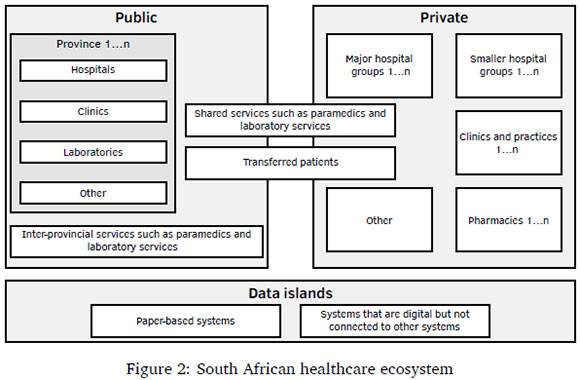
Healthcare data are sensitive and private and thus must be secure, especially when shared with other systems (de Oliveira et al., 2023; Gao et al., 2022). Notwithstanding this requirement, typical centralised healthcare architectures do not offer adequately secured mechanisms for sharing healthcare data with other systems (Shamshad et al., 2020). Moonsamy and Singh (2024) argue that the South African healthcare ecosystem comprising private and public healthcare sectors is more complicated when considering the components of each system. The private sector alone constitutes more than five main hospital groups, each centralising their data. In addition to these hospital groups, thousands of private healthcare providers store their patient data. The public sector has recently implemented SAP HIS for Gauteng (Sobuwa, 2023) but not yet in other provinces. This situation poses a practical challenge by creating medical silos, as mentioned by de Oliveira et al. (2023). Figure 2 depicts the existing healthcare ecosystem in South Africa. The healthcare ecosystems of other developing countries are expected to be similar.
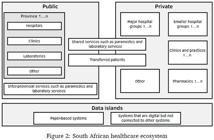
Data islands are included in Figure 2 due to the persistence of paper-based systems and digitised systems that do not share their data with other systems. Some studies (Gao et al., 2022; Jayabalan & Jeyanthi, 2022; Li et al., 2022; Zhu et al., 2024) highlight the benefits of decentralised systems within a healthcare context, whereas Monniot et al. (2023) discuss heterogeneous datasets and, Grover and Kushwaha (2022) consider centralised and decentralised systems. None of the authors suggested a fully centralised design - mostly due to security concerns. From a practical perspective, neither a fully centralised nor a fully decentralised system might be feasible designs due to the security risks of a fully centralised design and the large amount of work required to decentralise the healthcare system comprehensively.
2.4 LITERATURE REVIEW SUMMARY
The healthcare ecosystem in South Africa is not only fragmented insofar as service delivery, but also the systems and data are siloed, albeit with touchpoints in some areas, such as emergency patient transport and laboratory services. Even though previous authors have discussed the merits of a decentralised system, this author is not convinced that a fully decentralised system - even with off-chain functionality - would be practical. After examining the existing literature, the practicality gaps in the literature relating to designing a single EHR became more pronounced. This outcome called for a deeper analysis of the 22 included documents via an inductive content analysis. The analysis would promote a deeper understanding of the associations between the merits and shortcomings of centralised designs, decentralised designs, edge computing, Web 3.0 and other related technologies when designing a single EHR.
3 METHODOLOGY
Vears et al. (2022) describe inductive content analysis as a qualitative data analysis method suitable for the analysis of healthcare-related textual information such as research reports (journal articles) or non-research-related reports (doctors' notes). Since the methodology for this study was inherently inductive, the researcher needed to read through the texts to deduce meaning, thus negating the need for existing theories. This approach differs from a deductive content analysis, which uses existing theories on well-established literature. For this research, the author considered a well-established body of literature but did not consider existing theories related to the main concept of centralised and decentralised systems. The author opted for the inductive approach to establish new ideas or theories from the existing literature within a practical context.
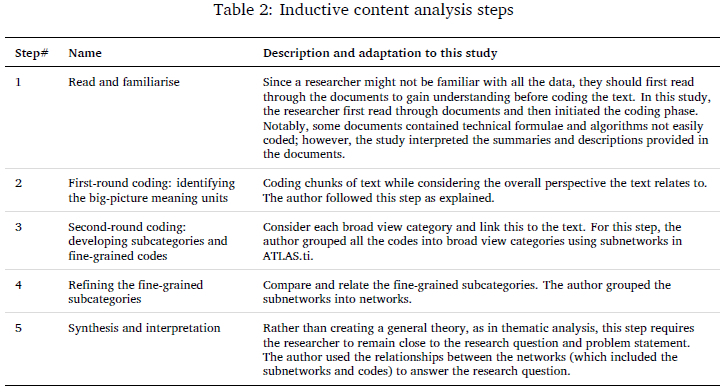
Table 2 describes the five steps followed in analysing the 22 documents, and Section 4 discusses the analysis results.
4 ANALYSIS AND RESULTS
The analysis of the 22 documents, together with the results of the analysis, are presented based on the five steps, as explained in Table 2. The documents were analysed using ATLAS.ti version 25.0.1.32924. Even though this version of ATLAS.ti integrates with OpenAI and is capable of performing coding using artificial intelligence, the author decided not to use this functionality and opted to code each document manually.
4.1 READ AND FAMILIARISE
During this step, the author read a document, coded the document and then moved on to the next document. Reading each document prior to coding gave the author a more detailed understanding of the core concepts of each document and how they related to centralised and decentralised healthcare system designs. Table 1 provides a summary of the concepts learnt from each document. As mentioned in Table 2, the very technical parts of some documents, such as the formulae and algorithms, were not examined in detail; however, the summaries and diagrams were synthesised, which led to the formulation of related codes. Section 4.2 contains a discussion of the first round of coding.
4.2 FIRST-ROUND CODING
The 22 documents were qualitatively analysed using inductive coding. During this step, 160 codes were formulated, presented in Appendix A. The coding depth or the number of codes identified per document has not been presented because some documents were very technical and focused on formulae and algorithms that did not directly impact this study. Furthermore, Vears et al. (2022) argue that qualitative content analysis is not concerned with counting frequencies of codes even though this notion contradicts Vaismoradi et al. (2013), who argue that content analysis - a branch of qualitative analysis - is concerned with interpreting the counts of codes.
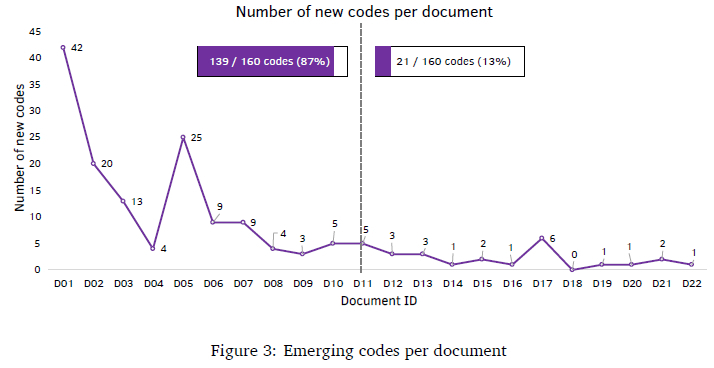
The output of the SLR (22 documents) was the input for the data analysis; hence, the 22 documents informed the sample size of the study. Braun and Clarke (2019) argue that thematic analysis and, by extension, content analysis do not always need to be examined for data saturation. Furthermore, Ahmed (2025) argues that the sample size for a content analysis depends on the amount of available text. Figure 3 presents the number of emerging codes per document.
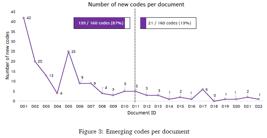
The 160 codes formulated during the first round of coding were used as input for the second round of coding, as discussed in Section 4.3.
4.3 SECOND-ROUND CODING
During the second round of coding, the 160 codes were grouped into 28 subnetworks, presented in Appendix A. The 28 subnetworks can be grouped into two main system design architectures: centralised and decentralised. Centralised data can support artificial intelligence and other forms of decision-making; however, healthcare systems (South Africa is no exception) store data fragmentedly or in medical silos. Decentralised systems are supported by technologies such as blockchain, Web 3.0 and edge computing. Blockchain has the potential to store indexes on-chain and can link to larger datasets stored off-chain. Even though edge computing and blockchain support decentralised designs, they are complicated to implement and require specialist skills and appropriate infrastructure. Once the subnetworks had been formulated, they were grouped into networks, which are discussed in Section 4.4.
4.4 REFINING THE FINE-GRAINED SUBCATEGORIES
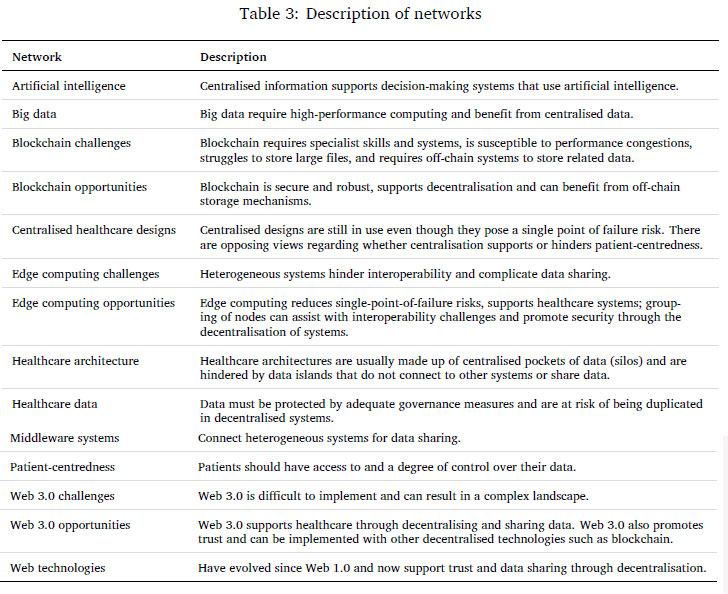
During this step, the 28 subnetworks were grouped into 14 networks, presented in Appendix A and explained in detail in Table 3.
Following the formulation of the codes, subnetworks and networks, the networks were used to answer the research questions, discussed in Section 4.5.
4.5 SYNTHESIS AND INTERPRETATION
Thus far, the literature review and data analysis have provided insights into healthcare system designs. A fully centralised system would easily support a single EHR as all records would be housed in a single location. Nonetheless, a fully centralised system is unquestionably impossible for South Africa to implement since there are potentially thousands of existing systems and data islands to consolidate. In addition, a fully centralised architecture is a security risk. Figure 2 illustrates siloed systems across the public and private sectors and the data islands created by unintegrated or paper-based systems. A closer inspection of Figure 2 reveals that the South African healthcare architecture is already decentralised even though Web 3.0, edge computing, and blockchain technologies are not directly referenced within this context.
RQ1: Is a single electronic health record better supported by a centralised or decentralised architecture in South Africa?
The question might be answered as follows: Since South Africa does not have a centralised healthcare architecture but is, instead, already decentralised, a single EHR would need to be designed based on this decentralised architecture, notwithstanding its siloed nature.
RQ2: Does the current South African healthcare architecture support a single electronic health record?
The question might be answered as follows: In its current state, the South African healthcare architecture does not support a single EHR. Even though decentralised systems can nevertheless connect, share information and create a single view of a patient, the primary requirement for system connectivity is absent or, at the very least, oversimplified.
Section 5 provides recommendations for the design of a single EHR.
5 DISCUSSION AND RECOMMENDATIONS
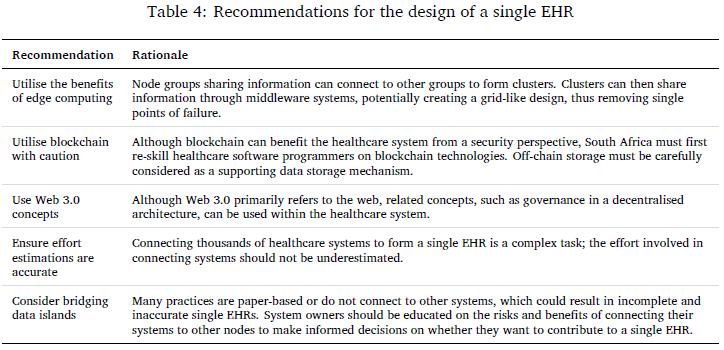
Several authors have criticised centralised architectures for being at risk of cyberattacks and subsequently becoming single points of failure (Hussien et al., 2021; Miyachi & Mackey, 2021; X. Wang, 2022). Therefore, decentralised architectures can benefit the healthcare system as they can be more secure since the South African healthcare architecture is already decentralised. However, creating a single EHR requires that the edge nodes (private and public hospital databases, private and public clinics, pharmacies and other facilities) should be connected. Even though middleware systems connect disparate systems (Sonbol et al., 2020), it might not be practical to link thousands of systems via a single middleware system since this would shift the single point of failure to the middleware system itself. Table 4 presents a list of recommendations for designing a single EHR.
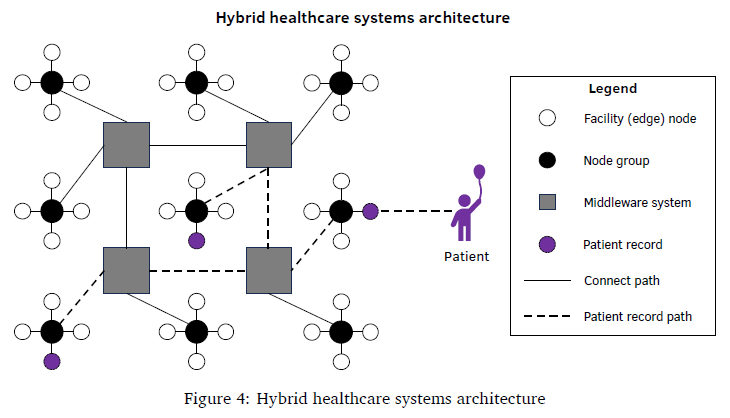
The recommendations presented in Table 4 and the existing landscape illustrated in Figure 2 could result in a hybrid design, whereby clusters of centralised systems can share information with a decentralised middleware architecture. All systems in the landscape can share information to form a single EHR. This concept is illustrated in Figure 4.
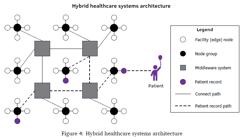
Creating a single EHR based on the architecture presented in Figure 4 requires further investigation to optimise searching for a patient and collecting all relevant data to form a single view of the patient. In addition, the hybrid architecture could be designed in detail by including blockchain and Web 3.0 principles. Failover scenarios should be investigated in future research.
6 CONCLUSION
South Africa seeks to benefit from a single EHR for all citizens, even though a single EHR has not been adequately defined. Therefore, the author proposes the following definition: "A single electronic health record is a logical grouping of healthcare records from several repositories forming a dynamic and comprehensive view of a patient". The author conducted an SLR to identify relevant studies related to the formulation of a single EHR focusing on centralised and decentralised technologies. This review led to the analysis of 22 documents using qualitative inductive content analysis. The first round of coding identified 160 codes, later grouped into 28 subnetworks and then further refined into 14 networks.
The author suggests a more practical approach to decision-making around healthcare architectures relating to centralisation versus decentralisation. Since it is impractical and unsafe to centralise the entire healthcare system, and fully decentralising the system requires significant skills development and changes to existing infrastructure, the author suggests a hybrid approach. In such an approach, a patient's entire record can be obtained from the relevant edges (facilities), which link up as edge groups. These edge groups are connected using middleware systems to form clusters. A single EHR can then be formulated based on following the correct path.
The proposed hybrid design considers decentralisation and edge computing because the South African healthcare architecture already resembles this layout. Future research should consider incorporating the benefits of blockchain, Web 3.0 and artificial intelligence technologies while considering the limitations of these technologies and the skill sets of existing resources.
References
2 LITERATURE REVIEW
- Ahmed, S. K. (2025). Sample size for saturation in qualitative research: Debates, definitions, and strategies. Journal of Medicine, Surgery, and Public Health, 5, 100171. https://doi.org/10.1016/j.glmedi.2024.100171
- Balsam, S., & Mishra, D. (2025). Web application testing - Challenges and opportunities. Journal of Systems and Software, 219, 112186. https://doi.org/10.1016/j.jss.2024.112186
- Braun, V., & Clarke, V. (2019). To saturate or not to saturate? Questioning data saturation as a useful concept for thematic analysis and sample-size rationales. Qualitative Research in Sport, Exercise and Health, 13(2), 201-216. https://doi.org/10.1080/2159676x.2019.1704846
- de Oliveira, N. R., dos Santos, Y., Mendes, A. C. R., Barbosa, G. N. N., de Oliveira, M. T., Valle, R., Medeiros, D. S. V., & Mattos, D. M. F. (2023). Storage standards and solutions, data storage, sharing, and structuring in digital health: A Brazilian case study. Information, 15(1), 20. https://doi.org/10.3390/info15010020
- Gao, Y., Zhang, A., Wu, S., & Chen, J. (2022). Blockchain-based multi-hop permission delegation scheme with controllable delegation depth for electronic health record sharing. High-Confidence Computing, 2(4), 100084. https://doi.org/10.1016/j.hcc.2022.100084
- Gao, Y., Chen, L., Han, J., Wu, G., & Liu, S. (2023). Similarity-based deduplication and secure auditing in IoT decentralized storage. Journal of Systems Architecture, 142, 102961. https://doi.org/10.1016/j.sysarc.2023.102961
- Grover, B., & Kushwaha, D. K. (2022). Authorization and privacy preservation in cloud-based distributed EHR system using blockchain technology and anonymous digital ring signature. Health Services and Outcomes Research Methodology, 23(2), 227-240. https://doi.org/10.1007/s10742-022-00281-z
- Guo, S., Chen, C., & Tong, Q. (2024). Secure data sharing technology of medical privacy data in the Web 3.0. IET Blockchain, 4(4), 335-343. https://doi.org/10.1049/blc2.12086
- Hussien, H. M., Yasin, S. M., Udzir, N. I., Ninggal, M. I. H., & Salman, S. (2021). Blockchain technology in the healthcare industry: Trends and opportunities. Journal of Industrial Information Integration, 22, 100217. https://doi.org/10.1016/j.jii.2021.100217
- ITWEB. (2023). South Africa ranked 5th on global cyber crime density list [Accessed: 12 July 2023]. https://www.itweb.co.za/article/south-africa-ranked-5th-on-global-cyber-crime-density-list/KA3WwMdz1nBvrydZ
- ITWEB. (2024). SA's cyber security vulnerability exposed [Accessed: 28 January 2025]. https://www.itweb.co.za/article/sas-cyber-security-vulnerability-exposed/KWEBb7yL1XavmRjO
- Kahn, T. (2024). NHLS still not fully operational after cyberattack [Accessed: 23 July 2025]. https://www.businessday.co.za/bd/national/health/2024-07-16-nhls-still-not-fully-operational-after-cyberattack/
- Li, Q., Yu, H., & Li, W. (2022). Information sharing and privacy protection of electronic nursing record management system (A. Farouk, Ed.). Scientific Programming, 2022, 1-12. https://doi.org/10.1155/2022/4169340
- Miyachi, K., & Mackey, T. K. (2021). hOCBS: A privacy-preserving blockchain framework for healthcare data leveraging an on-chain and off-chain system design. Information Processing & Management, 58(3), 102535. https://doi.org/10.1016/j.ipm.2021.102535
- Moonsamy, W. (2025). Working towards a single electronic health record for SA [Accessed: 29 April 2025]. https://www.itweb.co.za/article/working-towards-a-single-electronic-health-record-for-sa/Pero37Z38KyMQb6m
- Moonsamy, W., & Singh, S. (2024). Digital health model for South Africa's national health insurance: Addressing hospital occupancy and emergency care. Journal of Health Informatics in Africa, 10(2), 10-14. https://doi.org/10.12856/JHIA-2023-v10-i2-395
- Naz, A., Ali, M., Cheema, S. M., & Pires, I. M. (2024). Cloud-based framework for data exchange to enhance global healthcare. Procedia Computer Science, 241, 570-575. https://doi.org/10.1016/j.procs.2024.08.082
- Phillips, V., & Barker, E. (2021). Systematic reviews: Structure, form and content. Journal of Perioperative Practice, 31(9), 349-353. https://doi.org/10.1177/1750458921994693
- Ramaphosa, C. (2025). State of the nation address by President Cyril Ramaphosa [Accessed: 10 February 2025]. https://www.stateofthenation.gov.za/assets/downloads/SONA_2025_Speech.pdf
- Rethlefsen, M. L., & Page, M. J. (2021). PRISMA 2020 and PRISMA-S: Common questions on tracking records and the flow diagram. Journal of the Medical Library Association, 110(2). https://doi.org/10.5195/jmla.2022.1449
- Sobuwa, Y. (2023). How Gauteng's new information system will improve the quality of healthcare accreditation [Accessed: 24 August 2023]. https://www.news24.com/news24/southafrica/news/how-gautengs-new-information-system-will-improve-the-quality-of-healthcare-20230822
- Sonbol, K., Özkasap, Ö., Al-Oqily, I., & Aloqaily, M. (2020). EdgeKV: Decentralized, scalable, and consistent storage for the edge. Journal of Parallel and Distributed Computing, 144, 28-40. https://doi.org/10.1016/j.jpdc.2020.05.009
- Sumana, M., & Hareesha, K. S. (2020). Grouping of distributed data at multiple sites by sustaining the privacy of data. Procedia Computer Science, 171, 1688-1697. https://doi.org/10.1016/j.procs.2020.04.181
- Thantilage, R. D., Le-Khac, N., & Kechadi, M. (2023). Healthcare data security and privacy in data warehouse architectures. Informatics in Medicine Unlocked, 39, 101270. https://doi.org/10.1016/j.imu.2023.101270
- Vaismoradi, M., Turunen, H., & Bondas, T. (2013). Content analysis and thematic analysis: Implications for conducting a qualitative descriptive study. Nursing & Health Sciences, 15(3), 398-405. https://doi.org/10.1111/nhs.12048
- Valeonti, F., Vlachidis, A., Nyhan, J., Bikakis, A., Kotarski, R., & Jovanovic, P. (2024). Decentralising digital humanities: Exploring blockchain technology and "web3" for the Sloane Lab and towards a national collection (TaNC). Journal of Documentation, 81(1), 211-235. https://doi.org/10.1108/jd-04-2024-0093
- Wang, C., Xu, J., Tan, S., & Yin, L. (2024). Secure decision tree classification with decentralized authorization and access control. Computer Standards & Interfaces, 89, 103818. https://doi.org/10.1016/j.csi.2023.103818
- Wang, M., Li, S., Zheng, T., Li, N., Shi, Q., Zhuo, X., Ding, R., & Huang, Y. (2022). Big data health care platform with multisource heterogeneous data integration and massive high-dimensional data governance for large hospitals: Design, development, and application. JMIR Medical Informatics, 10(4), e36481. https://doi.org/10.2196/36481
- Wang, X. (2022). Design and implementation of a data sharing model for improving blockchain technology (Q. Li, Ed.). Advances in Multimedia, 2022, 1-8. https://doi.org/10.1155/2022/4578525
- Wu, C., Chen, Y., Qi, Z., & Guan, H. (2022). DSPR: Secure decentralized storage with proof-of-replication for edge devices. Journal of Systems Architecture, 125, 102441. https://doi.org/10.1016/j.sysarc.2022.102441
- Zhu, J., Li, F., & Chen, J. (2024). A survey of blockchain, artificial intelligence, and edge computing for Web 3.0. Computer Science Review, 54, 100667. https://doi.org/10.1016/j.cosrev.2024.100667
Accepted: 4 Jun 2026
Online: 31 July 2026