An IT career choice model
Abstract
Research focusing on students' Information Technology (IT) career choices shows that their decisions were influenced by factors, such as exposure to programming concepts at school level, culture, parents, teachers and role models. Theories relating to career choice have focused on individual characteristics and their environment. In South Africa however, there have been limited studies investigating the factors influencing students' IT career decisions, specifically choosing study programmes in Computer Science (CS), Information Systems (IS) and IT. The aim of this study was to evaluate a proposed IT career choices model. A questionnaire was developed and distributed amongst CS/IS/IT first-year students at the Nelson Mandela University in South Africa and 205 students completed the survey. The data were statistically analysed, including Exploratory Factor Analysis. The study highlighted that students with high academic confidence and exposure to programming concepts at an early age, chose an IT career. The study further showed statistical differences between students speaking different home languages and genders in their perceptions about the IT industry and choosing an IT career. The main contribution of the study is the evaluation of a proposed IT Career Choice Model, based on existing theories, literature and the statistical results obtained from the study.
IT career choice model; career choice theories; IT career choice factors
1 INTRODUCTION
The Information Technology (IT) industry is experiencing an IT skills shortage in some countries. IT and computing skills have been identified as one of top three scarce skills by the South African Government and the aim is to increase IT, Computer Science (CS) and Information Systems (IS) enrolments at Higher Education Institutions nationally (Kirlidog et al., 2018).
In South Africa, a limited number of scholars are choosing a career in IT (Kirlidog et al., 2018). First year students who have chosen a career in IT or other computing related fields were generally influenced by people and events in their daily living environment (Vernon & Drane, 2020). Research conducted globally on the factors that influence career choice identified the factors family influence, specifically parents, teachers, passion, values, a sense of belonging and self-efficacy (Yoel & Dori, 2023). Social media also has an influence on a student's career choice (Lee et al., 2019). Other interventions, such as computer clubs, gaming and mobile Apps, workshops and IT camps have created IT career awareness amongst scholars (Greyling, 2023; Kapoor & Gardner-McCune, 2019).
Career choice for scholars is a complex process and unique for everyone, depending on cognitive factors and the social structures of the individual's environment (Braza & Guillo Jr., 2015; Mtemeri, 2017). Mtemeri's (2017) research study proposed a career guidance model with the following six components: training career guidance teachers, planning career guidance activities, availing adequate resources, training parents, peer education on career guidance and linking students with industry. Parental education about careers, parental encouragement and advice are critical in students' choices of careers (Mtemeri, 2017).
Socialisers, such as family, parents, teachers and friends are key influencers for scholars' decisions in choosing an IT career (Säde et al., 2019; Stone, 2019). Recent research indicates that exposure to new technologies and being taught programming concepts at school level using mobile technologies can influence a scholar's IT career choice (Mano, 2019).
Students who have chosen a career in IT were influenced by parents, teachers and role models (Siddiky & Akter, 2021; Vernon & Drane, 2020). However, recent research findings in South Africa contradict the literature (Siddiky & Akter, 2021; Vernon & Drane, 2020), which states that parents and teachers, influence a first-year student's IT career choice. Thirty-five percent of the first-year respondents in a study by Cullen et al. (2024) indicated that they did not know their father, 19% did not know their mother and 38% did not know their father's occupation.
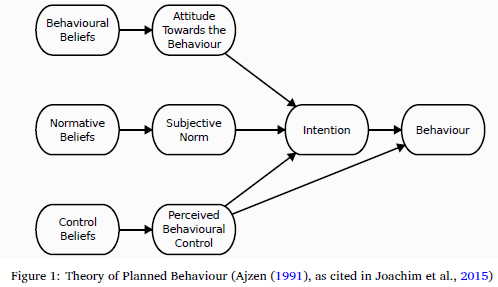
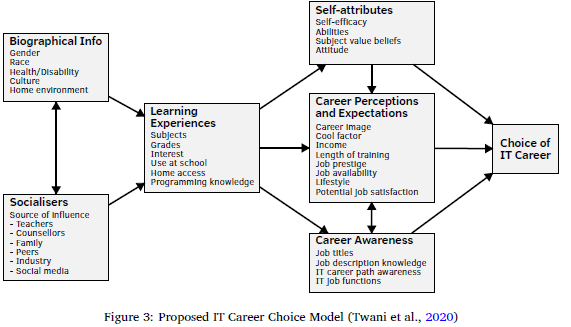
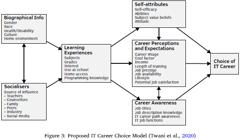
The important factors identified by Twani et al. (2020) and included in a proposed IT career choice conceptual model (Figure 3) were socialisers, learning experiences, career perceptions, self-efficacy and career awareness. The study (Twani et al., 2020) was based on the Theory of Planned Behaviour, which suggests that behaviour is determined by a person's intentions, attitudes (beliefs about a behaviour) and subjective norms (beliefs about others' attitudes toward a behaviour). The aim of this study was to empirically evaluate the proposed IT Career Choice Model and to statistically identify the factors that influence scholars' decisions to pursue an IT career.
2 STUDENT CAREER CHOICE
A scholar's career choice often starts with personal interest and curiosity about a certain field. Perceptions of IT careers vary, based on a person's gender, culture and other factors, such as future expected earnings and experience of working with computers (Carrico et al., 2019).
2.1 Theory of Planned Behaviour
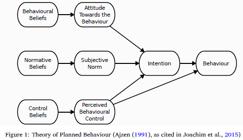
The Theory of Planned Behaviour (TPB) (Figure 1) is based on the perceived behavioural control component to account for behaviours that occur without a person's volitional control and norms (Ajzen (1991), as cited in Joachim et al., 2015). Human planned behaviour is guided by three kinds of considerations: beliefs about the likely consequences of the behaviour (behavioural beliefs), beliefs about the normative expectations of others (normative beliefs) and beliefs about the presence of factors that may facilitate or impede performance of the behaviour (control beliefs).
Behavioural beliefs produce a favourable or unfavourable attitude towards the behaviour. Normative beliefs result in perceived social pressure or subjective norm and control beliefs give rise to perceived behavioural control. In combination, attitude toward the behaviour, subjective norm and perception lead to the formation of behavioural intention.
2.2 Career choice models
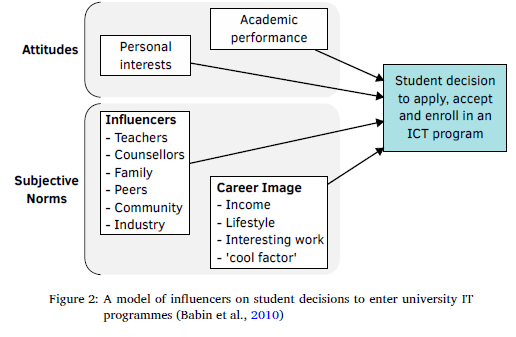
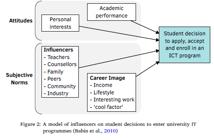
Babin et al. (2010) developed a model, using the concepts from the Theory of Planned Behaviour to provide a structure to assess students' decisions to pursue an IT programme at university (Figure 2). The model consists of attitudes and subjective norms as key influencers in a person's decision making. The model infers that personal interest and academic performance affect the students' decision to enroll for an IT programme after finishing school. Additionally, subjective norms, i.e. teachers, family, peers and career image will influence a student's career decision.
2.3 Factors influencing career choice
Different factors influence a scholar's career choice. The factors include gender, culture, influencers or socialisers, role models, computer experiences, self-efficacy, career perceptions and expectations and career awareness (Twani et al., 2020). Career image, career expectations and academic performance are factors Babin et al. (2010) included in their model (Figure 2). Wang et al. (2015) state that household income could be the pressure that may be used as an influencer. Household income and pressure to obtain a university qualification were pressures, specifically amongst African language speakers in South Africa (Twani et al., 2020). A lack of career knowledge by influencers, such as family and friends led to students not choosing to pursue IT studies.
Age, gender (Aivaloglou & Hermans, 2019) and culture affect scholars' career choice (Calitz et al., 2022). Aivaloglou and Hermans (2019) indicated gender differences with the CS career orientation of female students. Culture is defined as the customs and habits that characterise a certain group, society or a nation. Culture includes the way people in society dress, the language they speak, how the family lives, religion, work patterns and leisure pursuits. Culture includes the beliefs, values and material objects that constitute people's way of life (Naik et al., 2023). Culture influences the career choice of a person, how their career paths develop and how they earn a living (Naik et al., 2023). Culture has a major impact on a student's IT career choice (Calitz et al., 2022). Sharif et al. (2019) argue that in the Eastern Culture, the most powerful influence is making a difference in society and therefore parents pressure their children to choose a particular career.
Socialisers, also called influencers by Babin et al. (2010), include parents, family, teachers, counsellors and the community. Research indicated that a student's career choice is generally influenced by parents, teachers, career counselors and role models (Kirlidog et al., 2018; Vernon & Drane, 2020). The occupation, education and advice of a child's parents are influencers in students' choices of careers (Mtemeri, 2017). Social media also has an influence on a student's career choice (Lee et al., 2019). Positive school-based support from teachers and counsellors plays a positive role in guiding students to STEM fields (Abe & Chikoko, 2020; Twani et al., 2020).
Learning experiences, in school subjects, specifically mathematics and science, are important for a student's career choice (Twani et al., 2020). Learning experiences (interest, programming knowledge, enjoyment) are closely linked with Career Awareness, Self-Efficacy, Career Perceptions and Expectations (Twani et al., 2020). Early exposure to computer clubs and programming is important as interest in IT at school is a key factor for students' decisions (Grey-ling, 2023). Computer education and problem-solving were key as learning experiences that have influence on students' IT career decisions (Greyling, 2023).
Self-efficacy, including problem solving abilities, grades and enjoyment opportunities are also factors that influence a student's career choice (Aivaloglou & Hermans, 2019). Self-efficacy is defined as belief in one's capability to organise and execute a course of action required to achieve a specific goal. Beliefs are linked to self-perception, which is the same as self-efficacy, according to Wang et al. (2015) and provides internal encouragement for students' ongoing confidence and abilities. High self-perception is key to scholars choosing to study IT courses.
Career perceptions and expectations involve individuals' beliefs about the consequences of actions, which can be social or functional and are shaped by influencers and learning experiences (Carrico et al., 2019). A study in the USA by Hodges and Corley (2016) indicated that some students believe that by choosing IT careers, they would receive a good salary and are guaranteed good job security. In support of their study, Sharif et al. (2019) indicated that future income is a strong influencer of students' career decisions. Learning new skills, job opportunities and career-image were also important career perceptions that influenced students' career choice.
Career awareness is the process of knowing and understanding what various career paths or career options are available to a person, based on their interest. Career awareness assists a scholar to know what knowledge, training and skills they must learn and acquire to achieve success in their chosen career. A child's career awareness and interest vary according to knowledge and interests (Jusoh et al., 2021). Children today are increasingly focused on achieving excellence in education; however, they are uncertain about the career they want to pursue (Jusoh et al., 2021). A South African study on career awareness amongst IT graduates indicated that they too are not aware of the possible IT career opportunities and career tracks available to them. They are uninformed about new IT job titles, careers and IT job descriptions (Calitz et al., 2011).
Exposure to new technologies and programming concepts at school level creates IT career awareness and influences a scholar's career choice. Kirlidog et al. (2018) indicate that ignorance and lack of information on IT careers are reasons for students not enrolling in courses in the IT field. Awareness can be increased through exposure and can provide a broader picture of IT being relevant to students' lives. Even students in their senior years at university, were unaware of IT programmes and their function (Calitz et al., 2011).
Twani et al. (2020) proposed an IT Career Choice model that included the factors socialisers or influencers, learning experiences, self-efficacy, career perceptions and expectations, and career awareness (Figure 3).
3 RESEARCH METHODOLOGY
The first-year students have made a career choice to enter the IT profession and an understanding of the factors that influenced CS, IS and IT students' career decisions is important. A questionnaire for first year students was compiled based on a similar questionnaire used in previous studies (Twani et al., 2020). In order to determine personal perceptions and honest information, it was decided to keep the survey anonymous. The survey was sent to all registered CS, IS and IT first-year students at the Nelson Mandela University, a comprehensive university in South Africa. Over 1000 students were contacted via email to participate in the study. The first-year questionnaire consisted of the following sections:
• Biographical details;
• Culture and IT role models;
• Sources of influence (Socialisers);
• Learning experiences;
• Personal attributes, including self-efficacy;
• Career perceptions and expectations; and
• Career awareness.
The questionnaire consisted of 5-point Likert scale items and was captured using an on-line survey tool, QuestionPro. The data were collected from first year students enrolled for either a BSc CS, BCom IS or BIT programme. The research study focused on these programmes as these students intend to pursue a career in IT. The data were statistically analysed using Statistica. Ethics approval was obtained from the University Ethics Committee, #H2020BUSBS15.
4 RESULTS
4.1 Descriptive statistics
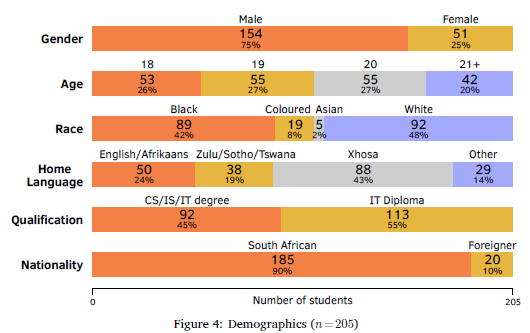
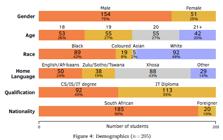
The survey was completed by 205 students who were registered for CS, IS, IT degree programmes (n = 92, 45%) and IT Diploma programmes (n = 113, 55%) in the Department of Computing Sciences and the School of IT at the Nelson Mandela University. Figure 4 shows that the sample consisted of 154 males and 51 females. The sample included 42% Black, 48% White, 8% Coloured, and 2% Asian students. The citizenship of the total group was mainly South African (90%). A small number of students (10%) were from Botswana, Malawi, Namibia, Zambia and Zimbabwe. The home language spoken was Afrikaans/English (24%), Xhosa (43%), Zulu, including Sesotho, Tswana, etc. (19%) and other languages, such as Sepedi and Xitsonga (14%). The Home languages were finally categorised into two groups, namely Afrikaans/English and African languages.
4.2 Exploratory Factor Analysis (EFA) and Reliability
The EFA was undertaken to keep items and factors that were statistically significant in the model (Figure 3). Eigenvalues and Scree plots were used as part of the EFA with the Cronbach Alpha for reliability. The factor loading greater or equal to 0.389 was deemed significant at the á = 0.05 level for the sample size n = 205. Various one factor and two factor models were evaluated and the Eigenvalues for all the factors were all greater than 1.
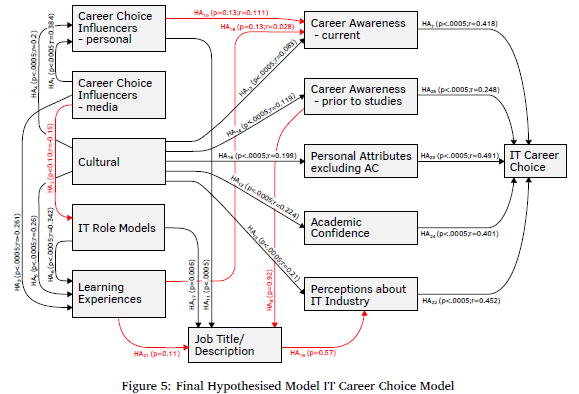
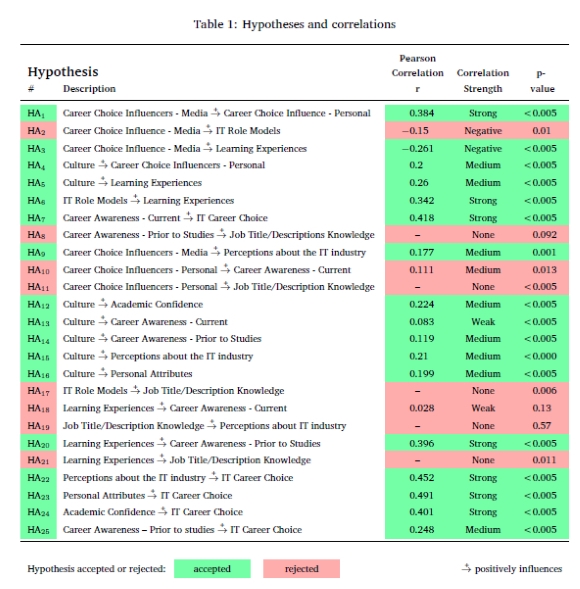
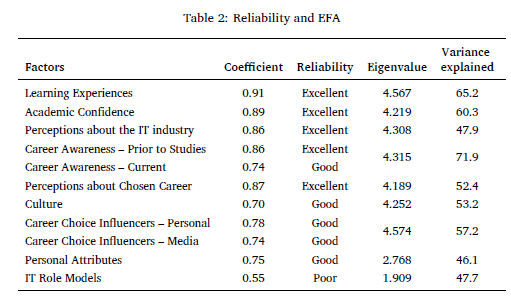
The EFA identified new factors, namely Career Choice Influencers (Media and Personal) and Career Awareness (Current and Prior to Study). The Self-Confidence factor name was changed to Academic Confidence. The reliability was 'Good' or 'Excellent', except for IT Role Models (á = 0.55, Poor). Cronbach's Alpha coefficient results are shown in Table 2. The revised hypotheses and correlations after EFA are presented in Table 1
and the hypothesised model is presented in Figure 5. In the survey, respondents were required to match IT job titles, such as Business Analyst, Database Administrator and Software Developer/programmer with job descriptions for these positions. The factor was named Job Title/Descriptions Knowledge. Table 1 shows that Career Awareness - Prior to Studies, Career Choice Influencers - Personal and IT Role Models did not influence Job Title/Descriptions Knowledge.
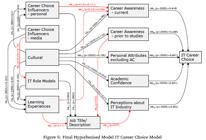
An interesting finding was that IT Role models (r = 0.342, p = 0.005) and Culture (r = 0.261, p = 0.005), positively influence a student's learning experiences. Culture also influences Academic Confidence (r = 0.224, p = 0.005), Career Awareness (r = 0.083, r = 0.0005) and IT Career Choice (r = 0.217, r = 0.005). Strong correlations were found between Perceptions about the IT Industry (r = 0.452, p = 0.005), Personal Attributes (r = 0.401, p = 0.005), Academic Confidence (r = 0.401, p = 0.005) and IT Career Choice.
Table 2 shows that the five factors; Learning Experiences (0.91), Academic-Confidence (0.89), Perceptions about IT industry (0.86), Career Awareness - Prior to Studies (0.86) and Perceptions about Chosen Career (0.87) recorded excellent Cronbach Alpha reliability as the coefficients were above 0.80. Furthermore five factors; namely Culture (0.70), Career Choice Influencers - Personal (0.78), Career Choice Influencers - Media (0.74), Personal Attributes (0.75) and Career Awareness - Current (0.74) indicated good Cronbach's Alpha reliability with a coefficient between 0.70 and 0.79.
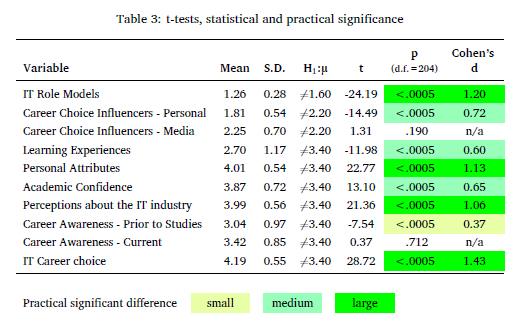
The one-sample t-tests are presented in Table 3. The only two factors that were not statistically and practically significant, as indicated by Cohen's d, were Career Choice Influencers -Media and Career Awareness - Current. Statistical analysis (ANOVA) was performed to determine whether any significant relationships were observed between demographic variables and the factors that influence the student's perceptions of their chosen IT careers. Statistical differences (p = 0.000) and practical significant differences (Cohen's d = 0.70, medium) were found between respondents whose home language was one of the African languages (ì1 = 1.22), compared to those with a home language Afrikaans/English (ì2 = 1.41) for the factor IT role models. The findings indicate that first-year students speaking African languages did generally not have IT role models. Most of these students lived in townships and in rural areas.
Home language was grouped into African languages (Zulu/Xhosa/Other) and Afrikaans/ English (Figure 4). Statistical differences (p = 0.004) and practical significant differences (Cohen's d = 0.36 - medium) were found between respondents whose home language was one of the African languages (ì1 = 3.57), compared to those with a home language for Afrikaans/English (ì2 = 3.77) speakers for the factor Culture. The findings indicate that Afrikaans/English speaking first-year students' culture influences their IT career choice more than African language speaking first-year students.
The findings (p = 0.000, Cohen's d = 0.39 - medium) indicate that Career Choice Influencers - Media, specifically social media, indicated gender differences between males (ì = 2.10) and females (ì2 = 2.37), indicating that social media is an important source of information for female students.
Learning experience showed a statistical (p = 0.005) and a large practical significance (Cohen's d = 1.30) between Afrikaans/English speaking first-year students (ì1 = 3.71), compared to those speaking an African home language (ì2 = 2.38). The findings highlight the discrepancies in the South African schooling system and the tragic state of the governmental schooling system.
The career awareness of the first-year students ages 18-20 years and 21+ years showed a statistical difference (p = 0.010) and a medium practical significance (Cohen's d = 0.36). Respondents under 21 years currently have a lower perception of IT careers (ì1 = 3.32) than respondents who are 21 years and older (ì2 = 3.62).
Finally, regarding the perceptions of their chosen IT career, statistical (p = 0.019) and medium practical significant differences (Cohen's d = 0.27) were observed between males (ì1 = 4.11) and females (ì2 = 4.26). The results indicate that female respondents have positive perceptions about Chosen Careers compared with male respondents.
4.3 IT Career Choice Model
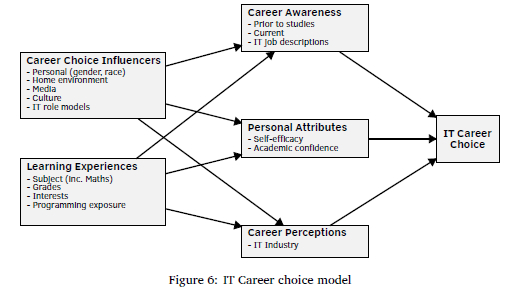
The IT Career Choice Model developed in this study after EFA is presented in Figure 6. The model included career choice influences, specifically culture, IT role models and home environment. Scholars growing up in a rural area, as is the situation in South Africa, generally do not have parents and family with the knowledge who can influence their IT career choice. Learning experiences, specifically in rural schools with limited infrastructure, further negatively influence scholar's career decisions.
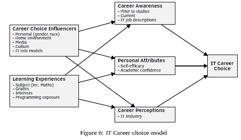
A two-factor model for the initial Career awareness factor was identified after the EFA. The two new factors were Career awareness prior to university studies and career awareness currently. The factor Self-attributes was renamed Personal attributes and included self-efficacy and present academic confidence. Career perceptions of the IT industry was added as a new factor affecting a first-year students IT career choice.
5 CONCLUSIONS, LIMITATIONS AND FUTURE RESEARCH
Scholars' career choices are influenced by a combination of internal and external factors, including personalities, interests, experiences and the cultural and societal environment where they grow up. Several factors influence a first-year IT student's career choice, most importantly, IT career awareness, academic confidence and exposure to programming concepts (Greyling, 2023). Recent research indicates that exposure to new mobile technologies, understanding programming concepts at school level and teachers and parents can influence a scholar's IT career choice (Aivaloglou & Hermans, 2019; Greyling, 2023; Mano, 2019).
In South Africa, culture has a significant effect on a scholar's IT career choice (Calitz et al., 2022). Social media and having IT role models were shown as important influencers for first-year CS, IS and IT students speaking an African language at home (Cullen et al., 2024). Younger first-year students were less aware of future IT careers than older (21+) first-year students.
The final IT career choice model included factors relating to a scholar's career choice influencers, including their home environment and IT role models. The factors learning experience, career awareness, personal attributes, including self-efficacy and IT industry career perceptions were included in the IT career choice model.
The theoretical contribution of this research study is based on the constructs in the Theory of Planned Behaviour. The factor culture includes items on beliefs and showed statistical and practical significance with the dependent factor, IT Career Choice. The practical contribution is a new IT Career model that can assist academic departments with identifying factors that influence scholars' IT career choice. They can then create activities based on the components, identified by Mtemeri (2017) to create IT career awareness amongst scholars.
The limitations of the study are the sample size and that the study was only undertaken at one university in South Africa. Recommended future research is repeating the study at other universities in South Africa and investigating opportunities to conduct the study internationally, specifically in other developing economies like South Africa. An additional factor that could be included in future research is the flexible work arrangements, remote work options and opportunities for freelancing or consulting in the IT industry. Scholars may be attracted to IT careers offering work-life balance and flexible remote working conditions.
References
- Abe, E. N., & Chikoko, V. (2020). Exploring the factors that influence the career decision of STEM students at a university in South Africa. International Journal of STEM Education, 7(1), 1-14. https://doi.org/10.1186/S40594-020-00256-X
- Aivaloglou, E., & Hermans, F. (2019). Early programming education and career orientation: The effects of gender, self-efficacy, motivation and stereotypes. Proceedings of the 50th ACM Technical Symposium on Computer Science Education, 679-685. https://doi.org/10.1145/3287324.3287358
- Babin, R., Grant, K. A., & Sawal, L. (2010). Identifying influencers in high school student ICT career choice. Information Systems Education Journal, 8(26). https://eric.ed.gov/7id=EJ1146968
- Braza, M. R. S., & Guillo Jr., R. M. (2015). Socio-demographic characteristics and career choice of private secondary school students. Asia Pacific Journal of Multidisciplinary Research, 3(4), 78-84. http://www.apjmr.com/wp-content/uploads/2015/11/APJMR-2015-3.4.4.12.pdf
- Calitz, A. P., Greyling, J. H., & Cullen, M. D. M. (2011). ICT career track awareness amongst ICT graduates. Proceedings of the South African Institute of Computer Scientists and Information Technologists Conference on Knowledge, Innovation and Leadership in a Diverse, Multidisciplinary Environment, 59-68. https://doi.org/10.1145/2072221.2072229
- Calitz, A. P., Cullen, M. D. M., Twani, M., & Fani, D. (2022). The role of culture in first year student's career choice. 2022 International Business Conference. https://www.researchgate.net/publication/364210172_The_Role_of_Culture_in_First_Year_Student's_Care er_Choice
- Carrico, C., Matusovich, H. M., & Paretti, M. C. (2019). A qualitative analysis of career choice pathways of college-oriented rural central Appalachian high school students. Journal of Career Development, 46(2), 94-111. https://doi.org/10.1177/0894845317725603
- Cullen, M., Calitz, A. P., Twani, M., & Greyling, J. (2024). First year computing students' career choice influencers. In H. E. Van Rensburg, D. P. Snyman, L. Drevin & G. R. Drevin (Eds.), ICT education (pp. 164-179). Springer Nature, Switzerland. https://doi.org/10.1007/978-3-031-48536-7_12
- Greyling, J. (2023). Coding unplugged - A guide to introducing coding and robotics to South African schools. In J. Halberstadt, A. Alcorta de Bronstein, J. Greyling & S. Bissett (Eds.), Transforming entrepreneurship education: Interdisciplinary insights on innovative methods and formats (pp. 155-174). Springer International Publishing. https://doi.org/10.1007/978-3-031-11578-3_9
- Hodges, D., & Corley, K. (2016). Why women choose to not major in information systems? [Paper 4010]. 2016 Proceedings of the EDSIG Conference, 1-16. https://proc.iscap.info/2016/
- Kapoor, A., & Gardner-McCune, C. (2019). Understanding CS undergraduate students' professional identity through the lens of their professional development. Proceedings ofthe 2019 ACM Conference on Innovation and Technology in Computer Science Education, 9-15. https://doi.org/10.1145/3304221.3319764
- Kirlidog, M., van der Vyver, C., Zeeman, M., & Coetzee, W. (2018). Unfulfilled need: Reasons for insufficient ICT skills in South Africa. Information Development, 34(1), 5-19. https://doi.org/10.1177/0266666916671984
- Mano, L. (2019). TANKS: An app that teaches coding, without a computer [Retrieved: 29 August 2024]. https://www.itweb.co.za/article/tanks-an-app-that-teaches-coding-without-a-computer/xnklOvzbQnpv4Ymz
- Naik, A. R., Baker, S., & Mohiyeddini, C. (2023). What is culture? Frontiers for Young Minds, 11. https://doi.org/10.3389/FRYM.2023.1150335/FULL
- Säde, M., Suviste, R., Luik, P., Tönisson, E., & Lepp, M. (2019). Factors that influence students' motivation and perception of studying computer science. Proceedings of the 50th ACM Technical Symposium on Computer Science Education, 873-878. https://doi.org/10.1145/3287324.3287395
- Siddiky, M. R., & Akter, S. (2021). The students' career choice and job preparedness strategies: A social environmental perspective. International Journal of Evaluation and Research in Education (IJERE), 10(2), 421-431. https://doi.org/10.11591/IJERE.V10I2.21086
- Stone, J. A. (2019). Student perceptions of computing and computing majors. The Journal of Computing Sciences in Colleges, 34(3), 22-30. https://dl.acm.orá/doi/10.5555/3306465.3306471
- Twani, M., Calitz, A. P., & Cullen, M. (2020). Identifying relevant factors for an IT career choice model. Proceedings of the 49th Annual SACLA 2020 Conference, 65-80. https://sacla2020.ru.ac.za/docs/SACLA2020Proceedings.pdf
- Wang, J., Hong, H., Ravitz, J., & Ivory, M. (2015). Gender differences in factors influencing pursuit of computer science and related fields. Proceedings of the 2015 ACM Conference on Innovation and Technology in Computer Science Education, 117-122. https://doi.org/10.1145/2729094.2742611
- Yoel, S. R., & Dori, Y. J. (2023). Interpersonal skills and STEM career choice of three types of FIRST mentors. Journal of Engineering Education, 112(4), 987-1011. https://doi.org/10.1002/JEE.20550
Accepted: 13 August 2024
Online: 11 December 2024