Grounding Information Systems Values in Ubuntu Business Ethics
Abstract
PURPOSE/OBJECTIVES: As information systems (IS) increasingly permeate nearly every facet of modern life, it is imperative to examine the values embedded in them to support their ethical development, deployment, and use. Yet IS ethics remains an under-researched area, particularly regarding its theoretical foundations, and especially from a sub-Saharan African perspective. The article aims to uncover weaknesses in mainstream IS ethics and to complement it by formulating a core Ubuntu ethic. METHODOLOGY/APPROACH: The article employs an interpretive-hermeneutical literature review within a qualitative research approach. FINDINGS: Although both Western and Ubuntu ethics recognise the importance of the individual and the community, they differ in emphasis. Ubuntu business ethics is found to provide path-defining guidelines for grounding IS ethics by doing justice to communalism. A unifying Ubuntu IS ethic is formulated, along with related heuristics to facilitate its implementation. RESEARCH LIMITATIONS/IMPLICATIONS: A limitation of the research is that the foundational Ubuntu ethical principles, uncovered from existing literature, have not been systemised into a comprehensive framework. In future work, the Ubuntu IS ethic should be developed into a full-fledged axiology. PRACTICAL IMPLICATIONS: The implications of the kernel Ubuntu ethic are demonstrated by suggesting practical ways in which it can be applied to the IS space. In follow-up research, it should be implemented in practical, real-life IS scenarios while evaluating its impact. ORIGINALITY/VALUE: The proposed Ubuntu IS ethic that provides an alternative to Eurocentric values in IS ethics underscores the originality of the article.
Ubuntu; ethics; business; information; information systems; values
Introduction
Since information systems (IS) have become ubiquitous affecting almost all aspects of modern life, it is essential to understand their ethical foundations and impact on diverse value systems to ensure their principled design, implementation, and use (Kern et al. 2022). However, the field of IS ethics is still understudied, especially regarding its underlying theoretical foundations and the perspective of research philosophy in sub-Saharan Africa (SSA) (Amugongo et al. 2023; Bock et al. 2021). Given the perceived gap in IS research, the article addresses the following research question: How can the "ancient moral theory" of Ubuntu (Otaluka 2024, 31) inform IS ethics?
Amugongo et al. (2023) provide an overview of the emergence of the Ubuntu philosophy in Information and Communication Technology (ICT)-related disciplines. There has been growing interest in Ubuntu ethics in IS, especially in the subfields of Human-Computer Interaction (HCI), Information and Communication Technology for Development (ICT4D), Technology Design, and Computing Education. They are, however, probably the first authors to propose an Ubuntu ethics-inspired framework for health informatics driven by artificial intelligence (AI). Their innovative framework, encompassing the principles of "fairness, community good, safeguarding humanity, respect for others and trust" (Amugongo et al. 2023, 583) may be relevant and applicable to the broader IS field.
Ubuntu has been used internationally as an ethical theory to sensitise IS students about the impact of Indigenous cultural values on the experience and success of software in local contexts (Fleischmann et al. 2011). It has, unfortunately, received relatively little attention in research on IS ethics. An advanced search on the Association for Information Systems eLibrary (AISeL), done on March 28, 2025, using the search string "title:Ubuntu OR abstract:Ubuntu OR subject:Ubuntu AND title:ethics OR abstract:ethics OR subject:ethics" returned five results of which three were directly relevant. A similar search on the Association for Computing Machinery Digital Library (ACM DL) yielded three relevant results. No relevant sources could be found in the Institute of Electrical and Electronics Engineers Xplore Digital Library (IEEE Xplore). Widening the search parameters to include "Africanis/zation" and "decolonis/zation" as search strings yielded five more useful results on the AISeL, one on the ACM DL, and nothing on IEEE Xplore.
An emerging field of study, such as IS ethics, often relies on reference disciplines for theoretical constructs to be reused and integrated in building its own foundations. The related disciplines that underpin Ubuntu IS ethics (UISE) are shown in Figure 1. The looking glass encircling the line graph of SSA portrays Ubuntu as a lens to explore IS ethics. The northern part of Africa is not shown on the line graph of the continent since Ubuntu and related value systems are typical of SSA (Metz 2007).
The article follows a qualitative research approach, making use of an interpretive-hermeneutic literature review. The research approach, which uses critical argumentation and judgement, is suitable to problematise existing theoretical assumptions and develop theory by building on a small number of landmark studies. Believing that "research is entangled in a dynamic network of ideas and concepts," the method uses an iterative (hermeneutic) approach to find relevant material that uncover and shed light on "problems, weaknesses, contradictions and controversies in a particular area of study" (Schultze 2015, 182).
The article aims to identify the weaknesses in mainstream IS ethics and to suggest a kernel of Ubuntu-informed ethics in IS complementing its theoretical foundations. The field of global ethics is introduced briefly, after which Ubuntu ethics, information ethics, and business ethics are discussed, all as reference disciplines for UISE. Following the formulation of a unifying ethic, the concept of UISE is applied to some relevant issues in IS to demonstrate the applicability and relevance of the axiology (theory of values).
Global Ethics
This section situates IS ethics within the wider context of global ethics, emphasising the need to first grasp the foundational ideas of information ethics and business ethics before introducing an Ubuntu-informed perspective on these concepts. Both business ethics and information ethics are closely related to IS ethics (Bock et al. 2021).
According to Bock et al. (2021), the main tenets of Western ethics are moral conceptualisations about what is good, right, and just. Information ethics is an important reference discipline for IS because it deals with the electronic storage, processing, and use of information in the business industry, organisations, and society, as well as the effect of digital applications on society and the environment. Information ethics also deals with moral issues related to ICT and social media (Capurro 2013). Durani et al. (2021) regard business ethics as a higher level of normative ethics where metaethical considerations are integrated with applied ethical theories. IS ethics is closely related to business ethics but may have a wider scope looking at ethical issues underlying software systems and affecting users in all types of organisations and social groups. Not only are Eurocentric worldviews deeply embedded and dominant in IS research and theory, but Western ethical principles have also been standardised in mainstream, globalised IS ethics (Myers et al. 2020; Pauleen et al. 2006). This entrenchment often leads to the phenomenon of digital coloniality, i.e., the inadvertent imposition of one culture over another via software systems (Kroeze 2024a; 2024b; Lamola 2021).
The traditional domain of IS ethics covers ethical behaviour, privacy, data security, and property rights (Bock et al. 2021). The principles of "beneficence, non-maleficence, autonomy, and justice," borrowed from biomedical ethics, are also relevant for the design, management, use, and evaluation of software, as well as the analysis of its impact on society (sociomateriality) (Amugongo et al. 2023, 585; Meredith and Arnott 2003).
When there is a conflict between ethical principles in computing spheres, public interest is prioritised above the interests of individuals or organisations (Myers and Venable 2014). Prabhakaran et al. (2022) suggest that human rights should be used as a point of departure to guide the ethical design and use of AI because these values are accepted and used globally. According to Geeling and Brown (2020), the concept of affordance in HCI offers a useful mechanism for limiting the use of compromising applications. An enabling affordance is a software feature that prompts a desirable action by a user, while a restrictive affordance is a software feature that prevents an undesirable digital activity by a user. When an enabling affordance is used to enforce ethically sound actions on the side of the user, or when a restrictive affordance is used to prevent unethical actions, it constitutes examples of ethically sound values that are built into the application. If an enabling affordance would be used to lure a user into unethical behaviour, or if a restrictive affordance would be used to prevent a user from behaving ethically, it would constitute examples of unethical values built into the software designs.
The use of affordances in AI is, however, more difficult and cannot guarantee ethical outcomes due to its semi-automated behaviour. AI ethics is a complex, interdisciplinary field in which axiology and philosophy meet computing and specifically IS, with its focus on the sociomaterial aspects of ICT (Sœtra 2025). Cyborgs, for example, are AI-driven thinking machines that simulate mindfulness and spirituality, but "the assumption that cognition can be mechanised or formalised leads to the disembodiment of intelligence and thought" (Matthee 2013, 547).
Having outlined the landscape of global, information, business, and IS ethics, the article can now shift focus to examine related aspects within the context of SSA.
Ubuntu Ethics
This section focuses specifically on ethics informed by Ubuntu, along with information ethics and business ethics, "[c]arving out ... foundational building blocks for theorizing" (Shepherd and Sutcliffe 2011, 367). Looking at ethics through an African lens provides opportunities for IS scholars and practitioners to embed alternative human and ethical values into IS system design (cf. Wambsganss et al. 2021). While comprehensive African ethical systems are still developing, Ubuntu contributes to post-positivist thought, challenges Western epistemologies, and promotes inclusivity (Mutula 2013a; Okyere-Manu 2021; West 2014).
Basic Ubuntu Principles
The Ubuntu axiology prioritises human dignity and relationality over money and economy (Sartorius 2022). The moral system can be defined briefly as follows: Ubuntu ethics is a relational sub-Saharan African (SSAn) value system prioritising collective morals to foster the peaceful co-existence of the members of a community who respect each other and have a sense of shared responsibility (Borti et al. 2024; Maluleke 2024; Mkabela 2014).
Based on the unique Ubuntu view on ethics that moral values are founded in human relationships, Metz (2007) formulates the following basic ethical principle as the foundation for a formalised ethic: "An action is right just insofar as it promotes shared identity among people grounded on good-will; an act is wrong to the extent that it fails to do so and tends to encourage the opposites of division and ill-will" (Metz 2007, 338). Sande (2021, 255) provides a concise version of the same principle: "An action is right to the extent that it maximizes harmony."
According to Metz (2007), Western and Ubuntu value systems share many basic principles, for example, the universal morals not to murder, steal, or deceive. In the arena of IS, the so-called hacker ethic is especially noteworthy when comparing mainstream and Ubuntu ethics. The hacker ethic, which builds on traditional Western values, such as freedom of speech, meritocracy, and anti-authoritarianism, represents a shift in emphasis in mainstream ethics towards more collaborative development (e.g., open-source software), information freedom, and care for the wider society (e.g., open access to information) (Himanen 2001). These values, especially the concern for society at large, resonate well with communalist Ubuntu values.
These Ubuntu-based values also align closely with other Indigenous communities outside Africa. Pio and Waddock (2021), writing from a North American Indigenous perspective, advocate harnessing the values of collectivism and a spirit of collaboration to humanise management thinking, which usually reflects Western individualism and competitiveness.
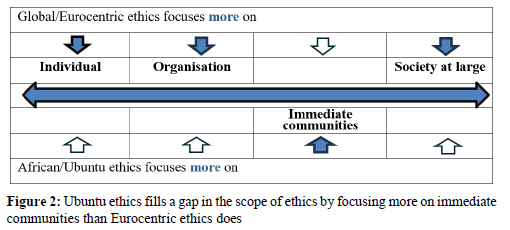
While there are indeed similarities between Ubuntu, some North American Indigenous values, and the hacker ethic, all acknowledging both the importance of the community/society and the individual (Lajul 2021; Naudé 2019; West 2014), there is a difference in emphasis. Western ethics is relatively quiet about immediate communities, while Ubuntu is quieter about society at large (Konyana 2021). An immediate community is a smaller, more direct and close-knit group of people than the public as a whole. It may refer to a cultural group, tribe, clan, and kinship group or "extended family" (Abubakre 2024, 2). Moreover, the concept, as it is used in this article not only refers to the traditional understanding of "a spatially compact set of people with a high frequency of interaction, interconnections, and a sense of solidarity" but also includes digital communities such as social media groups or organisations that mainly meet online (Amugongo et al. 2023, 588).
When Bock et al. (2021, 1) state that "information systems have become significant catalysts of moral or immoral behavior of individuals, groups, and organizations," they do refer to groups but not specifically to cultural communities. While one may argue that the community forms part of society at large, the fact that it is not mentioned explicitly supports the generalisation that African value systems put more emphasis on (local) communalism than Western value systems (Nwosimiri 2021) (see Figure 2). This leaves room for an African perspective to complement IS ethics regarding immediate communities on the continuum of the individual, organisation, and society at large.
According to Metz (2007), Africans place more value on reaching consensus than Westerners. They put a stronger emphasis on reconciliation and restoration than retribution and punishment. Communal wealth is more important than individual richness. Wealth distribution based on need is prioritised above individual rights. Observing communal norms is emphasised. Creating families (marriage and procreation) receives more weight than in Western societies.
Another difference between Western ethics and Ubuntu ethics is the fact that Western ethics looks for a single ethical principle and builds a whole system around it, while Ubuntu ethics is a more holistic system. According to Lajul (2021), Western philosophy is reductionist, while Ubuntu philosophy is a "philosophy of diversity ... [i.e.,] the accommodation of varied and peaceful apparently contradictory elements" (Lajul 2021, 199).
To clarify the difference between global (Western-dominated) and Ubuntu ethics, one could portray some of their tenets as extreme viewpoints. Amugongo et al. (2023, 583) compare five Ubuntu-inspired values ("fairness, community good, safeguarding humanity, respect for others and trust") with Western principles in table format. They state that there are overlaps but also some differences. The comparison of Western and Ubuntu ethics in Table 1 (adapted from Amugongo et al. 2023, 587) is a revised and extended version of their table (cf. Abubakre 2024; Bock et al. 2021; Etori et al. 2024; Fleischmann et al. 2011; Geyser 2024; Myers and Venable 2014; Wong-Villacres et al. 2024; and the other sources discussed above). It should be emphasised that a binary table such as this imposes a perspective of opposing conceptions. While such a view is helpful to clarify the concept of Ubuntu ethics and differentiate it from Western ethics, one must remember that, in reality, there is a spectrum of varying nuances. Therefore, a broken line was used to separate the two value systems, signalling the fluidity and overlaps of the two axiologies' principles. A balance between the two values (individualism and communitarianism) is, therefore, important (Etori et al. 2024). Too much emphasis on the community may lead to factionalism and nepotism (Otaluka 2024). Too much emphasis on the individual could again lead to selfishness, weak social networks, and deficient mutual support, which could, in turn, be problematic in some Western cultures.
As an aside, it may be insightful to study two South African ethical codes of practice to obtain more insight regarding the communal nature of Ubuntu value systems, namely the San Code of Research Ethics (South African San Institute 2017) and the Cape Town Statement on Fairness, Equity and Diversity in Research (Horn et al. 2023). Both deal with research ethics but the communalist principle may be applicable on a wider front. According to Visagie et al. (2019), Afro-communitarianism has important implications for informed consent from an individual versus collective perspective. In SSAn communities, especially in rural environments, researchers should involve gatekeepers and consult with communities to get access to participants and to approve or even determine their research agenda. Participatory research is important to ensure that the community shares in the benefits of the research results (Amugune and Otieno-Omutoko 2019). The applicability of these Ubuntu research principles to the ethics of IS practice is supported by Prabhakaran et al. (2022, 2), who emphasise "the need for participatory methods to incorporate marginalized stakeholder perspectives" in AI-driven applications.
Ubuntu Information Ethics and Business Ethics
Ubuntu information ethics is a foundational field that contributes to UISE. Britz (2013a) discusses several factors that lead to information poverty in Africa, which hampers development and growth. Diverse ontologies and cultural backgrounds result in an experience of alienation, particularly when compounded by the dominance of English as the lingua franca of the digital world, which poses barriers for non-English speaking communities. Additionally, factors such as gender and status in communities also impact the way information is interpreted.
Capurro (2013) mentions Ubuntu as a unique African philosophy that contributes to information ethics by reflecting on how ICTs affect African communities. Many Africans in former colonies live in two worlds, i.e., a Western lifestyle in urban environments versus an Ubuntu lifestyle in rural communities, or a combination of the two. There is a need for an African-to-Western flow of information to balance the stereotypic, opposite drift to ensure reciprocal respect for the different cultures. A mutual understanding of and respect for diverse cultures are important since culture influences moral values (Ocholla 2013).
Since IS ethics is closely related to business ethics, Ubuntu business ethics should also be used to complement its metaethical foundations. Since both direct transfer and translation (adaptation) of software for SSAn environments make only small contributions to decolonise axiology (Naudé 2019), there is a need to construct a unique, locally grounded, business axiology to make a substantial contribution.
An example of a unifying Ubuntu business ethic can be found in Taylor's (2014) work. Based on Metz's basic Ubuntu ethics principle referred to above, Taylor (2014, 338) proposes the following Ubuntu-based business ethical principle: "An action is right insofar as it promotes cohesion and reciprocal value amongst people. An action is wrong insofar as it damages relationships and devalues any individual or group." The principle can be applied to an ethical dilemma in the business domain to make value judgements in scenarios that are not clear-cut. After analysing the situation and determining the parties involved, any problematic actions are tested against the four elements of the business ethic (Taylor 2014, 341):
Does the action promote cohesion amongst the parties?
Does the action promote or acknowledge reciprocal value between the parties?
Does the action damage relationships with the various parties?
Does the action devalue any of the parties?
Woermann and Engelbrecht (2019) also build on Metz's basic Ubuntu ethical point of departure discussed above. They propose guidelines for the management of business firms in SSAn environments. These guidelines are relevant for African IS companies as well and may contribute to broader discussions on global business ethics and management principles. Woermann and Engelbrecht (2019) propose a relation-holder ethic, rather than a stakeholder ethic, as the basic foundational principle for business ethics. The principle implies that not only the management team of a business but also its employers and the affected community should participate in strategic decision-making. They should share in profits and have co-ownership. If termination of employment or retrenchment is necessary, they should be allowed the opportunity to suggest alternatives or to find sufficient consensus about the process. While these guidelines are idealistic principles, the challenge is how to balance them with the well-being of the firm.
Another application of Ubuntu values is presented by Claassen (2021a), who uses it to do an ethical analysis of nuclear power provision in South Africa. She concludes that an extension of nuclear energy in South Africa would not be reconcilable with Ubuntu values. The risks of a meltdown and nuclear waste for the environment cannot be justified from an Ubuntu perspective, which respects the environment and values the interconnectedness of people and the earth. These threats could also negatively impact future generations (Claassen 2021b). There are also significant economic risks in terms of job losses in the mining and tourism sectors that could be harmful to local communities. The possible economic advantages do not outweigh the possible disadvantages. Claassen's work illustrates how a local moral system, such as Ubuntu, can be used to inform strategic decision-making regarding economic development.
The principles gleaned from Ubuntu ethics, information ethics and business ethics form a strong foundation for UISE, which will be discussed next.
Ubuntu IS Ethics
This section reviews research on ethical issues in computing and highlights the need for UISE, proposing foundational elements and practical implications for scholars and practitioners.
Since most programming languages originated in the West, one may assume that Western epistemological concepts are embedded into these languages and the artefacts created by coding in these languages. Van der Linde and Liebenberg (2022, 51) say: "[T]he origin of programming languages is inherently Western. Students often do not resonate with some examples used, let alone abstract concepts of programming in general." Programming languages are based on mathematical logic that has been developed into a formal discipline mainly by Western mathematicians (Kfoury 2019). Moreover, even the architecture of the digital computer is, in essence, based on Wittgenstein's binary philosophical logic (Gruner 2016; Zemanek 1966; 1974). This shows how deep the value-ladenness of ICT cuts.
With reference to the "guns don't kill, people kill" debate, it could be argued, on the other hand, that the same programming language can be used to model any knowledge system regardless of the underlying cultural or value system. This view follows the value-neutrality thesis of technological artefacts (Pitt 2014). Yet, the artefacts created using these languages still embed specific values. For example, Western privacy principles that are often built into digital technology are an example of values that may not correlate well with some African cultures, thus resulting in a universalistic imposition on these communities (Britz 2013b; Capurro 2013; Mujinga 2021). AI algorithms that are not culturally sensitive may, for example, lead to improper and unsuccessful software solutions (Etori et al. 2024).
According to Geyser (2024), it is a myth that technology in general, and programming code specifically, are axiologically neutral. Techno- and digital-colonialism are forms of neo-colonialism that continue to dominate in subtle ways. Since Western values are prevalent and have invaded algorithms, computing students should be sensitised to the sociocultural embeddedness of software. To counteract a notion of "naive technological determinism" (Winner 1980, 122), the nurturing of critical thinking skills is indispensable. Since students should also be prepared for the global ICT market, a balancing act is needed to teach mainstream programming techniques while local cultural elements are included in syllabi "to develop a critical consciousness in their interactions with computing and take this forward in their own community activism" (Geyser 2024, 13).
The possible harmful effects of Eurocentric software on communitarian societies prompt the need for UISE to guide the ethical design and use of IS for SSAn communities (Kroeze 2024a). There are emic (intra-cultural) and etic (extra-cultural) forces that could stifle the embracement and actualisation of UISE. Groupthink and a lack of ownership-some of the dangers of unrestrained communalism-are examples of emic forces impeding UISE (Lutz 2009). Examples of etic forces constraining UISE are financial limitations and resistance to change software design procedures in the ICT industry. Fortunately, there are also emic and etic forces that stimulate and drive this process. An example of an emic force that could promote the actualisation of UISE is the decolonisation drive that is gaining momentum in African environments. The Africanisation of IS inspires software that strengthens communal cohesion (Tsibolane and Brown 2016). The hacker ethic values of sharing with and caring for communities, which resonates well with Ubuntu, are examples of etic forces that could promote the implementation of UISE (Himanen 2001).
Abubakre et al. (2021) argue for an emerging and adaptive form of Ubuntu, which they call digital Ubuntu, revising traditional values to make a valid and relevant contribution to an information-driven economy. These values are (1) humility: to use one's digital skills to help your company grow and develop the community; (2) reciprocity: to emphasise collaboration and curb unbridled competition; and (3) benevolence: to serve colleagues and the community. It is interesting to note that Abubakre et al. (2021) see the open-source movement as an enabler to promote Ubuntu values within the global world of entrepreneurship. Since this movement is driven by the hacker ethic (Himanen 2001), it should be noted as a point of convergence for Western and Ubuntu ethical paradigms. Although the idea of an adaptive, digital Ubuntu may sound strange at first, it is, in fact, in line with the acknowledgement that ICT has an impact on how the world perceives ethics, the concepts of privacy, and access to information as a socioeconomic right (Britz 2013b; Capurro 2013). "[D]igital Ubuntu highlights the dynamic nature of indigenous value systems and their adaptability to changes in the environment." (Abubakre and Mkansi 2021, 858)
Digital Ubuntu can be embodied in the IS field by integrating communalist values into IS ethics. A basic ethics principle for UISE can be based on Taylor's Ubuntu business ethics principle and heuristics, referred to above (Taylor 2014), as follows: An information system is right insofar as it promotes cohesion and reciprocal value among people; however, an information system is wrong insofar as it damages relationships and devalues any individual or group. The central principle implies the following heuristics that can be used to evaluate an information system:
Does the information system promote cohesion among the parties, communities or society at large?
Does the information system promote or acknowledge reciprocal value between the parties, communities or society at large?
Does the information system damage relationships with the various parties, communities or society at large?
Does the information system devalue any of the parties, communities or society at large?
Support for this core ethical concept can be found in recent literature on African values and technology. Both Sande (2021), quoted above, and Mujinga (2021) have used similar principles in their discussions of the ethical implications of ICT on religion. Mujinga (2021, 277) emphasises communality in the following principle: "Technology is beneficial to religion because it enhances the communal aspects of religion, and detrimental to religion when it degrades these communal aspects." The same value underlies Lajul's (2021, 204) formulation of an African biotechnical paradigm as being "centred on the capability building and the social, socioeconomic and environmental contexts."
Next, some of the implications of UISE are discussed. The field of intellectual property (IP) is an area where UISE could make an important contribution. Since the concepts of authorship and IP did not exist in traditional African communities due to their collectivist ethos (Kawooya 2013), the Ubuntu ethic should be built out to cover IP issues in the IS field.
Meredith and Arnott (2003, 156) mention "the right of an individual or group to self-determination" as a basic human right and a requirement for ethical accountability. This implies that cultural groups should be regarded as stakeholders when software is developed for the community. As stakeholders, the community should be consulted regarding any potential ethical issues related to the planned applications. Such an intervention will facilitate the ethical principle of autonomy. To satisfy the principles of beneficence and non-maleficence, a community could also be involved to judge if an application will do good or inflict harm. The ethical principle of justice can be met by ensuring equity and fairness to address ethical issues around information technology (IT) that affect society at large. For example, when an application uses Indigenous knowledge, the community to whom the knowledge belongs should be acknowledged and equally benefit from the software (South African San Institute 2017).
E-government is another IS subfield that could be affected by UISE. Mutula (2013b) opines that Africa lags in e-governance and asks how this can be solved. Ubuntu ethics could be used to stimulate ideas for public systems that are suitable for the continent. Since it is inappropriate to merely transfer Western systems to African environments, either new systems should be developed, or existing systems should at least be adapted to align them with local cultural trends (cf. Naudé 2019). While it may be relatively easy to adapt or redesign e-government systems to include Ubuntu values, it may be more difficult in the IS industry, where it is important to remain financially sustainable without any government funding or subsidies. However, companies should pursue the ideal as far as possible. Similar to the idea that the highest goal of management should be to seek the common good, for example, by selling goods that benefit the company's customers (Lutz 2009), software firms should also prioritise the advantage of the community and society at large over and above exorbitant financial profits.
To synthesise and wrap up the section on UISE, Table 2 provides an analysis of some of the strengths, weaknesses, opportunities, and threats (SWOT) of both Ubuntu and Western IS ethics (cf. Amugongo et al. 2023; Geyser 2024; and the discussion above). The comparative SWOT analysis implies that not one of the systems is better than the other. They complement each other and should be balanced depending on the purpose or market for which an application is developed. Etori et al. (2024) suggest a balanced approach towards the adoption of AI to reap its benefits while mitigating its threats to Indigenous communities. Blake (2010) calls for a hybrid approach in software engineering, for example, when communal values impede the right to privacy. The table gives one example of each strategic concept for both axiologies, which may assist IS scholars and practitioners as a starting point to weigh up their diverse options when developing or evaluating systems, especially in Indigenous environments.
Conclusion
Given the fact that very little research has been done regarding Ubuntu ethics in the IS field, this article borrowed ideas from global and Ubuntu ethics, information ethics, and especially business ethics to serve as building blocks for the creation of a unique UISE. A limitation is that these building blocks have not yet been systemised into a comprehensive framework; however, the article contributes by formulating a unifying UISE root. The core value and its implied heuristics may already guide the design and use of IS in communalist environments, albeit to a limited extent. The author realises that formulating a central ethical value may be regarded as reductionist, but it should be seen as an embryonic phase, which could serve as the foundation of a more holistic, detailed, and systemised ethic. In future work, the proposed unifying Ubuntu IS ethic should be developed into a comprehensive framework, which can then be evaluated by implementing it in practical, real-life scenarios. Moreover, IS scholars could investigate how the UISE root can inform IS theories and research ethics, as well as its applicability to shed light on contradictions and controversies such as the benefits and dangers of publishing preprints in the world of AI (Sœtra 2025). While the practice of preprinting can overcome the elitism of scholarly research by enabling speedy inputs and critique from underrepresented communities, it could enable the publication of insufficiently peer-reviewed research results. This could lead to harmful applications thereof in software. More work is also needed to bridge the gap between Ubuntu theory and the practice of participative design in HCI (Farao et al. 2024).
Introducing Ubuntu values into the field of IS can help scholars and practitioners overcome a paternalistic trend in ICT4D. Abubakre and Mkansi (2021) suggest the nurturing of a dyadic relationship between software designers and the disadvantaged groups for whom applications are developed to ensure user-centred solutions. Reframing ICT4D projects as being driven by a mutualistic relationship can prevent any power imbalances during these interventions. The field should not only be ICT4D anymore but should also become Ubuntu4ICT (Ubuntu for ICT). Digital technologists may learn as much from the collaborative processes as the community may benefit from the new software.
Acknowledgements
The article is a revised version of a conference paper (Kroeze 2024b). Ethical clearance for the research was obtained on November 24, 2024, from the College of Science, Engineering and Technology's (CSET) Ethics Review Committee (2022/CSET/SOC/003). The research was supported in part by the National Research Foundation (NRF) of South Africa (grant number 132180) and the Research Professor Support Programme of the University of South Africa (Unisa). The grant holder acknowledges that opinions, findings, conclusions, or recommendations expressed in the article are those of the author, and that neither the NRF nor Unisa accepts any liability whatsoever in this regard. The author also acknowledges the valuable feedback received from the peer reviewers and editors.
References
-
Abubakre, M. 2024. "Indigenous Approaches and Decolonising Digital Social Innovations." 2024 GlobDev Proceedings: 1-5. https://aisel.aisnet.org/globdev2024/13.
» https://aisel.aisnet.org/globdev2024/13 -
Abubakre, M., I. Faik, and M. Mkansi. 2021. "Digital Entrepreneurship and Indigenous Value Systems: An Ubuntu Perspective." Information Systems Journal 31 (6): 838-62. https://doi.org/10.1111/isj.12343.
» https://doi.org/10.1111/isj.12343 -
Abubakre, M., and M. Mkansi. 2021. "How Do Technologists Do 'ICT for Development'? A Contextualised Perspective on ICT4D in South Africa." European Journal of Information Systems 31 (1): 7-24. https://doi.org/10.1080/0960085X.2021.1978343.
» https://doi.org/10.1080/0960085X.2021.1978343 -
Amugune, B. K., and L. Otieno-Omutoko. 2019. "An African Perspective of Benefits in Social Science Research." In Social Science Research Ethics in Africa, edited by N. Nortjé, R. Visagie, and J. S. Wessels. Springer. https://doi.org/10.1007/978-3-030-15402-8_4.
» https://doi.org/10.1007/978-3-030-15402-8_4 -
Amugongo, L. M., N. J. Bidwell, and C. C. Corrigan, 2023. "Invigorating Ubuntu Ethics in AI for Healthcare: Enabling Equitable Care." FAccT '23 Proceedings: 583-92. https://doi.org/10.1145/3593013.3594024.
» https://doi.org/10.1145/3593013.3594024 -
Blake, E. 2010. "Software Engineering in Developing Communities." Proceedings of the 2010 ICSE CHASE '10 Workshop: 1-4. https://doi.org/10.1145/1833310.1833311.
» https://doi.org/10.1145/1833310.1833311 -
Bock, A., S. España, J. Gulden, K. Jahn, L. O. Nweke, and A. Richter. 2021. "The Ethics of Information Systems: The Present State of the Discussion and Avenues for Future Work." In Proceedings of the 29th European Conference on Information Systems (ECIS 2021), Research-in-Progress Papers 51: 1-11. https://aisel.aisnet.org/ecis2021_rip/51.
» https://aisel.aisnet.org/ecis2021_rip/51 -
Borti, A. M., R. K. Maurya, I. S. Jones-Mensah, and T. I. Wickramaarachchi. 2024. "Using Ubuntu as a Research Paradigm to Unpack How Ghanaian Novice Teachers and Their Collaborators Engaged Virtually in Collaborative International Qualitative Research. " International Journal of Qualitative Methods 23: 1-12. https://doi.org/10.1177/16094069241241149.
» https://doi.org/10.1177/16094069241241149 -
Britz, J. J. 2013a. "To Understand or Not to Understand: A Critical Reflection on Information and Knowledge Poverty." In Information Ethics in Africa: Cross-Cutting Themes, edited by D. N. Ocholla, J. J. Britz, R. Capurro, and C. Bester. African Centre of Excellence for Information Ethics, University of Pretoria. https://www.researchgate.net/publication/342707988_Information_Ethics_in_Africa_Cross-cutting_Themes.
» https://www.researchgate.net/publication/342707988_Information_Ethics_in_Africa_Cross-cutting_Themes -
Britz, J. J. 2013b. "Understanding Information Ethics." In Information Ethics in Africa: Cross-Cutting Themes, edited by D. N. Ocholla, J. J. Britz, R. Capurro, and C. Bester. African Centre of Excellence for Information Ethics, University of Pretoria. https://www.researchgate.net/publication/342707988_Information_Ethics_in_Africa_Cross-cutting_Themes.
» https://www.researchgate.net/publication/342707988_Information_Ethics_in_Africa_Cross-cutting_Themes -
Capurro, R. 2013. "Information Ethics in the African Context." In Information Ethics in Africa: Cross-Cutting Themes, edited by D. N. Ocholla, J. J. Britz, R. Capurro, and C. Bester. African Centre of Excellence for Information Ethics, University of Pretoria. https://www.researchgate.net/publication/342707988_Information_Ethics_in_Africa_Cross-cutting_Themes.
» https://www.researchgate.net/publication/342707988_Information_Ethics_in_Africa_Cross-cutting_Themes -
Claassen, K. 2021a. "Ubuntu en Tegniekfilosofiese Risikobepaling: Plaaslike Kernkragvoorsiening as Diskursiewe Geleier." Litnet Akademies 18 (3): 59-78. https://www.litnet.co.za/ubuntu-en-tegniekfilosofiese-risikobepaling-plaaslike-kernkragvoorsiening-as-diskursiewe-geleier/.
» https://www.litnet.co.za/ubuntu-en-tegniekfilosofiese-risikobepaling-plaaslike-kernkragvoorsiening-as-diskursiewe-geleier/ -
Claassen, K. 2021b. "Ubuntu in the Anthropocene: Towards an African Cosmotechnics." MSc thesis, University of Twente. https://purl.utwente.nl/essays/88174.
» https://purl.utwente.nl/essays/88174 -
Durani, K., A. Eckhardt, and T. Kollmer. 2021. "Towards Ethical Design Science Research." ICIS 2021 Proceedings 3: 1-9. https://aisel.aisnet.org/icis2021/adv_in_theories/adv_in_theories/3.
» https://aisel.aisnet.org/icis2021/adv_in_theories/adv_in_theories/3 -
Etori, N. A., M. Dawson, and M. Gini. 2024. "Double-Edged Sword: Navigating AI Opportunities and the Risk of Digital Colonization in Africa." MWAIS 2024 Proceedings: 1-8. https://aisel.aisnet.org/mwais2024/25.
» https://aisel.aisnet.org/mwais2024/25 -
Farao, J., A. G. Pillai, H. Mthoko, S. Lazem, and M. M. Samuel. 2024. "Embracing Ubuntu: Mapping Communal Ecologies in Participatory Design for HCI Practice." Extended abstract. Proceedings of PDC '24 2: 225-29. https://doi.org/10.1145/3661455.3669899.
» https://doi.org/10.1145/3661455.3669899 -
Fleischmann, K. R., R. W. Robbins, and W. A. Wallace. 2011. "Information Ethics Education for a Multicultural World." Journal of Information Systems Education 22 (3): 191-202. https://aisel.aisnet.org/jise/vol22/iss3/2.
» https://aisel.aisnet.org/jise/vol22/iss3/2 -
Geeling, S. L., and I. Brown. 2020. "Conceptualising Ethics in the Development of Social Information Systems: A Grounded Theory of Social Media Development." Proceedings of ECIS 2020 (Research-in-Progress Papers, 5): 1-12. https://aisel.aisnet.org/ecis2020_rip/5.
» https://aisel.aisnet.org/ecis2020_rip/5 -
Geyser, H. 2024. "Decoloniality, Digital-coloniality and Computer Programming Education." ACM Transactions on Computing Education 24 (4): 1-30. https://doi.org/10.1145/3702332.
» https://doi.org/10.1145/3702332 -
Gruner, S. 2016. "Heinz Zemanek's Almost Forgotten Contribution to the Early Philosophy of Informatics." Proceedings of ACIS 2016: 27th Australasian Conference on Information Systems: 1-11. https://aisel.aisnet.org/acis2016/1.
» https://aisel.aisnet.org/acis2016/1 - Himanen, P. 2001. The Hacker Ethic and the Spirit of the Information Age. Random House Books.
-
Horn, L., J. J. Britz, S. Coetzee, S. Ngobeni, and J. Steyn. 2023. "The Cape Town Statement on Fairness, Equity and Diversity in Research (Comment)." Nature 615: 790-93. https://doi.org/10.1038/d41586-023-00855-y.
» https://doi.org/10.1038/d41586-023-00855-y -
Kawooya, D. 2013. "Ethical Implications of Intellectual Property in Africa." In Information Ethics in Africa: Cross-Cutting Themes, edited by D. N. Ocholla, J. J. Britz, R. Capurro, and C. Bester. African Centre of Excellence for Information Ethics, University of Pretoria. https://www.researchgate.net/publication/342707988_Information_Ethics_in_Africa_Cross-cutting_Themes.
» https://www.researchgate.net/publication/342707988_Information_Ethics_in_Africa_Cross-cutting_Themes -
Kern, C. J., M. Noeltner, and J. Kroenung. 2022. "The Case of Digital Ethics in IS Research: A Literature Review." ICIS 2022 Proceedings: 1-17. https://aisel.aisnet.org/icis2022/soc_impact_is/soc_impact_is/10/.
» https://aisel.aisnet.org/icis2022/soc_impact_is/soc_impact_is/10/ -
Kfoury, A. 2019. "Personal Reflections on the Role of Mathematical Logic in Computer Science." Fundamenta Informaticae 170 (1-3): 207-21. https://doi.org/10.3233/FI-2019-1860.
» https://doi.org/10.3233/FI-2019-1860 -
Kroeze, J. H. 2024a. "Digital Coloniality: An Ubuntu Perspective." Scandinavian Journal of Information Systems 36 (2): 175-215. https://aisel.aisnet.org/sjis/vol36/iss2/6.
» https://aisel.aisnet.org/sjis/vol36/iss2/6 -
Kroeze, J. H. 2024b. "Pointers for Ubuntu Information Systems Ethics." Proceedings of SAICSIT 2024: 212-23. https://saicsit2024.mandela.ac.za/saicsit2024/media/Store/documents/SAICSITOnline.pdf.
» https://saicsit2024.mandela.ac.za/saicsit2024/media/Store/documents/SAICSITOnline.pdf -
Konyana, E. G. 2021. "Interrogating Social Media Group Communication's Integrity: An African, Utilitarian Perspective." In African Values, Ethics, and Technology: Questions, Issues, and Approaches, edited by B. D. Okyere-Manu. Springer International Publishing. https://doi.org/10.1007/978-3-030-70550-3_11.
» https://doi.org/10.1007/978-3-030-70550-3_11 -
Lajul, W. 2021. "Bioethics and Technology: An African Ethical Perspective." In African Values, Ethics, and Technology: Questions, Issues, and Approaches, edited by B. D. Okyere-Manu. Springer International Publishing. https://doi.org/10.1007/978-3-030-70550-3_12.
» https://doi.org/10.1007/978-3-030-70550-3_12 -
Lamola, M. J. 2021. "Africa in the Fourth Industrial Revolution: A Status Quaestionis, from the Cultural to the Phenomenological." In African Values, Ethics, and Technology: Questions, Issues, and Approaches, edited by B. D. Okyere-Manu. Springer International Publishing. https://doi.org/10.1007/978-3-030-70550-3_3.
» https://doi.org/10.1007/978-3-030-70550-3_3 -
Lutz, D. W. 2009. "African Ubuntu Philosophy and Global Management." Journal of Business Ethics 84 (Suppl. 3): 313-28. https://doi.org/10.1007/s10551-009-0204-z.
» https://doi.org/10.1007/s10551-009-0204-z -
Maluleke, A. 2024. "Exploring Ubuntu-based Research Methodologies in Southern African Bantu People's Embodied Movements: Ethical Considerations, Community-based Strategies, and Philosophy." Conversations Across the Field of Dance Studies 43: 87-109. https://doi.org/10.3998/conversations.5950.
» https://doi.org/10.3998/conversations.5950 -
Matthee, M. 2013. "Kuborge en die Toekoms van die Gees (Cyborgs and the Future of the Human Spirit)." Tydskrif vir Geesteswetenskappe 53 (4): 546-57. https://scielo.org.za/scielo.php?script=sci_arttext&pid=S0041-47512013000400005.
» https://scielo.org.za/scielo.php?script=sci_arttext&pid=S0041-47512013000400005 -
Meredith, R., and D. Arnott. 2003. "On Ethics and Decision Support Systems Development." Proceedings of the 7th Pacific Asia Conference on Information Systems, 106: 1562-575. https://aisel.aisnet.org/pacis2003/106/.
» https://aisel.aisnet.org/pacis2003/106/ -
Metz, T. 2007. "Toward an African Moral Theory." Journal of Political Philosophy 15 (3): 321-41. https://doi.org/10.1111/j.1467-9760.2007.00280.x.
» https://doi.org/10.1111/j.1467-9760.2007.00280.x -
Mkabela, Q. N. 2014. "Ubuntu as an Axiological Framework for Human Rights Education." Indilinga - African Journal of Indigenous Knowledge Systems 13 (2): 283-91. https://hdl.handle.net/10520/EJC166448.
» https://hdl.handle.net/10520/EJC166448 -
Mujinga, M. 2021. "Technologization of Religion: The Unstoppable Revolution in the Zimbabwean Mainline Churches." In African Values, Ethics, and Technology: Questions, Issues, and Approaches, edited by B. D. Okyere-Manu. Springer International Publishing. https://doi.org/10.1007/978-3-030-70550-3_16.
» https://doi.org/10.1007/978-3-030-70550-3_16 -
Mutula, S. M. 2013 a. "Ethical Dimension of the Information Society: Implications for Africa." In Information Ethics in Africa: Cross-Cutting Themes, edited by D. N. Ocholla, J. J. Britz, R. Capurro, and C. Bester. African Centre of Excellence for Information Ethics, University of Pretoria. https://www.researchgate.net/publication/342707988_Information_Ethics_in_Africa_Cross-cutting_Themes.
» https://www.researchgate.net/publication/342707988_Information_Ethics_in_Africa_Cross-cutting_Themes -
Mutula, S. M. 2013b. "E-Government Divide: Implications for Sub-Saharan Africa." In Information Ethics in Africa: Cross-Cutting Themes, edited by D. N. Ocholla, J. J. Britz, R. Capurro, and C. Bester. African Centre of Excellence for Information Ethics, University of Pretoria. https://www.researchgate.net/publication/342707988_Information_Ethics_in_Africa_Cross-cutting_Themes.
» https://www.researchgate.net/publication/342707988_Information_Ethics_in_Africa_Cross-cutting_Themes -
Myers, M. D., H. Chughtai, E. Davidson, P. Tsibolane, and A. Young. 2020. "Studying the Other or Becoming the Other: Engaging with Indigenous Peoples in IS Research." Communications of the Association for Information Systems 47 (2020): 382-96. https://doi.org/10.17705/1CAIS.04718.
» https://doi.org/10.17705/1CAIS.04718 -
Myers, M. D., and J. R. Venable. 2014. "A Set of Ethical Principles for Design Science Research in Information Systems." Information and Management 51 (6): 801-808. https://doi.org/10.1016/j.im.2014.01.002.
» https://doi.org/10.1016/j.im.2014.01.002 -
Naudé, P. 2019. "Decolonising Knowledge: Can Ubuntu Ethics Save Us from Coloniality?" Journal of Business Ethics 159 (1): 23-37. https://doi.org/10.1007/s10551-017-3763-4.
» https://doi.org/10.1007/s10551-017-3763-4 -
Nwosimiri, O. 2021. "African Cultural Values, Practices and Modern Technology." In African Values, Ethics, and Technology: Questions, Issues, and Approaches, edited by B. D. Okyere-Manu. Springer International Publishing. https://doi.org/10.1007/978-3-030-70550-3_6.
» https://doi.org/10.1007/978-3-030-70550-3_6 -
Ocholla, D. N. 2013. "What is African Information Ethics?" In Information Ethics in Africa: Cross-Cutting Themes, edited by D. N. Ocholla, J. J. Britz, R. Capurro, and C. Bester. African Centre of Excellence for Information Ethics, University of Pretoria. https://www.researchgate.net/publication/342707988_Information_Ethics_in_Africa_Cross-cutting_Themes.
» https://www.researchgate.net/publication/342707988_Information_Ethics_in_Africa_Cross-cutting_Themes -
Okyere-Manu, B. D. 2021. "Shifting Intimate Sexual Relations from Humans to Machines: An African Indigenous Ethical Perspective." In African Values, Ethics, and Technology: Questions, Issues, and Approaches, edited by B. D. Okyere-Manu. Springer International Publishing. https://doi.org/10.1007/978-3-030-70550-3_7.
» https://doi.org/10.1007/978-3-030-70550-3_7 -
Otaluka, W. O. 2024. "The Cultural Roots of Corruption: An Ethical Investigation with Particular Reference to Nepotism." PhD diss., University of KwaZulu-Natal. http://hdl.handle.net/10413/14232.
» http://hdl.handle.net/10413/14232 -
Pauleen, D. J., R. Evaristo, R. M. Davison, S. Ang, M. Alanis, and S. Klein. 2006. "Cultural Bias in Information Systems Research and Practice: Are You Coming from the Same Place I Am?" Communications of the Association for Information Systems 17 (2006): 354-72. https://doi.org/10.17705/1CAIS.01717.
» https://doi.org/10.17705/1CAIS.01717 -
Pio, E., and S. Waddock. 2021. "Invoking Indigenous Wisdom for Management Learning." Management Learning 52 (3): 328-46. https://doi.org/10.1177/1350507620963956.
» https://doi.org/10.1177/1350507620963956 -
Pitt, J. C. 2014. "'Guns Don't Kill, People Kill'; Values in and/or around Technologies." In The Moral Status of Technical Artefacts, edited by P. Kroes, and P. P. Verbeek. Philosophy of Engineering and Technology 17. Springer. https://doi.org/10.1007/978-94-007-7914-3_6.
» https://doi.org/10.1007/978-94-007-7914-3_6 -
Prabhakaran, V., M. Mitchell, T. Gebru, and I. Gabriel. 2022. "A Human Rights-based Approach to Responsible AI." Presented as a non-archival poster at the 2nd ACM Conference on Equity and Access in Algorithms, Mechanisms, and Optimization (EAAMO '22): 1-17. https://arxiv.org/abs/2210.02667v1.
» https://arxiv.org/abs/2210.02667v1 -
Sœtra, H. S. 2025. "Preprinting in AI Ethics: Toward a Set of Community Guidelines." Communications of the ACM 68 (4): 60-68. https://doi.org/10.1145/3699951.
» https://doi.org/10.1145/3699951 -
Sande, N. 2021. "The Impact of Technologies on African Religions: A Theological Perspective." In African Values, Ethics, and Technology: Questions, Issues, and Approaches, edited by B. D. Okyere-Manu. Springer International Publishing. https://doi.org/10.1007/978-3-030-70550-3_15.
» https://doi.org/10.1007/978-3-030-70550-3_15 -
Sartorius, R. 2022. "The Notion of 'Development' in Ubuntu." Religion and Development 1 (1): 95-115. https://doi.org/10.30965/27507955-20220006.
» https://doi.org/10.30965/27507955-20220006 -
Schultze, U. 2015. "Skirting SLR's Language Trap: Reframing the 'Systematic' vs 'Traditional' Literature Review Opposition as a Continuum." Journal of Information Technology 30 (2): 180-84. https://doi.org/10.1057/jit.2015.10.
» https://doi.org/10.1057/jit.2015.10 -
Shepherd, D. A., and K. M. Sutcliffe. 2011. "Inductive Top-down Theorizing: A Source of New Theories of Organization." Academy of Management Review 36 (2): 361-80. https://doi.org/10.5465/amr.2009.0157.
» https://doi.org/10.5465/amr.2009.0157 -
South African San Institute. 2017. "San Code of Research Ethics. Trust Project: Equitable Research Partnerships." Barkly West/Kimberley, South Africa. https://trust-project.eu/wp-content/uploads/2017/03/San-Code-of-RESEARCH-Ethics-Booklet-final.pdf.
» https://trust-project.eu/wp-content/uploads/2017/03/San-Code-of-RESEARCH-Ethics-Booklet-final.pdf -
Taylor, D. F. P. 2014. "Defining Ubuntu for Business Ethics: A Deontological Approach." South African Journal of Philosophy 33 (3): 331-45. https://doi.org/10.1080/02580136.2014.948328.
» https://doi.org/10.1080/02580136.2014.948328 -
Tsibolane, P., and I. Brown. 2016. "Principles for Conducting Critical Research Using Postcolonial Theory in ICT4D Studies." Proceedings of the Ninth Annual Workshop of the AIS Special Interest Group for ICT in Global Development: 1 -27. https://aisel.aisnet.org/globdev2016/3.
» https://aisel.aisnet.org/globdev2016/3 -
Van der Linde, S., and J. Liebenberg. 2022. "Utilizing Computational Thinking in Programming to Reduce Academic Dishonesty and Promote Decolonisation." In Communications in Computer and Information Science vol. 1461. Springer. https://doi.org/10.1007/978-3-030-95003-3_4.
» https://doi.org/10.1007/978-3-030-95003-3_4 -
Visagie, R., S. Beyers, and J. S. Wessels. 2019. "Informed Consent in Africa: Integrating Individual and Collective Autonomy." In Social Science Research Ethics in Africa, 7, edited by N. Nortjé, R. Visagie, and J. Wessels. Springer. https://doi.org/10.1007/978-3-030-15402-812.
» https://doi.org/10.1007/978-3-030-15402-812 -
Wambsganss, T., A. Hoch, N. Zierau, and M. Söllner. 2021. "Ethical Design of Conversational Agents: Towards Principles for a Value-Sensitive Design." Wirtschaftsinformatik 2021 Proceedings, Paper 2: 1-18. https://doi.org/10.1007/978-3-030-86790-4_37.
» https://doi.org/10.1007/978-3-030-86790-4_37 -
West, A. 2014. "Ubuntu and Business Ethics: Problems, Perspectives and Prospects." Journal of Business Ethics 121 (1): 47-61. https://doi.org/10.1007/s10551-013-1669-3.
» https://doi.org/10.1007/s10551-013-1669-3 -
Woermann, M., and S. Engelbrecht. 2019. "The Ubuntu Challenge to Business: From Stakeholders to Relationholders." Journal of Business Ethics 157: 27-44. https://doi.org/10.1007/s10551-017-3680-6.
» https://doi.org/10.1007/s10551-017-3680-6 -
Winner, L. 1980. Do Artifacts Have Politics? Daedalus 109 (1): 121-36. http://www.jstor.org/stable/20024652.
» http://www.jstor.org/stable/20024652 -
Wong-Villacres, M., C. Kutay, S. Lazem, N. Ahmed, C. Abad, C. Collazos, S. Elbassuoni, F. Islam, D. Singh, T. T. Mayeesha, M. M. Ujakpa, T. Zaman, and N. J. Bidwell, 2024. "Making Ethics at Home in Global CS Education: Provoking Stories from the Souths." ACM Journal on Computing and Sustainable Societies 2 (1): 1 -26. https://doi.org/10.1145/3608113.
» https://doi.org/10.1145/3608113 -
Zemanek, H. 1966. "Semiotics and Programming Languages." Communications of the ACM 9 (3): 139-43. https://doi.org/10.1145/365230.365249.
» https://doi.org/10.1145/365230.365249 - Zemanek, H. 1974. "The Computer: A Mechanical Device in a Live Environment." 6th Australian Computer Conference Proceedings: 894-911.