Ubuntu Leadership in Organisational Contexts: A Review of the Literature and Suggestions for Further Research
Abstract
PURPOSE: This study investigates how Ubuntu leadership has been portrayed within organisational contexts using a systematic literature review methodology to synthesise the literature in a thorough and transparent manner. DESIGN/METHODOLOGY/APPROACH: A computerised search of eight databases was conducted for peer-reviewed theoretical and empirical studies within organisational contexts, published from 1994 over a 25-year period, using the keywords "Ubuntu," "African," "Afrocentric," "relational leadership or management," and "cultural leadership or management in Africa." A decision tree was applied revealing 74 articles for review, classification, and analysis. FINDINGS: Results reveal a lack of robust empirical studies while academic interest in Ubuntu leadership within organisational contexts is growing. In addition, researchers are calling for blended leadership approaches in Africa given that Ubuntu leadership within organisational contexts is regarded as relational, participatory, and values-based. RESEARCH IMPLICATIONS: This article contributes to the development of organisational Ubuntu leadership theory and practice as well as providing further direction for developing this leadership construct through a clearer picture of the state of this field of research. ORIGINALITY/VALUE: The study offers a unique systematic review of literature on Ubuntu in organisational leadership contexts over a 25-year period, providing a robust foundation and roadmap to extend Ubuntu leadership theory.
African leadership; Afrocentric leadership; Ubuntu leadership; organisational Ubuntu
Introduction
Effective leadership and managerial practices are culturally contingent, and management principles may need to embrace cultural nuances (Mangaliso et al. 2021; Zondo 2022). Ubuntu is generally considered to be a unique Afrocentric approach to leading and managing, which captures the essence of what it means to be human by focusing on people and their dignity (Bolden and Kirk 2009; Penceliah and Mathe 2007; Walumbwa et al. 2011; Zondo 2022). In addition, Africans aspire for participative leadership founded on humanistic principles that value individual differences, authenticity, and serving the community (Bolden and Kirk 2009; Karsten and Illa 2005). Ubuntu within organisational contexts has been a subject of increasing interest leading up to South Africa's first democratic elections in 1994 and beyond. In literature, there is consensus that further conceptualisation of Afrocentric leadership, specifically the precise nature of Ubuntu within organisational contexts, is required (Brubaker 2013; Grobler and Singh 2018; Tauetsile 2021). This, therefore, necessitates studies on the nature of the Ubuntu philosophy and how this unique Afrocentric approach influences leadership and management, helping future leaders (from Africa and abroad) understand the phenomenon in its multifaceted dimensions.
The Ubuntu Philosophy
In the academic discourse on Ubuntu within organisational contexts, there is broad agreement on the descriptions provided by researchers Mangaliso (2001), Mbigi (1997), and Mbigi and Maree (2005). Mbigi (1997) and Mbigi and Maree (2005) suggest that Ubuntu is best expressed by the isiXhosa proverb, umuntu ngumuntu ngabantu, meaning "I am because we are." Mbigi and Maree (2005) further identify five key values that underpin Ubuntu: survival, compassion, solidarity, dignity, and respect. Similarly, Mangaliso (2001, 24) defines Ubuntu as "humaneness, a pervasive spirit of caring and community, harmony and hospitality, respect and responsiveness that individuals and groups display for one another." Recent literature agrees with these seminal perspectives, suggesting that relationality, humaneness, caring, and communal relationships are core features of Ubuntu (Grobler and Koen 2024; Tauetsile 2021; Zondo 2022).
Ubuntu Within an Organisational Context
Influential authors Mbigi (1997), Mbigi and Maree (2005), and Mangaliso (2001) insist that Ubuntu has a place within an organisational context. Mbigi (1997) suggests that collective solidarity in African life should be expressed in modern forms of business entrepreneurship, organisations, and management to build a competitive, developed nation and its institutions. Mangaliso (2001) agrees with Mbigi' s perspective and argues that Ubuntu can provide a competitive advantage to companies that incorporate its principles and practices. Mbigi and Maree (2005) suggest that it is important to build on indigenous cultural practices and the positive contributions of all cultures. More recently, Molose et al. (2019, 8) contend that if managers understand Ubuntu values and practices-namely compassion, survival, group solidarity, respect, dignity, and collectivism-they could foster a positive and motivational atmosphere among their teams. Mangaliso et al. (2021, 17) state that the "philosophy of Ubuntu offers great potential for enlightening organisations about the African worldview," and that to manage effectively in Africa, one needs to harmonise traditional corporate practices with those that are appropriate in the African context. Zondo (2022, 130) corroborates these perspectives and suggests the "practices of Ubuntu with regard to humanity, care, sharing, teamwork spirit, compassion, dignity, consensus decision-making systems, and respect for the environment are all positive elements that could make a contribution towards the improvement of corporate performance."
The purpose of this article is, therefore, to investigate how Ubuntu leadership has been portrayed in organisational contexts through its reporting in the literature. The review aims to provide further direction for developing the construct through a rigorous and evidence-informed systematic literature review covering a 25-year period.
Method
Research Design
Both researchers recognise that their social, cultural, and personal identities influence their perspectives. To minimise subjectivity, a systematic literature review was selected as the research methodology to effectively address positionality by reducing researcher bias through a rigorous, replicable approach that limits personal subjectivity compared to narrative or traditional literature reviews. It achieves this through structured processes that emphasise transparency, consistency, and objectivity. This process is based on a structured and replicable approach following established systematic literature review protocols (Higgins et al. 2019; Page et al. 2021). Additionally, for management studies, a more flexible approach was suggested by Tranfield et al. (2003), where the researcher clearly defines the intentions of the systematic review and can modify the plan during the review, as long as explanations are provided. This enables a protocol that does not compromise creativity during the review process while being less susceptible to researcher bias.
Data Collection
To identify publications for inclusion in the review, a time frame from 1994 to the end of June 2019 was chosen, as research into the role of Ubuntu leadership within South African organisations gained momentum after the first democratic elections in 1994. Further selection criteria included published, peer-reviewed theoretical and empirical studies within an organisational context. Critical reviews and essays are regarded as theoretical studies, while qualitative, quantitative, and mixed method studies are considered empirical studies. A computerised search of eight databases was conducted by the researchers to increase the likelihood that studies meeting the inclusion criteria would be located. The databases included Wiley Online Journals, Taylor and Francis Online Journals, Emerald Journals, SAGE Journals Online, EBSCO (Business Source Ultimate, Academic Search Ultimate, Masterfile Premier, and PsychArticles), SAE Publications, Science Direct, and ProQuest (ABI/Inform). Search terms included: Ubuntu leadership or management; Afrocentric leadership or management; African leadership or management; relational leadership or management; cultural leadership and Africa; and cultural management and Africa.
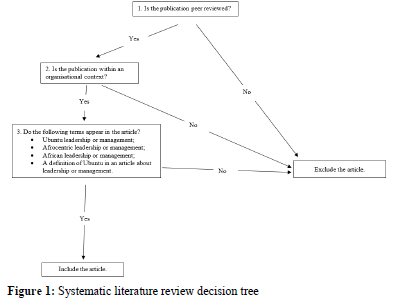
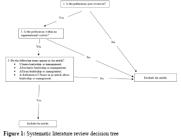
A decision tree was applied to identify articles for inclusion in the review, as shown in Figure 1. The results revealed 74 articles for review, classification, and analysis. These articles were in an organisational context and contained Ubuntu leadership/management or African leadership/management in the title, keywords, abstract, or body of the article, or there was a direct reference to or explanation of Ubuntu within the article.
Content Analysis
To ensure quality and rigour when analysing the data, a combination of methods described by Dinh et al. (2014), Gardner et al. (2010), Gardner et al. (2011), and Scandura and Williams (2000) was applied. These methods were chosen because the authors had previously conducted systematic literature reviews on leadership and management. Based on similar studies, specific dimensions informed the content analysis and were compiled. These dimensions were: year of publication, author name, institutional affiliation, country where the research was conducted, title of the article, journal, keywords, publication type, purpose of the article, author's research paradigm, methodology, and population. Qualitative studies were coded as follows: method of data collection, data analysis techniques, sample details, and whether trustworthiness was addressed. Quantitative studies were coded using the following criteria: method of data collection, data analysis techniques, sample details, and the provision of reliability estimates. For greater insight and theme identification, additional categories were included: Is Ubuntu or African leadership discussed or defined in the article? How is Ubuntu explained or defined? What is the theoretical foundation of Ubuntu leadership? In line with Tranfield et al.'s (2003) suggestion, some of the initial categories were adjusted or excluded to reflect the information available in the articles selected for inclusion in the review. For the sake of clarity in the discussions that follow, the term "Ubuntu leadership" includes Ubuntu management, African leadership or management, and Afrocentric leadership or management.
Results
Key Findings on Ubuntu Leadership in Organisational Contexts over 25 Years
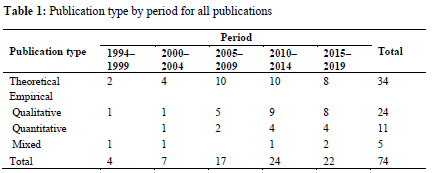
Tables 1 to 4 report the publication type, institutional affiliation of the authors, journal, and the study purpose by period for both theoretical and empirical publications.
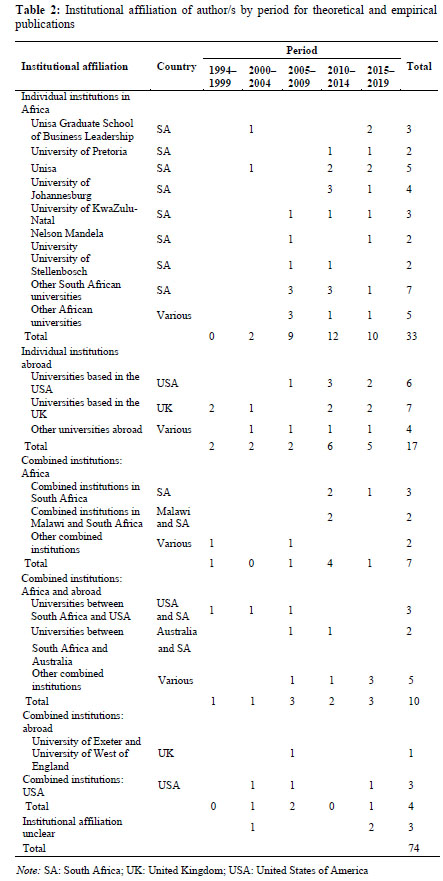
Table 1 indicates that interest in organisational Ubuntu leadership has gained momentum and authors are responding to the call for more empirical studies within this field. All categories showed a marked increase from 2005 onwards, with the first 15 years yielding 28 publications and the following decade yielding 46 publications. The empirical studies showed a marked increase from 12 studies in the first 15 years to 28 studies in the last decade. Additionally, the data revealed the institutional affiliations of the theoretical and empirical publications, as shown in Table 2.
The first category, Individual Institutions in Africa, yielded 11 publications within the first 15 years and 22 publications within the last decade, with the first two publications coming from the Unisa Graduate School of Business Leadership and Unisa between 2000 and 2004. Unisa yielded the highest number of publications (five) over the period, followed by the University of Johannesburg (four), Unisa Graduate School of Business (three), and the University of KwaZulu-Natal (three), as well as the universities of Pretoria, Nelson Mandela, and Stellenbosch (two). The institutions included in "other South African universities" and "other African universities" each yielded one publication.
The second category, Individual Institutions Abroad, yielded six publications from the USA, seven from the UK, and the rest from Canada, Australia, Germany, and Croatia. This category yielded six publications within the first 15 years and 11 in the last decade.
In the third category, Combined Institutions: Africa, there were three collaborations between institutions in South Africa, two between institutions in Malawi and South Africa, one between Malawi, Uganda, and Botswana, and one between South Africa, Kenya, and Botswana. Only two collaborations occurred within the first 15 years, while the remaining collaborations took place in the last decade.
The fourth category, Combined Institutions: Africa and Abroad, yielded three collaborations between institutions in the USA and South Africa, and two between Australia and South Africa. The remaining collaborations were between Canada and South Africa, the UK and Ghana, the Netherlands and West Africa, Ethiopia and Belgium, and Germany and South Africa.
The results of category five, Combined Institutions: Abroad, yielded three collaborations between institutions in the USA and one in the UK. Three occurred during the first 15 years, and one occurred within the last decade.
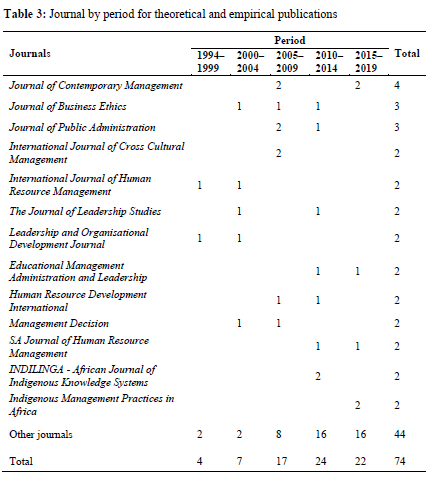
Three publications, in which the institutional affiliation is unclear, fell into the sixth category. Institutions in Africa were represented in 50 out of the 74 publications (68%). Data also showed which journals published theoretical and empirical articles during the period, shown in Table 3 below.
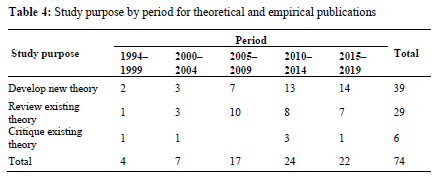
The Journal of Contemporary Management, a South Africa-based journal, yielded four publications; the Journal of Business Ethics, an international journal, yielded three publications; and the Journal of Public Administration, a South Africa-based journal, yielded three publications. Ten journals yielded two articles each-seven are international journals, and three are based in Africa. The remaining 44 journals yielded one article each. Furthermore, the data indicated the study purposes for the theoretical and empirical publications over the period, shown in Table 4 below.
The precise nature of Ubuntu in organisational contexts has been presented using various explanations in the literature. Authors have focused on developing and reviewing the theory in this field rather than empirically testing it. Three categories emerged: developing new theory (39 articles), reviewing existing theory (29 articles), and critiquing existing theory (6 articles). Twelve publications aimed at developing new theory during the first 15 years, followed by a sharp increase in the last decade to 27 publications. The review of existing theory rose from 2005 to 2009 but then tapered off during the last decade. A limited number of critiques have emerged, indicating that authors are beginning to critically evaluate and argue the concept of Ubuntu leadership within an organisational context.
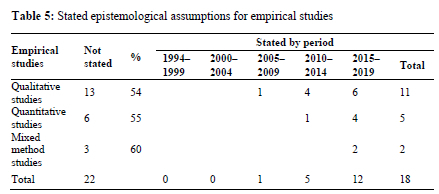
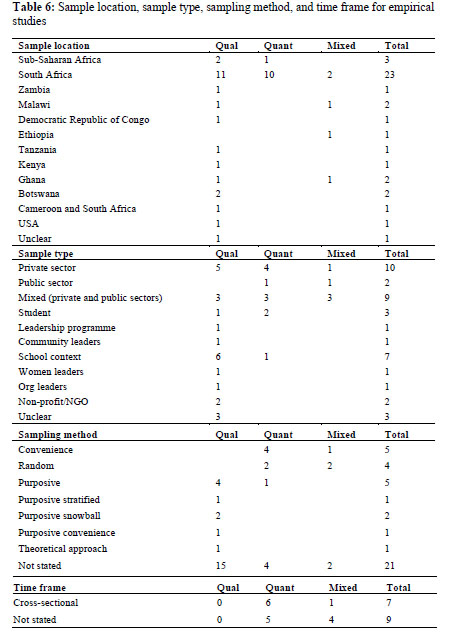
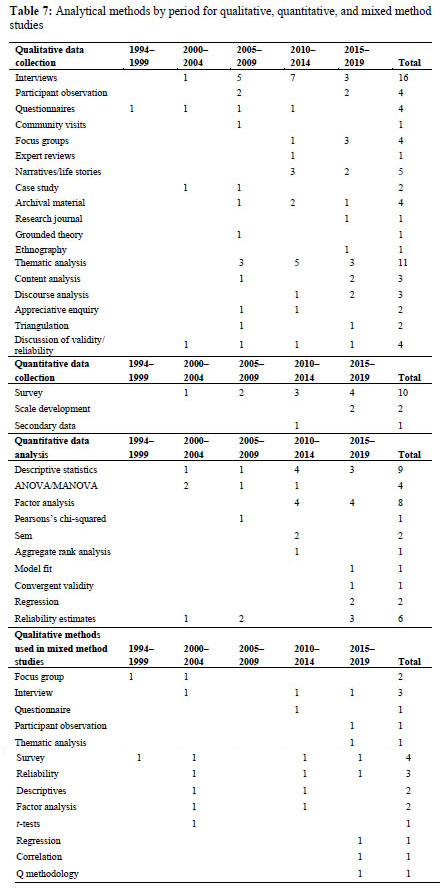
Tables 5 to 7 focus on empirical publications. Table 5 outlines whether the authors of the empirical articles stated their epistemological assumptions across the period; Table 6 illustrates sample location, sample type, sampling method, and time frame used; and Table 7 indicates the analytical methods by period for qualitative, quantitative, and mixed method studies.
Data were generated by searching each article for "epistemology," "paradigm," or "approach." Of the 40 empirical articles, 18 authors clearly stated their epistemological assumptions, while 22 did not. There has, however, been an improvement in the inclusion of this information in publications since 2005. Author epistemologies in qualitative studies included an inductive approach (Bolden and Kirk 2009); a two-way theory-practice iterative approach (Geldenhuys and Veldsman 2011); a qualitative research paradigm (Naicker 2015; Naidoo and Perumal 2014); an emic approach (Nkomo and Kriek 2011); an interventionist empirical approach (Puplampu 2010); a discursive approach (Karikari and Brown 2018); a phenomenological paradigm (Ngunjiri 2016; Steenkamp and Rensburg 2018); an ethnographic approach (Setlhodi 2019); and a social constructivist perspective (Mayer et al. 2018). Author epistemologies in quantitative studies included an interactive approach (Eustace and Martins 2014); a positivist approach (Mabasa and Eresia-Eke 2018; Muller et al. 2019); an empirical paradigm and etic approach (Grobler and Singh 2018); and an empirical paradigm (Grobler et al. 2019). The mixed method studies revealed Q methodology and grounded theory (Mitiku et al. 2017), as well as positivist approaches (Bagire et al. 2015). West (2014) clearly outlined his epistemological assumptions underlying his critique of existing theory by stating what would constitute evidence and what would not. Another observation is that Ubuntu was described as an epistemology in 48 of the articles. Additionally, the data revealed the sample location, sample type, sample method, and time frame of the study, as shown in Table 6 below.
Sample location data revealed that most samples consist of participants from South Africa. This was followed by sub-Saharan Africa, along with Malawi, Ghana, and Botswana. The remaining samples were from various locations in Africa. One sample was from the USA, while the location of the other sample was unclear. Regarding sample type, most samples were drawn from the private sector, followed by mixed contexts, school contexts, students, the public sector, non-profit organisations or NGOs, participants from leadership programmes, community leaders, women leaders, and organisational leaders. The sample type was unclear in three studies. The sampling method was unclear in half of the publications. Of those mentioned, convenience and purposive sampling were the most common, followed by random and purposive snowball sampling. The remaining methods included purposive stratified, purposive convenience, and a theoretical approach. Qualitative studies favoured purposive, purposive stratified, purposive convenience, and a theoretical approach, while quantitative and mixed methods favoured convenience, random, and purposive sampling methods. In over half of the quantitative and mixed studies, the time frame was not stated, while the remaining studies favoured a cross-sectional design. None of the publications utilised a longitudinal design. Furthermore, Table 7 categorises the analytical methods used for the empirical studies.
Qualitative data collection methods favoured interviews, followed by narratives/life stories, participant observation, questionnaires, focus groups, and archival material. The most common qualitative data analysis approaches are thematic analysis, content analysis, discourse analysis, and appreciative inquiry. Triangulation was mentioned in two of the publications, while validity and reliability aspects were discussed in four of the publications.
Quantitative studies favoured surveys, with two of the articles developing a scale and one article using secondary data. Studies developing a scale include Grobler and Singh (2018), who reviewed and validated the characteristics underpinning Afrocentric leadership using an existing (Western) leadership taxonomy, and Grobler et al. (2019), who validated the human resources practices perceptions questionnaire in a Southern African context while considering contextual realities such as collectivism embedded in Ubuntu and Afrocentrism. Of the data analysis methods chosen, descriptive statistics were the most common. This was followed by factor analysis, reliability estimates, ANOVA/MANOVA, SEM, and regression.
When investigating the analytical methods used in the five mixed method studies, it was found that interviews (in three studies) and focus groups (in two studies) were the most common qualitative methods. This was followed by questionnaires, participant observation, and thematic analysis. Common quantitative methods included surveys (four studies), reliability analysis (three studies), descriptive statistics (two studies), factor analysis (two studies), and finally t-tests, regression, correlation, and Q methodology (one study each). The study using Q methodology examined the leadership roles that Ethiopian civil service managers preferably embody in their environment (Mitiku et al. 2017).
The data presented in tables 1-7 reveal five key findings regarding how Ubuntu has been portrayed in organisational contexts.
Key Findings Emerging out of the Systematic Literature Review
Finding 1: Academic interest in Ubuntu leadership within an organisational context has gained momentum over the last 25 years, and authors are beginning to respond to the call for more empirical studies in this field.
Finding 2: The majority of the authors were affiliated with African institutions.
Finding 3: Of the three journals yielding the highest number of publications, two are based in Africa, and one is an international journal.
Finding 4: Over the past 25 years, authors have focused on developing and reviewing Ubuntu leadership theory rather than empirically testing it.
Finding 5: There are several indications of a lack of robust empirical studies:
1. In over half of the empirical studies, the author's epistemological assumptions are not clearly stated.
2. Sampling methods are unclear in over half of the empirical publications.
3. The study time frame was not clearly stated in more than half of the quantitative and mixed method studies.
4. Validity and reliability were addressed in four of the qualitative studies.
5. Of the 10 quantitative surveys, reliability estimates were provided in only six of the studies.
6. There was a lack of advanced data analysis techniques used in the quantitative and mixed method studies.
Additionally, five key themes emerged from coding for further categories. These themes ranged from the key influencers in Ubuntu leadership literature to the calls made by researchers.
Key Themes on Ubuntu Leadership in Organisational Contexts Over the 25-year Period
Theme One: Lovemore Mbigi is a Key Influencer Within the Academic Discourse on Ubuntu Leadership Within an Organisational Context
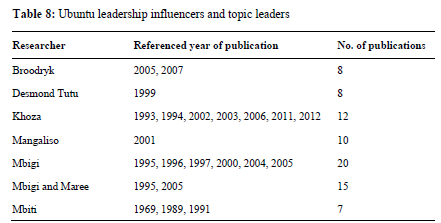
Table 8 illustrates the key influencers and topic leaders in Ubuntu leadership literature.
The results of coding the number of times a specific reference appeared in an article regarding how Ubuntu/African leadership was explained or defined are shown in Table 8. Lovemore Mbigi is the key influencer and topic leader, as his work from 1995 to 2005 is referenced 20 times. Mbigi and Maree's 1995/2005 book entitled Ubuntu: The Spirit of African Transformation Management, is referenced 15 times; Dr Reuel Khoza, an applied author and former Nedbank Chairman, is referenced 12 times; Mzamo Mangaliso's 2001 article entitled "Building competitive advantage from Ubuntu: Management lessons from South Africa" is referenced 10 times; Desmond Tutu, South African Anglican cleric and theologian, is referenced eight times; Dr Johann Broodryk, the first person to obtain a doctorate on the philosophy of Ubuntu, is referenced eight times; and, Mbiti's work is referenced seven times.
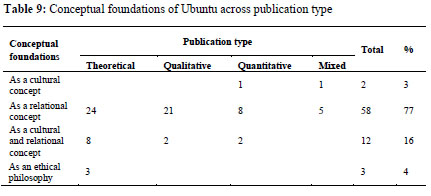
A second theme emerged from coding the theoretical foundations of Ubuntu across publication types, as illustrated in Table 9.
Theme Two: Ubuntu Within Organisational Contexts is Mostly Regarded as a Relational Concept
The underlying theoretical foundations of Ubuntu, across different publication types, were coded, revealing four conceptual foundations. The most common references were to Ubuntu as a relational concept, with articles using "I am because we are" or the umuntu ngumuntu ngabantu proverb, as well as similar variations. Additionally, referring to Ubuntu as a humanistic philosophy or social practice, and using terms like "values-based," "servant," or "relational," supported this conceptualisation. Less common were articles describing Ubuntu through the lens of collectivism and referencing Hofstede's (1984) cultural framework, which were regarded as supportive of a cultural foundation. Explanations of Ubuntu that employed a cultural and relational lens were categorised in the third category, while explanations of Ubuntu as an ethical philosophy were placed in the fourth category.
Additionally, a third theme emerged regarding the conceptualisation of Ubuntu as a management style.
Theme Three: There is Agreement that Ubuntu Could Be Conceptualised as a Leadership or Management Style
Literature was coded using the terms Ubuntu, African, and Afrocentric leadership or management. An example of a theoretical publication is by Nwagbara (2011), who calls for an African-centred organisational leadership paradigm where Africa's indigenous management practices are rooted in Ubuntu. A qualitative publication by Geldenhuys and Veldsman (2011) refers to elements of Ubuntu leadership as teamwork, inclusive participation, sacrificing personal gain for the group and the benefit of the community, openness, transparency, consensus in decision-making, and structure through rituals and ceremonies. Grobler and Singh (2018) published a quantitative study that revealed that, although some leadership behaviours are generic, there are unique Afrocentric leadership behaviours with a participatory, democratic, and communalistic focus. Similarly, literature describing Ubuntu as a philosophy that informs leadership and management has emerged. A theoretical publication by Mamman and Zakaria (2016) argued for the integration of Ubuntu philosophy and its principles into the development of organisations and their members. Geldenhuys and Veldsman (2011) published a qualitative study that aimed to develop a robust and holistic strategic management tool by examining scenario based planning and organisational change navigation within an Afrocentric context. A quantitative study by Khomba et al. (2011) aimed to redesign the innovation perspective of the Balanced Scorecard model and to suggest a new management approach for organisations in Africa. The empirical results revealed that this would be an ideal approach within an African organisation.
The literature also revealed agreement on how Ubuntu-related leadership is described, as shown in Theme Four.
Theme Four: Ubuntu-Related Leadership Can Be Described as Participatory and Values-Based
Literature supporting this theme was identified using terms such as participatory, collaborative, collective, inclusive, consensus, and democratic. In their theoretical publication, Iwowo (2015) refers to empathetic leadership, collective responsibility, and interactive leadership. A qualitative study by Elonga Mboyo (2019) described Ubuntu as communalism-an African sense of community, interdependence, and care resembling Western participative approaches to leadership. Shrivastava et al. (2014) authored a quantitative study that showed the ability to communicate inclusively with a diverse workforce is critical for South African managers. In addition, literature referring to Ubuntu leadership as values-based was coded. A theoretical publication by Bertsch (2012) suggested that for a cultural shift in American-based leadership practices to take place, a values-based leadership style like Ubuntu would need to be embraced. Mogadime et al. (2010) published a qualitative study that found spirituality, interdependence, and unity-three values of Ubuntu-embedded in the participants' narratives. Shrivastava et al. (2014) conducted a quantitative study examining how Ubuntu might manifest in the South African workplace from a values-based perspective. Similarly, literature on the Ubuntu philosophy that informs business and personal ethics was coded. A theoretical publication by Sebola (2014) concluded that there is a need to harmonise legislation governing ethics with the generally accepted cultural values and practices of South Africans. Mayer et al. (2018) published a qualitative study suggesting that women leaders focus on inner resources (moral, spiritual, and ethical) rather than on behavioural leadership traits when dealing with conflict. This points to spiritual or ethical leadership and a strong moral compass.
The final theme revealed some agreement among authors calling for blended leadership in Africa.
Theme Five: Researchers Are Calling for Blended Leadership Approaches in Africa
This theme was identified through a review of literature calling for a blend of Afrocentric and Eurocentric leadership. A theoretical publication authored by Penceliah and Mathe (2007) examined good practices and lessons in both Afrocentric and Eurocentric leadership and called for a creative synergy between the two styles. In addition, literature calling for a blend of instrumental versus humanistic, pragmatic versus transformative, autocratic versus relational, and classical versus indigenous was evident. In a theoretical publication, Naidoo (2005) proposes a hybrid leadership and governance framework based on values, ethics, collective decision-making, listening skills, and dialogue that is pragmatic and transformative. Naidoo and Perumal (2014) authored a qualitative study that found women school principals subscribed to a relational, inclusive, and compassionate leadership style, in addition to an autocratic leadership style, to ensure the effective and efficient management of their schools. In a mixed method study, Jackson (1999) calls for policies to reconcile the instrumental and humanistic orientations of people using an indigenous management style based on Western, Asian, and African values.
The systematic literature review concluded in June 2019. The discussion that follows considers the state of the literature since then and if researchers have been responding to the calls for further empirical studies
Discussion
Since June 2019, authors have responded to the call for more empirical studies. Theoretical conceptualisations of Ubuntu have been proposed by Molose et al. (2019) and Lerutla and Steyn (2021). Both studies used literature and interviews to inform their conceptualisation and measurement instruments, and the research design and sampling methods were clearly explained. Furthermore, Lerutla and Steyn (2021) explained their epistemology and addressed the reliability aspects of developing their instrument. Sachikonye and Ramlogan (2024) proposed a meta-theory of Ubuntu that seeks to explain how the nature of responsibility in African settings differs from that in Western settings, and discusses the key concepts of responsible leadership through the lens of Ubuntu.
Furthermore, Sibanda and Grobler (2023) proposed a conceptualisation of spiritual leadership within the context of African management philosophies that embraces the elements of Ubuntu and batho pele. Similarly, Grobler and Koen (2024) proposed a conceptualisation of responsible leadership in South Africa and suggested that, in Africa and South Africa, the dominant leadership philosophy of Ubuntu, which emphasises relationships, participative decision-making, and concern for group welfare, is complementary to the values and behaviours of responsible leadership. In both of these studies, the research design, methodology, and sample size are clearly explained.
Evans et al. (2021) examined the leadership preferences of working adults in Ghana, Kenya, and Zambia using the Leader Behaviour Description Questionnaire XII (LBDQXII), a theoretical model of explicit leader behaviour. The aim was to stimulate interest in understanding effective leadership practices on the African continent. Results revealed a strong need for more in-depth studies of leadership theory in the African context, particularly across countries. Lerutla and Steyn (2022) assessed whether the leadership styles of South African leaders differed based on their cultural backgrounds and whether the effectiveness of these leadership styles was judged differently by their subordinates. The survey demonstrated good reliability within the context of the study, and the findings revealed that leaders in South Africa, regardless of their cultural background, exhibit similar behavioural attributes. In addition, Grobler and Sibanda (2024) developed and tested an 18 item spiritual leadership scale within a South African organisational context. In these studies, the research methodology was clearly explained, the reliability and validity aspects were addressed, and more advanced statistical techniques were employed. Furthermore, there are publications confirming the relevance of the five themes identified in the systematic literature review. Lovemore Mbigi is referenced (Zondo 2022). Ubuntu is referred to as a relational, participatory, and values-based concept, as well as a leadership or management style (Evans et al. 2021; Mangaliso et al. 2021; Chetty and Price 2024). Additionally, Osa (2019) called for a culture and values-based model of blended leadership.
At this juncture, it is important to consider the limitations of the study.
Limitations
Despite efforts to review the literature in a thorough, rigorous, and evidence-informed manner, it is possible that some studies meeting the inclusion criteria were not identified. In addition, applied management articles, as well as unpublished reports and theses, were not considered or included in the sample used for content analysis. Lastly, despite using a combination of methods from previous systematic literature reviews to conduct the data analysis, some of the initial categories identified during data extraction needed to be adjusted or excluded to accurately reflect the information available in the articles.
Recommendations
This review provides evidence of a lack of robust empirical studies and differing views regarding the nature of Ubuntu leadership. In addition, the inclusion criteria excluded data on the potential exclusionary nature of Ubuntu (Asamoah and Yeboah-Assiamah 2019; Lerutla and Steyn 2021; Walumbwa et al. 2011). Despite recent evidence that researchers are responding to the call for more empirical studies in this field, academia is urged to continue exploring and testing Ubuntu with context sensitive conceptualisations, using qualitative, quantitative, and mixed method approaches, especially through the lived experiences of organisational leaders who understand the authentic cultural essence of Ubuntu.
Theoretical Implications
This paper provides a clearer picture of the state of research on Ubuntu leadership behaviours within an organisational context and offers direction for advancing this field of research.
Contribution
This review provides encouraging evidence for the inclusion of the emerging field of research on Ubuntu within the context of organisational leadership. In addition, it provides a robust foundation and roadmap to extend Ubuntu leadership theory.
Conclusion
"I am because we are" is a Xhosa proverb that continues to spark much debate about Ubuntu and how it manifests in an organisational leadership context. This systematic literature review and its resulting findings and themes confirm a lack of robust empirical studies in this field. Although several perspectives of Ubuntu in an organisational leadership context have emerged, it is mostly regarded as a relational, participatory, and values-based leadership approach.
References
Literature Review
-
Asamoah, K., and E. Yeboah-Assiamah. 2019. "'Ubuntu Philosophy' for Public Leadership and Governance Praxis: Revisiting the Ethos of Africa's Collectivism." Journal of Global Responsibility 10 (4): 307-321. https://doi.org/10.1108/JGR-01-2019-0008.
» https://doi.org/10.1108/JGR-01-2019-0008 -
Bagire, V., J. Byarugaba, and J. Kyogabiirwe. 2015. "Organizational Meetings: Management and Benefits." Journal of Management Development 34 (8): 960-72. https://doi.org/10.1108/JMD-03-2014-0023.
» https://doi.org/10.1108/JMD-03-2014-0023 - Bertsch, A. 2012. "Updating American Leadership Practices by Exploring the African Philosophy of Ubuntu." Journal of Leadership, Accountability and Ethics 9 (1): 81-97.
-
Bolden, R., and P. Kirk. 2009. "African Leadership: Surfacing New Understandings through Leadership Development. " International Journal of Cross Cultural Management 9 (1): 69-86. https://doi.org/10.1177/1470595808101156.
» https://doi.org/10.1177/1470595808101156 - Brubaker, L. 2013. "Servant Leadership, Ubuntu, and Leader Effectiveness in Rwanda." Emerging Leadership Journeys 6 (1): 114-33.
-
Chetty, K., and G. Price. 2024. "Ubuntu Leadership as a Predictor of Employee Engagement: A South African Study." SA Journal of Human Resource Management / SA Tydskrif vir Menslikehulpbronbestuur 22 (0): a2462. https://doi.org/10.4102/sajhrm.v22i0.2462.
» https://doi.org/10.4102/sajhrm.v22i0.2462 -
Dinh, J. E., R. G. Lord, W. L. Gardner, J. D. Meuser, R. C. Liden, and J. Hu. 2014. "Leadership Theory and Research in the New Millennium: Current Theoretical Trends and Changing Perspectives." The Leadership Quarterly 25 (1): 36-62. https://doi.org/10.1016/j.leaqua.2013.11.005.
» https://doi.org/10.1016/j.leaqua.2013.11.005 -
Elonga Mboyo, J. P. E. 2019. "Reimagining Ubuntu in Schools: A Perspective from Two Primary School Leaders in the Democratic Republic of Congo." Educational Management Administration and Leadership 47 (2): 206-23. https://doi.org/10.1177/1741143217728085.
» https://doi.org/10.1177/1741143217728085 -
Eustace, A., and N. Martins. 2014. "The Role of Leadership in Shaping Organisational Climate: An Example from the Fast Moving Consumer Goods Industry." SA Journal of Industrial Psychology 40 (1): 1-14. https://doi.org/10.4102/sajip.v40i1.1112.
» https://doi.org/10.4102/sajip.v40i1.1112 -
Evans, W. R., R. F. Littrell, N. H. Lamb, and B. Kirkman. 2021. "Examining Leadership Preferences of Working Adults in Ghana, Kenya, and Zambia." Africa Journal of Management 7 (3): 375-99. https://doi.org/10.1080/23322373.2021.1927447.
» https://doi.org/10.1080/23322373.2021.1927447 -
Gardner, W. L., K. B. Lowe, T. W. Moss, K. T. Mahoney, and C. C. Cogliser. 2010. "Scholarly Leadership of the Study of Leadership: A Review of The Leadership Quarterly's Second Decade, 2000-2009." The Leadership Quarterly 21 (6): 922-58. https://doi.org/10.1016/j.leaqua.2010.10.003.
» https://doi.org/10.1016/j.leaqua.2010.10.003 -
Gardner, W. L., C. C. Cogliser, K. M. Davis, and M. P. Dickens. 2011. "Authentic Leadership: A Review of the Literature and Research Agenda." Leadership Quarterly 22 (6): 1120-45. https://doi.org/10.1016/j.leaqua.2011.09.007.
» https://doi.org/10.1016/j.leaqua.2011.09.007 -
Geldenhuys, C. A., and T. H. Veldsman. 2011. "A Change Navigation-Based, Scenario Planning Process within a Developing World Context from an Afro-Centric Leadership Perspective. " SA Journal of Human Resource Management 9 (1): 1 -17. https://doi.org/10.4102/sajhrm.v9i1.265.
» https://doi.org/10.4102/sajhrm.v9i1.265 -
Grobler, A., and W. Koen. 2024. "Conceptualising Responsible Leadership in South Africa: An Interactive Qualitative Analysis. " South African Journal of Business Management 55 (1): a4338. https://doi.org/10.4102/sajbm.v55i1.4338.
» https://doi.org/10.4102/sajbm.v55i1.4338 -
Grobler, A., and K. Sibanda. 2024. "The Development and Validation of a Spiritual Leadership Scale within the South African Context." SA Journal of Industrial Psychology /SA Tydskrif vir Bedryfsielkunde 50 (0): a2098. https://doi.org/10.4102/sajip.v50i0.2098.
» https://doi.org/10.4102/sajip.v50i0.2098 -
Grobler, A., and M. Singh. 2018. "Leadership in Southern Africa - A Regional Afrocentric Hierarchical Taxonomy." Insight on Africa 10 (2): 1-25. https://doi.org/10.1177/0975087818772236.
» https://doi.org/10.1177/0975087818772236 -
Grobler, A., S. Grobler, and R. Mathafena. 2019. "Measurement of the Perceptions of Human Resource Practices in a Seemingly Collectivistic Culture." SA Journal of Human Resource Management 17: 1-11. https://doi.org/10.4102/sajhrm.v17i0.1069.
» https://doi.org/10.4102/sajhrm.v17i0.1069 -
Higgins, J. P. T., J. Thomas, J. Chandler, M. Cumpston, T. Li, M. J. Page, and V. A. Welch, eds. 2019. Cochrane Handbook for Systematic Reviews of Interventions. 2nd ed. Wiley-Blackwell. https://doi.org/10.1002/9781119536604.
» https://doi.org/10.1002/9781119536604 -
Hofstede, G. 1984. "Cultural Dimensions in Management and Planning." Asia Pacific Journal of Management 1 (2): 81-99. https://doi.org/10.1007/BF01733682.
» https://doi.org/10.1007/BF01733682 -
Iwowo, V. 2015. "Leadership in Africa: Rethinking Development." Personnel Review 44 (3): 408-29. https://doi.org/10.1108/PR-07-2013-0128.
» https://doi.org/10.1108/PR-07-2013-0128 -
Jackson, T. 1999. "Managing Change in South Africa: Developing People and Organisations." International Journal of Human Resource Management 10 (2): 306-26. https://doi.org/10.1080/095851999340576.
» https://doi.org/10.1080/095851999340576 -
Karikari, E., and C. Brown. 2018. "Sensemaking in Turbulent Contexts: African Student Leadership in a Postcolonial Context." Communication Studies 69 (4): 439-52. https://doi.org/10.1080/10510974.2018.1472126.
» https://doi.org/10.1080/10510974.2018.1472126 -
Karsten, L., and H. Illa. 2005. "Ubuntu as a Key African Management Concept: Contextual Background and Practical Insights for Knowledge Application." Journal of Managerial Psychology 20 (7): 607-20. https://doi.org/10.1108/02683940510623416.
» https://doi.org/10.1108/02683940510623416 - Khomba, J. K., F. N. S. Vermaak, and D. G. Gouws. 2011. "Redesigning an Innovation Section of the Balanced Scorecard Model: An African Perspective." Southern African Business Review 15 (3): 1-20.
-
Lerutla, M., and R. Steyn. 2021. "African Business Leadership: Perspectives from Aspiring Young Leaders. " SA Journal of Human Resource Management 19: a1467. https://doi.org/10.4102/sajhrm.v19i0.1467.
» https://doi.org/10.4102/sajhrm.v19i0.1467 -
Lerutla, M., and R. Steyn. 2022. "Distinct Leadership Styles and Differential Effectiveness across Culture: An Analysis of South African Business Leaders." SA Journal of Human Resource Management 20: a1957. https://doi.org/10.4102/sajhrm.v20i0.1957.
» https://doi.org/10.4102/sajhrm.v20i0.1957 - Mabasa, T., and C. Eresia-Eke. 2018. "Prevalent Leadership Styles of Black Top-Managers in South African State-Owned Enterprises (SOEs)." African Journal of Public Affairs 10 (4): 1 -20.
-
Mamman, A., and H. B. Zakaria. 2016. "Spirituality and Ubuntu as the Foundation for Building African Institutions, Organisations and Leaders." Journal of Management, Spirituality & Religion 13 (3): 246-65. https://doi.org/10.1080/14766086.2016.1159976.
» https://doi.org/10.1080/14766086.2016.1159976 -
Mangaliso, M. P. 2001. "Building Competitive Advantage from Ubuntu: Management Lessons from South Africa." Academy of Management Executive 15 (3): 23-33. https://doi.org/10.5465/ame.2001.5229453.
» https://doi.org/10.5465/ame.2001.5229453 -
Mangaliso, M. P., N. A. Mangaliso, L. Z. Ndanga, and H. Jean-Denis. 2021. "Contextualizing Organizational Change Management in Africa: Incorporating the Core Values of Ubuntu." Journal of African Business 23 (4): 1029-48. https://doi.org/10.1080/15228916.2021.1984817.
» https://doi.org/10.1080/15228916.2021.1984817 -
Mayer, C.-H., S. Surtee, and J. Mahadevan. 2018. "South African Women Leaders, Transformation and Diversity Conflict Intersections." Journal of Organizational Change Management 31 (4): 877-94. https://doi.org/10.1108/JOCM-10-2016-0196.
» https://doi.org/10.1108/JOCM-10-2016-0196 - Mbigi, L. 1997. Ubuntu: The African Dream in Management. Knowledge Resources.
- Mbigi, L., and J. Maree. 2005. Ubuntu: The Spirit of African Transformation Management. Knowres Publishing.
-
Mitiku, A. A., A. Hondeghem, and S. Troupin. 2017. "Administrative Leadership: Understanding the Preferred Leadership Roles of Ethiopian Civil Service Managers." African Journal of Economic and Management Studies 8 (3): 366-94. https://doi.org/10.1108/AJEMS-06-2016-0093.
» https://doi.org/10.1108/AJEMS-06-2016-0093 -
Mogadime, D., P. Mentz, D. E. Armstrong, and B. Holtam. 2010. "Constructing Self as Leader: Case Studies of Women Who Are Change Agents in South Africa." Urban Education 45 (6): 797-821. https://doi.org/10.1177/0042085910384203.
» https://doi.org/10.1177/0042085910384203 -
Molose, T., P. Thomas, and G. Goldman. 2019. "A Qualitative Approach to Developing Measurement Scales for the Concept of Ubuntu." Acta Commercii 19 (1): a692. https://doi.org/10.4102/ac.v19i1.692.
» https://doi.org/10.4102/ac.v19i1.692 -
Muller, R. J., E. E. Smith, and R. Lillah. 2019. "Perceptions Regarding the Impact of Ubuntu and Servant Leadership on Employee Engagement in the Workplace." Journal of Contemporary Management 16 (1): 20-51. https://doi.org/10.35683/jcm17104.0004.
» https://doi.org/10.35683/jcm17104.0004 -
Naicker, I. 2015. "School Principals Enacting the Values of Ubuntu in School Leadership: The Voices of Teachers." Studies of Tribes and Tribals 13 (1): 1-9. https://doi.org/10.1080/0972639X.2015.11886706.
» https://doi.org/10.1080/0972639X.2015.11886706 -
Naidoo, B., and J. Perumal. 2014. "Female Principals Leading at Disadvantaged Schools in Johannesburg, South Africa." Educational Management Administration & Leadership 42 (6): 808-24. https://doi.org/10.1177/1741143214543202.
» https://doi.org/10.1177/1741143214543202 - Naidoo, G. 2005. "A Transformative African Leadership and Governance Framework to Improve Public Service Delivery in South Africa." Journal of Public Administration 10 (1): 102-17.
-
Ngunjiri, F. W. 2016. "'I Am Because We Are': Exploring Women's Leadership Under an Ubuntu Worldview. " Advances in Developing Human Resources 18 (2): 223-42. https://doi.org/10.1177/1523422316641416.
» https://doi.org/10.1177/1523422316641416 -
Nkomo, S. M., and D. Kriek. 2011. "Leading Organisational Change in the 'New' South Africa. " Journal of Occupational and Organizational Psychology 84 (3): 453-70. https://doi.org/10.1111/j.2044-8325.2011.02020.x.
» https://doi.org/10.1111/j.2044-8325.2011.02020.x -
Nwaila, G. T., J. E. Bourdeau, S. E. Zhang, N. Chipangamate, I. Valodia, M. A. Mahboob, T. Lehohla, et al. 2024. "A Systematic Framework for Compilation of Critical Raw Material Lists and Their Importance for South Africa." Resources Policy 93: 105045. https://doi.org/10.1016/j.resourpol.2024.105045.
» https://doi.org/10.1016/j.resourpol.2024.105045 - Nwagbara, U. 2011. "Leading a Postmodern African Organisation: Towards a Model of Prospective Commitment." Journal of Economics and Business 4 (2): 75-92.
- Osa, E. A. 2019. "Tradocratic Leadership Style and Its Imperative for African Development: Towards a Theory of Leadership for Africa." Unilag Journal of Humanities 7 (1): 139-51.
-
Ouedraogo, N. S., and J. M. M. Kilolo. 2024. "Africa's Critical Minerals Can Power the Global Low-Carbon Transition." Progress in Energy 6 (3): 033004. https://doi.org/10.1088/2516-1083/ad46da.
» https://doi.org/10.1088/2516-1083/ad46da -
Page, M. J., J. E. McKenzie, P. M. Bossuyt, I. Boutron, T. C. Hoffmann, C. D. Mulrow, and D. Moher. 2021. "The PRISMA 2020 Statement: An Updated Guideline for Reporting Systematic Reviews." BMJ 372: n71. https://doi.org/10.1136/bmj.n71.
» https://doi.org/10.1136/bmj.n71 - Penceliah, Y., and E. N. J. Mathe. 2007. "Afrocentric versus Eurocentric Leadership: Towards an Appropriate Style for Organisational Effectiveness." Journal of Public Administration 42 (2): 149-59.
-
Puplampu, B. B. 2010. "Leadership as Engagement, Leadership as System Development: A Contextualised Ghanaian Study." European Business Review 22 (6): 624-51. https://doi.org/10.1108/09555341011082925.
» https://doi.org/10.1108/09555341011082925 -
Sachikonye, C., and R. Ramlogan. 2024. "A Meta-Theory of Ubuntu: Implications for Responsible Leadership in Africa." South African Journal of Business Management 55 (1): a4342. https://doi.org/10.4102/sajbm.v55i1.4342.
» https://doi.org/10.4102/sajbm.v55i1.4342 -
Scandura, T. A., and E. A. Williams. 2000. "Research Methodology in Management: Current Practices, Trends, and Implications for Future Research." Academy of Management Journal 43 (5): 1248-64. https://doi.org/10.2307/1556348.
» https://doi.org/10.2307/1556348 -
Sebola, M. P. 2014. "Ethics in the South African Public Service: A Paradox of Culture, Politics and Ethics in the World of Work." Journal of Social Sciences 40 (3): 295-304. https://doi.org/10.1080/09718923.2014.11893325.
» https://doi.org/10.1080/09718923.2014.11893325 -
Setlhodi, I. I. 2019. "Ubuntu Leadership: An African Panacea for Improving School Performance." Africa Education Review 16 (2): 126-42. https://doi.org/10.1080/18146627.2018.1464885.
» https://doi.org/10.1080/18146627.2018.1464885 -
Shrivastava, S., C. Selvarajah, D. Meyer, and N. Dorasamy. 2014. "Exploring Excellence in Leadership Perceptions amongst South African Managers." Human Resource Development International 17 (1): 47-66. https://doi.org/10.1080/13678868.2013.857510.
» https://doi.org/10.1080/13678868.2013.857510 -
Sibanda K., and A. Grobler. 2023. "Spiritual Leadership within the Ambit of African Management Philosophies Using Interactive Qualitative Analysis. " Acta Commercii 23 (1): a1069. https://doi.org/10.4102/ac.v23i1.1069.
» https://doi.org/10.4102/ac.v23i1.1069 -
Steenkamp, H., and R. Rensburg. 2018. "Utilising an Ubuntu-Centred Communication Management Framework to Analyse CSR Messages on SNSS." Communicatio 44 (3): 17-40. https://doi.org/10.1080/02500167.2018.1541914.
» https://doi.org/10.1080/02500167.2018.1541914 -
Tauetsile, J. 2021. "Employee Engagement in Non-Western Contexts: The Link Between Social Resources, Ubuntu and Employee Engagement." International Journal of Cross-Cultural Management 21 (2): 245-59. https://doi.org/10.1177/14705958211007874.
» https://doi.org/10.1177/14705958211007874 -
Tranfield, D., D. Denyer, and P. Smart. 2003. "Towards a Methodology for Developing Evidence-Informed Management Knowledge by Means of Systematic Review." British Journal of Management 14 (3): 207-22. https://doi.org/10.1111/1467-8551.00375.
» https://doi.org/10.1111/1467-8551.00375 -
Walumbwa, F. O., B. J. Avolio, and S. Aryee. 2011. "Leadership and Management Research in Africa: A Synthesis and Suggestions for Future Research." Journal of Occupational and Organizational Psychology 84 (3): 425-39. https://doi.org/10.1111/j.2044-8325.2011.02034.x.
» https://doi.org/10.1111/j.2044-8325.2011.02034.x -
West, A. 2014. "Ubuntu and Business Ethics: Problems, Perspectives and Prospects." Journal of Business Ethics 121 (1): 47-61. https://doi.org/10.1007/s10551-013-1669-3.
» https://doi.org/10.1007/s10551-013-1669-3 -
Zondo, R. D. 2022. "The Ubuntu and Batho Pele Principles: The Two Overarching South African Concepts for Business and Management Application." In Responsible Management in Africa, Volume 1: Traditions of Principled Entrepreneurship, edited by K. Ogunyemi, O. Ogunyemi, and A. Anozie. Emerald Publishing. https://doi.org/10.1108/978-1-80262-437-320221012i.
» https://doi.org/10.1108/978-1-80262-437-320221012i