A linguistic analysis of spelling errors in Grade 3 isiXhosa home-language learners
Abstract
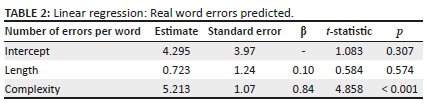
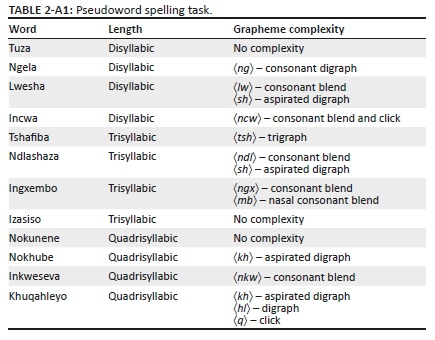
BACKGROUND: Spelling is a vital component of literacy. This is because spelling includes multiple metalinguistic components, such as phoneme-grapheme awareness, orthographic awareness and morphophonemic knowledge. Despite this, there remains, to date, insufficient literature on spelling in the Southern Bantu langauges and, more specifically, in isiXhosa. OBJECTIVES: This study explores the nature of spelling among Grade 3 isiXhosa home-language learners and provides a linguistic analysis of the types of errors produced by these learners. METHOD: Data were collected from 51 isiXhosa home-language learners using a carefully designed isiXhosa spelling task, which included both real and pseudowords. RESULTS: The findings showed that grapheme complexity was a significant predictor of spelling error production in isiXhosa. Furthermore, the main error type for both real words and pseudowords was errors of omission, specifically fnf in nasal blends and fhf in aspirated digraphs. CONCLUSION: While the isiXhosa orthography is transparent, and thus relatively predictable in decoding, its agglutinative, conjunctive character coupled with the existence of a number of complex graphemes presents a greater challenge for spelling. This supports the need for targeted instruction of complex graphemes in isiXhosa pedagogical practice to improve encoding skills
spelling; spelling errors; literacy; isiXhosa; Southern Bantu langauges