Modelling the turbulent flow of non-Newtonian slurries
Abstract
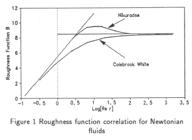
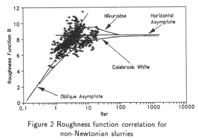
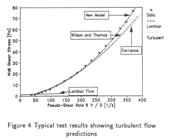
The only reliable approach open to designers of pipeline systems conveying non-Newtonian slurries in the turbulent flow regime has been large scale pipe tests. This paper addresses this design problem, with particular emphasis on the theoretical modelling of the turbulent flow behaviour of these slurries in pipes. The literature and theory pertinent to the flow of slurries in pipes is examined. A new model for the prediction of the turbulent energy gradient is developed from widely accepted fundamentals. A particle roughness effect has been observed and turbulent flow is modelled using a new roughness Reynolds number to correlate the roughness function. Three test facilities were built for the establishment of a data base of non-Newtonian slurry behaviour - a tube viscometer and two pumped recirculating pipe test rigs. The experimental investigation covered wide ranges of diameter (5 mm to 200 mm nominal bore), mean pipe velocity (0.1 m/s to 10 m/s), slurry relative density (1.02 to 1.65), volumetric concentration (2% to 37%), solids relative density (2.4 to 2.8) and particle size range (d85 = 24 to 120 μm). Turbulent flow predictions using the new turbulent model are accurate and better than previous models, particularly in the rough wall region. The new analysis is based on physical behaviour and contributes to the understanding of the mechanisms involved.
 Thumbnail
 Thumbnail
 Thumbnail
 Thumbnail
 Thumbnail
 Thumbnail
 Thumbnail
 Thumbnail
 Thumbnail
 Thumbnail