Cooling Tower Performance: A Critical Evaluation of the Merkel Assumptions
Abstract
The simplifying assumptions made by Merkel are critically evaluated by comparing the Merkel analysis to the more rigorous Poppe analysis of cooling tower performance. It is shown that the accuracy of the Merkel method can be greatly improved, under certain cooling tower operating conditions, to predict cooling tower performance within very close tolerance of the performance predicted by the Poppe method. It is shown under which tower operating conditions the thermal tower performance, according to the Merkel method, is likely to differ from the performance predicted by the Poppe method.
Introduction
Merkel,1 developed the theory for the evaluation of the thermal performance of cooling towers in 1925. This analysis is very popular and widely applied 2. The Merkel theory relies on several critical assumptions to reduce the solution to a simple hand calculation. Because of these assumptions, however, the Merkel method does not accurately represent the physics of the heat and mass transfer process in the cooling tower fill. The simplifying assumptions of the Merkel theory are:
□ Assumption 1: The Lewis factor relating heat and mass transfer is equal to 1.
□ Assumption 2: The reduction of water flow rate by evaporation is neglected in the energy balance.
□ Assumption 3: The air exiting the cooling tower is saturated with water vapor and it is characterized only by its enthalpy.
The more rigorous method to evaluate cooling tower performance was developed by Poppe and Rögener,3 in the early seventies. The Poppe method does not make the simplifying assumptions made by Merkel. The critical differences between the Merkel and Poppe methods are investigated by Kloppers and Kröger,4. Procedures to improve the accuracy of the Merkel method, and the cooling tower operating conditions under which they are valid, are discussed in the present study.
The Merkel method
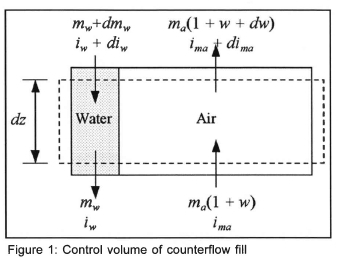
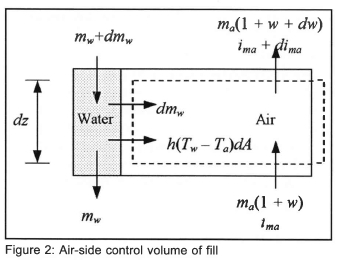
By applying mass and energy balances to control volumes shown in Fig. 1 and Fig. 2, where air is in counterflow with a downwards flowing water stream, the following equations are obtained respectively5.
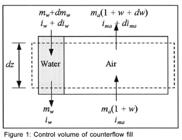
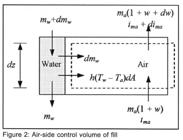
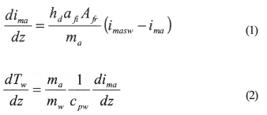
For the Merkel theory it is assumed that dw = 0.
Equations (1) and (2) describe respectively the change in the enthalpy of the air-water vapor mixture and the change in water temperature as the air travel distance changes. Equations (1) and (2) can be combined to yield upon integration the Merkel equation,
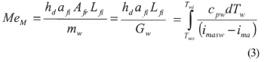
where MeM is the transfer coefficient or Merkel number according to the Merkel method.
Refer to Kröger,6 for a detailed derivation of Eq. (3). It is not possible to calculate the state of the air leaving the fill according to Eq. (3). Merkel assumed that the air leaving the fill is saturated with water vapor. This assumption enables the air temperature leaving the fill to be calculated.
The Poppe Method
Without the simplifying assumptions of Merkel, the mass and energy balances from Fig. 1 and Fig. 2, yield after manipulation for unsaturated air3,
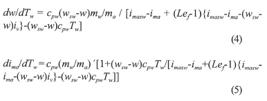
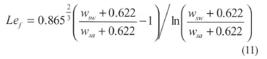
where the Lewis factor is defined as Lef = h/hdCpa.
Bosnjakovic,7 proposed the following relation to express the Lewis factor for air-water vapor systems:
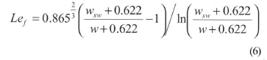
The transfer coefficient or Merkel number according to the Poppe method is given by

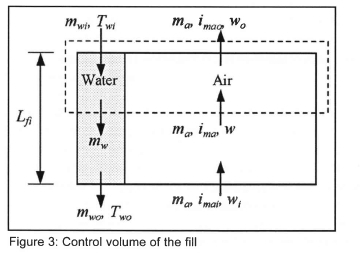
The varying mass flow rate ratio in Eq. (4) and Eq. (5) can be determined by considering the control volume in the fill of Fig. 3. A mass balance of the control volume in Fig. 3 yields,
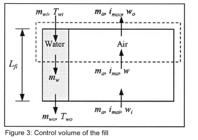

Equations (4) to (7) are only valid if the air is unsaturated. If the air is supersaturated, the governing equations are,
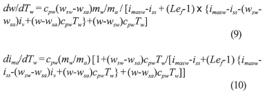
where the Lewis factor for supersaturated air is given by
The Merkel number according to the Poppe method is given by

The equations according to the Poppe method must be solved by an iterative procedure because w0 in Eq. (8) is not known a priori. Refer to Poppe and Rögener,3, Bourillot,8 and Baard,9 for more detailed information on the derivation and solving of these equations.
Comparison between Merkel and Poppe Methods
Performance calculation examples of the natural draft wet-cooling tower in Kröger,6 and the mechanical draft tower in Baard,9 are taken as reference towers in this investigation. The performance of these towers are determined by the Merkel method with detailed consideration of the transfer characteristics in the fill, rain and spray zones as well as the various flow resistances that affect tower draft.
The differences between the Merkel and Poppe methods are investigated in this study at various operating conditions for the abovementioned natural draft and mechanical draft cooling tower performance calculations. Ambient air temperatures of 7, 17,27 and 3 7 °C are considered. For each of these temperatures, the humidity of the air is varied from completely dry to saturated conditions. The effect of inlet temperature and humidity on cooling tower performance can therefore be determined over a wide range of atmospheric conditions. The differences between the Merkel and Poppe methods can then be discussed at the hand of the simplifying assumptions made by Merkel.
The Merkel numbers, or transfer characteristics, determined by the Poppe method for the particular fill employed in the abovementioned cooling towers, is approximately 9% higher than the Merkel number determined by employing the Merkel method. Notwithstanding this difference, the subsequent application of the Merkel method, employing the smaller value for the Merkel number obtained during fill tests, will predict approximately the same cooling tower water outlet temperature as obtained by the more rigorous Poppe method. Differences (< 1 °C) in the water outlet temperature predicted by the Merkel and Poppe methods, especially during hot and dry ambient conditions, are due to the fact that these methods predict different air outlet conditions causing the draft to be different in the two cases.
The employment of a specific method of analysis, i.e. Merkel or Poppe with their accompanying assumptions, in the fill performance evaluation and the subsequent employment of the same method of analysis in the cooling tower performance analysis, is defined in this study as the consistent employment of a specific method of analysis.
Merkel Assumption 1: Lewis Factor = 1
Merkel,1 assumed that the Lewis factor is equal to 1. Poppe and Rögener,3 used Eq. (6) that was proposed by Bosnjakovic,7 to express the Lewis factor in the Poppe method. The derivation of this equation can be seen in Bourillot,8 and Grange,10. Hässler,11 cited that other researchers showed that the assumption of Merkel is not correct and that most of the researchers find Lewis factors in the range from 0.6 to 1.3. An analysis of both splash and film packings by Feltzin and Benton,12 indicates that for counterflow towers, a Lewis factor of 1.25 is more appropriate. According to Feltzin and Benton,12 the Lewis number does not appear to be dependent on whether the packing is splash type or film type, but only on the configuration (i.e. counterflow or crossflow). Sutherland,13 used a Lewis factor of 0.9 in his tower performance analysis. Osterle,2 developed a wet-cooling tower model that corrected the Merkel,1 assumption so that the mass of water lost by evaporation is accounted for. However, he still assumes that the Lewis factor is equal to unity. Hässler,11 stated that the discrepancy in published results for the Lewis factor is because the Lewis factor is a function of the humidity of the air in the boundary layer at the air-water interface.
The cooling tower thermal performance analysis in this study is repeated for the different atmospheric temperatures with dry to saturation conditions. Different Lewis factors are specified for employment in the Poppe method. The minimum Lewis factor specified is 0.5 and the maximum 1.5. Bosnjakovic' s,7 equation is also employed in the analysis. The value of the Lewis factor in his equation is approximately 0.92. It is found that the higher the Lewis factor, the more heat is rejected from the tower, with a corresponding increase in outlet air temperature and a decrease in the outlet water temperature. Less water is evaporated with increasing Lewis factors. However, as the inlet air temperature increases, the discrepancy in the results with the different Lewis factors decreases. The Lewis factor, employed in the Poppe method, is thus only of importance when the ambient air temperature is less than approximately 26°C.
It is stressed that the same specification of the Lewis factor must be used in the Poppe method when evaluating the performance characteristics of a certain fill material and subsequently employing the same Lewis factor specification to predict cooling tower performance. At higher temperatures (>26°C) it does not matter as much if the Lewis factor specification is applied inconsistently. The results of Grange,10 verify this statement. Grange,10 shows in a comparative study that the Merkel method tends to underestimate the amount of water that evaporates when compared to the Poppe method but that the discrepancy decreases with increasing ambient temperatures.
If working consistently, the water outlet temperature and heat rejected are within close tolerance for different Lewis factors. However, the evaporated water and air outlet temperature do not follow the same trend. More water is evaporated for lower Lewis factors. This is because the Lewis factor is an indication of the relative rates of heat and mass transfer in an evaporative process. Therefore, it does not matter what the specific value of the Lewis factor in the Poppe method is, as long it is applied consistently it will predict approximately the same water outlet temperature. Only the water that evaporates will differ for the different Lewis factors in the Poppe method. Thus, if it is assumed that the Lewis factor is unity in the Merkel method, and it is applied consistently, then it will predict the same water outlet temperature as the Poppe method. Since it is assumed that the air at the top of the fill is saturated, which determines the amount of water that evaporates, the specific value of the Lewis factor (which is 1 in this case) is not of importance in the Merkel method. No adjustments to the Merkel method, due to the assumption that the Lewis factor is equal to unity, is therefore necessary to improve the accuracy of the Merkel method compared to the Poppe method. The water content of the outlet air is an important consideration for the design of hybrid cooling towers. The Poppe method is thus the preferred method of analysis during the design of hybrid cooling towers, as the Lewis factor can be adjusted in a fill performance analysis to accurately predict the measured evaporation loss 14.
Merkel Assumption 2: Neglect loss of water due to evaporation in the energy balance
It can be seen from Eq. (3) that the Merkel number, or transfer characteristic, can be obtained from the evaluation of a simple integral. Equation (3), however, is not self-sufficient so it does not lend itself to direct mathematical solution 15,16. The usual procedure is to integrate it in conjunction with an energy balance expressed by

The water flow rate due to evaporation is neglected in Eq. (13). As long as Eq. (13) is applied consistently, the Merkel method will predict the same water outlet temperature as the Poppe method, although the water loss due to evaporation is neglected in the Merkel method. If the approximated water loss due to evaporation is included in Eq. (13), and it is applied consistently, it would give approximately the same water outlet temperature as the consistent application of Eq. (13).
The water loss due to evaporation, according to the Merkel method, is only of any real importance when the outlet air temperature is determined. The enthalpy gain of the air according to the Merkel method, where the loss of water due to evaporation is neglected, is given by the equation,

Employing Eq. (14) in the Merkel method, the Poppe method generally predicts higher heat rejection rates than the Merkel method. If it is assumed that the air is saturated at the outlet of the fill then the mass flow rate of the evaporated water can be approximated by the equation,

A new improved equation for the heat rejection rate, according to the Merkel method, is proposed where the approximated water loss due to evaporation, given by Eq. (15), is included in the energy equation, i.e.,

When Eq. (16) for the heat transfer rate is included in the cooling tower analysis of the Merkel method, the predictions for the rejected heat and water outlet temperature, are generally within close tolerance of the results of the Poppe method. This improved approximation of the air outlet temperature has a strong influence on the predicted draft through natural draft cooling towers, since the temperature determines the density and hence the pressure on the inside of the tower. The pressure differential between the inside and outside of the tower is the driving potential for draft through natural draft cooling towers.
Merkel Assumption 3: The outlet air is saturated with water vapor and only characterized by its enthalpy
This assumption is already employed in assumption 2 where the amount of water that evaporates, according to the Merkel method, is estimated in Eq. (16). The air outlet enthalpy is determined by Eq. (14) or Eq. (16). The outlet air temperature can then be determined by assuming that the air is saturated.
The question is how accurate the air outlet temperature is, according to the Merkel method, when compared to the Poppe method, where the outlet air can be unsaturated, saturated or supersaturated. The assumption of Merkel that the outlet air is saturated is only correct when the outlet air is exactly saturated according to the Poppe method. However, it rarely happens that the state of the outlet air, according to the Poppe method, is exactly saturated with water vapor. The outlet air is generally supersaturated, but can be unsaturated for relatively hot and dry ambient conditions. The accuracy of the Merkel method, which assumes that the outlet air is saturated, is compared to the Poppe method when the outlet air is unsaturated and supersaturated, with the aid of psychrometric charts.
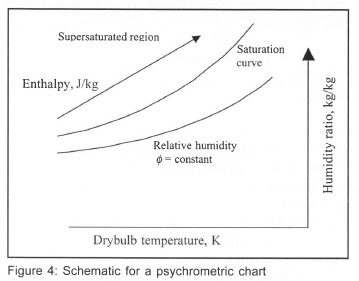
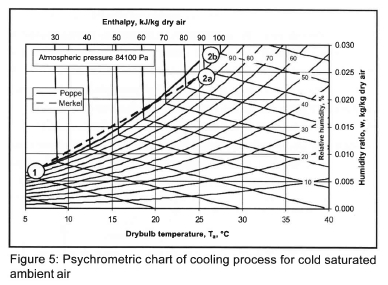
Psychrometric charts are generally not valid in the supersaturated region. Refer to Fig. 4 for a schematical layout of a psychrometric chart. It is possible to determine the enthalpy of the air in the supersaturated region. Figure 5 shows that the lines of constant enthalpy in the supersaturated region are very close to the vertical.
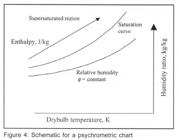
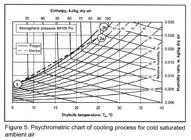
Figure 5 shows the typical heating path of the air in a cooling tower for cold and saturated inlet air on a psychrometric chart. Since the inlet air is already saturated with water vapor, indicated by point 1 in Fig. 5, it immediately becomes supersaturated, according to the Poppe method, as it enters the fill. As the air is heated and the humidity ratio increases, due to the latent heat transfer from the water, it follows the saturation curve very closely. This is because as the air is heated, it can contain more water vapor before it reaches the point of saturation. Point 2b in Fig. 5 shows the supersaturated state of the air at the outlet of the fill, according to the Poppe method. Point 2a in Fig. 5 shows the state of the outlet air, according to the Merkel method, that is saturated with water vapor. The air properties, according to the Merkel method, are only known at the inlet and outlet of the fill. It is not possible, according to the Merkel method, to determine the properties of the air as it passes through the fill. The path of the air according to the Merkel method is therefore given by a broken straight line. The outlet air temperatures according to the Merkel and Poppe methods are relatively close to each other in Fig. 5. The assumption of Merkel that the outlet air is saturated, regarding the calculation of the outlet air temperature, is therefore very good if the actual outlet air temperature is saturated or supersaturated.
The degree of supersaturation does not have a great influence on the relative difference between the outlet air temperatures predicted by the Merkel and Poppe methods. This is because the lines of constant air enthalpy, in the supersaturated region, are very close to vertical as can be seen in Fig. 5. It therefore does not matter how much water vapor and mist are present in the supersaturated air, for a specific air enthalpy, the air temperature will be approximately constant. The small difference in the air temperatures at point 2a and 2b in Fig. 5, for the Merkel and Poppe methods respectively, can be reduced by using the using Eq. (16) instead of Eq. (14) to determine the enthalpy of the outlet air.
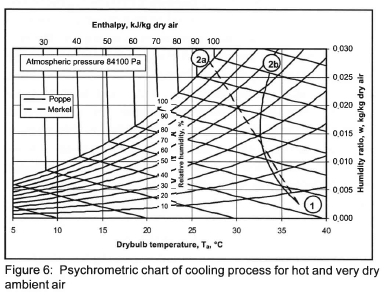
Figure 6 shows the heating path of the air in the cooling tower when the inlet air is hot and very dry. Point 1 in Fig. 6 shows the state of the inlet air on a psychrometric chart. Point 2a shows the saturated air according to the Merkel method while point 2b in Fig. 6 shows the state of the air at the outlet of the fill, according to the Poppe method.
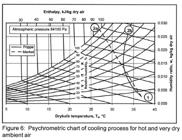
The outlet air temperatures, according to the Merkel and Poppe methods, are not as close in Fig. 6 as they were in Fig. 5. However, the outlet air temperatures, predicted by the Merkel and Poppe methods, lies approximately on the same constant enthalpy line in Fig. 6. In the unsaturated region, the lines of constant enthalpy are far form vertical and therefore the large discrepancy in the air temperatures. The assumption of Merkel that the outlet air is saturated with water vapor, is not as accurate if the outlet air, according to the Poppe method, is unsaturated as when it is supersaturated.
If the ambient air is cold (< 10 °C) the outlet air is generally supersaturated, even when the inlet air is very dry. This is because cold air can not absorb as much water vapor, before it reaches the point of saturation, as when it is hot. At higher ambient air temperatures the outlet air is generally also supersaturated when the humidity of the inlet air is relatively high. However, when the ambient air is relatively warm (> 17°C) and relatively dry, the outlet air will be unsaturated with water vapor. The assumption of Merkel that the outlet air is saturated is
therefore relatively inaccurate under these conditions.
It is interesting to note from Fig. 6 that the outlet air is colder than the inlet air, according to both the Merkel and Poppe methods. Two questions arise from this fact. The first question is if it is possible for both the water and air to be cooled, and the second is that how a potential for draft exists, in natural draft towers, if the air on the inside of the tower is colder than the air on the outside?
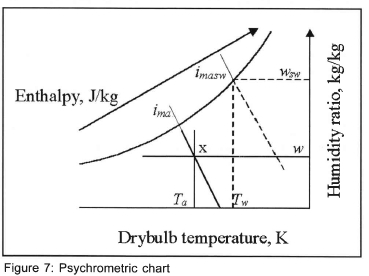
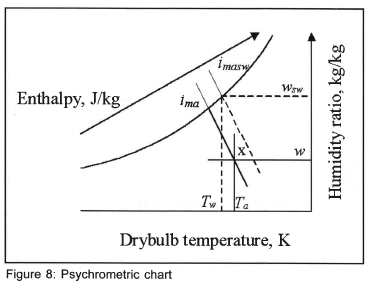
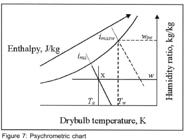
The enthalpy potential provides a qualitative indication of the direction of nett heat flow in the cooling tower fill. Air at condition χ (refer to Fig. 7 and Fig. 8) is in contact with water at temperature Tw. Figures 7 and 8 represent two different cases that can occur inside a cooling tower fill. Consider the case in Fig. 7 where wsw > w, thus, the latent heat transfer is from the water to the air and Tw > Ta, where the sensible heat transfer is from the water to the air. The total enthalpy transfer is from the water to the air since imasw > ima and since both the latent and sensible heat transfer are from the water to the air. The air is heated and the water is cooled.
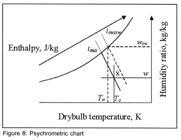
The fact that both the air and the water are cooled, can be described as follows: Consider the case in Fig. 8, where wsW>w, thus, the latent heat transfer is from the water to the air and Ta > Tw, where the sensible heat transfer is from the air to the water. The nett enthalpy transfer is from the water to the air since imasw > ima.
Notwithstanding the fact that the air outlet temperature is colder than the ambient temperature, there is still a draft through the tower. Draft through the natural draft tower is still possible, because the molar mass of vapor is less than that of air at the same temperature. Thus, a potential for draft still exists because the density of the air-vapor mixture inside the tower is less than that of the hotter less humid air on the outside of the tower.
If applied to mechanical draft towers, the Merkel method generally predicts water outlet temperatures that are essentially the same as those predicted by the Poppe method. For natural draft towers, however, the discrepancy between the Merkel and Poppe methods increases as the ambient air gets warmer and drier. This is because the air outlet temperature and tower draft are strongly coupled for natural draft towers, which is not the case for mechanical draft towers. Because of the higher outlet air temperatures and hence higher draft, according to the Poppe method, the heat transfer rates are higher than those predicted by the Merkel method for hot and dry conditions.
Conclusion
If only the cooling tower water outlet temperature is of importance to the designer, the less accurate Merkel method can be used, as the Merkel and Poppe methods predict practically identical water outlet temperatures for mechanical and natural draft towers if the methods are used consistently in the fill performance analysis and the subsequent cooling tower performance analysis.
No adjustments to the Merkel method, due to the assumption that the Lewis factor is equal to unity, is necessary to improve the accuracy of the Merkel method when compared to the more rigorous Poppe method. The heat rejected by the cooling tower and hence the air outlet temperature can usually be determined more accurately by the Merkel method when employing Eq. (16) where the approximated water loss due to evaporation is accounted for.
The Merkel method generally predicts heat rejection rates and air outlet temperatures very accurately when the actual outlet air is supersaturated with water vapor. However, when the ambient air is relatively hot and dry, the outlet air may be unsaturated and the air outlet temperatures predicted by the Merkel and Poppe methods may then differ significantly.
After the improvement to the Merkel method, and the determination of the conditions where the Merkel method is inaccurate, the Merkel method is still unable to predict the water evaporation rate accurately. The Poppe method is therefore the preferred method when the state of the outlet air has to be determined accurately, as for example in natural draft cooling towers when the ambient air is relatively hot and dry and in hybrid cooling towers.
Acknowledgement
The authors gratefully acknowledge Sasol Ltd for their financial support.
References
- 1. Merkel, F., "Verdunstungskühlung, " 1925, VDI-Zeitchrift, Vol. 70, pp. 123-128.
- 2. Osterle, F., 1991, "On the Analysis of Counter-Flow Cooling Towers, " International Journal of Heat and Mass Transfer, Vol. 34, No. 4/5, pp. 1313-1316.
- 3. Poppe, M. and Rögener, 1991, H., "Berechnung von Rückkühlwerken, " VDI-Wärmeatlas, pp. Mi 1-Mi 15.
- 4. Kloppers, J. C and Kröger, 2001, D. G., "A Critical Cooling Tower Performance Evaluation," 12th IAHR Symposium in Cooling Towers and Heat Exchangers, UTS, Sydney, Australia, pp. 108-115.
- 5. Kloppers, J.C. 2003, A Critical Evaluation and Refinement of the Performance Prediction of Wet-Cooling Towers, Ph.D. Thesis, University of Stellenbosch, South Africa.
- 6. Kröger, D.G., 2004, "Air-cooled Heat Exchangers and Cooling Towers ", Penwell Corp., Tulsa, Oklahoma.
- 7. Bosnjacovic, F., 1965, "Technische Thermodinamik, " Theodor Steinkopf, Dresden.
- 8. Bourillot, C, 1983b, "TEFERI, Numerical Model for Calculating the Performance of an Evaporative Cooling Tower, " EPR1Report CS-3212-SR, Electric Power Research Institute, Palo Alto.
- 9. Baard, T.W., 1998, "Performance Characteristics of Expanded Metal Cooling Tower Fill, " M.Eng Thesis, University of Stellenbosch, Stellenbosch, South Africa.
- 10. Grange, J.L., 1994, "Calculating the Evaporated Water Flow in a Wet Cooling Tower, " Paper presented at the 9th IAHR Cooling Tower and Spraying Pond Symposium, von Karman Institute, Brussels, Belgium.
- 11. Hässler, R., 1999, "Einfluss von Kondensation in der Grenzschicht auf die Wärme- und Stoff üb ertragung an einem Rieselfilm, "Fortschritt-Berichte VDI, Reihe 3, Nr. 615.