Certification of Unmanned Aerial Vehicles in South African Airspace
Abstract
Unmanned Aerial Vehicle technology is classified as being "disruptive", since it has the potential to radically change the utilization of airspace. Most unmanned vehicles are aimed at military applications, yet civilian applications of unmanned aerial vehicle technology could benefit South Africa considerably. This document highlights the benefits of this emerging technology; summarizes the documents published by international organizations and governments for creating standards and regulations; and also discusses philosophies, principles and international trends that have been observed. Specific applications in South African airspace are proposed viz. maritime patrol. Alternatives are proposed so that unmanned vehicles may operate within South African airspace while further research on operational procedures and standards can be conducted as part of regulation development.
Introduction
UAV History
U A Vs have been employed for a number of military applications since World War One, where they were mostly used for target practice1. The first widely used application of UAVs was by the USA during the war in Vietnam. Since then, UAVs have mostly been used for reconnaissance, forward air observation for artillery and as practice drones. More recently UAVs have carried out deep strike missions, where precision guided bombs and missiles are dropped deep inside hostile territory. As such, they were used effectively in Afghanistan and Iraq. It is foreseen that UAV technology will increasingly be used for tasks that are "dull, dirty and dangerous"2 (D3)5.
UAV Applications
Because UAVs can be configured for specific functions, they can be utilized for a number of additional missions. These include1:
□ Maritime Patrol/Boarder Patrol/Search and Rescue
□ Reconnaissance/Survey/Surveillance/Aerial Photography
□ Atmospheric/Environmental Research
□ Telecommunications
□ Agricultural Applications
□ Cargo Transport
Most of these applications have either not been exploited in the past, or have been fulfilled using other more expensive technology, eg, satellites.
At present, all the South African UAVs are operated by the military and government. These include:
□ Denel Aerospace Skua - high speed target drone UAV
□ Denel Aerospace Seeker - surveillance UAV
□ ATE Vulture - artillery forward air observation UAV
□ Denel Aerospace Bateleur (under development) - MALE UAV for surveillance
Many manned aircraft operators fear that UAVs will be replacing them. Although this is technically possible, it is neither desired nor economically feasible. Within the existing aerospace arrangements, there are a number of factors prohibiting the economically viable use of UAVs for many applications. There are however situations where the cost of human life far out-weighs the cost of the UAV and therefore UAVs become much more attractive. UAVs would also be preferred for operations that are dull, dirty and dangerous2. D3 refers to operations that will be too monotonous (dull) or require too long endurance for human occupants (eg, orbiting above a city for 24 hours while re-broadcasting radio information), hazardous (dirty) missions that could pose a health risk to a human crew (eg, monitoring nuclear radiation), and missions that would result in the loss of human life (dangerous) (eg, deep strike military missions where there is a high risk of hostile fire). The scope could be expanded to civilian operations such as long range maritime patrol missions where the possibility of crew rescue is almost impossible, eg, between South Africa and Antarctica during winter.
Cost Advantages of UAVs
The US DOD UAV Roadmap2 compares the costs of manned air vehicles with UAVs and states that acquisition costs are very similar. Although UAVs save developmental costs in human interface equipment (cockpit), they had extra procurement costs in the form of a ground station and a reliable/secure communications/data link. A significant advantage of UAVs includes the use of innovative technologies, and reduced operational and support costs. The Roadmap also states that at least 90% of operational costs of manned systems result from aircrew training, a component eliminated from UAV operations. UAVs require operators that may be trained on simulators, by using exactly the same equipment, but replacing the UAV with a simulated UAV, and/or using a limited amount of UAVs for training multiple operators. Actual UAVs, rather than simulators, would be used for training where UAVs interface with manned flight, eg, during formation flying or in-flight refuelling. Ground stations could also be standardized for most UAVs so that very little bridging training would be required between different types of vehicles. Using advanced "fly-by-wire" autopilots, different UAVs of the same category could be programmed to respond similarly.
UAV Certification
Current Status of UAV Certification
UAVs have been caught in a "chicken and egg" situation1,3 where the regulating authorities are waiting for evidence of equivalent safety from users before they create regulations. On the other hand, industry is waiting for UAV specifications and regulations before being able to sell certified UAV technology. Users are in turn waiting for certified UAV products before being able to operate them, thereby providing the required evidence of safety.
Present regulations for manned aircraft were derived historically, and were not based on a total system approach3. Partly for this reason, manned aircraft regulations are not always suitable for unmanned air vehicles. In order to gain access into airspace that is dominated by manned aircraft, UAVs will have to fit into the existing structure until such time as the manned airspace environment evolves1. In order to bring UAVs into the manned aircraft infrastructure, certain principles should be agreed upon before proceeding, so that UAVs may be integrated in a structured manner. The principles proposed by the UAV Task Force4 for creating of UAV regulations are, fairness, equivalence, responsibility and transparency, and could be used throughout the industry.
It has been stated that the countries that take the lead in UAV certification will become the leaders in UAV technology19,5. Although Europe, under the leadership of the JAA and EUROCONTROL, has been taking the lead4, no UAV specific regulations have yet been developed. Australia has created a set of UAV regulations5'6 which could be used in developing South African UAV regulations.
The end objective is the "file and fly" principle, which should require military and commercial UAVs to be type certified vehicles in accordance with the relevant regulations. Because South Africa is not currently a major role player in the aerospace manufacturing industry, it is unlikely that efforts in creating regulations for UAV operations will be adopted by Europe or the United States of America. A number of organizations have started the process of creating regulations that will enable the certification of UAVs.
Aircraft wishing to fly in controlled airspace must be airworthy and must also comply with design, safety, maintenance and operations regulations applicable to that country (eg, FAR7 in the USA). Provided that the conditions of ICAO are met8, countries recognize each others' regulations4 and for this reason there is usually much commonality in regulations. This enables aircraft, registered by foreign government organizations to operate in the airspace of another country. Although not mandatory, using internationally recognized standards and principles will therefore be advantageous1.
Many regulatory authorities are moving towards standards based regulations1. The benefit of using standards is that designers can use the standards as design guidelines. In addition, the standards can be updated without having to execute the long process of changing the regulations. It is partly this long process that presently makes the integration of UAVs into the national airspace so time consuming and problematic. The standards can then be developed by organizations consisting of specialists in the specific field of design, eg, the Radio Technical Commission for Aeronautics (RTC A) DO 178B18.
The American Society for Test and Materials9 was given the task to develop standards for UAVs by involving the relevant market place, manufacturers, users, regulators, trade associations, consultants and academics. The reason for the ASTM developing the standard is because of it's standing in the industry, as well as the hidden benefit of tax savings, as it is a non-governmental organization. A committee (F38) was formed to deal with UAVs, and is divided into three sub-committees viz. Airworthiness (F38.01), Flight Operations (F38.02) and Operator Qualifications (F38.03).
Work Done by International Governments, Organizations and Agencies
The FAA is the world's leading agency in aircraft and airspace regulations, and many nations base their regulations on the FARs. The FAA Flight Plan 2004-20087 states that one of its objectives is to develop policies, procedures and approval processes to enable operation of unmanned aerial vehicles. The FAA does however rely on the industry and UAV organizations such as NAS A/ERAST Alliance and Access 5 to provide it with the requirements for UAV regulations.
The NASA/ERAST Alliance Certification Project19 document is a concept document that proposes an overview of a particular class of UAV (High Altitude Long Endurance) in the US National Airspace (NAS) in 2002 and beyond. The organization includes the US government, industry and academics.
Access 5 is an initiative sponsored by NASA and the US industry with participation from the US DOD and FAA to introduce HALE UAVs into the US NAS. It proposes to develop standards, regulations and procedures, to demonstrate technology and implement infrastructure that would be necessary to make it possible to fly HALE UAVs in the US national airspace, routinely, safely and reliably by using a specified four step process.
The US Department of Defence, Office of the Secretary of Defence UAV Roadmap2 document aims to stimulate the planning process and to provide a forum for mutual discussion. The document states that it does not intend to seek concurrence with the services or impose any requirement for funding. It highlights the trends and future needs that will need to be in place if UAVs are intended to be used for future military applications. The document is described as being "descriptive" rather than "prescriptive" of what must be done in the future and highlights areas of research required in order to make UAVs feasible. It describes the concept of "the dull", "the dirty", and "the dangerous".
The JAA/EUROCONTROL Concept of European Regulations for Civil UAVs4 is a detailed document representing the final report of the UAV Task Force established to address a development of a concept for the regulation of civil unmanned aerial vehicles, with respect to safety, security, airworthiness, operational approval, maintenance and licensing. The document states that it does not address military UAV certification, but assumes that the military will benefit from the document. The final report also does not develop a concept for the air traffic management of civil UAVs. This document addresses the issues of fairness, equivalence, responsibility and accountability.
The Euro UVS Vision of the Future10 highlights the need for future application of civilian UAVs. The document addresses the requirement for the JAA/EUROCONTROL to be a multinational effort, to consist of all major stakeholders, to be a European initiative in which the FAA and US industry are participating and is a one year study to formulate the outline and guiding principles to further the establishment of UAV related airworthiness rules.
The UK CAA has published a document, CAP 72211, which provides a "signpost" for UAV operators. It does not replace existing regulations and only acts as guidance for UAV operators and manufacturers, who will be intending to operate and certify UAVs, and discusses existing regulations, procedures and addresses issues that will still need to be researched.
The French Flight Test Centre presented the framework of the USAR12 that uses a system safety assessment (SSA) to map the JAR/FAR directly with proposed UAV regulations.
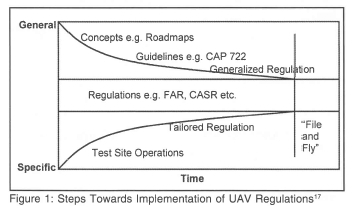
So far, Australia is the only country that has published a set of UAV regulations viz. Australian Civil Aviation Safety Regulation 1998 (CASR) Part 10113. These regulations are applicable to tethered balloons and kites, unmanned free balloons, UAVs, model aircraft, rockets and fireworks. These documents include advisory circulars14,15,16 detailing how compliance with the regulations must occur. Although these regulations are very comprehensive, they do not correspond directly with equivalent manned aircraft regulations. Figure 1 illustrates the role of the various documents in achieving the eventual aim of "file and fly".
UAV Regulation Principles
The first principle is fairness4. It would be unfair to allow UAVs not to have to comply with certain regulations that manned aircraft would have to comply with, and likewise, it would be unfair to create stringent regulations that are only applicable to UAVs and not to their manned counterparts purely because the technology exists to do so. Application of regulations to UAVs must be done fairly, with the acknowledgement of their unique differences. One issue that still needs to be debated is how strictly the regulations will be applied to UAVs, when even manned aircraft sometimes cannot comply with the existing regulations. For example, when certifying auto-pilot software, it is required to comply with very strict standards of (eg, DO178B18). The reality is that even a human crew can become incapacitated, as was the case in the Helios Airways Boeing 737, flight 522, which crashed with 121 people on board. It would be unfair to expect UAVs to have a perfect accident record, when manned aircraft also do not meet the same levels of safety.
The second principle is equivalence4. Regulations that apply to manned aircraft must be applied equally to UAVs. It must be remembered that the application and environment of UAVs will be different to manned aircraft, and the regulations would therefore be applied differently. A certain regulation could be applied to a manned aircraft for a specific mission and environment. The same regulation could also be applied to a UAV for a different mission and environment. The regulation must however be applied in a manner such that it is not applied more, or less strictly to a UAV than it would be to a manned aircraft. For this reason, an equivalent measure should be defined (eg, safety of people on the ground and/or in the air) so that the regulations can be applied effectively. These measures must include all relevant factors that make up the overall safety of the system, ie, UAVs have a less proven safety record, but will probably, for some time at least, not carry people on board.
The third principle is responsibility and accountability4. A method of approach must apply to UAVs which ensures that the responsibility and accountability of all aspects ie, design, manufacturing, maintenance and operations, is equivalent to that of a manned aircraft. For this reason, it is foreseeable, that a UAV system will always require a person accountable, eg, a mission commander or UAV pilot. Although fully autonomous missions are already possible, but because of this restriction, a responsible human will always have to be in the loop. Only once UAV technology with a human in the loop has been proven, will the effective technology be able to progress to human outside the loop1, or even full autonomy.
The fourth principle is transparency4. Airspace operations must appear to be exactly the same for all users of airspace. UAVs must therefore appear to other users of airspace in exactly the same manner as manned aircraft appear. ATC, for example, should be able to apply exactly the same rules to UAVs as they would to manned aircraft. This however does present a paradox since even though UAVs can appear to interact the same as manned aircraft, they will still physically look very different. Inconsistencies within manned aircraft operations1, such as radio blanking, radio un-serviceability, pilot non-cooperation or non-compliance makes air traffic management with existing regulations difficult, and it would therefore be unfair to expect UAVs to achieve a perfect record, when even manned platforms cannot achieve this.
UAV Categories
Because of the equivalence principle, and because many radio controlled aircraft are essentially UAVs, some authorities1,4,11,16 have decided to permit UAVs that are similar to radio controlled aircraft to continue to be operated as radio controlled aircraft, provided that they operate within existing arrangements of radio controlled aircraft. For example, they may not operate higher than 120m (400ft) AGL16. Most authorities base this classification on kinetic energy or mass.
UAVs lighter than 150kg are generally classified as light UAV systems4. These UAV systems do not qualify as model aircraft, but also do not necessarily have to comply with the same regulations as manned aircraft, but are still required to operate within certain restrictions, eg, daylight operations within visual range of the pilot in segregated airspace below 120m (400ft) AGL4. A measure of kinetic energy below 95 KJ has been proposed as a cut-off4.
UAVs heavier than 150kg or with a kinetic energy above 95 KJ that wish to operate in non-segregated airspace will most probably have to be classified according to existing manned aircraft regulations11. Owing to the principle of equivalence4, it therefore seems evident that UAVs will be expected to comply with the relevant regulation for the class of aircraft that it will be classified within (eg, helicopter, balloon etc.)4. Obviously, the regulations pertaining to human interfaces (eg, oxygen supply for aircrew), will not be relevant19. As aresult, manned aircraft regulations will need to be modified, where necessary, to include UAVs. Lastly, new regulations, specific to UAVs (eg, data link integrity), will need to be created, where manned aircraft regulations are completely unsuitable4. Eventually, a new set of regulations could evolve that refers to aerospace systems in general, and does not separate inhabited from uninhabited systems.
Topics Requiring Further Research
Collision/Conflict Avoidance
One of the major UAV concerns is detect and avoid. Presently, provision is made for the pilot in command of the aircraft to be responsible for "see and avoid". Without a pilot in the loop, this poses some problems to UAV operators, and airspace regulators.
This is however a dilemma, because manned aircraft depend on the integrity of the pilot to detect and avoid other aircraft. Much is left to the pilot's discretion, eg, the pilot must regularly report on his position, and keep a look out for other aircraft. The pilot's field of view is also limited by the size of the windscreen. When the requirements for UAVs are created, fairness and equivalence dictate that the limitations of manned aircraft should be considered.
Detect and avoid can be applied to UAVs as well as to manned aircraft in a number of different ways, each with their own advantages and disadvantages. Some detect and avoid technology is available for manned and unmanned aircraft, but work still needs to be done before they are proven, qualified and affordably available.
Accountability and Autonomy
A number of UAVs have proven that it is already possible for a UAV to complete a mission autonomously from start to shutdown with all the necessary information, such as navigation waypoints, downloaded prior to launch. Most UAVs will however require a human in the loop. The purpose of the human in the loop can range from controlling the aircraft remotely, to higher level functions such as mission planning, navigation or voice communications with ATC, or merely monitoring, pressing a termination button, and accepting responsibility for decisions taken.
Initially, because of the difficulty of integrating UAVs into existing airspace, it will be necessary to have a human in the loop. Since manned aircraft may be certified to fly with an autopilot, UAVs should be able to fly en-route using much the same autopilot regulations, provided that all other issues, including detect and avoid and control authority restrictions, are resolved. Takeoff and landings from busy airports will require more human interaction between ATC, other aircraft and the UAV pilot, and will therefore probably initially result in most UAV designs being remotely piloted. At short ranges, such as in the vicinity of an airfield, provided that the communications/data link is secure, this would enable UAVs and manned aircraft to share the same airspace in the short term. Such technology is presently available.
The long term goal would be to certify UAVs for autonomous takeoff through landing. At present, only a few UAVs have successfully demonstrated full autonomy. Full autonomous takeoff and landing will reduce risks associated with pilot induced loss of control and communications/data link loss etc. This will require a far greater degree of design integrity. The technology however is available, and it will be a matter of time before most UAVs will at least have the capability of autonomous takeoff and landing from/at controlled airfields. Certification and regulatory requirements would have to be in place in order for this to occur. Regulations are presently in place to allow civil passenger aircraft to takeoff and land in category 3 ILS7 conditions, which should also allow UAVs to land in the same airspace in similar conditions with equivalent (but not necessarily the same) onboard equipment.
Flight Termination and Contingencies
When manned aircraft experience a problem, it is sometimes required that the aircraft must divert to the closest airfield, announce the emergency, and execute an emergency landing. This procedure becomes more difficult, especially if the specific airfield is unknown to the pilot, or not programmed into the database. The interaction with VFR traffic in the local pattern must also be considered carefully. Possible alternatives include building special airfields specifically for UAV diversions, or, in the extreme, utilize flight termination.
A unique concept to UAVs is flight termination. This can be accomplished in a number of different ways, but always implies a near immediate end to the UAV flight. Flight termination can be achieved either by means of a ground command or by some autonomous means when a system test reveals a fatal, unrecoverable error. Depending on the kinetic energy of the UAV, an appropriate means can be provided to bring the UAV back to earth without loss or damage to humans.
Continued Airworthiness, Maintenance and System Monitoring
During manned aircraft missions, the pilot or flight engineer would usually monitor the systems, and take action in the event of a failure. Because the UAV operator resides on the ground, the system information either needs to be transmitted to the ground, or an on-board decision making process needs to be in place. Furthermore, because of the ability for UAVs to execute extended missions, longer than those of manned aircraft, continued airworthiness and maintenance of these systems would be different from aircraft operating for shorter periods of time. Developments in health monitoring systems will be required in order to monitor and rectify faults in on-board systems so as to prevent any failure that could result in the loss of the UAV during extended missions.
Air Traffic Management
At present, the airspace is dominated by manned aircraft, and is managed in most countries in accordance with FAR 917, or equivalent, requirements. The airspace has naturally evolved in a way that favours manned aircraft operations. When integrating UAVs into the national airspace system, it would be prudent to do so in a transparent way that would create the least disruption, and risk to human life. Research would be required in order to determine the feasibility of gradually increasing the frequency of UAV operations into the national air space, or to create separate UAV operating areas, and to gradually merge the two. It seems nevertheless obvious, that creating a completely new system in South Africa, with manned and unmanned aircraft operating together, from the beginning, is neither feasible nor recommended. Information first needs to be collected on operating procedures of UAVs in airspace using separate "pilot project airfields" and then to slowly integrate UAVs into the national airspace as the confidence in their operations builds. At the same time, the current air traffic management regulations and procedures will have to be reviewed in order to accommodate UAVs1,4.
Ground Station Design
Much attention is devoted to cockpit design and ergonomics in manned aircraft regulations7. In removing the human from the aircraft, some of these requirements will not be relevant to the air vehicle, but new requirements will need to be created in order to regulate the design of the ground station19,4. Many of the manned aircraft regulations were introduced to reduce workload of the pilot, so that the duties could be executed safely and effectively. These requirements remain the same for UAVs. The benefit of a ground station is that weight and size are no longer factors. This not only makes it easier to add safety features such as redundancy, it also allows additional safety features to be added that might not have been economical because of the size-weight-cost playoff in manned aircraft. Regulators must however guard against requiring additional equipment, which would not be regarded as equivalent, when compared to manned aircraft.
Data Link Integrity
The required level of data link integrity will in part be dependant on the level of autonomy. UAVs relying on a high level of ground based human control will require a secure and redundant data link in order to counter the threat of intentional and non-intentional attacks on system integrity. Countering intentional and non-intentional attacks must become part of the design and should include testing for EMC, EMI, HIRF and loss of signal control logic.
Fully autonomous UAVs will however require on-board fault diagnostics, proven contingency logic, and autonomous detect and avoid systems. As computer processors become faster and more powerful, many processing functions that presently require data links could be replaced by on-board processors20.
Operator Qualifications
Along with ground station design, the experience and qualifications of the operators must also be investigated1'4. Depending on the level of autonomy and automation, the workload and responsibility of the operator can vary greatly. The operator can take the form of a person who presses a launch button, to a pilot who actively flies the aircraft. All of these factors must be considered when deciding on the licensing requirements of the operators. Because space and weight are no longer factors, tasks that were usually required to be performed by one person can be split, and the licensing requirements will also have to accommodate this.
Security
Security of the ground station, as well as the command link to the UAV was raised as an issue in many UAV documents1'4. Because of the ability for the UAV (or any aircraft) to be used as a missile, control needs to be exercised over whom may have access to the control centre (cockpit). In an airliner, the passengers can be screened before the flight, and once airborne, there is little risk for anyone else climbing on board. The UAV ground control centre is vulnerable at all times, not only for direct attack, but also for jamming etc. These risks can be reduced using a greater degree of autonomy, as well as military signal technology that reduces the risk. However, a certain level of fairness and equivalence must be applied since it is possible at present to interfere with manned aircraft instruments in certain conditions, as well as well using false beacons and radio broadcasts to mislead aircraft during instrument flight conditions.
Application of UAV Technology in South Africa
Need for UAVs in South Africa
Because of the war on terrorism that was declared, the USA renewed efforts to encourage the use of lower cost technology for surveillance21,19. In addition to this, countries like South Africa are being expected to fulfil regional duties, by providing military support and humanitarian aid within Africa, and by providing maritime surveillance and search and rescue off the coast of Southern Africa, all the way to Antarctica. This has provided more reason to drive the requirement for UAV development in South Africa.
In addition, the South African Government has launched the Advanced Manufacturing Technology Strategy and the Aero-space Industry Strategic Initiative which partly aims to establish South Africa as a major player in the world aerospace industry.
We cannot therefore afford to lag behind in the key area of UAV technology.
Owing to the fact that South Africa has two major UAV manufacturers and potentially many smaller private UAV manufacturers, South African authorities must encourage the manufacturing and operation of UAVs. This will in turn create manufacturing jobs, and will create opportunities for UAV service providers for numerous tasks that cannot be accomplished at present with the current resources in South Africa. There is now a sense of urgency to integrate UAVs into South African civilian airspace, as well as to utilize UAVs for the numerous civilian and humanitarian applications.
South African Environment
Because of the lack of infrastructure in many African countries, as well as various hostile areas that need to be over flown, HALE/ MALE UAVs will be a major benefit because of their ability to stay airborne for long periods of time at high altitudes.
South Africa is ideally placed for UAV operations. To the south, there is a large ocean with minimal air traffic. As part of the extended economic zone (EEZ), South Africa is now required to defend the coastal waters from illegal fishing, protect its mineral rights and other legal responsibilities. As such, South Africa has been involved in operations as far as Antarctica and Australia.
The large uninhabited areas, as well as the few air corridors (in comparison to Europe), will make it more feasible to operate UAVs than in the USA or Europe. Because the airspace is well controlled and regulated, the infrastructure exists in which UAVs can be accommodated. Because of the large areas with no air traffic and few human inhabitants (i.e. the ocean to the south or the desert in the Northern Cape), together with the formalized aerospace structure, it should be possible to create areas where UAVs could operate between large cities such as Cape Town and Johannesburg, or Cape Town and Durban along the coast, as was done in Alaska22.
Future Requirements for Regular UAV Operations in South Africa
South Africa therefore has one of four options: Create its own regulations independently, wait for regulations to be created by the FAA or JAA, collaborate with the USA and Europe so as to speed up the creation of UAV regulations and adopt those regulations, or create an alternative plan for the operation of UAVs.
Creating indigenous regulations without a reference to draw from could be risky. The regulations might not be recognized, and in the interest of the aviation industry, would have to change to internationally accepted regulations. However, Australia has followed this route and is already, in a sense, leading the industry.
Waiting for regulations to be developed could take some time, and in the mean time, the South African UAV industry will loose its competitive edge to other countries who are closer to the FAA or JAA - depending on which regulation is adopted first as the industry standard (as the FAR has become for manned aircraft).
Taking part in the regulation development process is the method that has been adopted by most of the European and American industry. The reason for this is because they have no choice other than to collaborate with the hope that the joint effort will pool resources and add pressure to the regulating authorities. The disadvantage is that the large organizations have an inertia which slows down the process.
The last option is for South Africa to explore alternative methods of utilizing UAVs, while gaining sufficient experience in UAV operations, design and manufacture, before developing UAV regulations23.
UAV technology can typically be used for D3 tasks. With this concept, the nature of maritime patrol, with long endurance, over vast expanses of ocean, makes UAV technology ideally suited.
Since South Africa has to fulfil its duties for maritime surveillance, and search and rescue all the way to Antarctica, an opportunity exists to use UAVs. Because of the location of South Africa, with no controlled airspace to the south of the country, the question must be asked if it is necessary for aircraft, manned and unmanned (provided that no fare paying passengers are on board), to comply with the same regulations that are required over built up areas, and in controlled airspace.
This is an opportunity that few other countries can afford to take, purely because of their geographical location, and density of population. This could be the opportunity that South Africa needs in order to lead the world with UAV operations. This does not mean that UAVs should be permitted to fly over the sea in an un-regulated manner. Rather, a pragmatic approach should be taken to use the opportunity to prove the UAV technology where there is little or no risk, while providing useful insights into UAV operations in general, and obtaining data into UAV reliability etc.
In order to achieve this, an initial investment will be needed in the UAV industry. Since UAV products are already available, the investment can contribute to an existing need for maritime surveillance, with the objective of certification research taking place in the background.
Conclusions
The routine application of UAVs for many missions, military and civil, will become a reality around the world and in South Africa in the very near future.
UAV regulations must be developed in South Africa, in order to enable this technology locally, and to support the local UAV industry so that it will not be necessary to wait for and rely on imported technology.
Certain principles and standards that have been developed by other organizations could be used in the South African regulations so that they will be internationally recognized.
It will probably be necessary to comply with existing radio controlled aircraft, and manned aircraft regulations, and where these regulations cannot accommodate the differences between UAVs and their inhabited counterparts, new regulations will have to be created.
South Africa has a requirement for Maritime Surveillance that can be satisfied by UAV technology.
The situation of South Africa is ideally suited to allow UAV operations where there is almost no risk to humans.
If South Africa takes the opportunity to use UAV technology for maritime surveillance, there is a good possibility that the technology will reach the world market at a critical time when there is a demand for UAV technology, once other governments formalize their UAV certification requirements.
Because of the economical and leadership role that South Africa plays in S ADC, and the whole African continent, South Africa should at least become the true African Centre of Excellence in UAV Technology, strengthening its position internationally, further boosting the South African economy.
Recommendations
A process for creating South African UAV certification requirements must be initiated.
Existing principles and regulations should be used for the development of these requirements.
Widespread technologies need to be investigated for use on UAVs in South African airspace.
Research projects must be initiated and funded to research outstanding issues such as collision avoidance, data link integrity, continued airworthiness, ground station design/operation and operator qualifications, ground and flight testing criteria, etc.
Regulations must be developed in parallel with the development of technology in order to eventually certify UAVs in un-segregated airspace.
A special operating area should be created where UAVs can be utilized, without interference to or from other aircraft so that the necessary research can be executed.
An operational and maintenance concept for UAV utilization within South Africa must be developed.
References
1.De Gormo, M. T., Issues Concerning Integration of Unmanned Aerial Vehicles in Civil Airspace, MITRE, 2004.
2. Office of the Secretary of Defense, UAV Roadmap, 2001.
3.Küke, R., Unmanned Aerial Vehicle Safety Issues for Civil Operations, Inaugural Meeting UAVNET, 2004.
4.UAV Task Force Final Report, A Concept for European Regulations for Civil Unmanned Aerial Vehicles, 2004.
5. European Civil Unmanned Air Vehicle Roadmap, Volume 1, 2005.
6. Civil Aviation Safety Regulations (Australia), Part 101, 1st edition, 2003.
7. Federal Aviation Regulations, Title 14 - Aeronautics and Space, U.S. Government Printing Office, Washington.
8. Convention on International Civil Aviation, Chicago, 1944.
9. ASTM International Support to the U.S. Unmanned Air Vehicle Systems Industry: Position Statement
10. UAVs-A Vision of the Future: EURO UVS, 2003.
11. CAP 722, Unmanned Aerial Vehicle Operations in the UK Airspace - Guidance, 2004.
12. French Ministry of Defense Work and Efforts to Enable the Integration of UAVs into the Airspace, 2004.
13. Civil Aviation Safety Regulations 1998, Part 101, 1st edition, 2003.
14. AC 101-1(0) Unmanned Aircraft and Rockets - UAVs, Civil Aviation Safety Authority Australia, 2002.
15. AC 101-2(0) Unmanned Aircraft and Rockets - Rockets, Civil Aviation Safety Authority Australia, 2002.
16. AC 101-3(0) Unmanned Aircraft and Rockets - Model Aircraft, Civil Aviation Safety Authority Australia, 2002.
17.Beemster, T., Safe Operations - Overview of Results, USICO, 11th UAVNet Meeting, Budapest, 2004.
18. RTCA DO-178B, Software Considerations in Airborne Systems and Equipment Certification, 1992.
19. NASA EARST Alliance Certification Project, HALE Certification and Regulatory Road Map UAVs, version 1.3. 20 Unmanned Aircraft Systems Roadmap 2005-2030, United States Office of the Secretary of Defense, 2005.
21. White Paper, Vanguard Alliance, National Next Generation Aircraft Technology Program Introducing Remotely Operated Aircraft into the National Airspace System, 2001.
22. Federal Aviation Administration, Alaska.
23. USICO Work Package "Airworthiness Highlights and Results, UAVNET Workshop, Budapest, 2004.