The Influence of Some Secondary Effects on Solar Chimney Power Plant Performance
Abstract
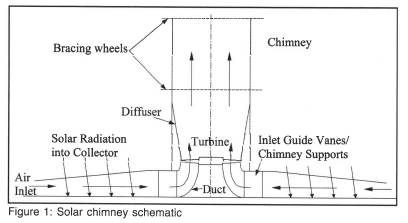
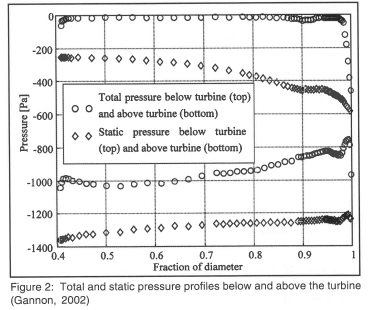
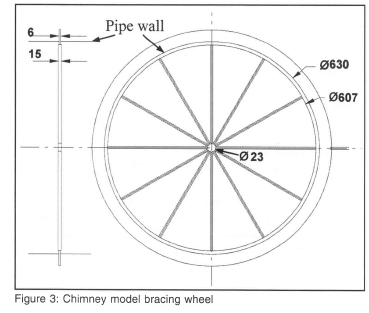
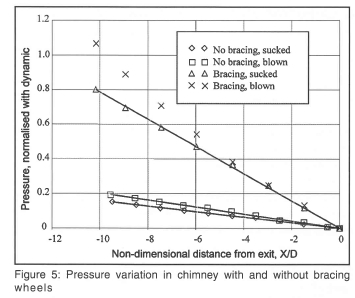
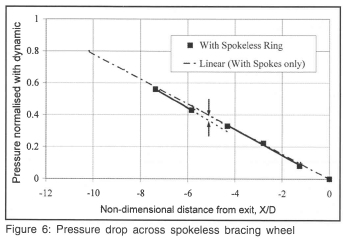
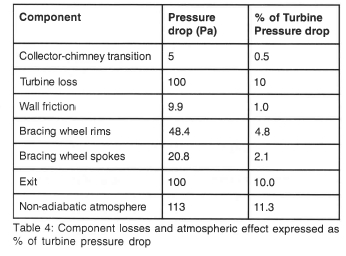
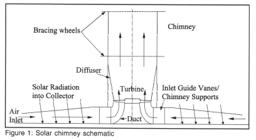
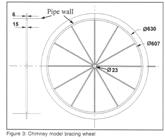
A solar chimney power plant consists of a large greenhouse type collector surrounding a tall chimney. Hot air escaping through the chimney first passes through a turbine that powers a generator. The paper compares the effects of collector-to-chimney-transition loss, turbine efficiency, skin friction loss, chimney internal bracing wheel loss and non-adiabatic atmospheric conditions on the performance of solar chimney power plants. New findings were that the chimney bracing wheel rims protruding into the chimney could account for as much as 70 % of the bracing wheel drag, or about 5 % of the turbine pressure drop. Of the effects investigated, the bracing wheel rim drag had the largest effect on pressure drop through the system. With the removal of the bracing wheel rims, as recommended, the only remaining effect larger than 1% of the turbine pressure drop is the drag of the bracing wheel spokes, and the exit dynamic pressure. When compared to an adiabatic atmospheric model, a standard type atmosphere with a lapse rate of 6.5 K per 1000 m reduces the pressure difference across the turbine by about 11% for the standard 1500 m tall chimney. This shows that there remains very limited scope for improving the performance of solar chimney power plants by reducing secondary losses in the system. The ultimate lower limit of the system pressure drop is about 1.5 times the chimney exit dynamic pressure. These findings are useful in optimisation studies of solar chimney power plants.
 Thumbnail
 Thumbnail
 Thumbnail
 Thumbnail
 Thumbnail
 Thumbnail
 Thumbnail
 Thumbnail
 Thumbnail