Characterising Silicone Rubber: Indentation and Dynamic Modelling
Abstract
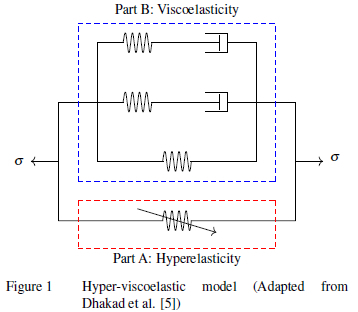
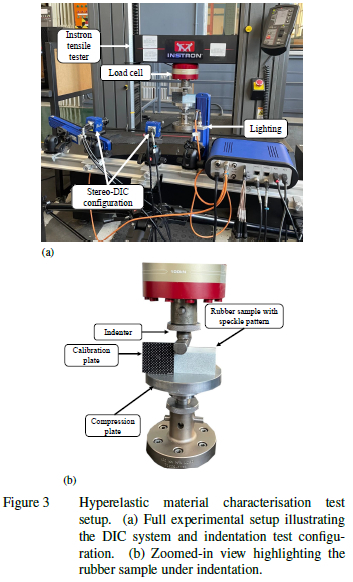
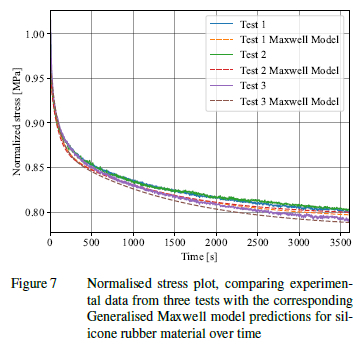
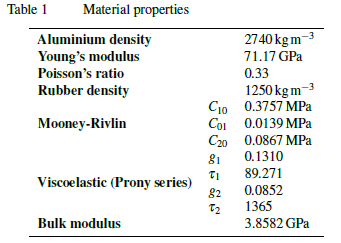
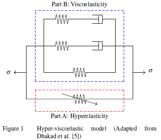
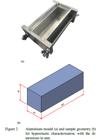
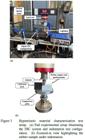
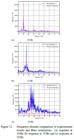
Rubber's unique elastic and viscous properties make it essential in engineering applications, particularly in industries such as automotive, construction, and mining. For example, in mining, vibrating screens often experience excessive vibrations during start-up and shutdown, potentially damaging machinery and reducing lifespan. Effective vibration isolators are crucial to mitigate this risk. This study presents a hyper-viscoelastic model for silicone rubber, combining the Mooney-Rivlin model for hyperelas-tic behaviour and the Generalised Maxwell model for time-dependent viscoelastic properties. Hyperelastic parameters were derived through inverse Finite Element (FE) modelling using indentation experiments with Digital Image Correlation (DIC) data. In contrast, viscoelastic parameters were obtained from stress relaxation tests via least-squares fitting. Validation through physical testing and FE simulations demonstrated the validity of the obtained material model and the significant influence of the viscoelastic effects on the dynamic behaviour. The validation data also show a loss in accuracy from the material model at high frequencies, as one would expect from a quasi-static relaxation test.
Hyper-viscoelastic; Indentation test; Relaxation test
 Thumbnail
 Thumbnail
 Thumbnail
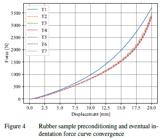 Thumbnail
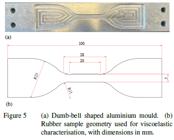 Thumbnail
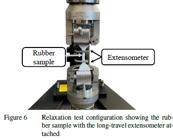 Thumbnail
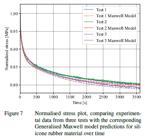 Thumbnail
 Thumbnail
 Thumbnail
 Thumbnail
 Thumbnail
 Thumbnail