Multi-Sensor Fusion Model for On-line Surface Roughness Prediction
Introduction
The on-line measurement of surface roughness in machine turning implies assessing the conditions of a work piece just behind the cutting edge of the tool. A stylus can be used, but it often results in destruction of the sensor head due to high surface speeds of the work piece. Optical reflection methods have been restricted to measurement of relatively smooth surfaces, but due to this limitations are not applicable for use on production floors.
A laser measuring system, which employs a linear charge-coupled device sensor and a neural network to process captured light patterns scattered from the work piece surface, was developed to predict the maximum peak to-valley roughness1. However, rather than using direct measurement, several researchers have derived surface roughness indirectly using vibration signals between tool and work piece generated during the turning process2. It is clear from recent literature that superior performance through neural networks (NN) may be achieved if information from multiple sensors is fused3. An individual sensor only senses partially as it contributes to the measurement of surface roughness. However, a combination of sensors or sensor fusion data may classify it with greater accuracy. Research in sensor fusion has a relatively short history in machining. However, recently more attention has been directed at using and improving sensor fusion techniques4. Two major difficulties are encountered when applying the fusion of sensors. These are the adequate selection of input sensors and the establishment of effective fusion modeling. This paper describes a statistical method to identify relevant sensors and the neuro-fuzzy (NF) modeling technique to predict surface roughness on-line for a machining process.
Neuro-Fuzzy
In most sensor fusion applications classification criteria are often expressed using sample data. Although NN has exciting possibilities, it does not use structured knowledge with symbols as used by humans to express reasoning processes5. NF technology allows for the automated generation of fuzzy logic (FL) systems based on neural network trained data. NF combines the advantages of fuzzy systems, the transparent representation of knowledge and the ability to cope with uncertainties, with the advantages of neural nets and its ability to learn. Figure 1 shows a general 5 - layer structure of a NF model, as well as an indication of how to map a NN to a FL system6.
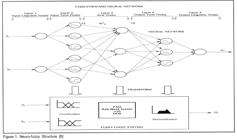
The linguistic nodes in layers one and five represent the input (SrSn) and output (OrOm) linguistic variables respectively. Nodes in layers two and four are term nodes acting as membership functions (MBFs) to represent the terms of the given linguistic variable. Each neuron of the third layer represents one fuzzy rule (rule nodes). Layer three links define the precondition of the rule and lay er-four links incorporate the rule consequences. Initially these layers are fully connected representing all possible rules. A fuzzy system uses different units of computation for the input, hidden and output layers. Rules may be represented by Fuzzy-Associative Maps (FAM), which is a fuzzy logic rule with an associated weight, known as the rule firing strength (or degree of support) for supervised learning.
The NF training employed combines error back propagation with the idea of competitive learning. After a system output is computed by forward propagation, an error is identified by comparing the system output with the sample data7. The error is then used to determine the fuzzy rules most suited for influencing system behavior. Using the selected rule, the plausibility of the fuzzy rule is modified before subsequent data sets are processed.
Experimental Setup
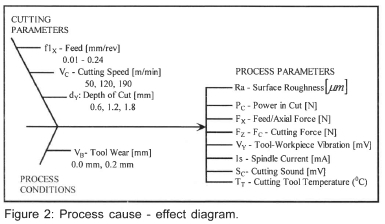
Numerous factors influence surface finish during turning operations. Accordingly, as shown by the cause-effect diagram in Figure 2, this study will be restricted to cutting parameters, namely: Feed, speed, depth of cut and a tool wear process condition.
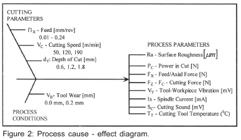
The effect of cutting parameters and tool wear on machining process parameters measured online include: Force in the direction of the feed (Fx), force in the direction of cut (Fz), tool-work piece vibration (Vy), cutting sound (Sc), spindle current (Is), cutting tool temperature (Tt) and power in the cut (Pc), which is calculated from Fz and Vc.
Statistical Data Analysis
The Spearman's rank correlation module of Statistica V6.0 was used to find the measure of association between surface finish and the machining cutting and process parameters derived from the experimental data. Statistical hypotheses testing used to indicate if there exists a relationship. The hypothesis for the Spearman's Rank test is:
Ho:RRa.Sensor_data= 0, indicates that the correlation equals zero and
HA- RRa-sensor_data ≠ 0 indicates the alternate hypothesis.
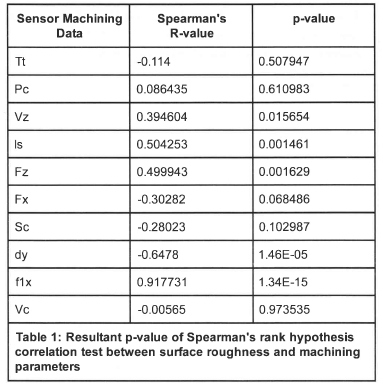
The p-value, shown in Table 1, indicates the truth of the null hypothesis. Therefore a p-value of less than 0.05 indicates a correlation between surfacE roughness and the machining parameter, i.e. alternative hypothesis. It shows that Ra is correlated with Vz (0.3946), Is (0.5043), Fz (0.4999), dy (-0.6478) and strongly correlates to flx (0.91770). The parameters are used as sensor inputs to an FL based model to predict surface roughness.
Multi-Sensor Fusion Modeling
FuzzyTech NF module8 was used to generate the FL model for surface roughness measurement. The surface roughness obtained experimentally with the predicted values determined using the FL model was compared with the theoretical model given as9:
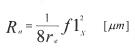
The comparative results indicate that the FL model represented an average error of at least three times lower than the theoretical model. In both cases the error increased as the feed increased. The FL model was able to measure Ra with an accuracy of 86.44%.
References
- 1. Yan D., Cheng M., Popplewell N, Balakrishnan S., 1995, Application of neural networks for surface roughness measurement in finish turning, International Journal of Production Research, Vol 83, No. 12, pp.3425-3438.
- 2. Jang D. Y, Choi Y, Kim H, Hsiao A., 1996, Study of the Correlation between Surface Roughness and Cutting Vibrations to Develop an On-Line Roughness Measuring Technique in Hard Turning, International Journal of Machine Tools Manufacturing, Vol. 36, No. 4, pp. 453-464, Elsevier Science Ltd, Great Britain.
- 3. Dimla D. E., Lister P. M., Lighton N. J., 1997, Neural Network Solutions to the Tool Condition Monitoring Problem in Metal Cutting, Int. J. Mach. Tools Manufacture, Vol. 37, No. 9, pp. 1219-1241.
- 4. Azouzi R., Guillot M., 1997, On-Line Prediction of Surface Finish and Dimensional Deviation in Turning using Neural Network Based Sensor Fusion, Vol. 37, No. 9, pp.1201-1217.
- 5. Medsker L. R., 1994, Hybrid Neural Network and Expert Systems, Kluwer Academic Publishers, London.
- 6. Monostori L., Egresits C, 1997, On Hybrid Learning and its Application in Intelligent Manufacturing, Computers in Industry, Vol. 33, pp. 111-117, Elsevier Science.