Over-attemperation and Short-term Overheating in Pendant-type Superheaters
Abstract
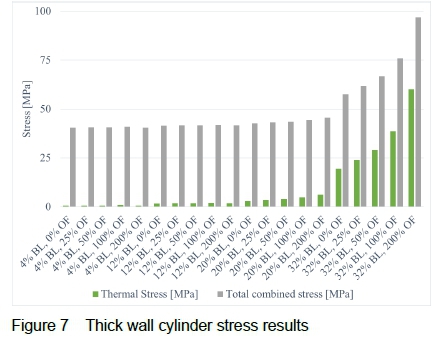
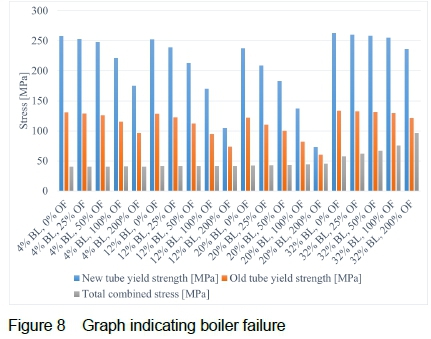
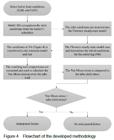
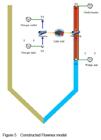
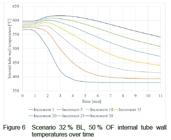
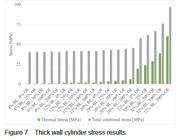
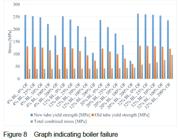
A water-wedge is often suspected to be the root cause for short-term overheating in fossil-fuelled boiler superheaters. However, it can be argued that evaporation of the water-wedge would cool the tube sufficiently and prevent overheating. This study aims to determine if the thermo-physical conditions occurring at low loads support this claim by studying the transient behaviour of a representative superheater segment under postulated conditions. A flow model was constructed to facilitate direct comparison with a boiler pendant superheater of a full-scale fossil-fuelled power plant. Several scenarios of water-wedges sustained by attemperation spraywater were simulated at low load operating conditions. The temperature evolution of the tube wall was tracked and, together with calculated equivalent stresses including thermal stress, was compared to the yield strength of the material. The results show that the stresses exerted over the tube wall and throughout the tube length are not sufficient to overcome the yield strength of the tube material, even for an aged tube under severe process conditions of boiler overfiring. Evaporation of the water-wedge provides sufficient cooling to the superheater tube to prevent failure. It was concluded that water-wedging alone is unlikely to be the root cause of short-term overheating at low boiler loads.
Short-term overheating; water-wedge; boiler superheater tube; attemperation; thermal stress; evaporation
 Thumbnail
 Thumbnail
 Thumbnail
 Thumbnail
 Thumbnail
 Thumbnail
 Thumbnail
 Thumbnail
 Thumbnail
 Thumbnail