Heat transfer between a horizontal flat surface and the natural environment
Abstract
The objective of this study was to obtain a correlation for the effective convective heat transfer between a horizontal 1 m × 1 m surface and the environment. Tests were conducted on a suitable surface at a particular location exposed to different solar radiation intensities, ambient temperatures and wind velocities. Based on the experimental data, a correlation for the effective heat transfer coefficient, that takes into consideration natural convection, forced convection (wind) and solar radiation (clear sky), is presented. This coefficient can be employed to predict the heat transfer on the surface of solar collectors having geometries similar to the present test set-up and operating under similar environmental conditions.
Introduction
In the evaluation of the performance of solar collectors, suitable equations are required to quantify the heat transfer between the collector cover and the environment. Although extensive research and development have been done to date, uncertainty still exists concerning reliable equations to predict these transfer rates.
Duffie,1 referring to convective heat transfer due to wind over the surface of a solar collector, stated that "from the preceding discussion it is apparent that the calculation of wind induced heat transfer coefficients is not well established". More recently Sharpies and Charlesworth5 came to the conclusion that "... as experiments come closer to resembling 'real' collector situations so more discrepancies and inconsistencies are found both between measured results from different experiments and with standard flat-plate forced convection relationships for hw".
Discrepancies are due to various reasons, including the fact that the definition of the convective heat transfer coefficient is not always consistent. Often the geometry of the apparatus and its environment is not adequately described. Unless wind tunnel tests for evaluating the convective heat transfer coefficient are conducted under conditions of turbulence levels, similar to those found under windy ambient conditions, resultant heat transfer correlations cannot be expected to be in agreement.
In general, the convective heat transfer coefficient due to wind on the surface of a collector cover is expressed by a relation of the form

where a, b and c are constants.
It is obvious from the many studies that have been reported to date, that this very simple equation cannot be expected to model what is really a very complex heat transfer process.
According to eqn. (1), hw = a when vw = 0. Values of 'a' quoted in the literature vary from 2.8 according to Watmuff et al.7 to 10.03 according to Kumar et al.2 The fact that hw has a finite value in the absence of wind, can only mean that under these conditions heat transfer occurs due to natural convection, and hw is unlikely to have a constant value.
As eqn. (1) is not written in dimensionless form, it does not make provision for changes in the thermophysical properties of the air when operating under different ambient conditions.
In the following analysis and experiment the above concerns are addressed in more detail. An effective heat transfer coefficient for a specific plate geometry operating in a particular environment is clearly defined and quantified by means of a correlation based on measured data.
Analysis
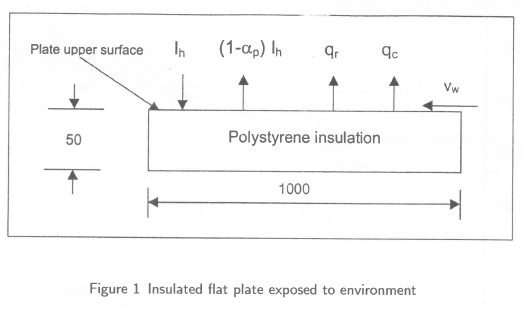
Consider the upper surface of a polystyrene horizontal flat plate that is exposed to the environment as shown in Figure 1. By applying an energy balance to a unit area of the upward facing surface find

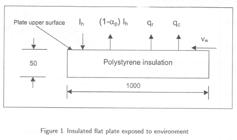
where Ih is the solar radiation (clear sky in present investigation) on a unit horizontal surface area, αp is the plate absorption coefficient, while qr and qc are the long-wave radiation and convection heat transfer rates in W/m2. Conduction losses through the polystyrene plate are assumed to be negligible.
The heat flux due to radiation from the upper surface of the plate to the sky can be expressed as

where εp is the emissivity of the plate, Tp is the mean plate surface temperature, and according to Swinbank6 the sky temperature in Kelvin is

where Ta is the ambient air Kelvin temperature.
Although other expressions for sky temperature are available, this particular expression is chosen in order to define a corresponding convective heat transfer coefficient.
The convective heat flux can be expressed as

with h defining the effective convective heat transfer coefficient which will be determined experimentally in this study.
Thus from eqn. (2), together with eqn. (3) and eqn. (4), it follows that

This relation defines the convective heat transfer coefficient. The latter can be determined experimentally if Ih, αp, εp, Tp and Ta are measured.
Experiment
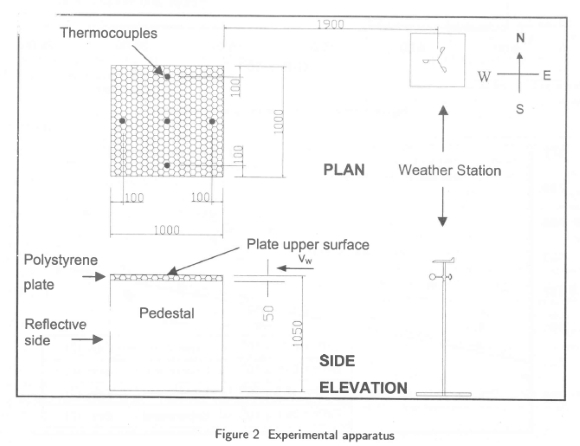
Experiments were conducted in order to determine the convective heat transfer coefficient between a 1 m × 1 m horizontal polystyrene plate (50-mm polystyrene) on a solid 1 m × 1 m square pedestal having a height of 1.05 m and highly reflective sides. Five fine type T thermo-couples, having short response times, were located on the upper surface in positions as shown in Figure 2.
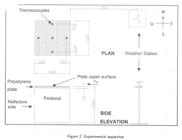
The test facility was located 100 m above sea level at 33.98°S latitude and 18.85°E longitude. During the tests solar radiation Ih (on a horizontal surface) ranged between 250 and 1030 W/m2, while wind velocities vw (speed and direction) measured at the elevation of the plate (1.05 m above ground level) with the aid of a cup anemometer ranged from 0 m/s to 3.6 m/s. Only data obtained during fairly steady winds in a particular direction perpendicular to one edge of the test plate were retained for evaluation purposes. The ambient air temperature was measured at the anemometer. Only test data obtained during clear sky conditions were used in the evaluation of h.
Two sets of experiments were conducted. In one case the upper surface of the plate was painted with a matt black paint having an absorption coefficient of αp = 0.9 and an emissivity of εp = 0.9. A second set of tests was conducted with the plate covered by an aluminium foil with αp =0.1 and εp = 0.03.
The αp and εp for both the aluminium surface and the black surface were determined experimentally and are in good agreement with values quoted in available literature.
Results
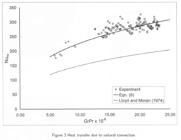
At wind speeds of vw = 0, heat transfer from the plate to the ambient air is due to natural convection.
The heat transfer coefficient determined according to eqn. (5) for the measured data sets can be correlated by the following dimensionless equation
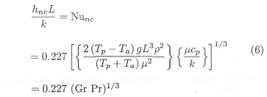
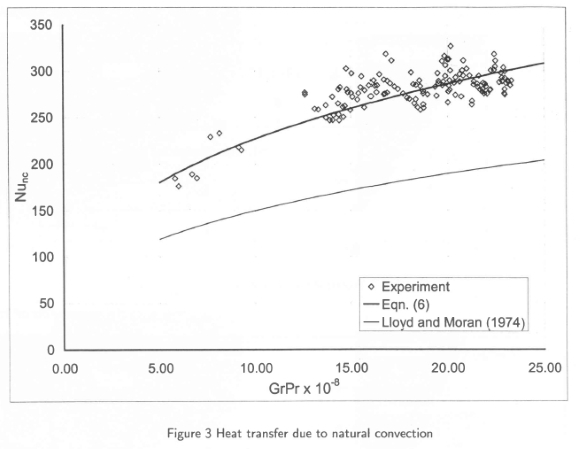
Measured experimental data were compared to eqn. (6) and to a correlation proposed by Lloyd and Moran3 for a heated horizontal surface facing upwards as shown in Figure 3. Note that the effective length dimension for both correlations in Figure 3 is the plate side length L.
According to Rohsenow et al.,4 natural convection will usually dominate when Gr >1100 Re3/2 while forced convection (windy conditions) will be the primary mechanism when Gr <11 Re3/2.
During windy conditions the airflow pattern across the test surface becomes very complex and the heat transfer coefficient becomes a function of both the Grashof (Gr) and Reynolds (Re) numbers.
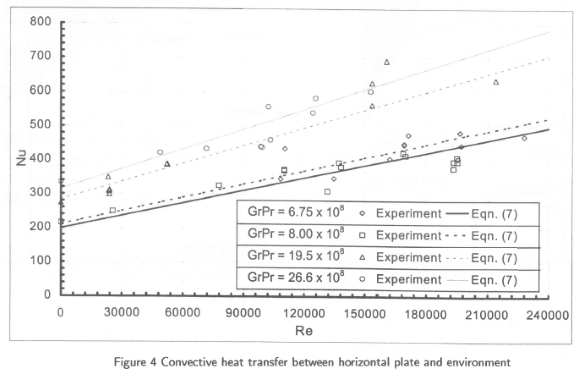
As shown in Figure 4, the present data are well correlated by the following equation:

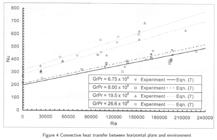
This equation is valid in the range 6.75 × 10⁸ < (Gr Pr) < 26.6 × 10⁸ and for 0 < Re < 2.5 x 10⁵.
Eqn. (7) correlates the data with a root-mean-square (RMS) value of 16.2 %. The RMS is defined as follows

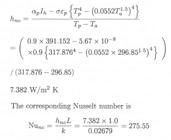
Numerical examples for evaluation of the Nusselt numbers are presented in Appendices A and B.
Conclusion
An equation that predicts the effective convective heat transfer on a horizontal heated plate exposed to the environment is presented. It should be noted that eqn. (7) is only applicable to a particular geometry. The range of operating conditions is clearly specified.
The fact that the present correlation (eqn. (6)) for heat transfer due to natural convection is higher than the prediction according to Lloyd and Moran3 may in part be due to the nature of the turbulence in the unstable ambient air and the geometry of the particular apparatus.
During windy conditions the nature of the flow of the air across the test surface will determine the heat transfer coefficient. For laminar flow over a surface Nul ⧜ Re0.8 Re05 while for turbulent flow Nut ⧜ Re0.8. In the present investigation eqn. (7) shows Nu oc Re. Due to relatively high free stream turbulence a Reynolds number exponent of 0.8 is not unrealistic since it is likely that turbulent flow will predominate although the test surface is not very long in the flow direction. Further flow distortions due to separation along the edge of the test surface and due to natural convection can be the reason for the Reynolds number exponent of unity over the range tested.
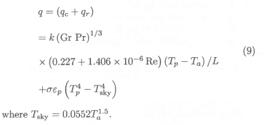
Although it may be argued that the sky temperature according to Swinbank6 is not the most accurate of equations, this would imply that the effective convective heat transfer coefficient, as defined by eqn. (5), is similarly not very accurate. In the evaluation of the heat transfer rate from the plate to the natural environment this possible inaccuracy will be of little significance if the convection and radiation effects are used in combination, i.e.
1. Duffie JA & Beckman WA 1991. Solar Engineering of Thermal Processes, 2nd edn, pp. 174-176. Wiley Interscience, New York.
References
- 2. Kumar Subodh, Sharma VB, Kandpal TC & Mullick SC 1997. Wind induced heat losses from outer cover of solar collectors. Renewable Energy, 10, pp.613-616.
- 3. Lloyd JR & Moran WP 1974. Natural convection adjacent to horizontal surface of various platforms. Trans. ASME J. of Heat Transfer, 96, p.417.
- 4. Rohsenow Warren M, Hartnett James P & Cho Young I 1998. Handbook of Heat Transfer, 3rd edn, pp.4.8-4.17. McGraw-Hill, New York.
- 5. Sharpies S & Charlesworth PS 1998. Full-scale measurements of wind-induced convective heat transfer from a roof-mounted flat-plate solar collector. Solar Energy, 62, pp.69-77.
- 6. Swinbank WC 1963. Long-wave radiation from clear skies. Quart. J. Royal Meteorology Soc., 89, pp.339-348.
Final version April 2001
Appendix A: Numerical example
Natural Convection
On 13 May 2000, at 10:00, the following temperatures, pressure and incident solar radiation were measured:
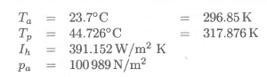
The thermophysical properties of the air as well as the Prandtl and Grashof numbers are evaluated at a mean air-plate temperature.
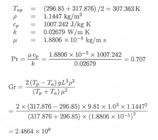
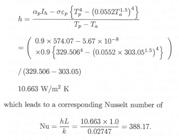
According to eqn. (5), the experimental heat transfer coefficient is
Appendix B: Numerical example
Forced convection
At 13:40 on 13 May 2000 the following pressure, temperatures, wind speed, and incident solar radiation were measured:
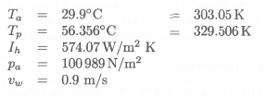
Making use of these experimental values, the thermo-physical properties and the Prandtl, Grashof and Reynolds numbers of the air are evaluated at a mean air-plate temperature.
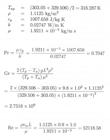
According to eqn. (5) the heat transfer coefficient is equal to