Orthotropic failure criterion for timber
Abstract
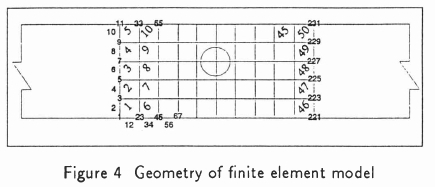
Timber is an organic, orthotropic material of which the strength is currently not fully utilised in structural designs. Most design codes treat timber as an isotropic material with special clauses to compensate for the weaker strength across the grain. Several safety factors are used to accommodate the large variations in the strength of timber. In the orthotropic approach presented here, the unidirectional properties of timber are assumed as constant. It is also assumed that the large strength variation which is observed between samples of the same group can mostly be attributed to the grain slope variation in a sample. The finite element method is employed to model grain slopes around a predetermined defect in a sample. The sample is then forced to fail at this defect, and the finite element model is then analysed at the failure load to determine which stress combination led to the failure. The results indicate that the strength of a timber section can be predicted on the basis of the observed grain directions if the unidirectional material strengths are known.
 Thumbnail
 Thumbnail
 Thumbnail
 Thumbnail