A Decision-making Model for Managing Project Risks on a Nuclear Fuel Project
Abstract
Project risk management is of key importance in supporting shareholders in managing their investment position and risk exposure. The close relationship between project risk management and decision analysis enables the latter discipline to improve the value of the risk-management process by providing a kit of tools that decision makers could use. The use of these tools improves the decisions made and ensures that these decisions are according to the strategic direction set by the stakeholders. The tools assist decision-making where strategy and risk exposure are being managed together. This paper reviews decision-making tools and develops a toolkit and selection model that could be used by decision makers on the pebble bed nuclear fuel project to improve the quality of decisions. The model ensures that decisions are aligned with overall strategic objectives and it provides guidelines for the use of specific decision-making tools. The model further integrates the risk-management process with decision analysis.
Introduction
1.1 Background to Pebble Bed Modular Reactor (PBMR) technology
Electrical utilities worldwide have been challenged to find sustainable, basic sources of energy for electrical power generation that would be economic, environmentally friendly and inherently safe.
Most of the world power demand is supplied by thermal power stations fuelled with coal, oil or natural gas. This is because "clean" and renewable energy sources have only limited application, due to natural conditions and economic considerations. Only a few countries have water resources suitable to ensure a feasible hydropower base load. Wind and solar heat applications are confined to regional and local applications only.
The associated release of hydro-carbons from fossil fuel power stations into the earth's atmosphere and the real danger of global warming have now become an issue that can no longer be evaded by governments and utilities. Enforced measures to clean up and limit noxious emissions from fossil fuel power plants have become so extensive and expensive that the economic viability of this type of power generation is now questionable in many industrialised countries.
Most major electricity utilities today view nuclear energy as an essential part of the future mix for electricity generation to solve the problem ofnoxious emissions. Utilities, like the South African utility Eskom, have made significant investments in R & D programmes to develop improved options for nuclear power generation.
The development of High-Temperature Gas Cooled Reactor (HTGR) technology and its derivative, the Pebble Bed Modular Reactor (PBMR), has created a new window of opportunity for electrical power generation based on nuclear energy. PBMR technology, unlike traditional nuclear technology, could be used to generate electrical power and achieve the required level of safety without the need for extensive auxiliary plant systems.
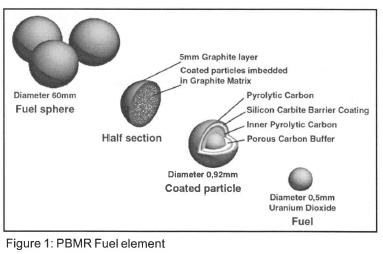
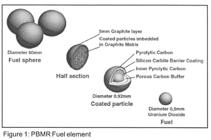
The PBMR fuel is the key to the safety of the reactor. The fuel is able to withstand very high temperatures without breaking down, thus releasing radioactive nuclides. Together with reliance on passive (not machine-activated) systems to remove heat build-up from the reactor core in the event of an accident, the fuel pebbles (see Figure 1) provide a guarantee against meltdown. Even in one of the worst-case scenarios - a complete loss of the helium coolant - the residual heat would flow naturally out of the reactor vessel and containment building to the environment. This is in sharp contrast to light-water reactors, in which loss of the water coolant leads to an enormous build-up of heat and a core meltdown.
1.2 PBMR (Pty) Ltd Strategy for Fuel
The potential future fuel producer, Pebble Bed Modular Reactor (Pty) Ltd, plans to construct a fuel fabrication plant that would supply the fuel needs of the demonstration power plant in S outh Africa. The fuel fabrication plant would be located at Pelindaba and housed in the old facility previously used for manufacturing fuel for the Eskom Koeberg pressure-water reactor. Making use of this fuel fabrication facility, support facilities and infrastructure available on an already licensed nuclear site, would avoid the higher costs associated with a "green field" development.
1.3 Investors in PBMR
Projects are the main vehicle to implement strategic objectives and to invest major capital. The Pebble Bed Modular Reactor (PBMR) is such a high-capital project and is characterised by much uncertainty. Financial viability is a prerequisite for this project and the future of the PBMR project relies heavily on stakeholders who have to invest years before they could expect to receive any return on their investment. As a result of the sensitivity related to nuclear power, investors are nervous about any commitment to such projects. The risk is increased by the fact that the performance of the PBMR technology still needs to be demonstrated, and investors have to make investments long before the demonstration will be completed. There is a huge risk to the investors that, should the technology demonstration fail, it would give rise to bad publicity that could jeopardise the position of the investing companies. On the other hand, should the project succeed, it would offer huge benefits to both the investors and to South Africa. Not only would it make an impact on nuclear energy, but it would also set a new worldwide standard for generating electrical energy.
Project risk management is a useful tool to address concerns of investors. It assures investors about the investment basis for the project and builds confidence.
2. Project risk management
Rook1 describes project risk management as follows: "Project risk management does not guarantee success but has the primary goal of identifying and responding to potential problems with sufficient lead time to avoid crises, so that it is possible for project management to achieve its goal of a successful project which meets its targets."
A typical project risk management process, as explained in various documents, consists of the following steps1,2,3,4,5,6:
□ Risk management planning step: Initiating the risk management process for the project by stating the project risk management policy and plan.
□ Risk identification step: Determining which risks or opportunities might affect the project, and documenting each of these.
□ Risk analysis step: Determining the likelihood and consequence of each risk or opportunity, as well as the impact of each risk or opportunity on the project objectives.
□ Risk response / mitigation planning step: Develop alternatives and generate actions to reduce risks and enhance opportunities to meet the project's objectives.
□ Risk monitoring and control step: Monitor risks and opportunities, execute mitigation plans and evaluate effectiveness thereof.
Hillson7 says: "Identification and assessment will be worthless unless responses can be developed and implemented which really make a difference in addressing identified risks. Yet risk response development is perhaps the weakest part of the risk process, and it is here that many organisations fail to gain the full benefits of project risk management." Often the focus of the risk-management effort is on the front-end of the risk management process and, once the work relating to risk management planning, risk identification and risk analysis have been done, the interest drops and mitigation planning is neglected.
Since mitigation planning relies heavily on creative thinking, scenario planning and on skills to choose between alternatives that have been developed, risk owners should understand the principles of decision analysis and of the different techniques available.
3. Decision-making
3.1
An overview of decision makingClemen8 explains that the reasons for a proper decision-making process is that most people generally do not process information and make decisions consistent with decision-analysis approaches. Decision analysis offers a systematic approach in often-difficult situations for making decisions.
The aim of decision analysis is to make effective decisions more constantly. There is a big difference between making good decisions and having good luck. A good decision might still have an unlucky outcome. Decision analysis cannot improve one's luck, but it helps one to understand the problems that are faced better, and thus helps one to make better decisions. Decision analyses are suitable for projects burdened by uncertainty and long durations. Decision analysis further fits in perfectly with project risk management: both disciplines are characterised by a probabilistic and iterative nature. Human behaviour also plays an important role in both these disciplines.
It is important to remember that decision makers are inclined to make decisions according to a specific value system.
3.2 Decision-making tools9
Decision analysis includes many different techniques that could either be used as such, or tailored to meet the requirements of a specific situation. These include:
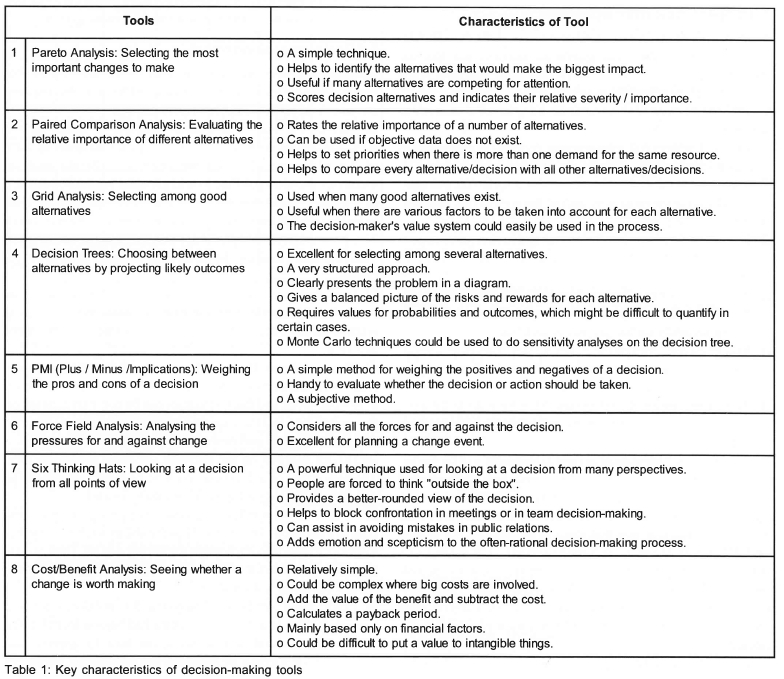
□ Pareto Analysis: The Pareto principle is based on the principle that by doing 20% of work, one could generate 80% of the advantage of doing the entire job. Pareto analysis identifies the changes that would give the biggest benefits.
□ Paired Comparison Analysis: Paired comparison analysis helps to work out the importance of a number of options relative to one another. All the options are weighed against one another. This tool helps to show the difference in importance amongst factors.
□ Grid Analysis: Selecting among good alternatives. This method considers the decision makers' value system and the relative importance of the items in the value system on the decision.
□ Decision Trees: Decision trees are probably the most powerful tool in the decision-making tool kit. A decision tree is built where decisions and their outcomes can be compared, based on the probability and the expected outcome of the decision. The expected outcome and probability could be varied to allow a sensitivity analysis on the decision via some modelling tool. The sensitivity of a decision could be of more value than the generation of a single figure from a static model.
□ PMI (Plus/Minus/Implications): Weighing the pros and cons of a decision: This method has the ability to check whether it is advantageous to implement the decision at all. Thus, would the actions, as a result of the decision, improve the situation or should one simply do nothing.
□ Force Field Analysis: Analysing the pressures for and against change. If a specific outcome has been selected, force field analysis could help to work out how to improve the probability of success by reducing the strength of the forces opposing a decision, or to increase the forces supporting the decision.
□ Six Thinking Hats: Looking at a decision from different points of view. This forces decision makers to move outside their habitual thinking styles and helps them to get a more rounded view of a situation. It opens up the opportunity for creativity within decision-making.
White Hat: Analytical review.
Red Hat: Use intuition.
Black Hat: Bad points (risks)
Yellow Hat: Be optimistic.
Green Hat: Be creative.
Blue Hat: Control the process (chairman's hat).
□ Cost/Benefit Analysis: Seeing whether a change is worth making. It is a relatively simple and widely used technique. Simply add up the value of the benefits of a course of action and subtract the costs associated with it.
Each of these tools has different applications that are summarised in the "characteristics of tool" column of Table 1.
3.3 Aligning decision making with strategy
Decision makers should always align their decisions with the strategic direction and position of the project that, in turn, should be aligned with the organisation's strategy. Cohen10 supports this when he states that project managers should pay much more attention to the organisation's strategy in order to guide their decision-making. Project managers should manage their projects in ways that would support the strategy of the organisation. In the future, measuring a project's performance will shift depending on how successfully the project supported the organisation's strategy. Thus, projects that are on time, within budget and within specification might still fail to support the organisation's strategy and would be considered as unsuccessful projects.
Cohen10 further argues that the environment has become more turbulent, with change happening more often, at a faster pace and in less predictable ways. Therefore, lengthy "up the line" checking of every decision is no longer practical.
Things are happening too fast and project managers should be able to make decisions in support of the organisation's strategy at their own level. Projects are the vehicle that organisations use to implement strategy. 1.1 In the case of the fuel plant project of Pebble Bed Modular Reactor (Pty) Ltd, a crucial part of the success of the system is the quality of the fuel.
This requires careful strategic positioning that involves key suppliers and the use of appropriate technology in order to meet the requirements.
4. Model for selecting decision-making tools
4.1 Methodology for developing the model
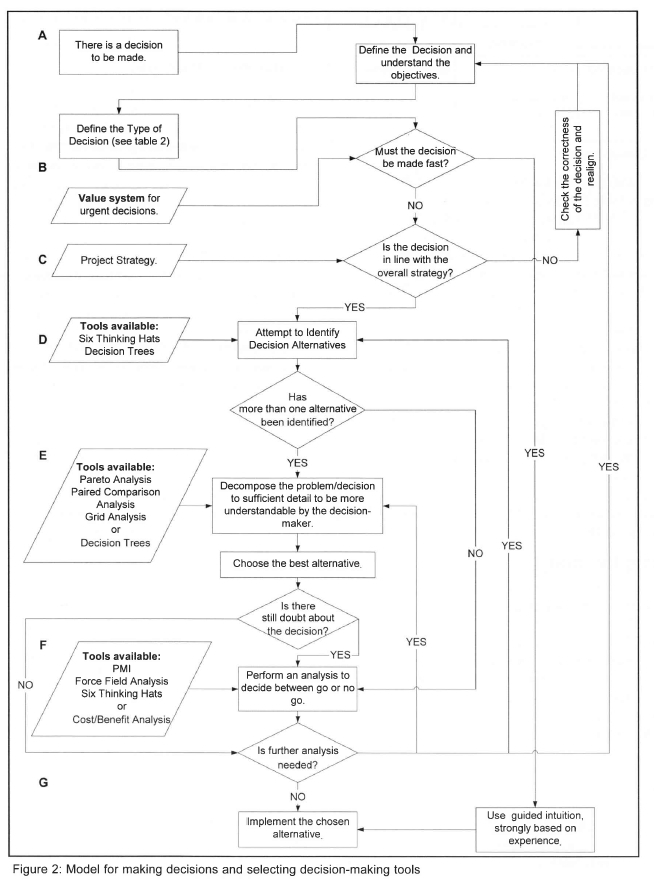
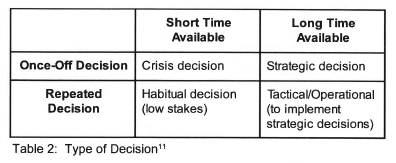
The model in Figure 2 started off with the decision-analysis process as explained by Clemen8. This model addresses the major aspects of decision-making, but it was not very practical from the perspective of a decision maker who is not educated in decision analysis. Further literature studies revealed a useful matrix by Murnighan11 that categorises a decision in terms of the available time and the repeatability of the decision. These two axes then define the type of decision as shown in Table 2. Defining the type of decision is helpful in directing the decisionmaker in approaching the decision. One should be cautious in defining the time allowed. The way in which people behave could easily result in the argument that a decision is always urgent, and decision makers might bypass the model (refer to Figure 2). A value system for defining time was added and fed into the decision point. As a rule of thumb, no decision on the fuel project would qualify for the "short time available" criterion as defined in Table 2. A decision-making process could be used to support any decision time frame of more than 24 hours. Crisis decisions, such as making decisions in a control room during an emergency (eg, a fire or some other potential disaster), would be classified as "plant operational" applications.
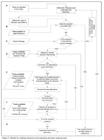
The mitigation-planning step in the process of project risk management (refer to Section 2) identifies decisions to be made. This mitigation-planning step is an important input into the model to identify a decision or trigger point.
Cohen10 provides more clarity on the importance of organisational strategy and how this strategy should be reflected in the decision-making process. The model was modified to give a clear check for alignment of decisions with the overall strategy. The updated model is shown in Figure 2.
Finally, the different decision-making tools, discussed in Section 3.2, were grouped according to the characteristics of each to support the decision-makers when using the model to make decisions, and to select the appropriate tools for making those decisions. This is also incorporated in Figure 2.
4.2 Using the model
The model is in the form of a flow chart that allows a decisionmaker to start at the top and to work through the model systematically.
A. The model starts with the identification of a need to make a decision. Decision-makers often jump directly into making decisions, but it is important to understand the decision first and then understand why the decision has to be made.
B. The type of decision must be defined next. This is where a distinction is made between crisis decisions (like a fire that requires a decision-maker to use his past experience and intuition to act quickly) and operational decisions. A project should have a value system that sets the rules for bypassing the model.
C. The project strategy is a very important gate in the model. No decision should be allowed to occupy or consume valuable time in a decision-making process, unless it is in line with the project strategy. A project charter could serve as such a document to check and to document project strategy.
D. Decision alternatives allow the decision-maker to search for alternatives and to be creative about the decision. Typical tools that could assist in this are listed.
E. Once alternative options exist, the model flows into a decomposition step where specific tools assist in the decision to choose between different options. If there is only one alternative - or once one has selected a specific option - the model allows the decision-maker to make a "go" or "no go" decision.
F. The listed tools assist the decision-maker to decide if the decision should be implemented. Sometimes it might be better to do nothing.
G. Lastly, the model allows the decision-maker either to implement the decision or to start the whole process from the beginning by re-defining the decision.
4.3 Benefits of the model
The model assists decision makers to structure decisions on the fuel plant project in order to simplify the decision-making process. Decision makers would be in a position to select the appropriate decision-making tools for the specific type of decision. The model further allows project managers to quantify and demonstrate a process for making decisions on the project that supports the overall strategy of the organisation and those of the project.
Conclusions
Decision analysis is a very powerful and useful knowledge field that could be used to develop mitigation plans in a project risk management process or in making project decisions that support the organisation's strategy.
It is important to know when a decision has to be made, but the challenge is always there to use a credible process and to select the correct decision-making tools for making good decisions.
The model provided in this paper assists decision-makers on the fuel project to make better decisions more constantly. The improved decision-making process should the investors and other stakeholders that the fuel plant project is under good management. The model further allows team members to demonstrate to the stakeholders that they actively align the project with the strategic direction of the organisation.
1. Association for Project Management (APM). Project Risk Analysis and Management Guide (PRAM Guide), 1997.
2. Project Management Institute. Project Management Body of Knowledge (PMBOK), 2000, Chapter 11, Pennsylvania.
3. European Cooperation for Space Standardization (ECSS). Space Project Management: Risk Management (ECSS-M-00-03A), 2000, ESA Publications Division.
4. AS/NZS 4360:1995, Australian/New Zealand Standard: Risk Management, 1995, Standards Australia & New Zealand.
5. Chapman C. & Ward S. Project Risk Management: Processes, Techniques and Insights, 1997, John Wiley and Sons.
6. Nicholas JM. Project Management for Business and Technology, 2001, Prentice Hall, Chapter 10.