The Impact of the Gamma Irradiation Dose During Sterilisation and Crosslinking on the Creep Properties of Ultra High Molecular Weight Polyethylene
Abstract
The amount of plastic flow that Ultra High Molecular Weight Polyethylene (UHMWPE) will undergo is measured by the creep properties of the material The amount of creep is determined by the operating conditions for example the operating temperature. The manufacturing procedure of the acetabular cup also influence the amount of creep achieved. The gamma irradiation dose during sterilisation and crosslinking can also influence the amount of creep. This study sets out to determine the creep trends for various gamma irradiation doses during sterilisation, as a result of the associated crosslinking. The effect of the gamma crosslinking coupled to different process parameters, under various conditions as also investigated. The indications are that the amount of creep stays almost the same with gamma irradiation during sterilisation, but there is a major decrease in the amount of creep for gamma crosslinked material, operating at elevated temperatures.
UHMWPE; creep; gamma irradiation; sterilisation; crosslinking; elevated temperatures
1. Introduction
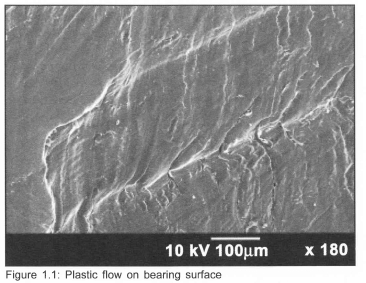
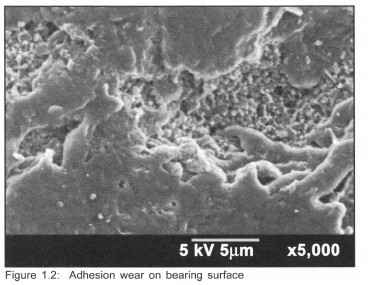
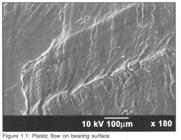
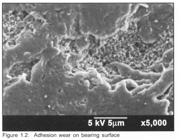
The predominant mechanical failure mechanism for acetabular cups, manufactured from Ultra High Molecular Weight Polyethylene (UHMWPE), in-vivo is a combination of excessive plastic flow (Figure 1.1) and adhesion wear, see figure 1.2. This is caused by localised overheating, on the bearing surface, due to insufficient lubrication. The limiting material parameter that determines the amount of plastic flow under the mentioned conditions is the creep property of the base material. Creep properties for UHMWPE are found in literature1,2,3. The shortcoming of this data is that the tests are either done at room temperature, ignoring the effect of higher temperatures, or that it does not take the effect of gamma irradiation with associated crosslinking during sterilisation or crosslinking into account.
The purpose of this study was not an in depth study of the creep properties under various conditions accompanied by an in depth statistical analysis. The aim was rather to establish the effect of elevated temperatures and gamma irradiated sterilisation with the associated crosslinking and crosslinking on the creep behaviour of the material.
The data presented must be used with caution due to the fact that the UHMWPE in the acetabular cup is under constraint against creep and therefore the creep will be much less. If designers want to take the creep data into account, a more in depth study will have to be completed. Furthermore the high temperatures occurring inside the bearing, occur in small localised areas and not over the total bearing area.
2. Methods
The investigation was broken down into the following steps to obtain the required data. The following steps were used
a. Clamping effects
b. The effect of elevated temperature on the creep properties of virgin material
c. The effect of elevated temperature on the creep properties of gamma irradiated sterilised material
d. The effect of elevated temperature on the creep properties of crosslinked material.
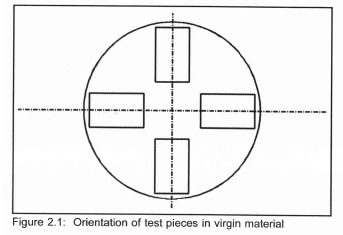
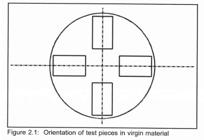
The material used for this investigation was Chirulen® rods, 500 mm long with a diameter of 65 mm supplied by Poly Hi Solidur. After determination of the clamping effects, see paragraph 3, the test pieces were machined from the virgin material as indicated in figure 2.1.
Test pieces were placed individually, in a Schenk testing machine and loaded to the equivalent of 8 MPa in compression. The 8 MPa represents a load of 1250 N. The displacement was measured by making use of a calibrated Schenk clip gauge while the load was measured with a calibrated 500 kg load cell. According to ASTM D2990, the load was applied within three seconds and kept on the test piece for one hour. The displacement data was sampled at arate of 50 Hz resulting in 1.8 x 10⁵
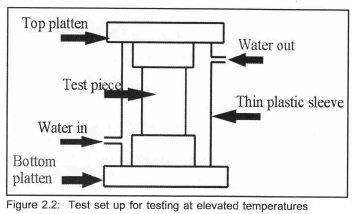
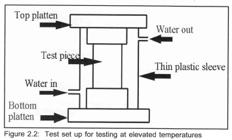
The baseline test was at room temperature. In the tests done at elevated temperatures, the temperatures were monitored by placing a thermocouple down the centre of the test piece, measuring the core temperature of the test piece. The test piece was then heated up by circulating hot water around the test piece until the core had reached the desired temperature. See figure 2.2 for the test set up. The tests were then performed at 40°, 50° and 60°C. The results were then compared with the results found in literature as well as with the baseline tests performed.
3. Clamping effects
3.1
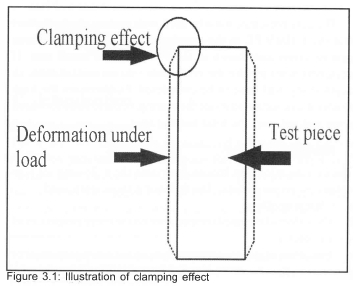
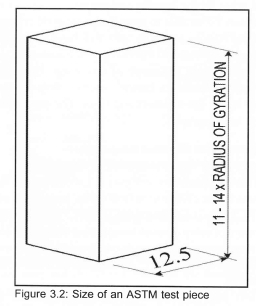
Purpose of the testThe purpose of this test was to establish the influence of the test piece length, as clamped, on the determination of the creep values for UHMWPE. See figure 3.1. According to ASTM D2990 the creep test piece must be 12.56 mm square with a slenderness ratio between 11 and 14. See figure 3.2. This means that the ratio of length to a minimum radius of gyration must be between 11 and 14. The radius of gyration is defined as 0.2887 x the width of the specimen4
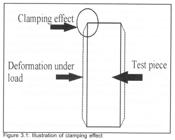
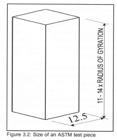
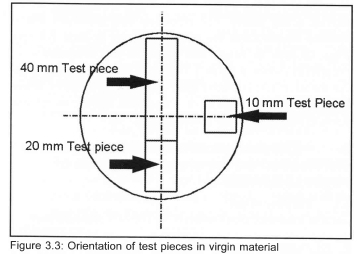
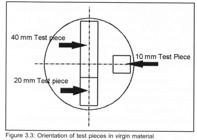
To determine the influence of test piece length on the creep properties, three different test pieces were cut from the bar, see figure 3.3, varying in length from 10 to 40 mm at the orientation indicated. It was decided to test three test pieces of each length.
3.2
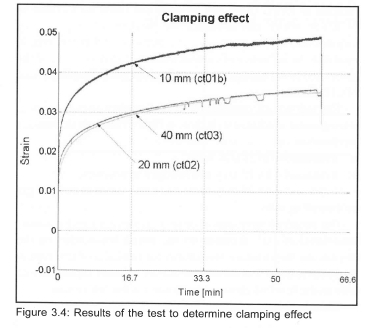
Test Results: Clamping effectsThe data presented in figure 3.4 is the strain plotted against time for the three different lengths. From the data it can be seen that there is a huge difference in the creep rate for the 10 mm test piece if compared to the plotted data for the 20 and 40 mm test pieces. This difference can be attributed to the restraints to lateral movement of the platten faces, ie, barrel shape effect. The difference in the data can also be explained by looking at figure 3.3. The 10 mm test pieces were machined from the bar right at the edge of the material. If any non-homogeneity across the material is present, the material will behave differently during these tests. This effect will have to be investigated further at a later stage.
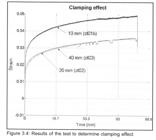
From the data presented in figure 3.4 it can be seen that the strain versus time plots for creep in the 20 and 40 mm test pieces are very close together. The two plots actually meet as the test progresses. The conclusion that can be drawn from these tests is that the clamping or restraint effect on a test piece of 20 mm length is almost negligible. If the test data is compared with the work of Lee et al32
For the continuation of this evaluation, test pieces of 20 mm in length machined from the bar as shown in figure 2.2 were used. The influence of elevated temperature, gamma irradiated sterilisation and crosslinking on the creep properties were them determined.
4. Investigation of anisotropic effects
4.1 Purpose of the test
The creep data for a test piece cut from the edge of the material differed significantly from the other results. This result can be due to the clamping effects or due to anisotropic material properties caused either by the extrusion process or by heat treatment of the bar. The aim of this evaluation was to determine the effect of test piece orientation, in the bar, on the creep properties of the material.
4.2
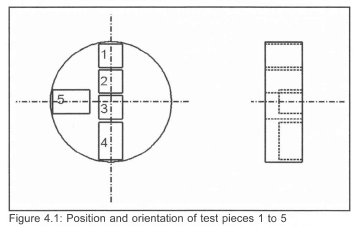
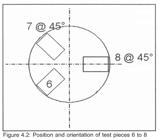
Test procedureEight test pieces were machined from a standard N65 mm stock bar at various orientations. See figure 4.1 and 4.2 for the position and orientation of the different test pieces.
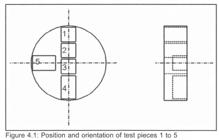
A slice of material, 20 mm thick, was cut from the bar stock and test pieces 1 to 5 were machined3figure 4.1. Test pieces 1 to 3 were cut out in the axial direction while 4 and 5 were cut out radially, perpendicular to the axial direction.
A second slice of material was used to cut test pieces 6 to 8. Test piece 6 is also perpendicular to the axial direction but midway between test pieces 4 and 5 while test pieces 7 and 8 are cut at an angle of 45° to the axial plane. If the anisotropic properties, as a result of the manufacturing and heat treatment are to be addressed, then a large number of tests over a 500 mm bar will have to be conducted.
The testing procedure was the same as that used to determine the clamping effects (See paragraph 3). The data sampling was again done at a frequency of 50 Hz. However for test number 3, running for 18 hours, the sampling rate was brought down to 25 Hz. The test was done to get an idea of the amount of creep that can be expected over a longer period. Due to the amount of data that is gathered, the sampling was paused after one hour with the load applied continuously. The recording was resumed after 16 hours to get the long-term effect.
4.3
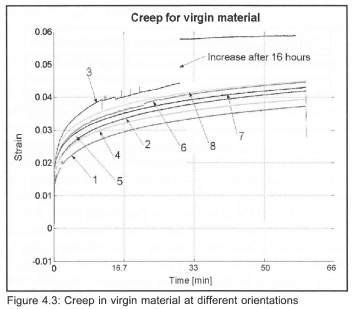
Test resultsThe results, plotted in figure 4.3, show a substantial difference in creep between the outside and the inside of the raw material, in the axial direction (Tests 1 and 3). The final difference in the creep values between these two tests is 32.43% or 0.24 mm. From this data it appears that the centre of the virgin bar is the most creep sensitive and that it is less creep sensitive towards the outside.
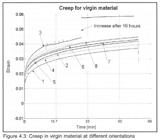
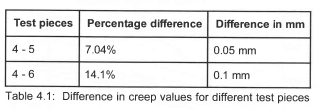
The orientation of the test piece in the stock material is crucial. As can be seen from figure 4.1, test pieces 3 and 4 were cut from the centre of the bar at different orientations. The final difference in the creep values between these two test pieces is 25.35% or 0.18 mm. The differences between the test pieces cut out radially (4, 5, and 6) are given in table 4.1
The final creep values of the two test pieces cut out at an angle of 45°, test pieces 7 and 8, only differ 5.1% or 0.044 mm. What is however important, is again the difference between the test piece cut out radially (4) and the rest of the test pieces that were cut out at 45° (7) The difference was found to be 15.5% or 0.11 mm. The importance of this result is that if when the position where the maximum wear achieved in the acetabular cups is observed, it is normally at an angle of 70.7° to the axial plane9figure 4.3 it is clear that the virgin material does not perform very well in this area.
The maximum creep measured during the experiment was 1.18 mm measured after 18 hours of continuous loading.
The conclusion that can be drawn from this test is that the material shows anisotropic behaviour. The anisotropic properties could have been caused by the extrusion process or by heat treatment afterwards.
5. Effect of elevated temperatures on the creep properties of virgin UHMWPE
5.1 Purpose of test
The purpose of this test was to determine an estimated effect of elevated temperatures on the creep properties of virgin UHMWPE. Creep tests at elevated temperatures were done by Meng Deng et al2
5.2 Test results: Elevated temperatures
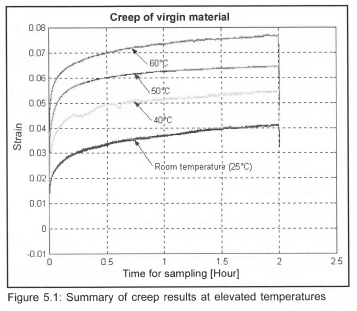
A summary of the data is presented in figure 5.1.
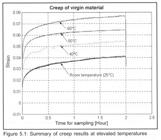
From the data presented in figure 5.1, it can be seen that there is a substantial difference in the creep properties of virgin UHMWPE at room temperature and at 60°C. The final difference in the amount of creep at room temperature and at 60°C is 87.3% or 0.716 mm as measured over a two hour period. Furthermore the total amount of creep, at 60°C, measured over a two hour period was 1.536 mm.
The test data presented above, correlates with the data presented by Meng Deng et al, however Meng Deng do not provide actual values. The creep test data illustrates that at elevated temperatures the material softens in local hot spot areas, to such an extent that extrusion and deformation of material as shown in figure 1.1 can take place. It must be noted that the strain rate is much higher in the first 30 minutes, where after it starts to decrease to such an extent, that the increase in strain in the next 2 hours is almost zero.
6. Effect of gamma irradiated sterilisation on the creep properties of virgin UHMWPE
6.1 Purpose of test
Gamma irradiated sterilisation is the industry standard used for the sterilisation of medical components. From literature5
The test pieces, manufactured as described in paragraph 2, were gamma irradiated with three different methods to simulate sterilisation i.e.
a. Irradiated with 25 kGy in air
b. Irradiated with 25 kGy in a nitrogen atmosphere
c. Irradiated with 25 kGy in air and heat treated at 80°C to get an annealing effect.
The required sterilisation dose to achieve a sterility assurance level of 10-6, depends on the initial bio-burden on the device. As the cleaning procedures for implants of this type is fairly standard, it was decided to use the industry standard of 25 kGy as the level of gamma irradiation for the test pieces.
The tests were performed at room temperature to have a good comparison with data available from this study, with that available in literature.
6.2 Test results: Sterilisation by means of gamma irradiation
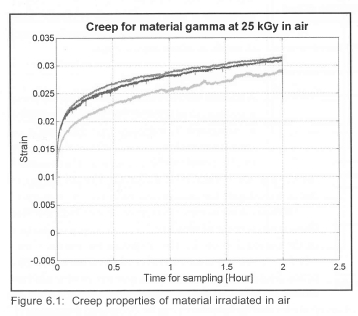
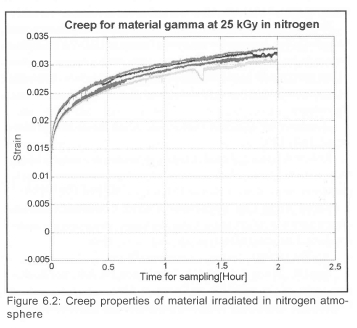
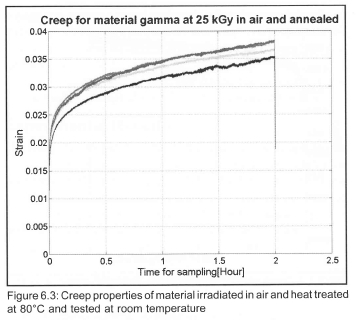
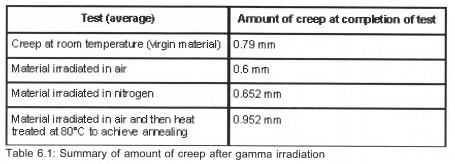
The test results to determine the influence of gamma irradiation are shown in figure 6.1 (irradiation in air), figure 6.2 (irradiation in nitrogen) and figure 6.3 (irradiation in air and heat treated to achieve annealing). If the data, as presented, is compared to the creep property data in literature and from paragraph 3, 4 and 5, it can be seen that there is a slight decrease in the creep values for UHMWPE (approximately 0.1 mm). See table 6.1.
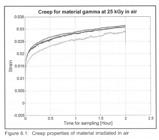
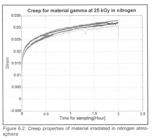
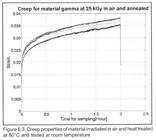
From the data presented, it can be seen that the total amount of creep in the test pieces, after annealing actually increases. If the in-vivo conditions and wear mechanisms active in an acetabular cup is taken into account, this increase in creep will negatively influence the achieved in-vivo service.
7. Effect of crosslinking on the creep characteristics of UHMWPE
7.1 Purpose of the test
The latest tendency is to crosslink the UHMWPE to achieve better wear characteristics, although there is a decrease in fracture toughness6,7. The purpose of this test is to determine the influence of crosslinking on the creep properties of UHMWPE, crossiinked in an acetylene atmosphere and at elevated temperatures.
The test pieces, manufactured as described in paragraph 2, were crossiinked in an acetylene atmosphere with gamma irradiation at a dose of 125 kGy. Three different tests were performed ie
a. Creep at room temperature
b. Creep at 50°C
c. Creep at 60°C
7.2 Test results: Crossiinked material
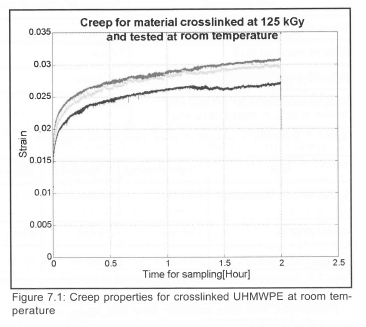
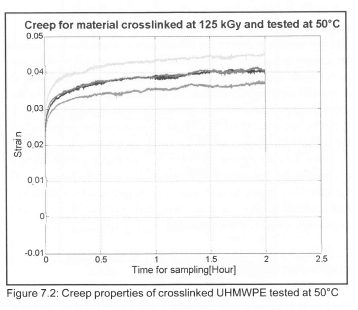
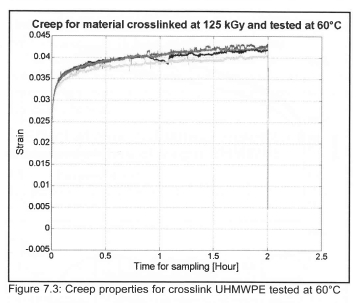
The test results are shown in figure 7.1 (room temperature), figure 7.2 (creep at 50°C) and figure 7.3 (creep at 60°C).
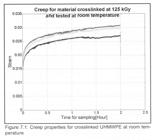
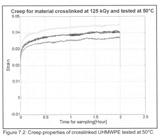
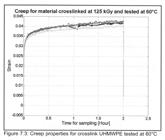
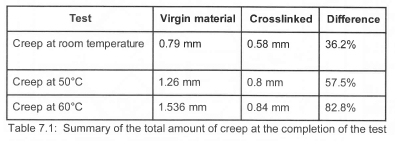
A summary of the creep data for crossiinked material compared to the creep data for virgin material can be seen in table 7.1, with the creep values given as average values.
From the data presented, in table 7.1, a significant decrease in the creep properties of the material after crosslinking is visible. This is to be expected if the decrease in impact strength is taken into account.6
8. Summary
Although the ASTM standard prescribe a test piece length of 40 mm the data, as presented in paragraph 3, indicates that the margin of error when making use of a 20 mm test piece is small enough to be neglected. This enabled the cutting out of material at different orientations in the bar to investigate the anisotropic effect of the material.
The tests done at elevated temperatures indicate that there is an increase of almost 87% in the creep properties of the material at 60°C. This explains the plastic flow, which is currently seen in retrieved acetabular components. Sterilisation by means of gamma irradiation has almost no effect on the creep properties but the amount of creep at elevated temperatures can be decreased dramatically (approximately 80%) when the material is crossiinked. Although the toughness of the material decreases with crosslinking, the improved resistance against creep will provide better in-vivo life.
This investigation was done to determine the influence that various factors have on the amount of creep in UHMWPE. If this data is to be used in future designs, tests with a larger number of test pieces will have to be done and these results will have to be statistically analysed, to determine the exact values.
References
- 1.Engineering Material Handbook, ASM International Volume 2, 167-1702
- 2. Robert A Latour, Amod A Ogale, Shalaby W Shalaby Meng Deng. Study of creep behaviour of ultra high molecular weight polyethylene systems, J Biomed Materres, 40, 214-223, 1998
- 3.Kwon Yong Lee, Pienkowski David. Compressive creep characteristics of extruded ultra high molecular weight polyethylene, J Biomed Mater res, 39, 261 -265, 1998
- 4.ASTM D2990: Testing of material
- 5.Sun DC, Wang A, Stark CF, Dumbleton JH. Effect of Radiation-Induced Crosslinking on Creep and Wear Performance of Ultra-High Molecular Weight Polyethylene, American Academy of Orthopaedic Surgeons, Annual Meeting, Scientific program, 1996
- 8.Material data sheet: UHMWPE
- 9.Sychterz, Cj, Moon KH, Yashushi MD, Terefenko KM, Engh CA jr, Bauer TW. Wear of Polyethylenes Cups in Total Hip Arthroplasty: A Study of Specimens Retrieved post Mortem; J Bone and Joint Surg, 78 -A: 1193-1200, Aug 1996