Circular Arc/Constant Load Camber Line Equivalence
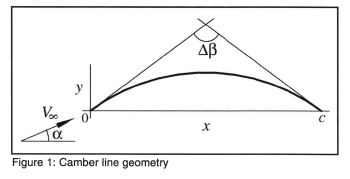
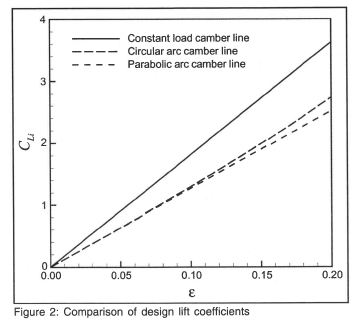
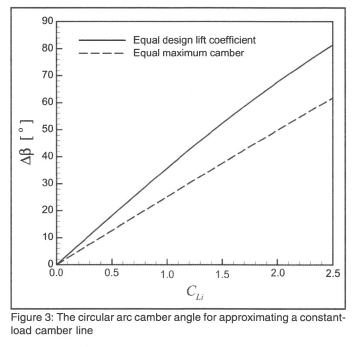
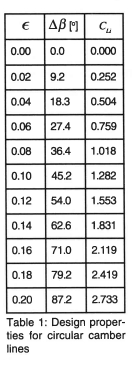
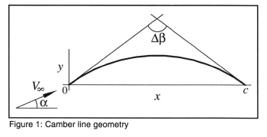
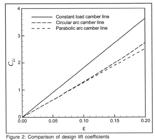
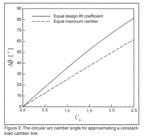
During the design process of an axial-flow compressor it is crucial that the correct geometric and aerodynamic properties of the selected blade profiles are used. Failure to do this may result in erroneous blade flow angles at design conditions, premature stall, etc. (overviews of axial-flow compressor aerodynamic design and analysis are given by, among others, Cumpsty [1] and Aungier [2]). It is therefore disconcerting that the relationship between the geometric and aerodynamic properties of the widely used NACA-65 family of blade profiles appears to be misrepresented in the authoritative literature. The original camber line for the NACA-65 family of blade profiles was the camber line with constant load distribution, ie, constant pressure difference between suction and pressure surfaces [1, p.478]. Later it became common practice to use the circular arc camber line for the NACA-65 family of blade profiles [1, p.479]. Now, since the so-called design lift coefficient determines the maximum camber of the blade section, the equivalent circular arc camber line (for equal design lift coefficient) has to be established when employing such a camber line rather than a constant load camber line. The purpose of this note is to identify the discrepancy that evidently exists in determining this equivalence, and to provide the correct relationship.
 Thumbnail
 Thumbnail
 Thumbnail