Effects of Wettability on the Performance of Cross-Fluted Counterflow Film Fill
Abstract
The performance of a newly manufactured counterflow cross-fluted PVC film pack was determined experimentally. After testing, the pack was subjected to an effective patented ageing treatment employing fluorine gases that polarize the polyvinyl chloride (PVC) surface. Excellent wettability was achieved and subsequent tests showed significant improvements in performance, especially at low water flow rates. The drop size distribution in the rain zone below both the new and the treated or "aged" fill material was determined by placing a digital camera below the fill in a water-tight enclosure to obtain undistorted images of drops in the rain zone. Image software (blob analysis tool) was then used to define the edges around the drops to calculate drop size distribution in terms of pixels. The pixels were subsequently converted to millimeters by calibration. The results of these measurements are presented in the form of size distribution curves and the respective different mean drop diameters. Drop diameters under the aged fill are found to be smaller than those under the new fill. Furthermore, it is shown that drop diameters generally become larger with an increase in water and air flow rate. The performance of cooling towers employing film type fills can be significantly influenced by the wettability of the fill and the corresponding drop size distribution in the rain zone below the fill. Pretreatment of the particular fill, or sufficient operating time is thus essential to ensure that good wettability is achieved before effective performance of a cooling tower can be expected.
1. Introduction
New plastic and polymer cooling tower fill materials are generally non-wettable or hydrophobic due to their low surface free energy. In the case of film fill materials good wettability is essential to ensure good performance of the cooling tower. After installation in a cooling tower, fill material ages and wettability improves. Over time the surface becomes conditioned (aged) allowing water to form a thin film. While PVC fills may achieve their full capability within one or two months in service, polypropylene fill with low water loading or flow rate requires more time or may never become fully conditioned as pointed out by Aull and Krell1.
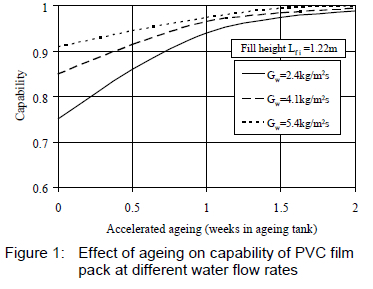
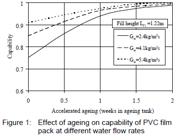
Various methods have been used to improve the wettability of film fill test samples. These include the application of coatings, corona and flame treatment etc. Wettability can also be achieved over time by exposing the fill material to a concentrated detergent solution (trisodium phosphate). Aull and Krell1 employed such a solution to accelerate the ageing of cross-fluted film packs. They observed significant improvements in the performance capability (ratio of Merkel number for partially wetted surface to Merkel number for fully wetted surface) of PVC packs as shown in figure 1 Nearly complete wetting was achieved after two weeks.
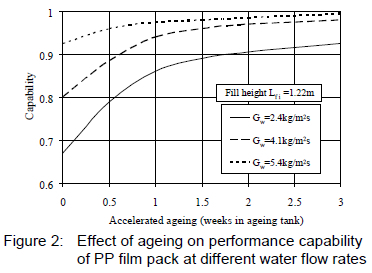
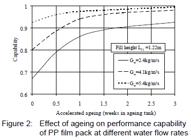
Similar tests were conducted on polypropylene (PP) film packs (see figure 2. After three weeks, full wetting was not yet achieved at the low water flow rate. Low water flow rates or loadings are typical for natural draft towers and for towers designed for a low approach. At higher water loadings where the film is thicker the effect of ageing is less.
The significance of achieving good wettability of film fill surfaces when conducting performance tests, has in the past not always been appreciated, with the result that many published performance results are unreliable.
2. Fill Performance Experiments and Results
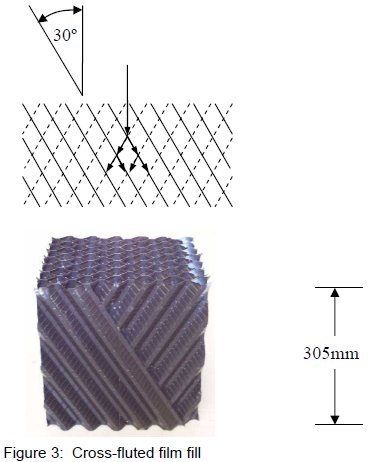
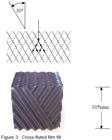
Counterflow fill performance tests, which do not include a rain zone, were conducted in a test tunnel as described by Kloppers and Kroger2. The test pack consisted of cross fluted PVC film fill material (similar to that described by Aull and Krell1 having a flute angle of 30° as shown in figure 3
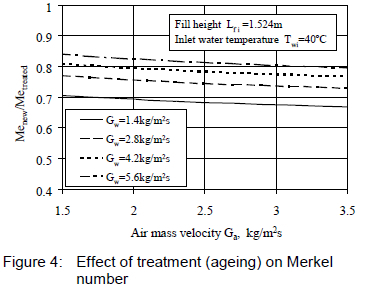
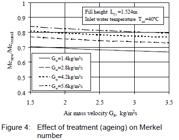
The 1.5 m x 1.5 m test pack was Lfi = 1.524 m high. Tests were conducted at water flow rates ranging from Gw = 1.4 kg/m2s to Gw = 5.6 kg/m2s and air flow rates ranging from Ga= 1.5 kg/m2s to Ga = 3.5 kg/m2s. The inlet water temperature was maintained at Twi = 40°C. Initial performance tests were conducted on a newly manufactured pack. The Merkel number and the loss coefficient for this pack were determined according to a procedure presented by Kroger3. After the initial tests, the pack was subjected to an effective fluorine gas ageing treatment process which polarizes the PVC surface, thereby achieving excellent wettability characteristics. The treated pack was subsequently tested and significant improvements in the Merkel number were observed. The ratio of the Merkel number for the untreated surface to the corresponding Merkel number for the treated surface is shown in figure 4 The difference in air side loss coefficients between the untreated and treated surfaces is small.
3. Drop Size and Distribution Experiments and Results
The thermal performance of the rain zone can be in the order of 10 - 20 % of the total performance of counterflow cooling towers. To model the performance of the rain zone accurately, the drop size distribution must be known.
Tests were conducted in the same test tunnel as described above, to determine the effect of the fill treatment (ageing) on the drop distribution in the rain zone. The drop size distribution was measured below both the newly manufactured and the treated (aged) film fill material using a measurement technique developed at Stellenbosch University, South Africa.
Due to height constraints inside the test tunnel, the 1.5 m x 1.5 m test pack could only be Lfi = 0.610 m high instead of Lfi = 1.524 m high as in the case of the fill performance test. This fill height was however considered to be adequate. Tests were conducted 40 cm below the fill at water flow rates ranging from Gw = 2.8 kg/m2s to Gw = 5.6 kg/m2s and air flow rates ranging from Ga = 1.8 kg/m2s to Ga = 3.0 kg/m2s. The water used in these tests was unheated and the water temperatures were around Tw = 20 °C.
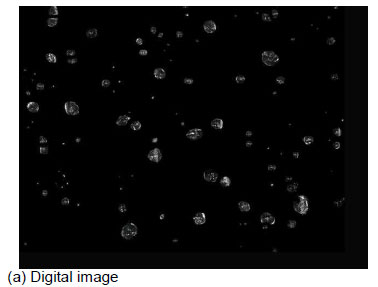
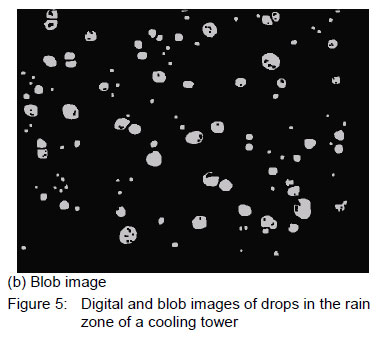
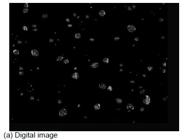
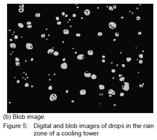
The measurement technique employed essentially involves placing a digital camera inside the test tunnel below the fill in a water-tight enclosure to obtain undistorted images of drops in the rain zone as shown in figure 5(a). The enclosure is designed to have the camera positioned at a fixed predetermined distance from the focus point and to ensure that the airflow in the test section remains parallel and interference on the drops due to the enclosure is minimal. Image software, also referred to as a blob analysis tool, is subsequently used to convert the drops to blobs, as shown in figure 5(b). The software defines circles (edges) around each drop, each with its own reference number, and calculates the diameter of each circle. The diameter is given in terms of pixels which can subsequently be converted to millimeters by calibration.
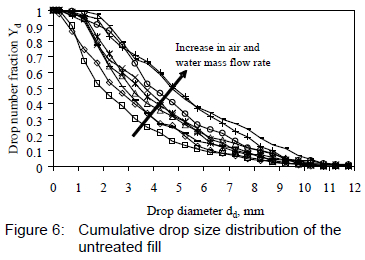
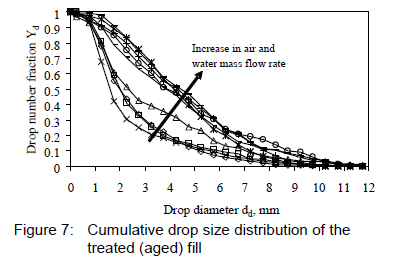
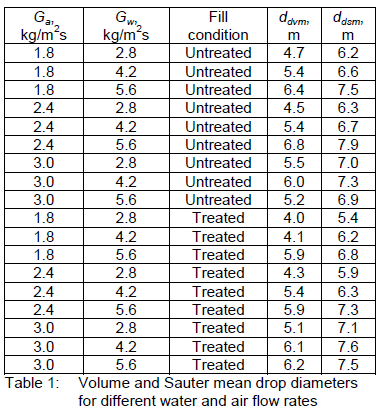
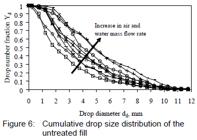
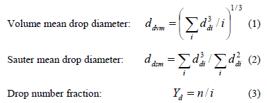
Cumulative size distribution (drop number fraction Yd) curves for the untreated and treated fill materials are presented in figures 6 and 7 respectively for different water and air flow rates. The volume mean and Sauter mean drop diameters presented in table 1 are calculated by means of equations 1 and 2 respectively.
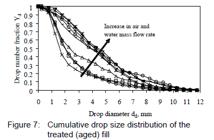
According to the data presented in table 1 an increase in water and air flow results in an increase in drop diameter of up to 50 % which may have a significant impact on the rain zone performance. The Sauter mean drop diameter for untreated fill ranges between ddsm = 6.2 mm and ddsm = 7.9 mm and for treated fill between ddsm = 5.4 mm and ddsm = 7.5 mm. Kroger3 states that drop diameters for film and trickle packs are generally between ddsm = 5 mm and ddsm = 6 mm. Furthermore, it was found that the drop diameters under the treated fill are generally smaller than
those under the untreated fill. Figure 6 shows that the cumulative drop size distribution (drop number fraction Yd) ddsm = 6 mm. Furthermore, it was found that the drop diameters under the treated fill are generally smaller than of the untreated fill increases gradually with an increase in air and water flow rate. Figure 7 however shows two distinct trends for the treated fill. This may be due to a sudden flow mode transition at the fill water outlet due to the interaction of the air and water in counterflow, which are different for hydrophilic (wettable) and hydrophobic (non-wettable) fill materials. This, however, needs to be investigated further.
4. Conclusion
The performance of cooling towers employing film type fills can be significantly influenced by the wettability of the fill and the corresponding drop size distribution in the rain zone below the fill. Pretreatment of the fill or sufficient operating time is thus essential to ensure that good ageing (wettability) is achieved before effective performance of a cooling tower can be expected. When designing a cooling tower, it is important to know the drop size distribution inside the rain zone for the particular type of fill used in terms of water and air flow rate.
R. Terblanche (student) for assisting with the drop size distribution tests.
6. Acknowledgements
F. Kriel (student) for assisting with the development, manufacture and testing of the drop size distribution measuring device.
Revised form 11 February 2009
Accepted 22 July 2009