The Case for Psychotherapeutic Case Studies in South Africa: A Scoping Review
Abstract
With the call for relevance in, and decolonisation of South African psychology, one must consider how this may be achieved through research and clinical practice. It is argued that South African psychology remains 'irrelevant' due to ongoing reliance on ahistorical and de-contextualised Eurocentric knowledge (as rooted in colonial and apartheid ideology and politics). Thus, methodologies that foreground both the immediate and historical context may assist in bridging the gap between knowledge generation and meaningful practice. In this scoping review of 45 South African psychotherapy case studies, we investigate whether the methodology may be as a means of developing relevant, contextually informed psychological knowledge in line with the decolonisation agenda. The results reveal that such case studies not only evaluate the applicability of Western-developed treatment models in the South African context but also explore the unique therapeutic dynamics in context. Additionally, themes reflecting broader social challenges were highlighted, such as violence, trauma, race, anger, shame, and sadness, supporting the potential for psychological case studies to contribute to more relevant psychological knowledge and practice in South Africa.
South Africa; psychology; psychotherapy; case study; relevance; decolonisation; trauma; violence; race; context
Introduction
Psychology in South Africa (SA) is considered to be "in crisis" (Kruger, 2015, p. 2). While the 'crisis' typically refers to the under-resourced and over-burdened public health care system, it can also be viewed as a crisis of relevance; that is that when psychological services are available, they can be considered not to be relevant in the South African context (Lappeman et al., 2021). Despite urgent calls for the decolonisation of psychology, Western/Eurocentric knowledge is still maintaining its hegemony in the field (Chilisa, 2017; Kadish & Smith, 2020; Naude, 2019). Historically, psychology in SA has been dominated by Eurocentric understandings of psychological phenomena, as influenced and supported by colonial and apartheid politics and ideology (Baloyi, 2021; Kruger, 2018; Long, 2017; Maine & Wagner, 2021; A. L. Pillay et al., 2013). Some contend that that "the haunting ghosts of our dark history were never properly exorcised" (S. R. Pillay, 2017, p. 301) and that the production and regulation of South African psychological knowledge is still "haunted by the Eurocentric hegemony" (Baloyi, 2021, p. 454; Ahmed & Pillay, 2004; Macleod & Howell, 2013).
Central to the critique regarding the application of mainstream Eurocentric psychological knowledge in SA is that it is too broadly applied across contexts and thus perpetuates "individualistic, universalistic, decontextualised notions of human behaviour" (Maine & Wagner, 2021, p. 28) and overlooks, silences, and marginalises alternative (indigenous/ contextually-informed) knowledge1 (Chilisa, 2017; Maldonado-Torres, 2017). Furthermore, the application of 'decontextualised' and 'ahistorical' hegemonic psychology often fails to recognise and fully capture the lived experiences of individuals who "fall outside of the dominant Euro-American 'Western' framework in terms of 'race', ethnicity, religion, etc." (Ahmed & Pillay, 2004, p. 631; Fernández et al., 2021; Hook, 2004; Long & Foster, 2013). Thus, with the transition to democracy in 1994, discussions regarding the relevance and decolonisation2 of psychology in South Africa intensified, and continue today.
While the notion of relevance in South African psychology is understood in different ways, Macleod and Howell (2013, p. 222) assert that psychological research may be deemed relevant in SA if it "...not only engages with the diverse socio-political concerns of our country but also contributes to overcoming the multiple sources of social inequalities and diffractions characteristic of South African society, and the psychological issues attached to these concerns". Long (2013, 2016a, 2016b, 2017) recognises the complexities and developments of the relevance debate in South African psychology, but maintains that researchers should be reflective of the main issues or challenges that face this specific society and always remain conscious of the very specific context, in which individuals are embedded. Relevance in South African psychology may also be viewed according to the need to bridge the gap between 'Westernised' psychological theory and marginalised indigenous knowledge systems (de la Rey & Ipser, 2004; Kagee, 2014). Decolonising psychology may therefore involve not only developing new, contextually informed knowledge, but also by adapting existing psychological theory and practice so that it is more appropriate to the South African context. There is thus an insistence on a need to develop different forms of contextually appropriate psychological knowledge, rather than continuing to impose Western understandings "that remain indifferent to the lived realities of most South Africans" (Long & Foster, 2013, p. 3).
In this paper we consider whether psychological case studies, as a potential form of context-dependent knowledge generation, can be a way of contributing to a knowledge base that makes for a South African psychology that is more relevant (Flyvbjerg, 2006). Writing up psychotherapy case studies has historically been central in the fields of clinical psychology, counselling psychology and psychiatry. From the original works of Sigmund Freud (the 'father of psychoanalysis') to the development of Aaron T Beck's cognitive behavioural therapy (CBT) and Carl Rogers' Person-Centered Theory, case studies have illustrated the work of psychologists and psychiatrists alike, how they think about, understand, and work with people (Edwards, 1998; Longhofer et al., 2017; Pletsch, 1982). Many clinicians have claimed that psychotherapy case studies are pivotal in building our knowledge of psychological processes and remain important in the professional training of psychologists (Fishman, 2013; Hodgetts & Stolte, 2012; Kruger, 2015; Pletsch, 1982; Stonington et al., 2018).
However, others have argued that psychotherapy case studies are unscientific and should not be used as a source of knowledge (Casper, 2007; Kagee, 2006). They are critiqued for being over-reliant on clinician memory, possibly including bias, failing to meet the falsification criterion, and of merely producing psychological knowledge that lacks scientific gen-eralisability (Casper, 2007; Kagee, 2006; Widdowson, 2011). Thus, doubt is cast on the validity of knowledge produced by single case studies, as they are deemed to be ineffective in generating knowledge that can be applied beyond the individual level (Widdowson, 2011). On the other hand, it may be argued that, by providing in-depth accounts of individual and subjective experiences, one may see case studies as bridging the gap between researcher and participant (Midgley, 2006; Widdowson, 2011). Thus, contextually relevant knowledge is generated from the perspective of those on whom the case study is based, rather from an 'outside' or external perspective (Midgley, 2006; Widdowson, 2011).
In this scoping review we attempt to develop a descriptive understanding of the frequency, type, and nature of South African psychotherapy case studies published in the literature over the past 20 years, also considering the specific themes raised in such studies. We argue that by closely looking at South African psychotherapy case studies, we can consider and assess whether they are (or are not) contributing meaningfully in the pursuit of relevance in psychology.
Conceptualising Case Studies
For the purposes of this scoping review, it is necessary to outline the case study methodology.
According to the American Psychological Association (2015, p. 161) the case study is defined as "an in-depth investigation of a single individual, family, event, or other entity", in which "multiple types of data (psychological, physiological, biographical, environmental) are assembled...to understand an individual's background, relationships, and behaviour". In light of their apparent idiosyncratic focus, case studies are still considered a form of "context-dependent knowledge" (Flyvbjerg, 2006, p. 222), as Kruger (2020b, p. 193) emphasises that "the individual does not exist, and cannot be understood separately from [their] relationships, community, and culture". Supporters of psychological case studies therefore suggest that, by analysing a single case, the individual's political, cultural, social, and economic circumstances, as well as the broader social dynamics and narratives of society, can be included (Evers & Wu, 2006; Hodgetts & Stolte, 2012; Kruger, 2020b; Stonington et al., 2018). Extending the concept of context-dependent knowledge, Kruger (2015) highlights that although case studies are located in a unique time and place (immediate context), the historical context in which the patient3 is situated, and how it impacts their present, is also relevant. This case study characteristic is considered significant within the South African context, where the lives of individuals and groups are shaped by a history of political and economic discrimination, oppression, and inequality (Kruger, 2020b). From a critical/decolonial perspective, case studies are therefore considered to support the notion that "one cannot take up psychological questions...outside the consideration of their specific social, historical, political and economic contexts" (Hook, 2004, p. 89).
While it may not be the case for early psychoanalytic case studies, from a epistemological standpoint, in-depth clinical case studies (particularly those arising from historically marginalised contexts) have the potential to align with postmodernist discourse. The postmodernist discourse supports the notion that multiple perspectives and sources of knowledge or truth can coexist, without privileging or positioning one as more valid than the other (Lewis, 2000; Ramey & Grubb, 2009). Clinical case studies are therefore typically associated with qualitative research and tend to follow an idiographic4 (rather than nomothetic) approach (Bryman, 2016). Moreover, the qualitative nature of case study research is often underpinned by the assumptions of the constructivist5, interpretivist/ hermeneutic6 and critical7 methodological paradigms (Harrison et al., 2017).
Case studies can also be classified according to their methodology, falling into three categories for the purposes of social science research: intrinsic, instrumental, and collective case studies (Evers & Wu, 2006; Willig, 2013). Intrinsic case studies are defined as those that are not intended to be generalised, in which the researcher aims to develop an in-depth understanding a single, specific case (Evers & Wu, 2006; Willig, 2013). In instrumental case studies, cases are analysed with the goal of gaining insight into how a particular phenomenon is present within a single case, that may be understood theoretically and lead to generalisable assumptions (Evers & Wu, 2006; Willig, 2013). Lastly, collective case studies involve using several single case studies to generalise findings for theoretical purposes (Evers & Wu, 2006).
Case studies are conceptualised differently within the field of psychology. In terms of quantitative (or mixed method) research, single case experimental designs are often used to determine changes in individual presentations through repeated (typically self-report) measurements (Barker et al., 2002). Naturalistic case study designs take place in the real-world context, in which the single individual is the unit of analysis and are considered better suited for in-depth descriptions of psychotherapeutic work, accommodating psychodynamic, experiential and cognitive-behavioural theoretical approaches (Barker et al., 2002; Willig, 2013). Naturalistic case study designs are further classified into narrative case studies and systematic case studies (Barker et al., 2002). Narrative case studies involve a "description of a client or treatment, based on the clinician's notes and memory" (Barker et al., 2002, p. 717). They may take on a story-like format, in which qualitative data from the clinical encounter is reported on through the clinician's understanding of the individual's lived experience, and therapeutic dynamics and aim to capture the meaning of therapy for both clinician and patient (Mcleod, 2010). Narrative case studies have historically been used in publication to demonstrate theory application, or to outline new intervention strategies (Barker et al., 2002). One may consider how the story-telling format of narrative case studies may reflect a means of teaching and knowledge generation that is deeply-rooted in South African culture. Systematic case studies, on the other hand, were designed to account for the critique that narrative case studies are too reliant on the clinician's subjectivity, making them unscientific. Systematic case studies therefore include additional quantitative measures (such as self-report scales) or include multiple cases to enhance "scientific" rigour (Barker et al., 2002). Lastly, in pragmatic case studies, comprehensive cases are presented with a pre-defined research question/ focus, typically aligned to theoretical orientation or treatment modality in order to demonstrate best practice (Mcleod, 2010; Willig, 2013).
Clinical case studies have also been classified according to approach rather than design (Longhofer et al., 2017). The paradigmatic approach endeavours to link clinical theory (for example, psychodynamic or cognitive behavioural theory) to the unique circumstances of individual cases (Longhofer et al., 2017). Secondly, the humanistic approach typically involves the clinician providing a first-person subjective account of their encounters with a patient, which may include descriptions of their therapeutic work or relationship (Longhofer et al., 2017). The ethnographic approach takes a holistic stance in evaluating clinical cases, in which "thick descriptions of field-based practice, situating and resituating the therapeutic and other relationships in cultural context and everyday realities" is essential (Longhofer et al., 2017, p. 190). Lastly, the interpretative phenomenological approach to case studies explicitly aims to develop an understanding of phenomena from the subjective, first-person perspective of the patient themselves (Eatough & Smith, 2017).
Rationale
It is evident that case studies hold a historically important place in the research, training, and practice of psychology, with a dual focus on the individual and the unique context within which they live. Although critiqued for being unscientific or unreliable, the literature suggests that the case study methodology is making its resurgence (Edwards, 2001; Harrison et al., 2017; Milliard, 1993). This is particularly pertinent within the context of South African psychology, in which the pursuit of decolonisation and of making psychology more 'relevant' is undermined by continued reliance on decontextualised mainstream Eurocentric knowledge (Maine & Wagner, 2021).
Considering the ongoing debate regarding the value of psychotherapy case studies, as well as the call for relevance in South African psychology, this scoping review aimed to develop a descriptive analysis of uniquely South African psychotherapeutic case studies published in the literature, with the hope that ultimately this may give rise to an understanding of how case studies are or are not contributing a knowledge base that is contextually meaningful.
Methodology
Scoping reviews are defined as "exploratory projects that systematically map the literature available on a topic, identifying key concepts, theories, sources of evidence, and gaps in the research" (Grimshaw, 2020, p. 34, as cited in Peters et al., 2020, p. 2121). They are understood to be extended appraisals of the available literature (or form of knowledge synthesis) on a broad research question or area of interest (Arksey & O'Malley, 2005; Colquhoun et al., 2014). The purpose of scoping reviews is to "examine the extent, range, and nature of a research activity" to establish a descriptive analysis of the research being published (relying on secondary data) in the area of interest (Arksey & O'Malley, 2005, p. 21). Scoping reviews differ from other forms of knowledge synthesis (systematic reviews) as they are broader in focus and are "exploratory and descriptive in nature", rather than explanatory or analytical (Peters et al., 2020, p. 2122).
According to Arksey and O'Malley (2005), the scoping review methodology follows five stages: developing the research question, identifying relevant studies in the literature, establishing a study selection from the identified literature, charting, and organising the data, and lastly, collating, summarising, and reporting on the data. These steps were followed to enhance research reliability and rigour.
Developing a Research Question
The aim of this scoping review was to conduct a detailed appraisal of the literature to identify the frequency, scope, and nature of South African psychotherapy case studies published in the last 20 years. By focusing specifically on qualitative in-depth psychotherapy case studies (including narrative, systematic, and pragmatic case studies), a descriptive understanding of how the lived experiences of South Africans are represented in the literature, as well as how case studies are (or are not) contributing to relevant psychological knowledge in SA may be developed. The questions that formed the basis of this scoping review were: what types of case studies are being written (methodology), what approach is being taken (paradigmatic, humanistic, ethnographic), who is writing (authors) and publishing South African case studies, what are the stated goals of the case study, on whom are the case studies based (demographics, intersectionality, diagnoses, clinical presentations), what theoretical paradigms are applied to the case study (for example, psychodynamic or cognitive behavioural theory), what are the themes present within the case studies, and how do the authors attend to the ethics of writing up clinical cases?
Identifying Relevant Studies
For the purposes of this review, case studies were sourced from six electronic databases, including: Google Scholar, Google Books,8 Web of Science, ScienceDirect, Sage Journals Online, and APA PsycNet. The following search string was used: "case study" (OR case studies) AND "psychotherapy" (OR psychology OR psychological OR psychiatry OR counselling) AND "South Africa". The search string was used with the setting "all fields", indicating that the key words in the search string may be present in the title, abstract, or content of the publication. Additionally, a time span (from 2004 until 2024) and language preference (English) was set. The search string initially yielded a total of 17,215 articles/ book chapters. The first 50 publications that matched the search string on each platform were taken to the next stage of data collection. To account for the fact that some case studies may have been omitted in the database search, a manual search of the following peer-reviewed journals was incorporated: Clinical Case Studies, Pragmatic Case Studies in Psychotherapy, South African Journal of Psychology, Psycho-analytic Psychotherapy in South Africa, and Psychology in Society. An additional 129 results meeting the search string were identified (total 17,344) and taken to the stage of data collection.
Study Selection
A total of 343 results were manually screened through an initial search of the first 50 publications on each database/online journal that matched the search string according to their title and abstract. Subsequently, a full-text review of the publications was conducted to ensure that they met the inclusion and exclusion criteria of the study (Arksey & O'Malley, 2005; Peters et al., 2020). The inclusion criteria incorporated: (1) case studies in peer-reviewed journal articles, books, or book chapters, (2) published between 2004 and 2024, (3) written in English, (4) case studies within the field of clinical and counselling psychology or psychiatry, (5) single in-depth psychotherapy (or therapy) case studies, (6) located within the South African context, and (7) based on South African individuals, or individuals currently living in SA although born elsewhere. Due to the fact that this scoping review focused on single psychotherapy case studies, short case vignettes, multiple or collective case studies and single case studies that were conducted in research (rather than therapeutic setting) were excluded. Review articles and dissertations were excluded from this study.
Charting the Data
Once the relevant case studies were identified, they were manually organised and charted using Microsoft Excel according to author and publication details, case study methodology and approach, case study features and themes, and ethical considerations (Arksey & O'Malley, 2005). Case study themes were derived using basic thematic analysis strategies (Bryman, 2016). After carefully reading through each case study, key words were highlighted before being grouped into larger categories and themes. These included: case identifiers (age, race, sex/gender, language, culture), setting (private, public, primary, tertiary), clinical diagnosis, core theory (psychodynamic theory, cognitive behavioural theory, behaviour-based, integrative), specific theory (for example, object relations theory), therapeutic dynamics (for example, transference/countertransference, conflict, racial dynamics), ethical considerations, and finally themes of therapy (for example, anger, trauma, sadness, grief, substances, anxiety, abandonment).
Data Analysis
The data analysis phase involves "collating, summarising, and reporting the results" in a descriptive manner (Arksey & O'Malley, 2005, p. 27). In line with the established methodology, the data were analysed according to author (name, affiliation, profession), details of publication (format, publication), type of case study (intrinsic or instrumental), case methodology (narrative, systematic, pragmatic, hermeneutic), approach (paradigmatic, ethnographic, humanistic), case identifiers (pseudonym, demographics, socio-economic status, diagnosis, setting of intervention), topic, theoretical paradigm applied, themes, and ethics. This process gave rise to a basic numerical analysis of the availability/frequency, scope, and nature of South African psychological case studies available in the literature, as well as an overview of the key qualitative themes and trends.
Ethical Considerations
Scoping reviews do not involve direct interaction with participants or the handling of personal or confidential information and therefore pose a low risk to participants/society (Suri, 2020). This research received formal exemption from ethical review and clearance by Stellenbosch University's Research Ethics Committee: Social, Behavioural and Education Research (REC: SBE).
Results
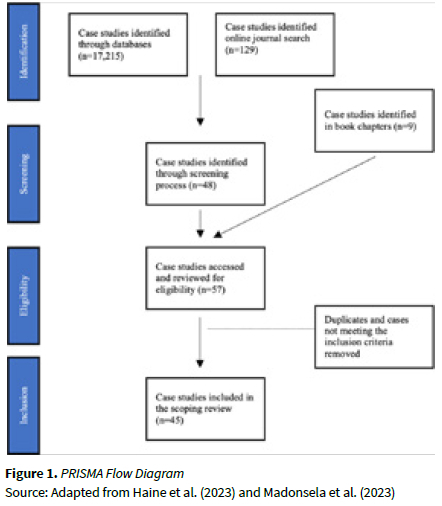
Through searching electronic databases and key peer-reviewed journals, a total of 17,344 sources were identified. Following the initial screening process, 57 psychotherapy case studies were identified. As depicted in Figure 1, once duplicates and case studies not meeting the inclusion and exclusion criteria were removed, a total of 45 were confirmed for inclusion in the study.
Publication Characteristics
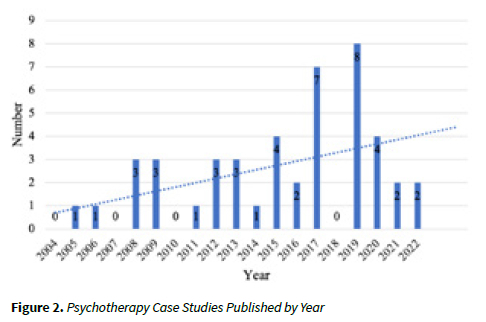
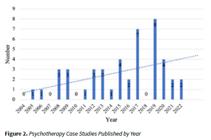
The case studies included were published in peer-reviewed journal articles (36) and published book chapters (nine). The two journals with the highest number of psychotherapy case studies published were Psycho-analytic Psychotherapy in South Africa (27.8%) and the Journal of Psychology in Africa (19.4%). South African psychotherapy case studies were also retrieved from books published by: University of Kwa-Zulu Natal Press (Kruger, 2020b), Nova Science Publishers Inc (Knight, 2016, 2017), Wits University Press (Smith et al., 2013), Imbali Academic Publishers (Kruger, 2021), and Routledge (Togashi & Kottler, 2015). The majority (64.4%) of the case studies used in this study were published between 2014 and 2024, possibly indicating an upward trend (see Figure 2) in South African psychotherapy case studies adding to the existing knowledge base.
Authors(s)
According to professional registration, 30 (66.7%) of the case studies reviewed were authored by clinical psychologists, six (13.3%) by counselling psychologists and registered counsellors, and nine (20%) were co-authored by individuals from mixed psychology fields. In terms of institutional affiliation, 78% of the authors were affiliated with a South African university, while 18% did not have a formal institutional affiliation. Rhodes University held the highest number of case study publications (12), followed by the University of Witwatersrand (5) and Stellenbosch University (5). It is relevant to note that two case studies were authored and co-authored by individuals affiliated with the Ububela Educational and Psychology Trust.
Case Study Methodology
Of the 45 case studies analysed, slightly more were classified as intrinsic (55%) compared to instrumental (45%) in their focus. In terms of methodological style, narrative case studies were most prominent (62.2%), followed by systematic (20%) and pragmatic (8%) case studies. The paradigmatic approach (60%) was most commonly used within psychotherapy case studies, suggesting that the authors aimed to offer a theoretical understanding of the case in order to demonstrate best practice (Longhofer et al., 2017). On the other hand, 33.3% of authors followed the humanistic approach, in which authors described their subjective experiences of working with patients, the therapeutic alliance and therapy process (Longhofer et al., 2017). Smaller proportions of authors employed the ethnographic (4.5%) and phenomenological (2.2%) approaches to psychotherapy case studies.
Psychological Theory
Each psychotherapy case study included a theoretical position, or perspective, to frame case analyses, or offer a description of the intervention used. Case studies within the psychoanalytic/psychodynamic paradigm (60%) were most prevalent. Cognitive behavioural theory (CBT) informed ten case studies (22.2%), five of which were classified as trauma-focused/informed CBT (TF-CBT). Five (11.1%) case studies were classified as integrative (combining different theoretical paradigms). One case study was framed within the context of cross-cultural psychiatry theory (Coetzee et al., 2019), one was influenced by critical theory (Sibanda, 2020), and another primarily utilised behaviour-based theory (Knettel et al., 2020).
Participants9
Most of the case studies (30 or 66.7%) were based on female patients, with 13 (28.9%) studies being based on male patients. A case study authored by Bain (2011) described a psychotherapy with a young couple (male and female), and a case study authored by Rosenbaum et al. (2012) described the therapy with a mother-infant dyad (both female). The ages of the case study patients ranged between three- and 58-years-old. The most predominant age bracket among patients ranged from 20- to 29-years old (28.89%).
Case study patients were also described according to their racial identity.10 Patients that identified as African encompassed 48.9% of the total case studies. Additionally, 13.3% of patients were described as White or Caucasian, 15.6% as Coloured,11 and 2.2% as Indian. The patient racial identities of the remaining 20% of the case studies were not specified. Although 53.3% of the case studies did not specify patient home language, a number of case studies included other demographic identifiers, such as religion or cultural affiliation. Nine (20%) case studies referenced patients with Christian beliefs, one (2.2%) following the religion of Islam, and seven (15.5%) studies referred to patients holding traditional African cultural beliefs.
Socio-economic status (SES) was considered a relevant 'demographic' descriptor for psychotherapy case studies in the South African context. A total of 22 (48.9%) case studies described the patient as having a low SES, and ten (22.2%) indicated that the patient was of middle or upper middle SES. Although patient SES was not clearly stated in 13 (28.9%) case studies, the descriptors broadly correspond with the context in which therapy took place. The analyses suggested that 33.3% of psychotherapy case studies were based in the public health sector, 24.4% in private practice, and 13.3% at university psychology clinics.
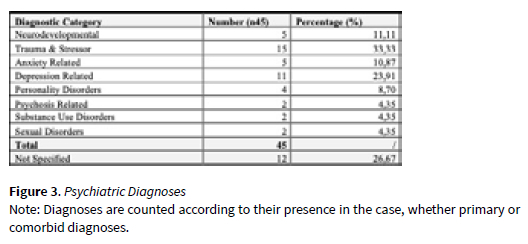
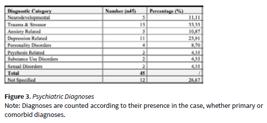
Of the 45 case studies analysed, 33 (73.3%) identified patient psychiatric diagnoses (see Figure 3). The diagnostic categories outlined in the Diagnostic and Statistical Manual of Mental Disorders, fifth edition (DSM-5), were used to guide the analysis (American Psychiatric Association, 2013). The results revealed diagnoses within the Trauma- and Stressor-Related Disorders category (33.3%) were most prominent across the case studies included. This was followed by the Depressive Disorders category (23.9%).
Ethics
Writing up psychotherapy case studies is ethically contested, given the challenges related to ensuring patient confidentiality and protecting the therapeutic relationship, while still striving to advance psychological knowledge through publication (Fallon, 2018). This scoping review thus aimed to ascertain whether, and how, authors addressed this ethical dilemma. The analysis found that 37 (82.22%) authors explicitly stated that patient information was anonymised through mechanisms such as changing personal information and using pseudonyms. Although it is likely that the remaining eight (17.78%) case studies were anonymised, it was not overtly stated. A total of 25 (55.56%) case studies reported that informed consent (or assent) for publication was provided by the patients themselves. One case study noted that the patient read the full manuscript prior to publication (Naidu & Shabangu, 2015). Nine (20%) of the authors discussed their ethical considerations of writing up psychotherapy case studies more extensively. These included ethical considerations around the dual role of psychotherapist and researcher (Coetzee, 2019; Coetzee et al., 2019), the power and racial dynamics existing between patient and therapist that may influence consent (Hartley & Kruger, 2017; Kruger, 2020a), and the ethics of applying Eurocentric psychological theory to the South African context (Ivey & Myers, 2008).
Thematic Analysis of Case Studies
Treatment Applicability
A number of instrumental case studies sought to demonstrate the implementation and efficacy of internationally established treatment options for the South African population. Five case studies outlined the implementation of CBT for post-traumatic stress disorder (PTSD) in South African adults. This included TF-CBT (Boulind & Edwards, 2008; Drake & Edwards, 2012; Padmanabhanunni & Edwards, 2013), social cognitive therapy (Padmanabhanunni & Edwards, 2015), and prolonged exposure therapy for PTSD (Booysen & Kagee, 2020). Three case studies demonstrated the applicability of TF-CBT among South African children and adolescents diagnosed with PTSD (Haine & Knoetze, 2021; Padmanabhanunni & Edwards, 2016; Payne & Edwards, 2009). The studies concluded that the CBT based interventions used were generally effective in reducing the presence or intensity of PTSD symptoms, and therefore considered 'transferable' to the South African context.
A further two case studies demonstrated the successful treatment of female patients with PTSD from an integrative perspective, using the South African developed Wits Trauma Model (Papaikonomou, 2009; Teodorczuk, 2017). On the other hand, a psychodynamic approach to the treatment of PTSD was described by Labe (2005), using the guidelines of Judith Herman (1997). It is important to highlight that seven of these case studies involved psychotherapy with women who either experienced violence in the community or were sexually assaulted (Labe, 2005; Padmanabhanunni & Edwards, 2013, 2015, 2016; Papaikonomou, 2009; Payne & Edwards, 2009; Teodorczuk, 2017).
Beyond interventions for PTSD, case studies described the process and efficacy of CBT interventions for social phobia (Edwards, 2022) and attention-deficit/hyperactivity disorder (ADHD) in SA (Whitefield-Alexander & Edwards, 2009). Another case study illustrated the use of an attachment-based intervention (Theraplay) that was developed in the United States (US) (Mohamed & Mkabile, 2015). It was concluded that the intervention was well-suited and effective with a mother-child dyad from a low-income community in Cape Town (Mohamed & Mkabile, 2015). Furthermore, a case study authored by Davies (2017) described the application of a Western developed integrative treatment model for children called the Sequentially Planned Integrative Counselling for Children Model (SPICC). Davies (2017) recounted the implementation of the model over 18 sessions with an eight-year-old child (living in a children's home) diagnosed with ADHD, oppositional defiant disorder (ODD) and learning disorders. The intervention was deemed appropriate and applicable within the South African context (Davies, 2017). Finally, an instrumental case study described the successful implementation of the US developed Improving Aids Care After Trauma (impACT) in SA (Knettel et al., 2020). Knettel et al. (2020) found that the manualised behaviour-based intervention has potential to be effective in SA, when delivered by trained therapists.
Demonstrating the Application of Theory
A number of psychotherapy case studies provided an in-depth psychological formulation and overview of the treatment process, in order to illustrate how theory can be applied to understand the presentation and treatment of South African individuals. This included the application of psychodynamic theory to the formulation and treatment of childhood ADHD (Perkel, 2019), major depressive disorder (MDD) (Hartley & Kruger, 2017), grief (Jordan, 2006) and PTSD (Labe, 2005), long-term schema therapy (Edwards, 2022), Bionian field theory of anxiety (Cartwright, 2019) and the powerful use of poetry in narrative therapy (Naidu & Shabangu, 2015).
Psychotherapy case studies were also employed to demonstrate how events, phenomena, or behavioural characteristics could be theoretically understood. This included how the important role that siblings play in South African families can be understood as lateral self-object experiences (Hart, 2019) or the influence that maternal complex PTSD may have on mothering South African children with special needs (Coetzee, 2019). A case study by Bradfield (2017) showed the manifestations of autistoid personality organisation and Kruger (2021) used psychodynamic concepts to frame a mother-daughter relationship amid the Covid-19 pandemic.
Case studies also showed how theory can be used to understand the therapeutic relationship and process. The phenomenon of therapeutic impasse and rupture and repair was understood psychodynamically by Laurenson (2017) and also by Card (2017) in reference to racial differences between therapist and patient. Transference-countertransference dynamics were also elaborated on in case studies by Card and Knight (2016), with Rosenbaum et al. (2012) highlighting how negative countertransference may impede on therapists' ability to mentalise. Two case studies specifically focused on therapist challenges in the treatment process of borderline personality disorder (Cambanis, 2012) and psychosis (Saayman, 2017). Lastly, Kottler (2015) used self-psychology theory as a lens through which the therapeutic relationship between a gay identifying male patient and lesbian identifying female therapist was explored.
Psychotherapy in SA: Dynamics, Considerations, and Context
Race and Relationships
A theme of working with difference between therapist and patient was identified in the case studies. Specifically, a number of case studies explored how racialised transference-countertransference, difference, othering, and racism may manifest in the post-apartheid psychotherapy space, as displayed through individual cases (Coetzee et al., 2019; Knight, 2013; Sibanda, 2020).
Traditional African Belief Systems
A division between indigenous/traditional African systems of knowledge and psychological theory has long existed. Two published case studies offered a psychoanalytic (Kleinian Object Relations and Freudian Psychoanalysis) understanding of bewitchment (Ivey, 2013; Ivey & Myers, 2008). Furthermore, a case study authored by Ngcobo and Edwards (2012) offered an understanding of depression through a traditional African lens, viewing it as a 'creative illness', and Kekae-Moletsane (2008) outlined the incorporation of a traditional seSotho game (Masekitlane) into therapy.
Government Institutions
A number of case studies highlighted the shortcomings of governmental institutions in SA. Ranging from the psychological impact of residing in an institutionalised care facility on children (Davies, 2017; Goldschmidt, 2019), to the ineffectiveness of the criminal justice system in response to child abuse and rape (Padmanabhanunni & Edwards, 2015; Payne & Edwards, 2009). Others discussed the challenges associated with conducting psychotherapy in the overburdened public health care system in SA (Booysen & Kagee, 2020; Hartley & Kruger, 2017; Knettel et al., 2020; Saayman, 2017; Smith et al., 2013).
Socioeconomic Concerns and Poverty
53.33% of the case studies highlighted the challenges faced by patients living in under-resourced or low-income communities. This was discussed according to the limited access that South Africans have to healthcare, as well as poor service delivery (Booysen & Kagee, 2020; Maine & Knoetze, 2021; Padmanabhanunni & Edwards, 2013, 2015). On the other hand, Kruger (2020a) specifically considered the lived experience of motherhood in poverty, and its relation to guilt, anger, and shame.
Violence and Trauma
Importantly, the link between violence and trauma among South Africans was highly prevalent in the case studies reviewed. A total of 22 (48.89%) case studies included the theme of violence and 27 (60%) referred to trauma (or traumatisation), irrespective of clinical diagnoses. Specifically, 13 (28.89%) referred to violence associated with criminality (including gangsterism and theft), nine (20%) to sexual violence, 11 (24.44%) to child abuse, and four (8.89%) to childhood sexual abuse. A case study authored by Padmanabhanunni and Edwards (2013) specifically focused on trauma following 'corrective rape' of a lesbian woman, while Knight (2019) outlined the manifestation of the intergenerational transmission of trauma of a young African woman. Lastly, Kruger (2019) described the phenomenon of intimate partner violence (IPV) in her case study of a woman living in a low-income community.
Emotional Experiences
Case studies were also analysed according to themes related to the emotional experiences of patients. Notably, the most prominent affective experiences described across the case studies were shame (55.56%) and anger (51.11%). Additional affective states described included the presence of low mood (44.44%), anxiety (35.56%), guilt (35.56%), and grief (22.22%). Fewer case studies described patient distress as manifesting in somatic symptoms (6.67%).
Discussion
This scoping review was informed by the call for relevance in, and decolonisation of, South African psychology in the form of contextualised knowledge, with consideration to the ongoing debate regarding the value of psychotherapy case studies. The aim was thus to develop a descriptive overview of the frequency, scope, and characteristics of South African psychotherapy case studies available in the literature over the last 20 years. A total of 45 psychotherapy case studies were included, informing analysis and interpretation of results.
It is evident that the number of psychotherapy case studies being published has incrementally increased each year. This corresponds with the assertion that, despite facing wide critique, the case study methodology is making its resurgence, in line with the growth of the postmodernist movement across the social sciences (Edwards, 2001; Fishman, 2013; Mackrill & Iwakabe, 2013). One may consider that an increase in knowledge that is context-dependent being published in SA meets the call for psychology to be "socially aware, socially responsible, and constantly engage in conversations and an exchange of ideas with society" (Kramer et al., 2001, p. 2). The fact that the case studies were distributed between the public and private health settings, as well as University clinics, may be interpreted to further support this imperative. The authors of psychological case studies appear to be distributed within the fields of clinical psychology (predominant) and counselling psychology, however, the majority of authors (78%) were associated with various universities.
In terms of patient demographics, it is significant to note that case studies generally described individuals according to their sex, racial identity, and age group. Although debated in the literature, specifying patient racial identity within the South African therapy setting is considered to be relevant, as "South African society continues to be strongly characterised by the power of 'race' and racism as determinants of social division, interaction and identity" (Duncan & Bowman, 2009, p. 93; P. B. Jackson et al., 2010). The assertion made by Duncan and Bowman (2009, p. 94) regarding "ongoing racialised inequality" in SA necessitates recognition of the power dynamics existing between patient and therapist (author), as research indicates psychology in SA (specifically, clinical psychology) continues to be dominated by white therapists (A. L. Pillay & Nyandeni, 2021; Young & Saville Young, 2019). Of the psychotherapy case studies analysed, patients who racially identified as African were of the highest percentage (48.9%). One may interpret this in relation to population composition, as individuals identifying as African constitute the predominant racial group in SA (81.4%) according to Statistics South Africa (Stats SA, 2022). On the other hand, a consideration as to the demographics and positionality of the authors writing about African patients is an area for further consideration and analysis.
Case studies were relatively evenly distributed between intrinsic and instrumental case studies. However, those rooted within the psychodynamic psychotherapy paradigm dominated, corresponding with the historical use of case studies in psychology (Pletsch, 1982). Psychodynamically informed cases were mostly associated with intrinsic, narrative case studies that demonstrated (paradigmatically or ethnographically) the application of theory and the process and dynamics related to therapy through a theoretical lens. These case studies were valuable in their foregrounding of intra-and interpersonal dynamics within the therapeutic space, as representative of the South African context. On the other hand, a number of CBT and integrative case studies typically took on the systematic case study methodology and paradigmatic approach. They were highly valuable in their analysis of the 'transferability' of evidence-based treatments to the SA context, while illustrating associated processes, barriers, and challenges. While it may be said that case studies assessing the transferability of Western developed interventions in SA represent a continued reliance on Eurocentric psychological knowledge, they also include an implicit questioning of the appropriateness of the interventions. Furthermore, by analysing the appropriateness and efficacy of these treatment approaches in SA, clinicians inherently recognise the importance of context and resist the Eurocentric notion of universalistic knowledge application, thus aligning with the question of relevance and decolonisation of South African psychology (Hartley & Kruger, 2017).
The relevance of psychology is considered to be a complicated concept in SA, as it is nuanced and challenging to concisely define and thus evaluate (Ahmed & Pillay, 2004; Kagee, 2014; Long, 2013). However, Long (2013) contends that relevance can be viewed according to whether psychology (and psychological research) truly reflects and grapples with pertinent issues facing society, as embedded within a specific historical context. Thus, the contributions of uniquely South African psychotherapy case studies in pursuing relevance may also be analysed/evaluated according to the themes and issues that they address or highlight.
A key theme that emerged from the case studies was the presence of violence and trauma within South African society. Trauma was not only framed in Westernised diagnostic terms (by PTSD), but also regarding complex trauma (Coetzee, 2019), the intergenerational transmission of trauma (Knight, 2019), childhood traumatic grief (Haine & Knoetze, 2021), trauma associated with gender based violence (GBV), sexual assault and rape, including corrective rape (Coetzee, 2019; Knettel et al., 2020; Kruger, 2019; Labe, 2005; Padmanabhanunni & Edwards, 2013, 2015, 2016; Papaikonomou, 2009; Payne & Edwards, 2009), theft and crime (Papaikonomou, 2009; Payne & Edwards, 2009; Teodorczuk, 2017).
The current review of case studies strongly suggests that following from colonisation (and coloniality) and apartheid, the traumatisation of South Africans continues. Specifically, paying attention to the intergenerational transmission of trauma (Knight, 2019) is relevant as it reflects the ongoing psychological manifestations of SA's history of violence and oppression (Crankshaw & Dwarika, 2023; Theisen-Womersley, 2021). SA is understood to have a high crime rate (including crimes that are rooted in gang affiliations) and the highest rates of GBV in the world (Breetzke, 2012; Snodgrass & Bodish, 2015; Swartz, 2012). Also highlighted in some case studies is the continued influence of structural violence (Snodgrass & Bodish, 2015) or the "slow violence of poverty" (Kruger, 2020b, p. 5; Kruger & Lourens, 2016).
Thus, the concepts of structural violence and the slow violence of poverty can be carried through in interpreting the results, as many of the case studies analysed included themes of how governmental institutions repeatedly 'fail' South Africans. Structural violence was present in case studies that highlighted the inefficacy of child protective services (and the criminal justice system) in protecting the physical safety of South African youth (Davies, 2017; Goldschmidt, 2019; Padmanabhanunni & Edwards, 2016; Payne & Edwards, 2009). The ineffectiveness of the criminal justice system was also emphasised in case studies regarding challenges in prosecuting perpetrators of rape, committed in adulthood. In terms of public health care in SA, it is widely documented that the system is over-burdened and under-resourced, which may create challenges in the provision of mental health care. Thus, one may consider that the presence of trauma in South African psychotherapy case studies is not only individually relevant, but representative of the continued presence of structural violence (felt most acutely by marginalised individuals) as rooted within colonial and apartheid dynamics (Long, 2017).
Historically, psychology in SA was typically (or primarily) available to white South Africans able to pay private practice fees. Despite post-1994 governmental and institutional changes, psychology services in the public sector remain inaccessible due to a lack of human and material resources (de Kock & Pillay, 2017). A study conducted by de Kock and Pillay (2017) found that despite above 70% of the South African population being reliant on the public health system, there was a ratio of roughly 2.6 clinical psychologists per 100,000 South Africans. Thus, while the challenges of working in the public health sector were outlined in the case studies, one may also consider it appropriate that at least 33.3% of the case studies analysed were based in the public health care system. It is possible that the knowledge produced by these studies contributes to a more relevant South African psychology as they include descriptions of time-limited treatment and reflect some of the needs of those relying on public health care.
It is important to note that only two case studies focused on the intersection (or gap) between 'Western' psychology and traditional or indigenous knowledge or beliefs (Ivey, 2013; Ivey & Myers, 2008). This indicates an area for increased focus in pursuing 'relevance' in South African psychology, as Cooper (2013, p. 217) highlights "how an Africentric perspective in psychology could enrich theoretical visions and methodological strategies to extend the frontiers of the discipline" in the pursuit of decolonising psychological knowledge. However, so long as indigenous African epistemologies continue to be 'muted' in psychological literature, relevance shall be contested (Cooper, 2013; Mkhize, 2021). Therefore, the scarcity of psychotherapy case studies in this area is highlighted as a concern, and a prioritised gap for attention in the future.
Lastly, one may consider the relevance of the affective themes included in South African psychotherapy case studies. A prominent theme revealed in the case studies was the experience of anger. Although each case study may not have specifically focused on anger, 51.1% recognised anger as an affect experienced by the patient. This is significant as clinicians argue that the DSM-5 does not adequately recognise anger, or that anger is over pathologised (medicalised) in women (Anand & Malhi, 2009; Kruger et al., 2014). The experience of shame was also highly prevalent in the case studies (55.56%). Shame is documented in the literature according to its salience in relation to stigma (for example, mental health or HIV/Aids associated), post-apartheid 'guilt', poverty, shame within the psychotherapy setting, and by perpetrating or being victim to violence (Busisiwe & Rosenblatt, 2019; Kruger, 2012; Swartz, 2012; Willan et al., 2024). One may thus consider whether this reflects the interconnectedness between anger, shame, and trauma as documented in the existing literature, particularly within the South African context (Fleming & Kruger, 2013; Kruger, 2012, 2019; Theisen-Womersley, 2021). Equally, the affective experiences of shame among South Africans may not only relate to trauma, but also with poverty and difference within the current socio-political context (Kruger, 2012; Kruger & Lourens, 2016; Lappeman et al., 2021; Swartz, 2012). One may contend that the presence of these affective themes in South African psychotherapy case studies is relevant as they are informed by and rooted in historical context and influenced by immediate contextual factors.
Strengths and Limitations
This scoping review focused on in-depth, full, therapeutic cases and therefore excluded brief case vignettes and multiple (or collective case studies). Even brief case reports may also contribute meaningfully to relevant knowledge generation in SA, and warrant further analyses. A limitation of this scoping review pertains to difficulties locating and accessing psychotherapy case studies included as book chapters. Despite incorporating Google Books as an online search platform, due to inconsistent availability of e-books online, it is possible that case studies were not identified in the search. However, this limitation is relevant as the case studies included in the scoping review are considered to reflect what is readily available in the public domain. Furthermore, due to the broad focus of scoping reviews, this research article offers only a glimpse of the knowledge produced by South African psychotherapy case studies in the literature. Lastly, while the authors' professions and work environments (private/public sector) were considered, the demographics/ positionality of the authors may be an area worth exploring. However, in the pursuit of relevance in South African psychology, this scoping review (descriptive as it is by nature) may be considered as a 'starting point' for deeper analyses of the themes included.
Implications for Future Research
The results of this scoping review indicate that there is indeed a growing database of uniquely South African psychotherapy case studies available in the literature. Thus, there is a possibility to do more focused investigations into South African psychotherapy case studies, for example regarding the ethics of writing up clinical cases, the efficacy of Western-developed treatment approaches in SA, understandings of the therapeutic relationship in the South African context, how trauma is represented in SA, and related representations of affective experiences in the South African population. The limited inclusion and representation of indigenous knowledge systems in South African psychotherapy case studies is specifically highlighted for future research.
Conclusion
Despite the debate regarding the value of psychotherapy case studies, particularly within the South African context, this scoping review revealed that there is an upward trend in the number of psychotherapy case studies being published. This suggests the publication of context-dependent knowledge in the form of psychological case studies is gradually increasing, constituting one possible mechanism of decolonising South African psychology. Although few case studies produced generalisable knowledge in the conventional scientific sense, one may argue that they offer value through "naturalistic generalisation" (Evers & Wu, 2006, p. 514) by reflecting some of the key challenges faced by individual South Africans seeking psychotherapy in different settings.
The case studies analysed both demonstrated the adaptation and implementation of internationally developed therapy models in the South African context and illustrated the ways in which the lives and challenges of individuals can be understood through a theoretical lens. Furthermore, South African psychotherapy case studies have both directly and indirectly accounted for the challenges faced by patients individually, within the community setting, according to SES, and as a result of ongoing inequality and structural violence. Thus, following Long's (2013) understanding of relevance in psychology, the pertinent individual and societal challenges were indeed foregrounded.
Therefore, case studies can be considered as contributing to a more decolonised psychology by foregrounding individual experience as located within both immediate and historical context and emphasising the importance of trauma and structural violence in SA. Furthermore, by conveying the lived emotional experiences of South Africans, with an inadvertent focus on the emotions of anger, shame, sadness, and anxiety, case studies highlight the influence that context and social structures can have on patients' internal worlds. Lastly, psychotherapy case studies may contribute to a more decolonised psychology by investigating the applicability of Eurocentric theories and treatment models in SA and describing and understanding the use of indigenous knowledge in psychotherapy. One may therefore conclude that South African psychotherapy case studies are indeed a potential mechanism through which contextually appropriate psychological knowledge can be generated with the aim of dismantling universalistic reliance on Eurocentric psychological knowledge that currently maintains hegemony in SA.
Acknowledgements
The authors would like to thank Dr Andrea Palk for her valuable editorial input on this paper.
References
- Ahmed, R., & Pillay, A. L. (2004). Reviewing clinical psychology training in the post-apartheid period: Have we made any progress? South African Journal of Psychology, 34(4), 630-656.
- American Psychiatric Association. (2013). Diagnostic and Statistical Manual of Mental Disorders: DSM-5 (5th ed.). American Psychiatric Association Publishing.
- American Psychological Association. (2015). APA Dictionary of Psychology (G. R. Vanden-Bos, Ed.; Second). American Psychological Association.
-
Anand, S., & Malhi, G. S. (2009). Why the DSM-V Needs to Address Anger. The Journal of Clinical Psychiatry, 70(10), 1478-1480. https://doi.org/10.4088/JCP.08l04786whi
» https://doi.org/10.4088/JCP.08l04786whi -
Arksey, H., & O'Malley, L. (2005). Scoping studies: towards a methodological framework. International Journal of Social Research Methodology, 8(1), 19-32. https://doi.org/10.1080/1364557032000119616
» https://doi.org/10.1080/1364557032000119616 -
Avenier, M.-J., & Thomas, C. (2015). Finding one's way around various methodological guidelines for doing rigorous case studies: A comparison of four epistemolog-ical frameworks. Systèmes d'Information et Management, 20(1), 1-32. https://doi.org/10.3917/sim.151.0061ï
» https://doi.org/10.3917/sim.151.0061ï - Bain, K. (2011). 'Hold my hand, I'm dying': Identification in attachment and melancholia. Psycho-Analytic Psychotherapy in South Africa, 18(2), 1-29.
- Baloyi, L. (2021). From teaching psychology in conqueror South Africa to teaching African swa moya in the psychology cirriculum: Critical reflections and experiences in a Masters Clinical Psychology programme. South African Journal of Psychology, 51(3), 453-463.
- Barker, C., Pistrang, N., & Elliot, R. (2002). Research Methods in Clinical Psychology: An Introduction for Students and Practitioners (2nd ed.). John Wiley & Sons, Ltd.
-
Booysen, D. D., & Kagee, A. (2020). Implementing Prolonged Exposure Therapy for PTSD in a Context of Ongoing Adversity: A Clinical Case Study. Clinical Case Studies, 19(4), 258-269. https://doi.org/10.1177/1534650120925918
» https://doi.org/10.1177/1534650120925918 -
Boulind, M., & Edwards, D. (2008). The Assessment and Treatment of Post-Abortion Syndrome: A Systematic Case Study From Southern Africa. Journal of Psychology in Africa, 18(4), 539-547. https://doi.org/10.1080/14330237.2008.10820233
» https://doi.org/10.1080/14330237.2008.10820233 - Bradfield, B. (2017). Without Form and Void: Working with Autistic Defences in a Psychoanalytic Treatment . In Z. G. Knight (Ed.), The Art of Psychotherapy: Case Studies, Processes and Techniques (pp. 13-29). Nova Science Publishers Inc.
-
Breetzke, G. D. (2012). Understanding the magnitude and extent of crime in post-apartheid South Africa. Social Identities, 18(3), 299-315. https://doi.org/10.1080/13504630.2012.661998
» https://doi.org/10.1080/13504630.2012.661998 -
Briere, J., & Scott, C. (2015). Complex Trauma in Adolescents and Adults. Psychiatric Clinics of North America, 38(3), 515-527. https://doi.org/10.1016/j.psc.2015.05.004
» https://doi.org/10.1016/j.psc.2015.05.004 - Bryman, A. (2016). Social Research Methods (Internatio). Oxford University Press.
- Busisiwe, N., & Rosenblatt, P. C. (2019). From 'Death Sentence" to Hope, HIV and AIDS in South Africa. In C.-H. Mayer & E. Vanderheiden (Eds.), The Bright Side of Shame: Transforming and Growing Through Practical Applications in Cultural Contexts (1st ed., pp. 77-87). Springer.
-
Cambanis, E. V. A. (2012). Treating borderline personality disorder as a trainee psychologist: Issues of resistance, inexperience and countertransference. In Journal of Child and Adolescent Mental Health (Vol. 24, Issue 1, pp. 99-109). https://doi.org/10.2989/17280583.2011.639075
» https://doi.org/10.2989/17280583.2011.639075 - Card, M. (2017). Please Acknowledge What You Have Done to Me: Working Through Rupture and Repair in the Therapeutic Relationship. In Z. G. Knight (Ed.), The Art of Psychotherapy: Case Studies, Processes and Techniques (pp. 113-139). Nova Science Publishers, Inc.
- Card, M., & Knight, Z. G. (2016). Cushioned Patient, Turmoiled Therapist: Awareness and Use of Countertransference and Enactment as a Part of the Therapeutic Process. In Z. G. Knight (Ed.), Psychoanalysis: Perspectives, Techniques and Socio-Psychological Implications (pp. 107-128). Nova Science Publishers, Inc.
- Cartwright, D. (2019). 'Terrible twos': Developing the capacity to think and feel in the analytic field. Psycho-Analytic Psychotherapy in South Africa, 27(1), 34-57.
- Casper, F. (2007). Two Babies in Two Bathtubs - Don't Throw Out Either, But Rather Advance Both: Discussion of Edwards, Eels, and Messer Papers. Pragmatic Case Studies in Psychotherapy, 3(1), 59-67.
-
Chilisa, B. (2017). Decolonising transdisciplinary research approaches: an African perspective for enhancing knowledge integration in sustainability science. Sustainability Science, 12(5), 813-827. https://doi.org/10.1007/s11625-017-0461-1
» https://doi.org/10.1007/s11625-017-0461-1 -
Coetzee, O. (2019). Complex PTSD in relatives of people with ID: an illustrative clinical case study from South Africa. Psychoanalytic Psychotherapy, 33(3), 175-191. https://doi.org/10.1080/02668734.2019.1650815
» https://doi.org/10.1080/02668734.2019.1650815 - Coetzee, O., Adnams, C., & Swartz, L. (2019). Finding Common Ground in the Context of Difference: A South African Case Study. Culture, Medicine, and Psychiatry, 43(1), 277-289.
- Colquhoun, H. L., Levac, D., O'Brien, K. K., Straus, S., Tricco, A. C., Perrier, L., Kastner, M., & Moher, D. (2014). Scoping Reviews: Time for clarity in definition, methods, and reporting. Journal of Clinical Epidemiology, 67, 1291-1294.
-
Cooper, S. (2013). Africanizing South African Psychology. Journal of Black Psychology, 39(3), 212-222. https://doi.org/10.1177/0095798413478070
» https://doi.org/10.1177/0095798413478070 -
Courtois, C. A. (2008). Complex trauma, complex reactions: Assessment and treatment. Psychological Trauma: Theory, Research, Practice, and Policy, S(1), 86-100. https://doi.org/10.1037/1942-9681.S.1.86
» https://doi.org/10.1037/1942-9681.S.1.86 -
Crankshaw, A. T., & Dwarika, V. M. (2023). Exploring Psychologists' Interventions for Trans-generational Trauma in South Africa's Born Free Generation. Trauma Care, 3(4), 212-236. https://doi.org/10.3390/traumacare3040020
» https://doi.org/10.3390/traumacare3040020 -
Cullen, K., Rhodes, P., Brockman, R., Hunt, C., & Langtiw, C. L. (2020). Decolonising clinical psychology: National and international perspectives. Clinical Psychologist, 24(3), 211-222. https://doi.org/10.1111/cp.12228
» https://doi.org/10.1111/cp.12228 - Davies, J. C. (2017). Daisy: From Dissociation to Resolution Using an Integrative Approach to Working with Children. In Z. G. Knight (Ed.), The Art of Psychotherapy: Case Studies, Processes and Techniques (pp. 141-162). Nova Science Publishers, Inc.
-
de Kock, J. H., & Pillay, B. J. (2017). A situation analysis of clinical psychology services in South Africa's public rural primary care settings. South African Journal of Psychology, 47(2), 260-270. https://doi.org/10.1177/0081246316673243
» https://doi.org/10.1177/0081246316673243 - de la Rey, C., & Ipser, J. (2004). The call for relevance: South African Psychology ten years into democracy. South African Journal of Psychology, 34(4), 544-552.
- Doan-Minh, S. (2019). Corrective Rape: An Extreme Manifestation of Discrimination and the State's Complicity in Sexual Violence. Hastings Women's Law Journal, 30(1), 167-197.
-
Drake, B., & Edwards, D. (2012). Treatment of Posttraumatic Stress Disorder Following an Armed Robbery: A Case Study Testing the Transportability of Trauma-Focused Cognitive-Behavioural Therapy to Urban Africans. Journal of Psychology in Africa, 22(3), 359-368. https://doi.org/10.1080/14330237.2012.10820540
» https://doi.org/10.1080/14330237.2012.10820540 - Duncan, N., & Bowman, B. (2009). Liberating South African Psychology: The Legacy of Racism and the Pursuit of Representative Knowledge Production. In M. Montero & C. C. Sonn (Eds.), Psychology of Liberation: Theory and Applications (pp. 93-114). Springer.
- Eatough, v., & Smith, J. A. (2017). Interpretative Phenomenological Analysis. In C. Willig & W. Stainton-Rogers (Eds.), Handbook of Qualitative Psychology (2nd ed., pp. 193-211). Sage.
-
Edwards, D. (1998). Types of Case Study Work: A Conceptual Framework for Case-Based Research. Journal of Humanistic Psychology, 38(3), 36-70. https://doi.org/10.1177/00221678980383003
» https://doi.org/10.1177/00221678980383003 - Edwards, D. (2001). Systematic case study research in clinical and counselling psychology. In S. Laher, A. Fynn, & S. Kramer (Eds.), Transforming Research Methods in the Social Sciences: Case Studies from South Africa (pp. 151-167). Wits University Press.
- Edwards, D. (2022). Kelly's Circle of Safety and Healing: An Extended Schema Therapy Narrative and Interpretative Investigation. Pragmatic Case Studies in Psychotherapy, 18(3), 210-261.
- Erwin, K. (2012). Race and race thinking: reflections in theory and practice for researchers in South Africa and beyond. Transformation, 79(1), 93-113.
-
Evans, M. (2016). Structural Violence, Socioeconomic Rights, and Transformative Justice. Journal of Human Rights, 15(1), 1-20. https://doi.org/10.1080/14754835.2015.1032223
» https://doi.org/10.1080/14754835.2015.1032223 - Evers, C. W., & Wu, E. H. (2006). On Generalising from Single Case Studies: Epistemological Reflections. Journal of Philosophy of Education, 40(4), 511-526.
- Fallon, T. (2018). Sharing Patient Cases: Balancing Confidentiality and Educational Needs. Psychiatric Times, 35(8), 1-7.
- Farmer, P. E., Nizeye, B., Stulac, S., & Keshavjee, S. (2016). Structural Violence and Clinical Medicine. Understanding and Applying Medical Anthropology, 3(10), 336-343.
-
Fernández, J. S., Sonn, C. C., Carolissen, R., & Stevens, G. (2021). Roots and Routes Toward Decoloniality Within and Outside Psychology Praxis. Review of General Psychology, 25(4), 354-368. https://doi.org/10.1177/10892680211002437
» https://doi.org/10.1177/10892680211002437 - Fishman, D. B. (2013). The Pragmatic Case Study Method for Creating Rigorous and Systematic, Practitioner-Friendly Research. Pragmatic Case Studies in Psychotherapy, 9(4), 403-425.
- Fleming, K., & Kruger, L.-M. (2013). 'She keeps his secrets': A gendered analysis of the impact of shame on the non-disclosure of sexual violence in one low-income South African community. African Safety Promotion Journal, 11(2), 107-124.
-
Flyvbjerg, B. (2006). Five Misunderstandings About Case-Study Research. Qualitative Inquiry, 12(2), 219-245. https://doi.org/10.1177/1077800405284363
» https://doi.org/10.1177/1077800405284363 - Frosh, S. (2003). Psychosocial studies and psychology: Is a critical approach emerging? Human Relations, 56(12), 1545-1567.
- Goldschmidt, L. (2019). Mitigating risks for children in institutional care: A case study. Psycho-Analytic Psychotherapy in South Africa, 27(1), 76-108.
-
Haine, P., & Knoetze, J. J. (2021). Childhood traumatic grief counselling: A South African case study. Journal of Psychology in Africa, 31(5), 539-545. https://doi.org/10.1080/14330237.2021.1978673
» https://doi.org/10.1080/14330237.2021.1978673 -
Haine, P., Young, C., & Booysen, D. D. (2023). Looking back to move forward: a scoping review of counselling psychology in South Africa. South African Journal of Psychology, 53(1), 32-43. https://doi.org/10.1177/00812463221091433
» https://doi.org/10.1177/00812463221091433 -
Hammett, D. (2010). Ongoing contestations: The use of racial signifiers in post-apartheid South Africa. Social Identities, 16(2), 247-260. https://doi.org/10.1080/13504631003691090
» https://doi.org/10.1080/13504631003691090 - Harrison, H., Birks, M., Franklin, R., & Mills, J. (2017). Case Study Research: Foundations and Methodological Orientations. Forum: Qualitative Social Research, 1(19), 1-17.
- Hart, C. (2019). Welcoming Siblings to Self Psychology: Exploring Vertical and Leteral Selfobjects. Psychoanalysis, Self and Context, 14(1), 178-194.
- Hartley, M., & Kruger, L.-M. (2017). On being human: The power of specificity in psychotherapy in the South African context. Psycho-Analytic Psychotherapy in South Africa, 25(2), 75-115.
- Herman, J. (1997). Trauma and Recovery: The Aftermath of Violence - From Domestic Abuse to Political Terror. Basic Books.
- Hilliard, R. B. (1993). Single-Case Methodology in Psychotherapy Process and Outcome Research. Journal of Consulting and Clinical Psychology, 61(3), 373-380.
-
Hodgetts, D. J., & Stolte, O. E. E. (2012). Case-based Research in Community and Social Psychology: Introduction to the Special Issue. Journal of Community & Applied Social Psychology, 22(5), 379-389. https://doi.org/10.1002/casp.2124
» https://doi.org/10.1002/casp.2124 - Hook, D. (2004). Frantz Fanon, Steve Biko, 'psychopolitics' and critical psychology. In D. Hook, N. Mkhize, P. Kiguwa, & A. Collins (Eds.), Critical Psychology (1st ed., pp. 84-114). Juta and Company.
- Ivey, G. (2013). Unconscious Meaning and Magic: Comparing psychoanalysis and African indigenous healing . In C. Smith, G. Lobban, & M. O'Loughlin (Eds.), Psychodynamic Psychotherapy in South Africa: Contexts, Theories and Applications (pp. 142-168). Wits University Press.
- Ivey, G., & Myers, T. (2008). The psychology of bewitchment (Part II): A psychoanalytic model for conceptualising and working with bewitchment experiences. South African Journal of Psychology, 38(1), 75-94.
-
Jackson, B., & Sadler, L. S. (2022). Structural violence: An evolutionary concept analysis. Journal of Advanced Nursing, 78(11), 3495-3516. https://doi.org/10.1111/jan.15341
» https://doi.org/10.1111/jan.15341 -
Jackson, P. B., Williams, D. R., Stein, D. J., Herman, A., Williams, S. L., & Redmond, D. L. (2010). Race and psychological distress: The South African stress and health study. Journal of Health and Social Behavior, 51(4), 458-477. https://doi.org/10.1177/0022146510386795
» https://doi.org/10.1177/0022146510386795 - Jordan, N. (2006). Breaking the cycle of attack and dependency: A case study of a young boy responding to loss with violence. Psycho-Analytic Psychotherapy in South Africa, 14(2), 79-93.
-
Kadish, Y. (2013). Two types of psychic encapsulation in anorexia. Psychoanalytic Psychotherapy, 27(1), 60-76. https://doi.org/10.1080/02668734.2012.761278
» https://doi.org/10.1080/02668734.2012.761278 -
Kadish, Y., & Smith, C. (2020). Psychoanalysis and psychoanalytic psychotherapy in the South African context. Psychoanalytic Psychotherapy, 34(2), 163-179. https://doi.org/10.1080/02668734.2020.1827286
» https://doi.org/10.1080/02668734.2020.1827286 - Kagee, A. (2006). Where is the evidence in South African clinical psychology? South African Journal of Psychology, 36(2), 233-248.
-
Kagee, A. (2014). South African psychology after 20 years of democracy: Criticality, social development, and relevance. South African Journal of Psychology, 44(3), 350-363. https://doi.org/10.1177/0081246314534147
» https://doi.org/10.1177/0081246314534147 - Kekae-Moletsane, M. (2008). Masekitlana: South African traditional play as a therapeutic tool in child psychotherapy. South African Journal of Psychology, 38(2), 367-375.
-
Knettel, B. A., Robertson, C., Ciya, N., Coleman, J. N., Elliott, S. A., Joska, J. A., & Sikkema, K. J. (2020). "I cannot change what happened to me, but I can learn to change how I feel": A case study from ImpACT, an intervention for women with a history of sexual trauma who are living with HIV in Cape Town, South Africa. Psychotherapy, 57(1), 90-96. https://doi.org/10.1037/pst0000263
» https://doi.org/10.1037/pst0000263 -
Knight, Z. G. (2013). Black client, white therapist: Working with race in psychoanalytic psychotherapy in South Africa. The International Journal of Psychoanalysis, 94(1), 17-31. https://doi.org/10.1111/1745-8315.12034
» https://doi.org/10.1111/1745-8315.12034 - Knight, Z. G. (Ed.). (2016). Psychoanalysis: Perspectives, Techniques and Socio-Psychological Implications. Nova Science Publishers Inc.
- Knight, Z. G. (Ed.). (2017). The Art of Psychotherapy: Case Studies, Processes and Techniques. Nova Science Publishers Inc.
-
» https://doi.org/10.11124/JBIES-20-00167 -
Knight, Z. G. (2019). In the shadow of apartheid: Intergenerational transmission of black parental trauma as it emerges in the analytical space of inter-racial subjectivities. Research in Psychotherapy: Psychopathology, Process and Outcome, 22(1), 128-137. https://doi.org/10.4081/ripppo.2019.345
» https://doi.org/10.4081/ripppo.2019.345 - Kottler, A. (2015). Twinship and 'otherness': A self-psychological, intersubjective approach to 'difference'. In K. Togashi & A. Kottler (Eds.), Kohut's Twinship Across Cultures: The Psychology of Being Human (pp. 41-57). Routledge.
- Kramer, S., Fynn, A., & Laher, S. (2001). Research as practice: Contextualising applied research in the South African context. In S. Laher, A. Fynn, & S. Kramer (Eds.), Transforming Research Methods in the Social Sciences: Case Studies from South Africa (pp. 1-15). Wits University Press.
- Kruger, L.-M. (2012). 'Vrot kolletjies': Shame, silence and enactment in psychotherapy with impoverished clients. Psycho-Analytic Psychotherapy in South Africa, 20(2), 1-32.
- Kruger, L.-M. (2015). Ten reasons for doing and reporting case studies in the South African context.
- Kruger, L.-M. (2018, May). Purist positivism and delusions of 'relevance': Disreputable origins and unpalatable functions. Stellenbosch University Psychology Department Newsletter, 19-24.
- Kruger, L.-M. (2019). Of Violence and Intimacy: the Shame of Loving and Being Loved. The Philosophical Journal of Conflict and Violence, 3(1), 55-81.
- Kruger, L.-M. (2020a). Love. In Of Motherhood and Melancholia: Notebook of a Psycho-ethnographer (pp. 97-127). University of Kwa-Zulu Natal Press.
- Kruger, L.-M. (2020b). Of Motherhood and Melancholia: Notebook of a psycho-ethnographer (S. Hines & A. Lockhart, Eds.). University of Kwa-Zulu Natal Press.
- Kruger, L.-M. (2021). Of Love and Violence: Snow White and the Seven Mirrors. In A. Gouws & O. Ezeobi (Eds.), Covid Diaries: Women's Experience of the Pandemic (pp. 214-223). Imbali Academic Publishers.
-
Kruger, L.-M., & Lourens, M. (2016). Motherhood and the "Madness of Hunger": "...Want Almal Vra vir My vir 'n Stukkie Brood" ("...Because Everyone Asks Me for a Little Piece of Bread"). Culture, Medicine, and Psychiatry, 40(1), 124-143. https://doi.org/10.1007/s11013-015-9480-5
» https://doi.org/10.1007/s11013-015-9480-5 -
Kruger, L.-M., van Straaten, K., Taylor, L., Lourens, M., & Dukas, C. (2014). The melancholy of murderous mothers: Depression and the medicalization of women's anger. Feminism and Psychology, 24(4), 461-478. https://doi.org/10.1177/0959353514539653
» https://doi.org/10.1177/0959353514539653 - Labe, D. (2005). Psychotherapy for post-traumatic stress disorder in a young rape survivor: A case study. Journal of Psychology in Africa, 15(2), 177-184.
-
Lappeman, M., Ndwandwa, E., Hunt, X., Ned, L., & Swartz, L. (2021). South African clinical psychology practice: The challenge of local contextual change. Professional Psychology: Research and Practice, 52(5), 494-502. https://doi.org/10.1037/pro0000401
» https://doi.org/10.1037/pro0000401 - Laurenson, H. (2017). When a therapist's therapy implodes: Relational reflections on a case of terminal impasse. Psycho-Analytic Psychotherapy in South Africa, 25(2), 41-74.
- Lewis, B. (2000). Psychiatry and Postmodern Theory. Journal of Medical Humanities, 21(2), 71-84.
-
Long, W. (2013). Rethinking 'relevance': South African psychology in context. History of Psychology, 16(1), 19-35. https://doi.org/10.1037/a0029675
» https://doi.org/10.1037/a0029675 -
Long, W. (2016a). On the Africanization of psychology. In South African Journal of Psychology (Vol. 46, Issue 4, pp. 429-431). SAGE Publications Inc. https://doi.org/10.1177/0081246316650853
» https://doi.org/10.1177/0081246316650853 -
Long, W. (2016b). Psychology in South Africa and the end of history. History of Psychology, 19(3), 220-228. https://doi.org/10.1037/hop0000013
» https://doi.org/10.1037/hop0000013 -
Long, W. (2017). Essence or experience? A new direction for African psychology. Theory and Psychology, 27(3), 293-312. https://doi.org/10.1177/0959354316686428
» https://doi.org/10.1177/0959354316686428 - Long, W., & Foster, D. (2013). The changing face of 'relevance' in South African psychology. Psychology in Society, 45(1), 3-16.
-
Longhofer, J., Floersch, J., & Hartmann, E. (2017). A Case for the Case Study: How and Why They Matter. Clinical Social Work Journal, 45(3), 189-200. https://doi.org/10.1007/s10615-017-0631-8
» https://doi.org/10.1007/s10615-017-0631-8 -
Mackrill, T., & Iwakabe, S. (2013). Making a case for case studies in psychotherapy training: A small step towards establishing an empirical basis for psychotherapy training. Counselling Psychology Quarterly, 26(3-4), 250-266. https://doi.org/10.1080/09515070.2013.832148
» https://doi.org/10.1080/09515070.2013.832148 -
Macleod, C., & Howell, S. (2013). Reflecting on South African Psychology: Published research, 'relevance', and social issues. South African Journal of Psychology, 43(2), 222-237. https://doi.org/10.1177/0081246313482630
» https://doi.org/10.1177/0081246313482630 -
Madonsela, S., Ware, L. J., Scott, M., & Watermeyer, J. (2023). The development and use of adolescent mobile mental health (m-mhealth) interventions in low- and middle-income countries: a scoping review. South African Journal of Psychology, 53(4), 471-483. https://doi.org/10.1177/00812463231186260
» https://doi.org/10.1177/00812463231186260 - Maine, K., & Wagner, C. (2021). Student voices in studies on curriculum decolonisation: A scoping review. Psychology in Society, 61(1), 27-79.
-
Maldonado-Torres, N. (2017). Frantz Fanon and the decolonial turn in psychology: from modern/colonial methods to the decolonial attitude. South African Journal of Psychology, 47(4), 432-441. https://doi.org/10.1177/0081246317737918
» https://doi.org/10.1177/0081246317737918 -
Malherbe, N., & Ratele, K. (2022). What and for whom is a decolonising African psychology? Theory and Psychology, 32(1), 116-130. https://doi.org/10.1177/09593543211027231
» https://doi.org/10.1177/09593543211027231 - Mcleod, J. (2010). Case Study Research in Counselling and Psychotherapy. SAGE Publications Ltd.
-
Midgley, N. (2006). The 'inseparable bond between cure and research': clinical case study as a method of psychoanalytic inquiry. Journal of Child Psychotherapy, 32(2), 122-147. https://doi.org/10.1080/00754170600780273
» https://doi.org/10.1080/00754170600780273 - Mkhize, N. (2021). African/Afrikan-centered Psychology. South African Journal of Psychology, 51(3), 422-429.
-
Mohamed, A. R., & Mkabile, S. (2015). An attachment-focused parent-child intervention for biting behaviour in a child with intellectual disability: A clinical case study. Journal of Intellectual Disabilities, 19(3), 251-265. https://doi.org/10.1177/1744629515572711
» https://doi.org/10.1177/1744629515572711 -
Naidu, T., & Shabangu, S. (2015). Poetry and narrative therapy for anxiety about spinal surgery. Journal of Child and Adolescent Mental Health, 27(1), 75-84. https://doi.org/10.2989/17280583.2015.1034722
» https://doi.org/10.2989/17280583.2015.1034722 -
Naude, P. (2019). Decolonising Knowledge: Can Ubuntu Ethics Save Us from Coloniality? Journal ofBusiness Ethics, 159(1), 23-37. https://doi.org/10.1007/s10551-017-3763-4
» https://doi.org/10.1007/s10551-017-3763-4 - Ngcobo, H., & Edwards, S. (2012). Depression as a Creative Illness: A South African Case Study. Journal of Psychology in Africa, 22(1), 114-119.
-
Nissen, B. (2008). On the determination of autistoid organizations in non-autistic adults. The International Journal of Psychoanalysis, 89(2), 261-277. https://doi.org/10.1111/j.1745-8315.2008.00013.x
» https://doi.org/10.1111/j.1745-8315.2008.00013.x - Nixon, R. (2011). Slow Violence and the Environmentalism of the Poor. Harvard University Press.
-
Padmanabhanunni, A., & Edwards, D. (2013). Victimisation in the Lives of Lesbian-Identified Women in South Africa: Implications for Clinical Assessment and Treatment. Journal of Psychology in Africa, 23(3), 385-392. https://doi.org/10.1080/14330237.2013.10820642
» https://doi.org/10.1080/14330237.2013.10820642 -
Padmanabhanunni, A., & Edwards, D. (2015). A Case Study of Social Cognitive Treatment of PTSD in a South African Rape Survivor: The Central Role of Case Formulation. Journal of Child Sexual Abuse, 24(2), 174-194. https://doi.org/10.1080/10538712.2015.997412
» https://doi.org/10.1080/10538712.2015.997412 - Padmanabhanunni, A., & Edwards, D. (2016). Derailed by a sugar daddy: An investigation of the failed treatment of an adolescent township rape survivor with PTSD. Child Abuse Research: A South African Journal, 17(2), 83-94.
-
Papaikonomou, M. (2009). Rape and Trauma: A Case Study of a Journey of Recovery. Journal of Psychology in Africa, 19(2), 213-216. https://doi.org/10.1080/14330237.2009.10820281
» https://doi.org/10.1080/14330237.2009.10820281 - Payne, C., & Edwards, D. (2009). What services and supports are needed to enable trauma survivors to rebuild their lives? Implications of a systematic case study of cognitive therapy with a township adolescent girl with PTSD following rape. Child Abuse Research in South Africa, 10(1), 27-40.
- Perkel, J. (2019). In search of the missing pieces of mind. Psycho-Analytic Psychotherapy in South Africa, 27(1), 58-75.
-
Pillay, A. L., Ahmed, R., & Bawa, U. (2013). Clinical psychology training in South Africa: A call to action. South African Journal of Psychology, 43(1), 46-58. https://doi.org/10.1177/0081246312474411
» https://doi.org/10.1177/0081246312474411 -
Pillay, A. L., & Nyandeni, L. N. (2021). Is post-apartheid South Africa training more black African clinical psychologists and addressing the historical imbalance? South African Journal of Psychology, 51(1), 147-157. https://doi.org/10.1177/0081246320977985
» https://doi.org/10.1177/0081246320977985 -
Pillay, S. R. (2017). Cracking the fortress: Can we really decolonize psychology? South African Journal of Psychology, 47(2), 135-140. https://doi.org/10.1177/0081246317698059
» https://doi.org/10.1177/0081246317698059 - Pletsch, C. E. (1982). Freud's case studies and the locus of psychoanlytic knowledge. Dynamis: Acta Hispanica Ad Medicinae Scientiarumque Historiam Illustrandam 2, 2, 263-297.
-
Ramey, H. L., & Grubb, S. (2009). Modernism, Postmodernism and (Evidence-Based) Practice. Contemporary Family Therapy, 31(2), 75-86. https://doi.org/10.1007/s10591-009-9086-6
» https://doi.org/10.1007/s10591-009-9086-6 - Rosenbaum, L., Bain, K. M., Esterhuizen, M., & Frost, K. (2012). 'My baby cries for nothing': Mentalisation challenges when working with mothers who struggle to hold their babies in mind. Psycho-Analytic Psychotherapy in South Africa, 20(1), 69-101.
- Saayman, N. (2017). Flying blind in the psychotic storm. Psycho-Analytic Psychotherapy in South Africa, 25(1), 1-33.
-
Saville Young, L. (2011). Research entanglements, race, and recognizability: A psychosocial reading of interview encounters in (Post-) Colonial, (Post-) apartheid South Africa. Qualitative Inquiry, 17(1), 45-55. https://doi.org/10.1177/1077800410389443
» https://doi.org/10.1177/1077800410389443 -
Seekings, J. (2008). The continuing salience of race: Discrimination and diversity in South Africa. Journal of Contemporary African Studies, 26(1), 1-25. https://doi.org/10.1080/02589000701782612
» https://doi.org/10.1080/02589000701782612 - Sibanda, S. (2020). Self-hatred disguised in racial hatred of another. Psycho-Analytic Psychotherapy in South Africa, 28(1), 33-61.
- Smith, C., Lobban, G., & O'Loughlin, M. (Eds.). (2013). Psychodynamic Psychotherapy in South Africa: Contexts, Theories and Applications. Wits University Press.
- Snodgrass, L., & Bodish, A. (2015). Why are We Such a Violent Nation? The Legacy of Humiliation in South Africa. Africa Insight, 43(3), 63-75.
-
Sorsdahl, K., Stein, D. J., & Flisher, A. J. (2010). Traditional Healer Attitudes and Beliefs Regarding Referral of the Mentally Ill to Western Doctors in South Africa. Trans-cultural Psychiatry, 47(4), 591-609. https://doi.org/10.1177/1363461510383330
» https://doi.org/10.1177/1363461510383330 - Sperry, L., & Pies, R. (2010). Writing about clients: Ethical considerations and options. Counselling and Values, 54(2), 1-12.
-
Stats SA. (2022). Census 2022: Statistical Release. https://census.statssa.gov.za/assets/documents/2022/P03014_Census_2022_Statistical_Release.pdf
» https://census.statssa.gov.za/assets/documents/2022/P03014_Census_2022_Statistical_Release.pdf - Stonington, S. D., Holmes, S. M., Hansen, H., Greene, J. A., Wailoo, K. A., Malina, D., Morrissey, S., Farmer, P. E., & Marmot, M. G. (2018). Case Studies in Social Medicine - Attending to Structural Forces in Clinical Practice. The New England Journal of Medicine, 379(20), 1958-1961.
- Suri, H. (2020). Ethical Considerations of Conducting Systematic Reviews in Educational Research. In O. Zawacki-Richter, M. Kerres, S. Bedenlier, M. Bond, & K. Buntins (Eds.), Systematic Reviews in Educational Research: Methodology, Perspectives and Application (pp. 41-54). Springer VS.
-
Swartz, S. (2012). The Broken Mirror: Difference and Shame in South African Psychotherapy. International Journal of Psychoanalytic Self Psychology, 7(2), 196-212. https://doi.org/10.1080/15551024.2012.656351
» https://doi.org/10.1080/15551024.2012.656351 - Teodorczuk, K. (2017). Rape and Sexual Violence in South Africa: A Case Study of Trauma. In Z. G. Knight (Ed.), The Art of Psychotherapy: Case Studies, Processes and Techniques (pp. 163-193). Nova Science Publishers, Inc.
-
Theisen-Womersley, G. (2021). Working with Shame and Trauma. In Trauma and Resilience Among Displaced Populations (pp. 209-232). Springer International Publishing. https://doi.org/10.1007/978-3-030-67712-1_9
» https://doi.org/10.1007/978-3-030-67712-1_9 - Togashi, K., & Kottler, A. (2015). Kohut's Twinship Across Cultures: The Psychology of Being Human. Routledge.
-
Whitefield-Alexander, V., & Edwards, D. (2009). A case of effective single-session treatment for attention deficit and learning problems in a routine clinical practice: the value of a transdiagnostic approach to case formulation. Journal of Child & Adolescent Mental Health, 21(1), 61-72. https://doi.org/10.2989/JCAMH.2009.21.1.8.810
» https://doi.org/10.2989/JCAMH.2009.21.1.8.810 -
Widdowson, M. (2011). Case Study Research Methodology. International Journal of Transactional Analysis Research & Practice, 2(1). https://doi.org/10.29044/v2i1p25
» https://doi.org/10.29044/v2i1p25 -
Willan, S., Shai, N., Majola, T., Mabhida, M., Mngadi, S., Gounden, T., Jewkes, R., Abrahams, N., & Machisa, M. (2024). South African rape survivors' expressions of shame, self-blame and internalized-stigma. SSM - Mental Health, 5(1), 1-9. https://doi.org/10.1016/j.ssmmh.2024.100310
» https://doi.org/10.1016/j.ssmmh.2024.100310 - Willig, C. (2013). Introducing Qualitative Research in Psychology (3rd ed.). Open University Press.
-
Young, C., & Saville Young, L. (2019). Comparing clinical and counselling psychologists' practitioner demographics, key activities, theoretical orientations, values, and career satisfaction: a contribution to the Scopes of Practice debate. South African Journal of Psychology, 49(4), 505-517. https://doi.org/10.1177
» https://doi.org/10.1177
2 The concept of decolonising psychology rests on the critical psychology position that mainstream Eurocentric psychology is rooted in and remains entangled with colonialism (Maldonado-Torres, 2017; Malherbe & Ratele, 2022). Decolonising psychology thus entails disrupting the reliance on hegemonic, decontextualised, and individualistic Eurocentric knowledge by foregrounding previously marginalised indigenous voices/perspectives, interrogating the social and institutional mechanisms that perpetuate coloniality, and advocating for social justice and change (Cullen et al., 2020; Maldonado-Torres, 2017; Malherbe & Ratele, 2022).
3 Throughout this scoping review, the term patient (otherwise referred to as client) is used to refer to individuals engaging in psychotherapy.
4 The American Psychological Association (2015, p. 521) defines the idiographic approach as involving "the thorough, intensive study of a single person or case in order to develop an in-depth understanding of that person or case, as contrasted with the universal aspects of groups of people or cases".
5 The American Psychological Association (2015, p. 993) defines social constructivism as "a school of thought that recognises knowledge as embedded in social context and sees human thoughts, feelings, language, and behaviour as the result of interchanges with the external world...not only knowledge but also reality itself is created in an interactive process".
6 The hermeneutic/interpretivist paradigm focuses on the lived experiences of individuals (subjective position) and how they attach meaning to their experiences. Interpretivism further includes the assumption that these lived experiences are understood through third party (the therapist/researcher) reflections (Avenier & Thomas, 2015).
7 The critical social approach in psychology views individual (personal) and social dynamics as intimately connected and foregrounds the influence that social structures have on individual wellbeing (Frosh, 2003).
8 Google Books was included in the database list to account for case studies that may be published in books, and therefore will not necessarily appear on the journal databases.
9 It is common for authors to anonymise patients by altering personal information (Fallon, 2018). However, it is generally accepted that such alterations should be done tactfully, and in a way that allows the case to be a true representation while still protecting patient confidentiality. Thus, while patient details (names, location, field of work) are anonymised, other demographic details such as sex, race and age group may remain unchanged (Sperry & Pies, 2010).
10 The use of racial or ethnic categories in research has historically been problematic in the South African context (Hammett, 2010; Seekings, 2008). While some scholars critique the continued use of race as a means of 'categorising' people in psychology research (Hammett, 2010; Seekings, 2008), others support the continued need to recognise race in research, given the enormous bearing that it still has in SA in terms of discrimination, inequality, power dynamics, access to resources, and as a form of social identity (Erwin, 2012; Hartley & Kruger, 2017; Kruger, 2020b; Saville Young, 2011). The decision to comment on the racial identities of patients in this paper is based on the link that race has to socioeconomic status in South Africa (apartheid history), the power that it may have in the therapeutic encounter, and the differences in lived experience and cultural identity that may accompany race.
11 Under the apartheid regime, the term 'Coloured' was used to refer to individuals of mixed racial descent. The term is still widely used today, and although viewed as derogatory in some contexts, is also an important term referring to social identity in SA (Hartley & Kruger, 2017).