Cosmology, chemistry, and Aristotle's elemental powers
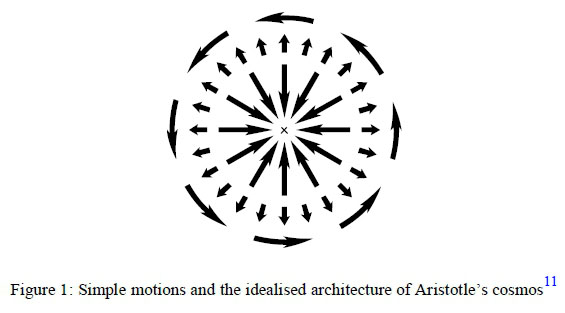
Aristotle employs the simple bodies, or elements, in two rather different scientific contexts, each of which highlights some of their qualities at the expense of others. On the one hand, he uses the elements in the service of cosmology, where their natural motions are imperative to drafting an architectural plan of the cosmos. On the other hand, he uses them in the service of chemistry, where their heat, coldness, dryness, and moistness are decisive in securing accounts of elemental transformation and the generation of composite bodies. Two families of interpretive proposals for the formal principles of Aristotle's elements have been advanced accordingly. One family of interpretations construes the form of a simple body in terms of its cosmological characterisation, while a second construes that form in terms of the simple body's chemical characterisation instead. A critical step in bridging that interpretive divide is thus to bridge the underlying divide between Aristotle's cosmological and chemical characterisations of the sublunary elements. It is that latter task that I set out to accomplish in the present paper. I argue that the hot and the cold are efficient causes, respectively, of the light and the heavy, and further, that the moistness of elemental water and air explains the intermediary natural positions of those elements relative to earth and fire in Aristotle's idealised cosmic landscape. In this way, Aristotle's chemical characterisation of the elements is shown to ground his cosmological characterisation of them.
Aristotle; simple body; element; cosmology; chemistry; elemental powers; elemental motion
 Thumbnail