Educational Innovation for Liberation: Practising a Re-Humanising Pedagogy through African Philosophy
Abstract
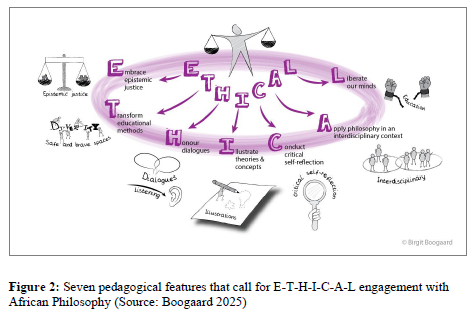
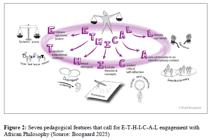
Epistemic boundaries that were established during colonial times persist in many current academic curricula. This article presents ways to overcome such epistemic boundaries. The article addresses the following key question: How can teachers and students across the globe transform education in such a way that it contributes to epistemic justice of historically oppressed knowledge and cultivates critical consciousness? The article introduces education for liberation as a re-humanising pedagogy, through Mogobe Ramose's "pan-epistemic education", Paulo Freire's "pedagogy of the oppressed", and Heinz Kimmerle's dialogical approach to intercultural philosophy. Based on an analysis of the "African Philosophy" course at Wageningen University (WUR), The Netherlands, the article presents seven pedagogical features that have proven to be effective, which can be summarised as E-T-H-I-C-A-L: Embrace epistemic justice; Transform educational methods; Honour dialogues; Illustrate theories and concepts; Conduct critical self-reflection; Apply philosophy in an interdisciplinary context; and Liberate our minds. These seven pedagogical features should not be seen as a framework that leads to ethical engagement. Instead, it recognises education as an ethical undertaking, which requires ethical engagement in education. The seven pedagogical features show that education for liberation calls for transformation of the curriculum in terms of content as well as process. Academic teachers tend to place a lot of emphasis on the content, while they often have limited experience with the design and facilitation of dialogical teaching methods that cultivate critical consciousness. Therefore, the article makes a plea that education for liberation needs innovation on both content and process.
African Philosophy; critical consciousness; re-humanising pedagogy; epistemic justice; dialogue
 Thumbnail
 Thumbnail
 Thumbnail