Educational Innovation for Liberation: Practising a Re-Humanising Pedagogy through African Philosophy
Abstract
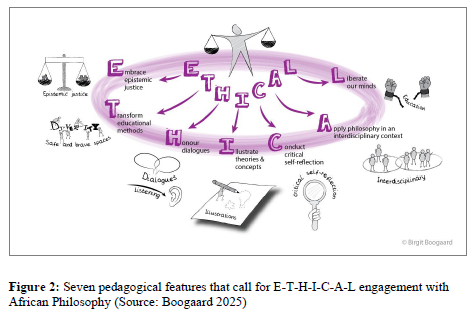
Epistemic boundaries that were established during colonial times persist in many current academic curricula. This article presents ways to overcome such epistemic boundaries. The article addresses the following key question: How can teachers and students across the globe transform education in such a way that it contributes to epistemic justice of historically oppressed knowledge and cultivates critical consciousness? The article introduces education for liberation as a re-humanising pedagogy, through Mogobe Ramose's "pan-epistemic education", Paulo Freire's "pedagogy of the oppressed", and Heinz Kimmerle's dialogical approach to intercultural philosophy. Based on an analysis of the "African Philosophy" course at Wageningen University (WUR), The Netherlands, the article presents seven pedagogical features that have proven to be effective, which can be summarised as E-T-H-I-C-A-L: Embrace epistemic justice; Transform educational methods; Honour dialogues; Illustrate theories and concepts; Conduct critical self-reflection; Apply philosophy in an interdisciplinary context; and Liberate our minds. These seven pedagogical features should not be seen as a framework that leads to ethical engagement. Instead, it recognises education as an ethical undertaking, which requires ethical engagement in education. The seven pedagogical features show that education for liberation calls for transformation of the curriculum in terms of content as well as process. Academic teachers tend to place a lot of emphasis on the content, while they often have limited experience with the design and facilitation of dialogical teaching methods that cultivate critical consciousness. Therefore, the article makes a plea that education for liberation needs innovation on both content and process.
African Philosophy; critical consciousness; re-humanising pedagogy; epistemic justice; dialogue
Introduction
Education for liberation is the direst need of our time and every contribution in that direction is very much appreciated.1 (Ramose 2019, personal communication)
The classic philosophical notion, that "man is a rational animal", did not include the African, the Amerindian and the Australasian (Ramose 2003a). This belief has historically served as a justification for unjust wars of colonisation. A line was drawn, as it were, between the civilised and the uncivilised, those who were rational, philosophical, moral and human, and those who were not, thereby constructing an epistemic boundary between the two (Mignolo and Tlostanova 2006; Ramose 2007). Colonisation of the mind has resulted in the loss of control and ownership over African knowledge systems by the indigenous people. Despite formal colonialism having ended decades ago, the epistemic boundaries that were established during that time have not yet been transcended and Western superiority thinking persists. One way in which these perspectives continue to be manifested, is within universities, where Western academic knowledge dominates the curriculum while indigenous epistemologies remain largely ignored (Bhambra, Gebrial and Niþancýoðlu 2018; Mungwini 2022; Ramose 2016). Colonial legacies in higher education are apparent in the selection of largely Western literature, authors and teachers, and the exclusion of voices and knowledge from the "Global South" (Ramose 2016). In order to discontinue to the perpetuation of epistemic injustice in education, we advocate for the embracement of a diversity of knowledges, in this case specifically African Philosophy.2 Moreover, in present times, the world is confronted with a multitude of social and environmental crises, such as environmental degradation, exploitation, and the climate crisis, in which Western academic knowledge alone is insufficient. Instead, a diversity of knowledges is needed to deal responsibly with these global challenges.
Given the largely Eurocentric content of curricula at universities, a key point is not only to cross epistemic boundaries (what is being taught), but also to do this in a respectful and mutually enriching way, that does not reinforce historical injustices and colonial legacies (how it is being taught). As such, the current article addresses the following key question: How can teachers and students across the globe transform education in such a way that it contributes to epistemic justice of historically oppressed knowledge and cultivates critical consciousness?
To answer this question, we first present theories on education for liberation based on the works of Paulo Freire, Mogobe Ramose and Heinz Kimmerle, who emphasise the need for a re-humanising pedagogy through a dialogical approach. Subsequently, we present the research methodology, which entails a case study analysis of the course "African philosophy" at Wageningen University (WUR) in The Netherlands that has run since 2018. Inspired by the work of intercultural philosopher Kimmerle, and with the support of Ramose and other colleagues, Birgit Boogaard designed the course with the aim to fill a gap at WUR. The success of the course (see case study description in the article) was beyond any expectations. After receiving multiple educational awards, colleagues and other teachers frequently asked: "What do you do in class?"
The article has been written as a response to that question and clarifies the philosophy behind the course as well as the careful design and the practical implementation. Based on the case study analysis, the article presents seven pedagogical features that have proven to be effective in crossing epistemic boundaries in a mutually respectful way. Subsequently, the discussion provides several limitations of the presented case study, including a reflection on the roles and positions of teachers and students. The article concludes by arguing that there is an urgent need for educational innovation on both content and methods, that can liberate education at universities from ongoing Eurocentrism and epistemic injustices, and instead engage with historically oppressed knowledge in respectful and mutually enriching ways.
Education for Liberation
Pan-Epistemic Education
We concur with Ramose (2016, 546) that "the construction of the education curriculum demands a specific vision of the kind of human being education is designed to deliver to society". As such, education is not neutral (Freire 2005) and is not free from ideological tension (Ramose 2003a). In fact, many universities have been built on Western and Eurocentric epistemological paradigms, and the dominance of the coloniser's imposed epistemological paradigm has been left intact (Ramose 2016). Specifically at universities in Africa, liberation from the bondage of this imposed paradigm is required (Ramose 2016), as Ramose (2003a, 6) explains:
For the sake of the liberation of those who bore the burden of learning under the imposed Western epistemological paradigm, they urge for the transformation of the curriculum. Resistance to this is tantamount to the rejection of liberation.
This need for liberation does not only count for universities in Africa: as long as a dominant Western epistemological paradigm is maintained at universities across the globe, epistemic injustice prevails. As such, there is a need to transform curricula (Ramose 2003a), towards what Ramose (2016) calls "pan-epistemic education". Pan-epistemic education shifts towards a pluriversity that acknowledges a multitude of universes, rather than recognising the university as institution which embraces one universal knowledge (Ramose 2016). As Ramose (2016, 552) clarifies:
Thus the pluriversity and not the university is an educational institution open to acquire knowledge of all that may be known. It is a pan-epistemic institution. The continued use of the word "university" speaks against the pan-epistemic openness of the pluriversity.
From the above, it follows that the construction of knowledge is also an act of liberation (Ramose 2003a). Some authors refer to the liberation of an imposed epistemological paradigm as "decolonising the curriculum" or "decoloniality" (e.g. Bhambra, Gebrial and Niþancýoðlu 2018). It goes beyond the scope of the article to discuss the problematics of terms like "decoloniality" (see, e.g., Ramose 2020). We follow Mungwini (2022) who clarifies that decoloniality needs to be appreciated as liberatory thought that gestures towards the possibility of another world and knowledge. This means that education for liberation is about creating space and opening up curricula to a diversity of knowledges, by including historically oppressed knowledge such as African Philosophy.
Re-Humanising Pedagogy
While the article does not discuss the history of slavery and colonialism, it addresses an important historical reality: colonisation was dehumanising and these historical injustices continue to exist today (Ramose 2007; 2020), also in education. Freire (2005) describes dehumanisation as a historical reality, and points to the fact that ongoing forms of oppression are an act of dehumanisation.3 In education, dehumanisation occurs by maintaining oppressor-oppressed relations. This counts for coloniser-colonised relations as well as teacher-student relations. Freire (2005) describes this as the banking concept of education, where students are treated as passive depositories who are taught to memorise a motionless, static and compartmentalised view of reality as presented by their teachers. The banking system operates under the assumption that there is a separation between humans and the world - humans are in the world, not with the world - making them mere spectators of what is happening around them (Freire 2005). Freire (2005, 44, italics in original) argues that this oppression is an act of dehumanisation, forming "a distortion of the vocation of becoming more fully human". In response, Freire (2005, 79) makes a plea for liberation of education:
Authentic liberation - the process of humanization - is not another deposit to be made in men. Liberation is a praxis: the action and reflection of men and women upon their world in order to transform it. Those truly committed to the cause of liberation can accept neither the mechanistic concept of consciousness as an empty vessel to be filled, not the use of banking methods of domination (propaganda, slogans - deposits) in the name of liberation.
Thus, according to Freire (2005), liberation is a praxis, in which one rejects the banking concept of education and instead engages in action and reflection to transform the world. To overcome forms of oppression, individuals must therefore become aware of the oppressive conditions they find themselves, and as such awaken critical consciousness. Thus, liberation means that "the oppressor-oppressed contradiction is superseded by the humanization of all people" (Freire 2005, 49). This view on education places emphasis on the relationship between individuals and the world and their ability to transform this world (Freire 2005). Freire contends that this process can be facilitated through a humanising pedagogy.
Ramose expands upon Freire's humanising pedagogy, and - as a response to the ongoing injustices of colonization - Ramose (2020, 304) writes: "The ethical-historical counter to dehumanisation is learning to be human. It is indeed a life-long learning, because each historical moment can have its peculiar manifestations of dehumanisation." Subsequently, Ramose (2020) makes a call for mothofatso - a re-humanisation of human relations. Mothofatso builds on the well-known ubuntu maxim "umuntu ngumuntu nga bantu" or "motho ke motho ka batho" that can be translated as "to be a human being is to affirm one's humanity by recognizing the humanity of others and, on that basis, establish humane relations with them" (Ramose 2002, 37).
To summarise, from the above, it becomes clear that education can reinforce dehumanisation in at least two intertwined forms of oppression: (1) a dominant Eurocentric epistemological paradigm; and (2) oppressive and dehumanising relations. Thus, education needs to be liberated through a re-humanising pedagogy. This means changing the curriculum in terms of content, by including oppressed knowledge and authors, while also creating and maintaining human relations in and through education. In doing so, we recognise our shared humanity and together learn to be human.
A Dialogical Approach
Freire, Kimmerle and Ramose all three describe dialogue as an appropriate method for liberation from Eurocentrism and dehumanisation.4 For Freire (2005, 135), dialogue is the correct method for liberation since dialogue is "a fundamental precondition" for "true humanisation". It is through critical dialogues that students and teachers come to know the world and can reshape it (Freire 2005). He emphasises the epistemic relationship in a dialogue, in the sense that it is not about an individual but social process of knowing. Kimmerle (2004) also places emphasis on the process of knowledge creation through dialogue, in the sense that the goal of a dialogue is not to convince each other - as is common in a discussion or debate - but rather to allow new knowledge to unfold. The process of knowledge creation goes beyond the individual since "the others tell me something, which I could not have told myself by any means" (Kimmerle 2004, 77). By co-creating knowledge through dialogues, this can lead to what Kimmerle calls "specific knowledge increase" - knowledge that could not have been created by one person alone. Ramose refers to the need for epistemic love, which is "feeling and treating each other as an end by student and teacher. It is desiring the good and, certainly the best for each other" (Ramose 2016, 552). According to Ramose, epistemic love is one of the five qualities that teachers and students should apply in pan-epistemic education. Courage is another quality emphasised by Ramose (2016).5 While Ramose does not refer to Freire when describing these qualities, interestingly Freire also mentions the importance of love and courage in dialogues. For him, dialogue is founded upon humility, faith and love, in which love is described as "a profound love for the world and for people" and an act of courage towards liberation. In Freire's (2005, 90) words: "No matter where the oppressed are found, the act of love is commitment to their cause - the cause of liberation. And this commitment, because it is loving, is dialogical." Through dialogical approaches, the people involved can change, which can lead to mutual understanding and respect (Kimmerle 2004).
Dialogical approaches thus create possibilities to move away from oppressor-oppressed relations and instead create more horizontal and humanising relations. Both Kimmerle and Ramose emphasise the importance of dialogue as philosophical method, specifically in an intercultural context (Kimmerle 1995; 2004; Ramose 2007; 2014). In intercultural philosophy, Kimmerle (2004) develops a "methodology of listening", which means to listen without immediate judgement, and instead trying to think in terms of difference thereby keeping understanding in a provision state.6 This requires an open mind and a willingness to learn from each other (Kimmerle 2004). In other words, it requires a humble attitude. Freire also mentioned the necessity of humility, in the sense that dialogue cannot exist without it (Freire 2005, 90). As such, dialogue is as an act of creation - contrary to an instrument of domination. This also means that the outcomes of a dialogue cannot - and should not - be set in advance. True dialogue, instead, is open to whatever results emerge (Kimmerle 2004).
From the above, it follows that a re-humanising pedagogy entails a dialogical approach that tries to overcome oppressor-oppressed contradiction through qualities such as epistemic love, courage, humility, an open mind, and willingness to listen and learn.
Methodology: A Case Study Analysis of African Philosophy at Wageningen University
Case Study Description: African Philosophy at Wageningen University
The case study under discussion focuses on the African Philosophy course that is offered at WUR, which is a life science university in The Netherlands. WUR offers 20 bachelor's and 30 plus master's programmes, all with a specific focus on a healthy food and living environment (WUR 2025b). Within WUR, philosophy courses are mainly at the service of other study programmes and there is no specific philosophy study programme. WUR is highly international, hosting students and staff from over 100 different countries (WUR 2025a). Many researchers at WUR work with African colleagues and/or on the African continent. In addition, many students at WUR want to travel to the "Global South", which is something the university encourages (WUR 2025a). This poses the need for education that addresses historical awareness, Eurocentrism, and epistemic injustice as well as critical self-reflection and ways to deal constructively with colonial legacies.
Since 2018, African Philosophy has been offered as an elective course at WUR. The course has been developed and designed by the first author (Birgit Boogaard) in close collaboration with African philosophers. Apart from the course coordinator, the composition of the teacher team has changed almost annually. Since 2022, the second author (Eva Meijer) has consistently been part of the team.7 She followed the course in 2018 and started working as a teacher at WUR in 2021. The third author (Naomie Tieks) followed the course as a student in 2019 and has been a teaching assistant in the course for two consecutive years, in 2023 and 2024. The dialogical approach of the course is reflected in the desire to co-teach the course with one or more African colleagues. Since the start of the course, several colleagues have provided online or in-person guest lectures. From 2022 until 2024, Pius Mosima joined the teacher team and co-taught the entire course together.
The African Philosophy course spans eight weeks from October to December, of which six include in-class education (per week there are two sessions each of three hours), followed by an additional two weeks to complete a philosophical essay. The course gives students an introduction into African Philosophy, in which the oppression of African Philosophy and the importance of knowledge diversity and epistemic justice is addressed. Students do not require a philosophical background prior to the start of the course. Rather, students are requested to have an open mind and willingness to learn. Such "epistemological curiosity", in Freire's (2005) words, is a primary point of departure for the course.
The course is open to all study programmes and can be followed by third year BSc students as well as first or second year MSc students. In the past years, the student group has been highly diverse in terms of nationalities - for example, students from Mexico, Colombia, China, Ghana, Nigeria, Indonesia, Italy, Germany, and The Netherlands - as well as BSc and MSc study programmes from both natural and social sciences. For example, in 2024, students from 28 different study programmes joined the course. While no information has been collected about students' backgrounds and privileges, during in-class conversations and exercises it became clear that many students in the course have a privileged background. Van Gorder (2007, 9) describes such student groups as follows:
[they] come either from the middle class or are wealthy and come to their experience of higher education with little social awareness of the injustices of the world or their possible complicity in the persistence of those problems.
Yet, it is important to emphasise that students can be privileged in one context, while they can be marginalised in another context.
Case Study Analysis: Educational Practices and Student Evaluations
For the analysis of the course, we looked at educational practices and student course evaluations based on experiences from the past seven years of teaching the course. This has been an iterative and reflective process in the form of conversations with the three authors as well as (re-)reading the texts of Kimmerle, Ramose and Freire - whose works are the foundation of the course. The second and third author both had experience as students who followed the course relatively at the start (in 2018 and 2019, respectively) as well as facilitator and assistant in later years of the course (2022 onwards).
In addition, several presentations were given about the course and its educational practices to academic colleagues at various conferences, which led to a deeper understanding and analysis of its pedagogical features.8
We analysed official course evaluations by students to illustrate and underpin the pedagogical features from student perspectives. In this way, the relevance of the pedagogical features is underscored by students who followed the course. We analysed course evaluations of seven years, which includes the academic years 2017/2018 until 2024/2025.9 At WUR, all courses are evaluated through student surveys after completion of the course. A survey consists of quantitative as well as qualitative parts. The quantitative parts contain statements with a 5-point Likert-scale scores (0-5) about the overall course content, the exam, and the teachers. The qualitative part consists of two open questions: "What did you like about this course?" and "What could be improved in this course?". For the article, we analysed students' answers to these open questions by selecting student quotes with each pedagogical feature.
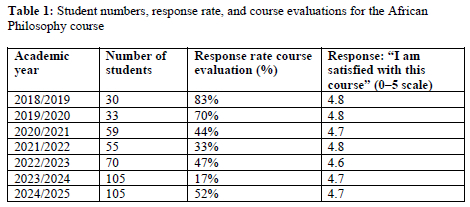
Further, we conducted surveys online via the "Programme and Course Evaluation" (PaCE) system. PaCE is a digital system in which standard course evaluations are created for every course. Students fill out the PaCE form on a voluntary basis, resulting in varying response rates (see table 1). Table 1 shows that since 2018, the number of students has increased steadily.10 Moreover, the statement "I am satisfied with this course" was consistently rated between 4.7 and 4.9. The high student appreciation was also reflected in multiple awards. In 2020, the course received the university's "Excellent Education Award" in the category "Specialized courses". In addition, the course coordinator herself was awarded "WUR Teacher of the Year 2022" (Enter 2023a) and also "National Teacher of the Year 2023" in the Netherlands (Enter 2023b).
Seven Pedagogical Features in the Classroom
Next, we present seven key pedagogical features that have demonstrated their value and effectiveness in teaching African Philosophy. It is important to mention that the course has been carefully designed and adapted over the past years, and that the seven features were not designed as a framework at the start. Instead, the seven features emerged from an analysis of teaching the course for seven years. Moreover, the different features do not exclude each other but overlap and are intertwined. The description of each pedagogical feature is underpinned with concrete examples, connections to the theory, and student quotes from course evaluations.
Embrace Epistemic Justice
Ongoing epistemic injustices in the domain of philosophy and science are reflected in Eurocentrism in philosophy and science (Kimmerle 2016) and the fact that most of the authors included in the reading lists are Western authors (Ramose 2016). As a way to move towards epistemic justice, Ramose (2004) makes a plea for epistemic equality in the entire educational system, meaning that course and reading lists should be more representative in terms of authors and concepts. In pan-epistemic education (Ramose 2016), epistemic justice is not an add-on option by adding an author to a reading list while leaving the dominant frame intact. Instead, epistemic justice is about redesigning course material in such a way that it does justice a diversity of knowledge, especially historically oppressed knowledges.
Therefore, the first pedagogical feature of the African Philosophy course is to embrace epistemic justice. The course aims to do so in two, interconnected, ways. First, the majority of the selected obligatory readings have been written by African scholars. The texts have been selected carefully on the criterium that the text is relevant for Wageningen students, that is, related to life science domains, such as food, environment, climate, plants, animals and "development" (see Appendix 1).11 In doing so, the course provides students with rather different perspectives on the issues under discussion. As one student wrote:
This course is very important for any student working on global issues, because taking into account world views that are different from ours is crucial to solve problems and create a more just world. (Student '21/'22)
Second, it is important to teach with the oppressed, not for the oppressed (Freire 2005). This means that close collaboration with African philosophers and universities is crucial, in which educators do not teach for African scholars but with African scholars. Therefore, teachers and students in the African Philosophy course learn through lectures by influential philosophers, such as, Mogobe Ramose, Pius Mosima, Michael Eze, Pascah Mungwini, Beatrice Okyere-Manu and Olatunji Oyeshile. As another student mentioned:
I liked that we were taught by teachers from the continent of Africa themselves. They had a lot of knowledge and a different way of teaching than Dutch teachers. (Student '24/'25)
Transform Educational Methods
Given the often hierarchical structure of an academic educational environment, the teacher-student contradiction - as described by Freire (2005) in the banking concept -can easily be reinforced when a teacher is lecturing in front of the class. Following a re-humanising pedagogy and ubuntu philosophy, education is about making connections between humans. Thus, to move towards more horizonal teacher-student relations, educators need to (re-)design and use methods that create a dialogical learning environment. Therefore, the second pedagogical feature is the design and use of transformative exercises to connect with each other. In the African Philosophy course, this is achieved in at least three ways. First, by maintaining a balanced ratio between hearing lectures and working lectures. During the hearing lectures the teacher(s) explain(s) content, which includes pretext and context to the selected course literature. The hearing lectures last approximately 60 minutes and are immediately followed by a working lecture of about 90 minutes. During the working lectures, the students process and reflect upon the information of the hearing lecture through interactive exercises. The teachers then act as facilitators, explaining and facilitating the exercises, keeping track of time, and encouraging students to participate and feel safe sharing their thoughts. In terms of course design, much of the teachers' preparation time (estimated about 50%) is dedicated to carefully design interactive exercises that fit with the content of the hearing lecture and contribute to the learning goals of the specific session. The working lectures minimise the conventional teacher-teaches and student-listens dynamic. Second, the group sizes in the working lectures are about 35 students per group - the so-called "home-group". The composition of each "home group" remains the same throughout the course, which gives students the opportunity to connect with each other. As a student explained:
To process and discuss ideas in class again was wonderful, and as a mode of teaching, also very appropriate to the topic. I was impressed that it managed to achieve this despite having over 100 students, and having relatively large breakout groups. [...] I was impressed to find it done so well here with so many more students with wildly different backgrounds. (Student '23/'24)
The above quote also illustrates that in an interdisciplinary and culturally diverse student group, it is even more important that each voice is heard. Therefore - and this is the third way - during the working lectures, a range of transformative in-class exercises are used that allow for equal opportunity for all students to engage, such as: impromptu networking; creative destruction; 1 -2-4-all; talking circle; empathic listening; spiral journal; crowd sourcing; shoe shuffle; carrousel; and conversation café.12 The majority of these methods have been adapted from "Hosting Transformation" (2025a) and "Liberating Structures". The former is a community of practice on transformative learning methods, while the latter are facilitation methods designed to include and engage everybody (Lipmanowicz and McCandless 2013, 353). While each group process is unique, the common denominator is that students and teachers connect with each other, especially through transformative exercises. Textbox 1 provides an example of a talking circle, as adapted from Chilisa (2020, 256), who describes this exercise in her book. The transformative exercises - or "tools" - appeared to be very effective, as another student mentioned:
Thanks to these tools, the course really enabled us to connect and bond with new people and be open with them, even though we were strangers. (Student '24/'25)
The design of the course did not start with the ambition to use transformative methods, but are the result of a desire and search for dialogical approaches that strengthen humanness in education. The desire to re-humanise education also extended in less apparent ways, such as using name tags throughout the course and trying to remember students' names. This was noted by various students, as another quote illustrated:
I liked the open-mindedness and recognition of human factor in this course that is not so apparent in other academic courses. I appreciated the humanness · · (Student '22/'23)
Honour Dialogues
As described previously, a dialogical approach is deemed suitable to re-humanise education. As such, the third pedagogical feature is to honour dialogues. The course follows an intercultural dialogical approach, as developed by Kimmerle (2004, 69):
Listening is an important condition at the beginning and in the course of any dialogue. It is a rule of politeness and an expression of my respect for the others that I listen to what they have to say. There is, however, a specific need of listening in intercultural dialogues. In this kind of dialogues listening has to be guided by a certain methodology.
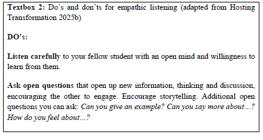
Kimmerle's (2004) methodology of listening in intercultural dialogues means to listen without immediate judgement or understanding. Difference is then seen as an invitation for cooperation (Ramose 2013). In an academic educational environment, students are often trained to convince each other with arguments, which is contrary to dialogues where students need to learn to listen and try to understand different perspectives. Therefore, during the African Philosophy course, students practise with listening through, for example, "empathic interviews" (adapted from Hosting Transformation 2025b). In this exercise, students interview each other in pairs, and learn to listen carefully: rather than thinking in terms of good or bad, or right or wrong, students are invited to ask open questions and to listen with an open mind. Asking open questions creates space for people to express themselves freely and to better understand each other's perspectives and experiences. Textbox 2 shows the instructions that the students receive at the start of the exercise. Throughout the course, the students practise with dialogues and the skill of listening an important starting point, that is appreciated by students as illustrated by the following quote:
[I appreciated] that we could listen to each other and minimalise prejudices and maximise acceptance in a safe space. (Student '21/'22)
Illustrate Theories and Concepts
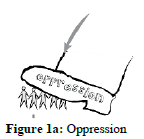
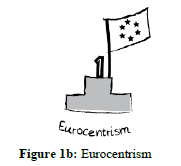
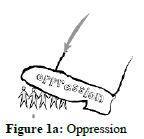
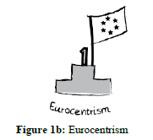
The fourth pedagogical feature of the course is the fact that key concepts and theories have been translated into illustrations - with the aim to make rather abstract philosophical concepts more accessible, especially for students with a non-philosophical background. By making things visual, an illustration can sometimes convey more than a definition or description of an (abstract) concept, thereby enhancing students' understanding of the readings and course materials. For example, the word "oppression" might not resonate necessarily for students who have mainly been on the oppressor side, whereas a drawing of a foot can make this visual (see figure 1a). Likewise, the word "Eurocentrism" - which refers to a view that (often implicitly) considers European culture and history as superior (adapted from Kimmerle 2016) -becomes visible by putting Europe as superior on "number one" (see figure 1b).
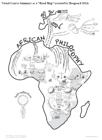
At the end of the course, the illustrations come together in a visual summary in the form of a "road map" (see Appendix II). Such a visual summary is specifically suitable to show non-linear connections. While PowerPoint slides are widely used in lectures and courses, these mainly show linear connections, which are often insufficient for philosophical reasoning as well as visualising complex global challenges. Instead, a visual course summary shows various connections between theories and concepts. In addition, the visual "road map" gives students guidance about where they are in the lecture and course, which helps them to stay on track. Course evaluations showed that students experienced the illustrations and road map as very helpful in their learning process. All illustrations have been hand-made by one of the teachers. Once students realised this, some noticed that this reflected how much the teachers care about the students' learning process, by investing much time, attention and dedication in creating the course material, such as the drawings. As one student wrote:
[The teacher's] drawings were a great way to engage with the content of the lectures and literature. I am always struggling with finding the main topics of the material and always go into detail way too much, so this has helped me tremendously with staying on track and learning more effectively. In the end I also believe this has helped me remember everything better for it was a kind of an umbrella on which to hang everything you've learned is much nicer than making the questions alone (also more fruitful). (Student '21/'22)
Conduct Critical Self-Reflection
A dialogical approach should include critical thinking and reflection (Freire 2005; Kimmerle 2004; Ramose 2014). Critical self-reflection is about being truthful. Truthfulness - which goes beyond honesty - means avoiding the temptation to lie to oneself (Ramose 2014) and requires courage (Ramose 2016). Therefore, the fifth key pedagogical feature is to conduct critical self-reflection. In the course, transformative exercises are employed that create a safe learning environment that also encourage students to move out of their comfort zone. This is particularly relevant for students with a privileged background, as Van Gorder (2007, 20) clarifies:
Education among the privileged must push students away from the comforting "bubbles" of their wealth and convenience and challenge them to seriously engage the world as it actually exists for most individuals suffering in oppression.
Thus, critical self-reflection is about looking into the mirror "especially when we know we are ugly" (Ceton 2013). In the course this is done in multiple ways, of which we will briefly mention two. First, students are invited to reflect on Eurocentrism and epistemic blindness of the teacher. In this exercise, the students and teacher sit in a talking circle (see textbox 1) and together they reflect on the teacher's Eurocentrism in a research project in Mozambique.13
Textbox 3 provides the key questions that the teacher and students discuss. In doing so, the teacher demonstrates critical self-reflection, which also requires a certain vulnerability. According to Van Gorder (2007) vulnerability and transparency of teachers are necessary, as way to show their role in ongoing systemic injustices. Second, students are encouraged to reflect on themselves, including their Eurocentrism, epistemic blindness, privileges, as well as possible marginalisations. Textbox 3 shows the questions students discuss in pairs, thereby simultaneously practicing empathic listening to each other (see textbox 2). In doing so, the course gives space to students' real-life experiences - including their concerns, doubts, and hopes - and addresses the assumptions that students bring into the classroom (Freire 2005).
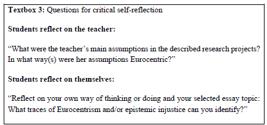
Conversations with students during and after the course, revealed that this course has often been (one of) the first course(s) where students learned about Eurocentrism and ongoing colonial legacies in their study programmes. It was also one of the first where they were invited to reflect critically on themselves from these perspectives. While privileges vary between students, when those who hold certain privileges become aware of systemic, historical injustices in which she/he discovers "[her/]himself to be an oppressor", then this "may cause considerable anguish" (Freire 2005, 49). However, a re-humanising pedagogy also means not remaining in positions of ignorance, guilt, saviourism, or paternalistic activism, but to move towards a dialogical relationship through solidarity (Van Gorder 2007). Despite possible feelings of anguish, most students experienced the critical reflections and insights as urgently needed in academia. As another student clarified:
I would recommend this course for everyone that has been educated and grown up with Western narratives because it makes the participant reflect very critically on biases that originate from these narratives. Furthermore, the course made me reflect deeply on science in general; the dominance of certain perspectives, the violence that it can do to other cultures, even the damage it can do to individuals. I think this perspective needs to be put on the basis of academia in order to make the whole scientific movement more inclusive and in order to keep the focus on finding true knowledge. (Student '21/'22)
Apply Philosophy in an Interdisciplinary Context
Following Freire's (2005) view that students are posed with problems they experience in the world and with the world, the course applies philosophy to real-life, concrete situations and global challenges, such as sustainable development, climate crisis, food systems, environmental ethics, international collaboration, decolonisation, racism, discrimination, gender and intersectionality. During the in-class exercises, it became clear that students are deeply motivated to contribute to transforming the world towards more justice. This aligns with Ramose's (2016, 546) call for pan-epistemic education in which "teacher and student ought to be engaged in the mission to change the educational curriculum orientation towards justice and peace in global human relations".
As such, philosophy as academic discipline - including African Philosophy - is relevant for a wide variety of academic disciplines and study programs to become aware of and move away from epistemic injustice and colonial legacies. This was also reflected in the diversity in academic backgrounds of students who joined the course. In the academic year '24/'25, students from 28 study programmes (14 BSc and 14 MSc) participated in the course, including: Animal Sciences; Aquaculture and Marine Resource Management; Agrotechnology; Biology; Biotechnology; Communication and Life Sciences; Climate Studies Economy and Policy; Development and Rural Innovation; Environmental Sciences; Forest and Nature Conservation; Food Technology; Geo-Information Sciences; Health and Society; International Land and Water Management; International Development Studies; Landscape Architecture and Planning; Management, Economics and Consumer Studies; Plant Biotechnology; Plant Sciences; Resilient Farming and Food Systems; and Tourism, Society and Environment. In that sense, the content of the course is anchored within an interdisciplinary approach that allows for integrating philosophy with a range of academic disciplines. As another student wrote:
Thanks to this course, I have gained a whole new perspective on many diverse fields: on Africa and African Philosophy, but also on science, knowledge, my own worldview and perspective, social justice, colonialism, the research area of my own study programme (nature conservation), etc. It makes the course very special and it was beyond my expectations. (Student '24/'25)
Hence, putting African Philosophy at the centre enables students to develop an interdisciplinary understanding of global challenges. For example, Cakata, Radebe and Ramose (2023) note that African indigenous knowledge is interdisciplinary by "definition", in the sense that indigenous knowledge is not fragmented in different disciplines like Sociology or Animal Science.
Liberate Our Minds
All of the above can be seen as attempts to avoid treating students as "passive depositories" who are taught to memorise knowledge (Freire 2017) but instead can lead to re-humanise human relations (Ramose 2016). This was also noted by several students, as the following quote illustrates:
I was happy to be treated as a person, rather than a student or something that should be changed into a professional working object. We learned about rehumanising, and I feel rehumanised in the WUR institute. (Student '24/'25)
In doing so, students and teachers develop critical consciousness, which can lead to liberation minds of both oppressor and oppressed (Freire 2005). A student described this as follows:
[I appreciated] the feeling that I am learning something that truly matters and provides me tools with how to be a better person in this world. (Student '24/'25)
As mentioned previously, liberation is a praxis (Freire 2005), which also involves historical awareness to avoid reinforcing historical injustices by maintaining the status quo. Or to put it in Ramose's (2019, 71) words "a philosophy without memory cannot abolish epistemic and social injustice". This also entails the importance of people philosophising and expressing themselves in their mother tongue. Therefore, the students are requested to add an abstract in their mother tongue to their final essay. This request is a response to the dominance of English as an academic language, and as such an attempt to move towards epistemic justice.
Based on official student feedback, it can be concluded that the course content and dialogical methods changed students' perspectives towards the world and themselves (Enter 2023a). As another student wrote:
The course did not just teach us things by telling them, but it changed our (at least my) mindset and changed my outlook on many things. It celebrates personal growth as well as academic course. (Student '21/'22)
Hence, liberation of our minds is the seventh pedagogical feature.
Limitations of the Course: Can the Oppressor Contribute to Education for Liberation?
Despite the above-mentioned successes of the African Philosophy course at WUR, there are also a few limitations and potential criticisms, which we address here. To start with, when following Freire's pedagogy of the oppressed, the teacher-student contradiction needs to be overcome by moving towards a more dialogical and horizontal relationship. While the seven features showed how the teachers tried to overcome this contradiction, the teacher team also made specific choices and prescribed these to the students.
According to Freire (2005), an oppressor-oppressed relationship is characterised by prescription by the oppressor. For example, the students did not have a say in the course literature, as the obligatory literature was selected by the teacher team prior to the start of the course. In addition, teachers designed and facilitated the transformative educational methods. In doing so, the teachers also prescribed the process. At the same time, if no explicit attention is being paid to the process in a classroom, then the teacher also prescribes the process, for example, in deciding who gets to speak or ask a question. Thus, in the current course, at least the process has been consciously designed and transparently shared with students with the aim to reach the course learning goals. Transparency can contribute to create mutual trust (Van Gorder 2007). At the same time, there are limitations to have a horizontal teacher-student relation within a university context, since students need to meet specific learning goals in their courses and curricula. For example, students need to write an essay to pass the course, which is graded by the teachers.
In addition, the presented course focused on education for liberation inside the classroom. However, outside the classroom there are additional institutionalised forms of oppression at universities, which also maintain and reinforce colonial legacies. For example, the presented course is an elective course (not obligatory). However, to move towards epistemic justice in academia, historically oppressed knowledge should not only be an optional choice, but it should also structurally be part of curricula. In addition, the course makes an effort to invite African scholars to provide (guest) lectures. For example, it is important to recognise and emphasise that the course - and its successes - would not have been possible without the contributions of and close collaborations with African scholars. However, more equal relations between African and European colleagues requires structural involvement of African colleagues, that goes beyond guest lectures. In line with this, Mosima co-taught the entire course in the years 2022-2024. Yet, it turns out to be very difficult to hire African colleagues as equal co-teachers, for example, due to lack of finance for such positions and academic hiring procedures that maintain the status quo.
Despite the collaboration with African colleagues in the course, a third criticism may arise from the cultural and educational background of the course coordinator: it seems contradictory that a white, Dutch woman teaches African Philosophy. As such, the presented course raises an important issue: when teachers with a Western cultural and educational background teach African Philosophy at a (European) university this can easily lead to extracting knowledge, reinforcing epistemic injustices, and worsening power inequalities. Therefore, educators who teach African philosophy at a university should be conscious of (at least) two forms of oppression:14 (1) ongoing colonial legacies in university education; and (2) the teacher-student contradiction. In terms of education for liberation, an underlying fundamental question regarding the involvement of teachers with a Western educational and/or cultural background is then: Can the oppressor contribute to education for liberation?
According to Freire (2005, 54), "pedagogy of the oppressed cannot be developed or practiced by the oppressors. It would be a contradiction in terms if the oppressors not only defended but actually implemented a liberating education". In that sense, oppressors cannot - by definition - start liberating education (Van Gorder 2007). A main reason is that oppressors tend to keep the current system in place in their own interest - they maintain the status quo (Freire 2005; Van Gorder 2007). At the same time oppressors should "not become more complicitous in the preservation of the status quo" (Van Gorder 2007, 19), and moreover, there is a need to transform Eurocentric curricula at universities - due to ongoing colonial legacies at universities. As such, teachers and students with all kinds of different cultural and educational backgrounds can - and should - be involved in transforming curricula, for example by studying and teaching African Philosophy. The question is, however, how this is done. This brings us back to the main question of the article, to which we provide a response next.
A Call for E-T-H-I-C-A-L Engagement with African Philosophy
The key question addressed in the article is: "How can teachers and students across the globe transform education in such a way that it contributes to epistemic justice of historically oppressed knowledge and cultivates critical consciousness?" The answer lies in the presented educational practices, which can be summarised by combining the first letters of the seven pedagogical features, namely: E-T-H-I-C-A-L (see figure 2).
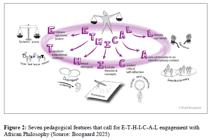
These seven pedagogical features provide an invitation for ethical engagement with African Philosophy, that is, to practise ubuntu and a re-humanising pedagogy in the classroom. This does not mean that when all seven E-T-H-I-C-A-L pedagogical features are applied in a course, it leads to ethical engagement. Instead, it means that in all described actions, an ethical attitude is required, which means trying to do good and avoid evil (Ramose 2004). It is in line with Ramose's (2016, 552) view on education, who states that "the human being must understand education as an ethical undertaking". Acting in an ethical way is not a normative description of what is good or right, but it requires constant ethical reflections of what is ethical in a specific situation (Ramose 2004). Thus, it needs to be re-evaluated in every situation.
Acting ethically means that people are truthful to themselves and each other (Ramose 2014). In line with this, Freire (2005) notes that people need to act in line with what they say, otherwise the dialogue will be undermined. For example, oppressors should not fall into what Freire (2005, 45) calls "false generosity" or have the aim to liberate others. Instead, human beings liberate each other, which Freire (2005, 56) formulates as follows:
It is only the oppressed who, by freeing themselves, can free their oppressors [. . .] If the goal of the oppressed is to become fully human, they will not achieve their goal by merely reversing the terms of the contradiction, by simply changing poles.
Thus, the oppressed and oppressors are both re-humanised through dialogical interactions. As mentioned previously, dialogical interactions in education require specific qualities such as love, courage, humility, an open mind, and willingness to listen and learn. Following Kimmerle (1995 and 2004), Freire (2005) and Ramose (2016), the African Philosophy course makes an attempt to be dialogical from the outset by putting these qualities into practice in the classroom. Student quotes in the seven pedagogical features indicate that some of these values are noticed. One student summarised the course as "nothing less than a labour of love" (Enter 2023a). In this process, we recognise continuously changing situations, which need to be re-evaluated on ethical grounds with critical (self-)reflection. For example, the presented case study is an analysis of teaching the course for seven years, in which the course has been adapted annually based on additional insights and interactions with the students. In doing so, we aim for ethical engagement in which teachers and students are jointly responsible for the learning process (Freire 2005). As such, teachers, students, and courses grow together with the potential to transform education and cultivate critical consciousness.
Concluding Remarks: Educational Innovation for Liberation
Although the case study analysis of the "African Philosophy" course can be considered rather specific - as it is being taught at a European life science university - the pedagogical features might be relevant and applicable to universities across the globe. The results provide seven pedagogical features that show how education can be innovated so that it does (more) justice to historically oppressed knowledge and cultivates critical consciousness.
While academic teachers tend to focus mostly on content, they often have limited experience with facilitation. In education for liberation, both are needed: transforming the curriculum in terms of content - by including historically oppressed knowledge and authors - while also using transformative, dialogical teaching methods that cultivate critical consciousness. With regard to the first point, there is a growing debate on "decolonising" education at European universities (see, e.g., Bhambra, Gebrial and Niþancýoðlu 2018). This debate is not new on the African continent (Mungwini 2022). Therefore, teachers and universities with a predominantly Western educational and cultural background can learn a lot from African academics and universities. With regard to the second point, Van Gorder (2007, 24 - author's emphasis) summarises the task of a teacher to facilitate learning processes that may lead to critical consciousness:
The task of the educator is not to remonstrate privileged students about what they should be doing or what they need to learn but to join them in this struggle and seek, with mutuality, to facilitate each other's learning and development of conscientização [ critical consciousness].
To conclude, our task as teachers is to facilitate learning processes as a way to put a re-humanising pedagogy into practice. If learning processes are not actively re-designed, teachers will reinforce forms of oppression through the status quo - both in content and process. Therefore, we need to innovate education, so that it can be liberated from ongoing Eurocentrism and epistemic injustices. The presented case study illustrated how education can be innovated in such ways that it does (more) justice to historically oppressed knowledge and cultivates critical consciousness. We showed that the African Philosophy course at WUR does not have a single method, but a coherent set of carefully designed methods and contents, which are built on one another, which can be summarised in seven E-T-H-I-C-A-L pedagogical features. These pedagogical features should not be seen as a blueprint or "tick-the-box" list. Instead, this article is an invitation to continuously innovate education for liberation, since "education for liberation is the direst need of our time" (Ramose 2019, personal communication).
Acknowledgements
The African Philosophy course at WUR would not have been possible without the following people to whom we are deeply grateful. We wish to thank the co-teachers and guest lecturers who have provided lectures at WUR over the seven past years, including Pius Mosima, Beatrice Okyere-Manu, Olatunji Oyeshile, Pascah Mungwini, Ndumiso Dladla, and Michael Eze. A special thanks to Mogobe Ramose for his continuing support and contributions to the course over the past seven years. In addition, the course would not have run smoothly without the support of student assistants Annelies van Ingen ('20/'21), Juliette van Vliet ('21/'22), and Franciska Sprong ('22/'23). The course would most likely not have existed at WUR without the initial (financial) support by Cees Leeuwis (Knowledge Technology Innovation group) and Ewout Frankema (Economic and Environmental History group) in 2018. We also wish to thank the family of late professor Heinz Kimmerle for allowing the first author access to Kimmerle's study room and unique book collection on African Philosophy in his house in Zoetermeer, The Netherlands - as well as for providing accommodation for visiting African colleagues in the same house. Finally, we wish to express our deep gratitude to the more than 450 students for their active participation in and appreciation of the course over the past seven years. Regarding the current article, we are thankful to the organisers of the Honorary Symposium for Prof. Mogobe Ramose - Department of Philosophy Practical and Systematic Theology at UNISA - for the opportunity to present the paper on 18 March 2025. We also thank the anonymous reviewers for their valuable feedback.
References
-
Bhambra, G. K., D. Gebrial, and K. Niþancýoðlu. 2018. Decolonising the University. London: Pluto Press. http://library.oapen.org/handle/20.500.12657/25936
» http://library.oapen.org/handle/20.500.12657/25936 -
Boogaard, B. K. 2021. "Epistemic Injustice in Agricultural Development: Critical Reflections on a Livestock Development Project in Rural Mozambique." Knowledge Management for Development Journal 16: 1. https://edepot.wur.nl/562887
» https://edepot.wur.nl/562887 - Cakata, Z., N. Z. Radebe, and M. B. Ramose. 2023. Azibuye Emasisweni: Reclaiming Our Space and Centring Our Knowledge. Cape Town: AOSI.
-
Ceton, C. 2013. "We moeten voor de spiegel gaan staan vooral als we weten dat we lelijk zijn!" Filosofie Magazine, February 6. https://www.filosofie.nl/mogobe-ramose-we-moeten-voor-de-spiegel-gaan-staan-vooral-als-we-weten-dat-we-lelijk-zijn/
» https://www.filosofie.nl/mogobe-ramose-we-moeten-voor-de-spiegel-gaan-staan-vooral-als-we-weten-dat-we-lelijk-zijn/ - Chilisa, B. 2020. Indigenous Research Methodologies. 2nd ed. Thousand Oaks: Sage.
-
Enter, M. 2023a. "A Class of Its Own - A New View of the World and of Yourself." Resource. WUR from Within, February 6. https://www.resource-online.nl/index.php/2023/02/06/a-class-of-its-own-a-new-view-of-the-world-and-of-yourself/?lang=en
» https://www.resource-online.nl/index.php/2023/02/06/a-class-of-its-own-a-new-view-of-the-world-and-of-yourself/?lang=en -
Enter, M. 2023b. "Birgit Boogaard Elected National Teacher of the Year. Award with a Message: Focus More on Real Inclusion." Resource. WUR from Within, April 24. https://www.resource-online.nl/index.php/2023/04/24/birgit-boogaard-elected-national-teacher-of-the-year/?lang=en
» https://www.resource-online.nl/index.php/2023/04/24/birgit-boogaard-elected-national-teacher-of-the-year/?lang=en - Fanon, F. 2004. The Wretched of the Earth. Translated by R. Philcox. New York: Grove Press.
- Freire, P. 2005. Pedagogy of the Oppressed. 30th Anniversary Edition. Translated by M. B. Ramos. New York: Continuum.
-
Hosting Transformation. 2025a. "Community of Practice." Hosting Transformation Accessed June 3, 2025. https://hostingtransformation.eu/community-of-practice/
» https://hostingtransformation.eu/community-of-practice/ -
Hosting Transformation. 2025b. "Empathic Interview." Hosting Transformation. Accessed June 3, 2025. https://hostingtransformation.eu/method/empathic-interview/
» https://hostingtransformation.eu/method/empathic-interview/ - Kimmerle, H. 1995. Mazungumzo: Dialogen tussen Afrikaanse en Westerse Filosofieën. Amsterdam: Boom.
-
Kimmerle, H. 2004. "Dialogues as Form of Intercultural Philosophy." In Rethinking Ecumenism: Strategies for the 21st Century, edited by F. L. Bakker, W. van den Bercken, E. van den Borght, M. Frederiks, H. Gooren and K. Steenbrink, 63-78. Zoetermeer: Meinema. Re-published in 2012. Iranian Society of Intercultural Philosophy. Accessed June 3, 2025. https://isiph.ir/en/?p=27
» https://isiph.ir/en/?p=27 - Kimmerle, H. 2016. "Hegel's Eurocentric Concept of Philosophy." Confluence: Journal of World Philosophies 1: 99-117.
- Lipmanowicz, H., and K. McCandless. 2013. The Surprising Power of Liberating Structures: Simple Rules to Unleash a Culture of Innovation. Seattle: Liberating Structures Press.
- Mignolo, W. D., and M. V. Tlostanova. 2006. "Theorizing from the Borders: Shifting to Geo-and Body-Politics of Knowledge." European Journal of Social Theory 9 (2): 205-221.
- Mungwini, P. 2022. "Recentering Africa: The Unfinished Promise of Decolonization." In African Philosophy Emancipation and Practice, 105-139. London: Bloomsbury.
- Ramose, M. B. [1999] 2002. African Philosophy through Ubuntu. Rev. ed. Harare: Mond Books.
- Ramose, M. B. 2003a. "Introduction. The Struggle for Reason in Africa." In The African Philosophy Reader, edited by P. H. Coetzee and A. P. J. Roux, 1-9. 2nd ed. London: Routledge.
-
Ramose, M. B. 2003b. "I Doubt, therefore African Philosophy Exists." South African Journal of Philosophy 22 (2): 113-127. https://doi.org/10.4314/sajpem.v22i2.31364
» https://doi.org/10.4314/sajpem.v22i2.31364 - Ramose, M. B. 2004. "In Search of an African Philosophy of Education." South African Journal of Higher Education 18 (3): 138-160.
- Ramose, M. B. 2007. "African Philosophy as the Bridge to Intercultural Philosophy." International Journal of the Humanities: Annual Review 4 (9): 123-132.
-
Ramose, M. B. 2013. Hegel's Twilight: LiberAmicorum DiscipulorumquePro Heinz Kimmerle. Amsterdam: Editions Rodopi. https://doi.org/10.1163/9789401209311
» https://doi.org/10.1163/9789401209311 -
Ramose, M. B. 2014. "Dying a Hundred Deaths: Socrates on Truth and Justice." Phronimon 15 (1): 67-80. https://doi.org/10.25159/2413-3086/2213
» https://doi.org/10.25159/2413-3086/2213 -
Ramose, M. B. 2016. "Teacher and Student with a Critical Pan-Epistemic Orientation: An Ethical Necessity for Africanising the Educational Curriculum in Africa." South African Journal of Philosophy 35 (4): 546-555. https://doi.org/10.1080/02580136.2016.1247248
» https://doi.org/10.1080/02580136.2016.1247248 - Ramose, M. B. 2019. "A Philosophy without Memory Cannot Abolish Slavery: On Epistemic Justice in South Africa." In Debating African Philosophy. Perspectives on Identity, Decolonial Ethics and Comparative Philosophy, edited by G. Hull, 60-72. New York: Routledge.
- Ramose, M. B. 2020. "Critique of Ramon Grosfoguel's 'The Epistemic Decolonial Turn'." Alternations 27 (1): 269-305.
-
Soler-Gallart, M. 2023. "Pedagogy of the Oppressed: 50th Anniversary Edition Paulo Freire." International Review of Education 69 (1-2): 249-251. https://doi.org/10.1007/s11159-023-09992-y
» https://doi.org/10.1007/s11159-023-09992-y -
Van Gorder, A. C. 2007. "Pedagogy for the Children of the Oppressors: Liberative Education for Social Justice among the World's Privileged." Journal of Transformative Education 5 (1): 8-32. https://doi.org/10.1177/1541344607299854
» https://doi.org/10.1177/1541344607299854 -
WUR (Wageningen University). 2025a. "Responsible Change Makers for Science and Society. Vision for Education 2025." Wageningen University. Accessed June 3, 2025. https://www.wur.nl/en/education-programmes/wageningen-university/about-wageningen-university/vision-for-education.htm
» https://www.wur.nl/en/education-programmes/wageningen-university/about-wageningen-university/vision-for-education.htm -
WUR (Wageningen University). 2025b. "Why Wageningen?" Wageningen University. Accessed June 3, 2025. https://www.wur.nl/en/education-programmes/wageningen-university/why-wageningen-university.htm
» https://www.wur.nl/en/education-programmes/wageningen-university/why-wageningen-university.htm
2 We recognise the problematics of the term "African" and the fact that Ramose uses it under protest (see Ramose 2003b). In general, the term "African" is often used to refer to a geographical region and experiences of people living on the continent. However, the term "Africa" did not arise from the Indigenous people of the continent, but has Greek and Roman origins (Ramose 2003b). In fact, "the term 'Africa' speaks more to the West European historical experience with the peoples of the continent and much less to the experience of the peoples of the continent with regard to their own self-understanding" (Ramose 2003b, 115).
3 Although Freire's book Pedagogy of the Oppressed was published more than five decades ago in 1970, there are still forms of oppression which make the text relevant and necessary today (Soler-Gallart 2023).
4 We recognise that there are other methods of liberation (see, e.g., Fanon 2004), but the current article focuses on a dialogical approach.
5 The five qualities that Ramose (2016) mentions are epistemic love, courage, sensitivity, intelligence and good health.
6 The methodology of listening is one of the five aspects that Kimmerle (2004) describes for an intercultural dialogue. The other four aspects are: equality and difference; openness with regard to expected results; other than discursive-linguistic means of understanding; and specific knowledge increase.
7 The majority of the teacher team were born and raised in The Netherlands with a cultural and educational background that can be described as European and privileged. This also counts for the three authors of the current article, who completed their education at WUR. The first author had previously worked and lived in Mozambique from 2011-2013 (see Boogaard 2021). Upon her return to The Netherlands, she learnt about African and intercultural philosophy through Heinz Kimmerle (1930-2016). She had not learnt about Eurocentrism and African Philosophy during her studies at WUR.
8 Previous versions of the article have been presented as follows: (1) a keynote lecture at the Comenius Festival on Educational Innovation (Utrecht, June 2023); (2) a seminar for WUR colleagues (Wageningen, May 2024); and (3) a presentation at the 2025 "Honorary Symposium: Honoring Professor Mogobe Ramose: Legacy and Impact" at the University of South Africa (Pretoria, March 2025).
9 The academic year at Dutch universities runs from September until July.
10 These numbers might be relatively small for a course, especially in comparison to other universities. However, the educational environment at WUR focuses on small-scale education (WUR 2025a), in which a number of more than 100 students per course can be considered high.
11 Every year, the course literature is adapted depending on the availability of African colleagues to participate as co-teachers and/or guest lecturers.
12 Concrete examples of and inspiration for interactive facilitation methods can be found on the website of "Liberation Structures" (https://www.liberatingstructures.com/ls/) as well as "Hosting Transformation" (https://hostingtransformation.eu/methods-toolbox/). It should be noted that these methods are not specifically designed for educational purposes, but can be adapted and used in an educational context.
13 For more information about this reflection and the project, see Boogaard (2021).
14 While the current article does not address other forms of oppression or domination, we recognise that there are more forms of oppression in education, such as gender dynamics.